
230822 Yohji Yamamoto > words
The ability for a textile to incorporate time, ageing, wear, and use all of these to enhance the garment throughout its history gives each item its exclusivity and longevity. Dyes fade over numerous washes, or bleach out under sunlight chronicling the wearer’s usage, each fold records its own rate or usage and through this exposure each garment reveals its own time map. This ageless quality of Yohji Yamamoto’s clothes along with the black aesthetic became the designer’s uniform throughout the 1990’s. With time the black aesthetic became less important and the ageless and more subtle qualities of Yohji’s clothes became more endearing. Ageless and classic are often the same term within design vocabulary.
Yohji Yamamoto’s interest in textiles is the basis of much of his work, within his designs he can give them strength and fragility to form. Whether a garment is hemmed or not hemmed, allowed to fall on the bias or is gathered and tied, the textile embodies the wearer and is imprinted over time through use, unique to the wearer. The textile in this way does not wear out or become redundant but instead becomes enriched and personalised. The clothes are styled in such a way that they evade fashion and seek to avoid the disposable churn incorporated into the two shows per season ethos. It is possible to wear an early 1990’s Yohji garment with a contemporary piece of today 2022 without it either looking out of place or dated.
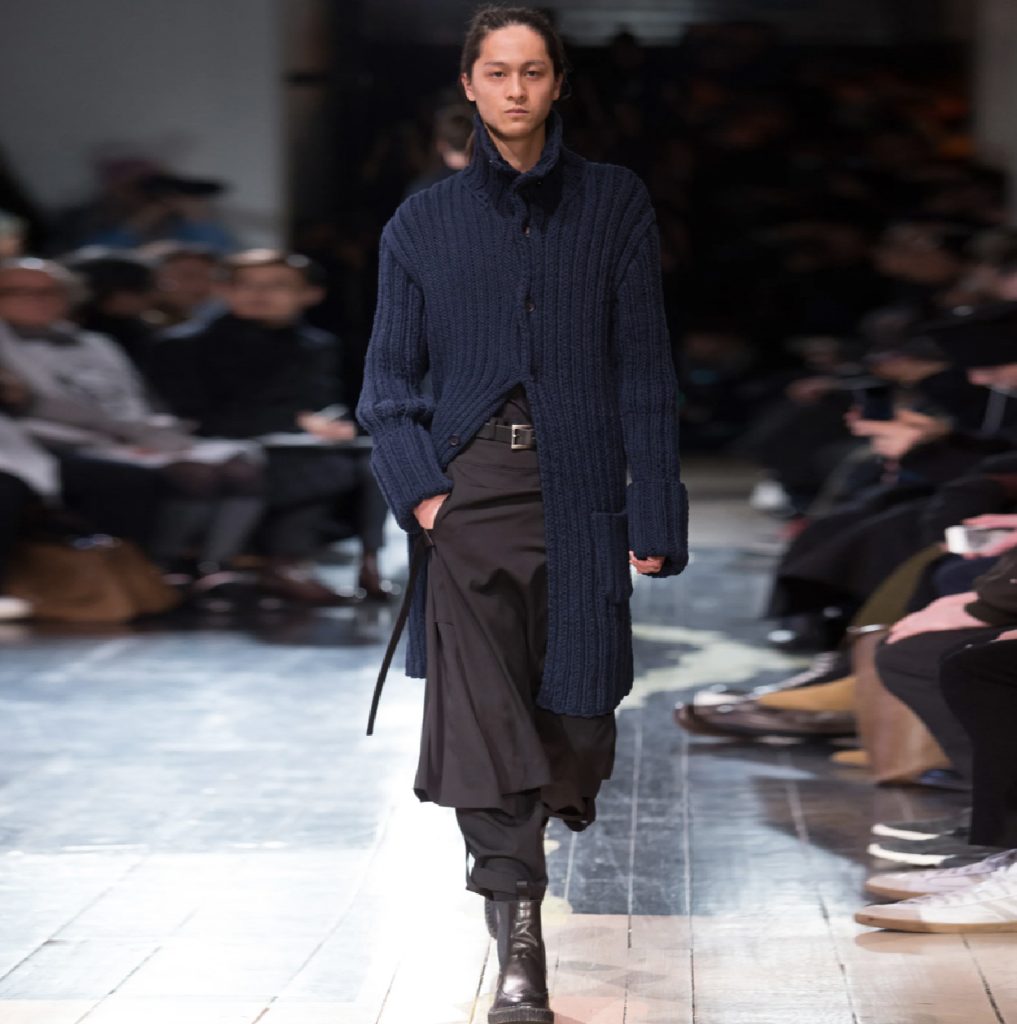
It needs to be remembered that when Yohji made his Paris debut in 1981, Paris was still promoting the “Jolie Madame’ candy-coloured expensive outfits, designed to be the envy of other women and pleasing to men. Yamamoto’s show, a parade of marching women, often shaven headed, in dark, distressed, asymmetric, oversized outfits confronted this preconception. Those that wore Yamamoto were labelled ‘the crows’. Paris was forced to reassess it’s preconceptions of female beauty. Yohji describes Winter as his favourite season and that he is a coat designer, “coats represent the house, protection” you can live inside protected. Yamamoto dresses women in men’s clothes, to create coats for protection. To protect women in men’s coats, empower the working independent woman. Soon after, in 1984, Yamamoto introduced his men’s collections to Paris with a similar aesthetic, not only were these pieces gender neutral, but many items were also interchangeable across the collections women’s to men’s. Yamamoto wanted his clothes to envelope a person’s body as opposed to exposing it. He describes the desire to design clothes that protect, hiding the body, protecting it from the elements, protecting it visually, this he says is about sexuality, gender protection. Yamamoto also wished to protect the clothes from fashion. His clothes are designed for long life, ten years or more, they are clothes designed to be outside of the fashion world or the perpetual transience of fashion. Yamamoto saw fashion design as too busy, fiddled with, appliqued, whereas longevity required simplicity and simplicity requires purity or essence.
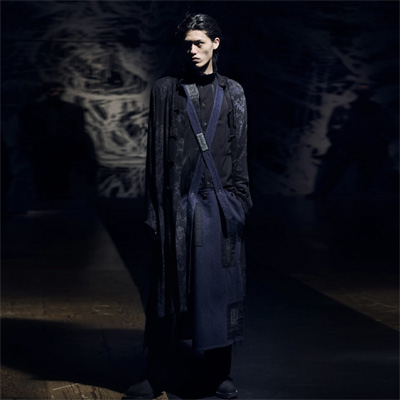
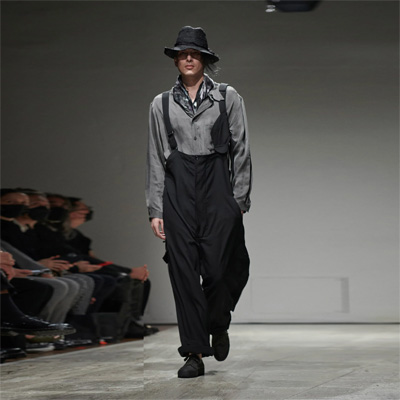
The ‘Jolie Madame’ clothes of the eighties which were fitted, Yohji’s garments rarely fit or are fitted, hanging slightly oversize incorporating a space between the garment and the body allowing the wearer to inhabit the garment naturally. The garments are not tailored to the point that they dictate the way one sits, walks or stands and as such are not tailored for that moment, that fad, that season. They fall in soft folds, can be layered and as such absorb the texture of woollens, rough cloth, cottons, working together to create a timeless look of the chique vagabond. This volume, the space between garment and wearer animates movement, as the garments are rarely static, the recurring fall of soft fold over fold, a daily choreography, the unseen performance. The non-fit or non-fitted avoids gender stereotypes, it is gender neutral, non-ageist, non-sexist, androgenous. In 1998 Yamamoto presented an entire Menswear Collection on women, in 2004 a menswear collection with each male model skirted. Menswear and women’s wear collections consisting of garments, large loose-fitting garments, often asymmetrically constructed with minimal decoration, regularly with unfinished seams and nearly always predominantly black can be interchanged, traded between male and female.
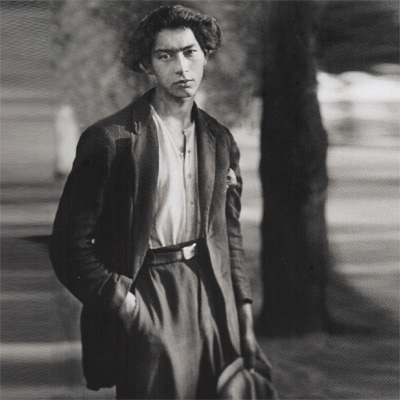
Yamamoto’s clothes are often asymmetrical. Asymmetry falls within the broader philosophy of perfection and imperfection, unfinished. Like an artist’s sketch that allows the viewer to complete the composition, here the wearer completes the look by adding their personality. Symmetry, what the eye expects to perceive, is too easy, too ordered whereas asymmetry enhances the fall of a moving garment, a garment where space between the wearer and the clothing allow for movement. Clothes are never still, never perfect as drawn or as worn on the mannequin. One can imagine a symmetrical front, a symmetrical back but how often is anyone viewed perfectly square on, most of the time we are at three quarters view and moving, a composition which explores the rhythm of that movement not the static idealised perfection of symmetry. Asymmetry with sleeves of different lengths, pockets orphaned, panels opposed in both length, cut and volume enhance this continually changing moving composition. There is a romanticism to the clothing and a reference to the period of Romanticism. The clothes draw from the past yet embrace the degradation of the contemporary, their conclusion a timeless artifact outside of the seasonal à la mode procedures and practices, with gender-ambiguous clothing and reconstructions of historical western dress. As a musician or a dancer that continually practices scales or steps, Yohji has been described as a master tailor but he is this only in his ability to understand full traditional clothes and then to deconstruct and reconstruct them for the contemporary urban world. He understands that the same clothes worn on the catwalk by a model become knowingly reconfigured when worn by the customer, the designer no longer controls either their look or their composition. The loose fit, asymmetrical folded compositions, multiple layered items allow for endless re-composition controlled by the inherent theme of the quixotic itinerant gypsy. From his first men’s collection in 1984, Yamamoto had an objective to be the outsider of men’s suits, the outsider of the businessman, the desire to design for the urban vagabond. Within this parameter, material comes to life with time, making its mark over the years as it wears and frays, folds and creases, slowly incorporating the imprint of the wearer bearing the traces of a rich past. To encourage this Yamamoto can often manipulates his materials, crushing, boiling, fraying, cutting, crumpling, tearing or stretching it, so that it looks worked, lived in. Simple woollens, cottons, canvas, workwear fabrics, these are the materials that can absorb time. The unstitched pinstripe suit with hanging cotton threads seen also as a theme in the collections of Vivienne Westwood’s. Yamamoto’s clothes can get dirty, they can wear out and with that they barely age this only adds to the aesthetic.
Like all individuals practising outside what is expected this can create tensions between business and the business of design. Yohji’s company filed for bankruptcy in 2009 and was taken over by Japan’s Integral Corporation. We live in a world dominated by corporations and conglomerates, and these have their use as now Yohji can concentrate on design and the Integral Corporation can concentrate on the business side. The design prerequisite is not to lose control over direction, even as the market by necessity may need to grow and incorporate other branded items. For example, Yohji Homme, the first men’s fragrance a mixture of cardamom, bergamot, cedar wood, leather, patchouli with a glaze of coffee was aimed at the nomadic spirit, the explorer, the adventurer, that lies dormant within every man. The fragrance references the clothes, an unchained freedom, not tied to an office, not enforced to follow the latest trend. The clothes, a veneer of freedom that we aspire to or desire and yet we are all, each of us tied to our rents, our orders and systems, confined within the cultural parameters of ones accepted social circle, entities that are difficult if not impossible to break. This freedom to reverie, the inspiration that drives us forward hoping one day to reach the escape velocity to be able to leave behind the encumbrance of conditioning and obligation. Even the sounds used at Yohji’s shows follow a consistent theme an electronic ambience for industrial landscapes of asphalt, cement and metal, scraping textures and beats of the urban landscape.
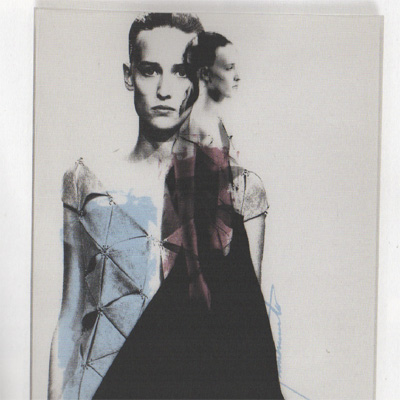
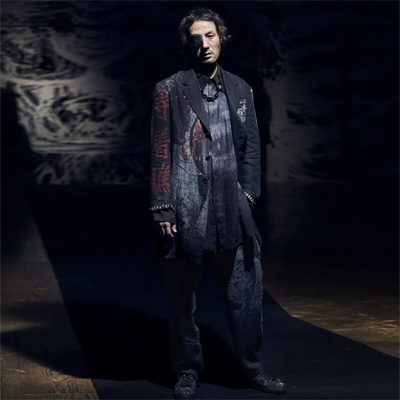
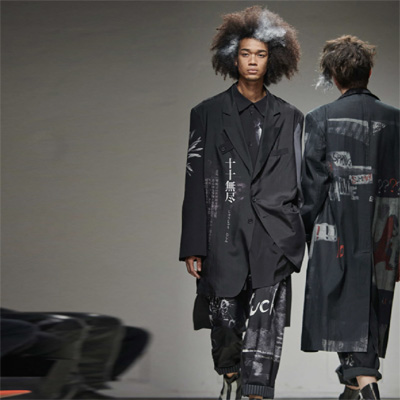
The graphics of Paul Bouden best exemplify Yohji’s work, they are themselves urban textures. The models are not the central or the total composition they are elements of a larger whole, often a scaleless composition, overlaid and transparent and always very masculine. They are rough edged, printed across the binding of a book or magazine with a very limited tonal range, graffiti, or music posters on the shuttering that surrounds building sites, temporary, passing through but with a prescience that expands, once noticed. This aesthetic spill back into Yamamoto’s later collection where image is used across clothes as if graffitied post fabrication.
Ultimately in designing clothes Yamamoto designs men’s clothes for his own taste, and women’s clothes how he believes they should be represented. He designs men’s clothes that he would like to wear, and women’s clothes that empower, clothes that describe the way he feels about the world and by sales many others feel that way too.
Images
- 1. 1930c Gypsy, August Sander
- 2. YY 2004 SS, Graphics, Paul Bouden
- 3. YY 2016 AW
- 4. YY 2023 SS
- 5. YY 2021 SS
- 6. YY 2021 SS
- 7. YY 2023 SS