
100822 – Grand Prix Wheel > words
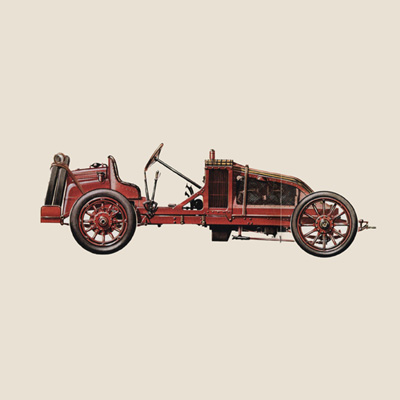
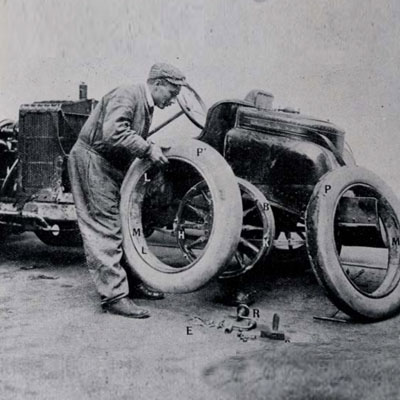
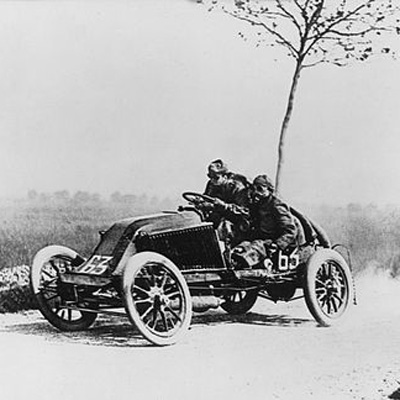
26th June 1906, the date of the first Grand Prix, Le Mans. The race was won by Ferenc Szisz in a 12.9 litre Renault (18.3 litre engines were also in the race). The car had its engine up front with its radiator fitted behind the engine, it was prop driven via the rear wheels but without the use of a differential. It had a three-speed gearbox with a leather cone clutch. The car covered 769.9 miles at an average speed of 63 mph but reached 92 mph on the straights. The Renault team used wire wheels during practice, with these the car had no wheel brakes and only engine braking to the rear wheels through the transmission. The life of a rear tyre was short. The cars had to carry both a driver and a mechanic and any repairs on the cars away from the pits were carried out by the driver and mechanic. Spare tyres were carried on the car along with the tools to fit. To fix a puncture on the track, the old tyre would be cut off by knife and a new tyre, with tube pre-inflated at low pressure was forced over the wire rim and then fully inflated, enabling the team to re-join the race. A good driver and mechanic could change a tyre in about 16 minutes. Tyre technology was in its infancy and punctures were often, meaning that a race could be won or lost on tyre changes. The Renault team had a trump card yet to be played.
The Renault Type K race car had a strong technological provenance. Of the eleven car makes taking place in the 1906 Le Mans, it was one of seven to use a shaft drive with U joints, which Renault had pioneered and had used in on all his cars from the 1898 prototype through to the Type K. It was one of six to have a three-speed gearbox, one of five to use a high-tension magneto ignition and one of two to use thermo-syphon cooling. More importantly, at the start of the race the Renault team had changed its wheels. Renault was one of the three teams running “la jante amovible”. In place of the 34×3 inch wire wheels were wooden artillery wheels. The rear wheels only incorporated a 290mm rod driven drum brake, Michelin tyres, and an eight-bolt detachable rim. With these split rim wheels it was possible to replace a tyre in under two minutes. Renault’s last-minute wheel change paid off, on the fourth lap Szisz and his mechanic changed all four wheels in 3 minutes 47 seconds, quick enough to gain a lead advantage that no other car was able to close. At the end of the first day’s racing, circa 6hrs of continuous racing, Szisz car number 3A, had a 26 minute lead.
All the cars that finished the first day’s racing were then locked in a paddock overnight in the condition that they had finished the race and they were not able to be touched. The race would recommence at staggered times the following day. This meant that Szisz would leave first and set off at 5.45am. His car, car 3A had a flat tire, Szisz drove straight to the pits, where he replaced two wheels, refilled all fluids and lubricated all joints in 11.5 minutes, still setting off 14.5 minutes before the next starter. Szisz maintained his lead throughout the day winning the first Grand Prix. His 105 h.p. side valved Renault had beaten into second place a 135 h.p. o.h.v. Fiat by a margin of 34 minutes. A race won where reliability and sensible driving, conserving tyre wear whenever possible had bettered pure power and performance. The victory bade well with Renault factory orders, the Le Mans Grand Prix race cars were adapted road cars of the day. However, why in this race was a state-of-the-art Grand prix car running on wooden spoke wheels?
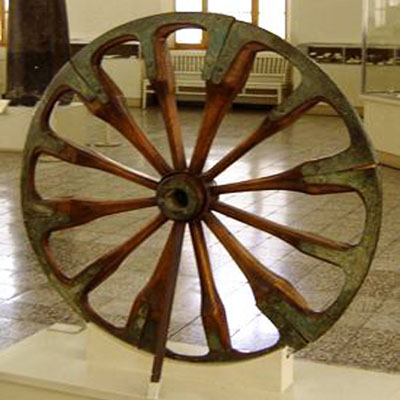
The wheel was invented around 4000 BC, exact dates are unknown. This would have first been a circular wooden disc place upon an axle. The wooden disc most probably a crosscut from a tree. The spoked wooden wheel was invented around 2200 BC, it was lighter and could be used on faster moving vehicles such as chariots. The wooden spoked wheel remained in continuous use through to the 1870’s, a continuous run of over 3600 years, when it was slowly replaced by the tensioned wired spoke wheel.
The wire wheel was invented by George Cayley in 1808 but further developed and applied to bicycles by William Stanley in 1849. By the late 1800’s the wire wheel was used mainly on bicycles, tricycles and early quadricycles and yet for the 1906 Grand Prix, the Renault Type K ran on 4000-year-old wooden wheel technology. Wire wheels in 1906 were still tied radially, the shortest route from hub to rim, these wheels were not strong enough for heavy race cars driven on poor roads. Radially spoked wheels although strong in compression (they could physically hold the weight of the car) were unable to cope with momentum forces, those of acceleration and braking. When accelerating using the colossal torque of a 12.9 litre engine, the rotation forces from wheel hub to rim would collapse a radially spoked wheel. Transmission braking would have the same affect in reverse. It was not until the invention of the tangential wire wheel, designed in 1907, that a resistance to the acceleration and braking forces could be accommodated.
In 1907 John Pugh designed a tangential steel spoked wheel for Rudge-Whitworth that could safely be used on cars. These wheels owed their resistance to braking and accelerative stresses due to their two inner rows of tangential spokes. An outer row of radial spokes gave lateral strength against cornering stresses. These wheels were deeply dished so that steering pivot pins might lie as near as possible to the centreline of the tires. Their second feature was that they were easily detachable, being mounted on splined false hubs with knock-off fixings. This made changing a wheel quicker and easier. The pressed steel wheel was later invented by Joseph Sankey in 1908 and was quickly adopted by cost conscious car manufacturers. The Type K Grand Prix car had to use the technology that was available, and this meant reverting to the wooden spoke wheel.
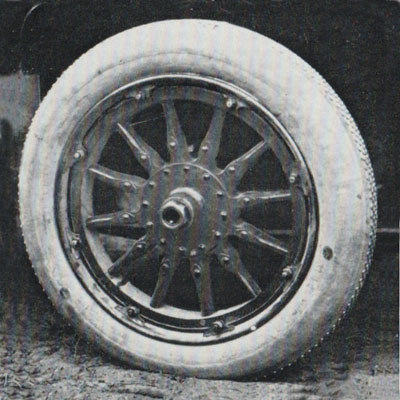
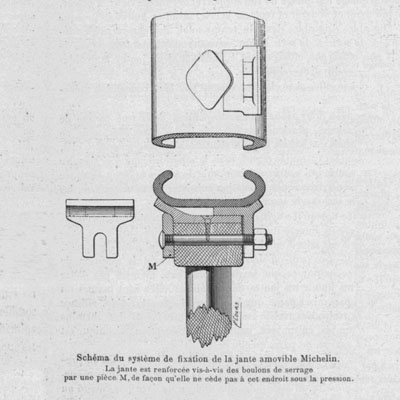
So how far could a wooden spoke G.P. race car wheel be upgraded from a wooden spoke wheel that had graced Persian chariots 4000 years prior? The Renault wooden artillery wheel had a large hub circa 240mm in diameter from which the twelve wooden spokes would radiate. The hub had a steel reinforcing plate bolted to both sides, through the wooden hub, making a steel plated sandwich and spreading torque forces over a wider circumference. Each spoke was then widened at a knuckle through which was bolted a 290 mm drum brake. The wheel and the drum brake were then one unit. The wheel then had a timber outer rim, as a conventional wooden wheel. The word tire comes from attire, as in a dressed wheel. The first tyres were a steel rim surrounding the circumference of the wheel. The steel rim would be preheated and then shrunk fit to the wheel by cooling. This provided a compression around the wheel holding it tightly together. The Renault cars had steel rims but the inner edge of the rim was turned up to support a pneumatic tyre. Around the rim were eight bolt on flanges that held the tyre in place. By undoing and removing these flanges it was possible to change a tyre without removing the wheel (see cross section detail). The technology is extremely crude, but every car related technology was still in its infancy. With early race cars design development focussed firstly on developing power from the engine, suspension, braking, roadholding would all have to wait.
Further to qualify for entry into the 1906 Grand Prix the cars had to have a maximum unladen weight of 1000kg (one metric tonne) but this is extremely misleading as to the actual weight of the car. To this weight all fluids, driver and mechanic, tools and spares would be added. These are the early days of the motorcar and there are design inefficiencies everywhere. A by-product of inefficiency is heat and with an engine as inefficient as a 1906 12.9 litre Renault the by-product is a lot of heat. To cool this heat the radiators were huge. On the earlier Renault Type K of 1903, (the car on which Marcel Renault died during the infamous 1903 Paris-Madrid race) the radiators were fixed along the full length of both outsides of the bonnet. This design inefficiency wrapped the engine in a hot water jacket making engine maintenance near impossible. The radiator was consolidated into a single unit on the 1906 Renault Type K, its sheer volume made its location a difficult problem to resolve. The radiator had an approximate volume of 1200x900x400mm and when full would have a weight of approximately 432 kgs. A radiator of that size has two pragmatic options for its location on a car, transversally mounted in front of, or behind the drivers. If mounted behind the drivers, while cooling a front engine car, its heat tubes would need to run past the driver’s, back to front of the car. Putting this much mass behind the rear axle would drastically affect handling. It was decided to put the radiator behind the engine and in front of the drivers, along the scuttle. This placed the weight central to the car but had its own issues. With the radiator behind the engine, it had almost no through ventilation and the steering column had to pass through the radiator to reach the front wheels, an insane configuration by contemporary engineering standards.
With water in this huge radiator and circulating a 12.9 litre engine, it is easy to see how quickly the car could gain additional weight on top of its unladen entry level weight of 1000kg. A 12.9 litre engine also requires a lot of oil and a car that at best returns 9 mpg requires a lot of fuel for a 700-mile race. Added to this additional weight is that of the driver, the mechanic, tools, jack and three spare wooden wheels (the rims and tyres alone weighed 18kg each). With the tank and the radiator full and the driver and mechanic on board, a 1000 kg entry car would be approaching a two tonne (2000 kg) race car. This would have been a two-tonne car capable of 100 mph, running on a dirt road with no shock absorbers, on wooden spoke wheels, with rod driven drum brakes only fitted to the rear wheels. A driver needed considerably more courage than skill to push these cars to their limits. A car without a differential would also mean that the rear wheels would need to skid round corners, as this is the only way to compensate for the difference in distance between the inner and outer radius of a bend. The huge torque of a 12.9 litre engine, with the car running on a dirt surface, the 3-inch-wide wheels would slip when accelerating or braking. This was to the benefit of the wooden wheel. A wooden wheel racing on a contemporary tarmac surface would better grip on the bends and the sheer force across the timber wheel when cornering would probably break the spokes. The slip on the 1906 Le Mans poor road surfaces made the tyres suffer but saved the wheel.
Car design was still in its early days, but competition was fierce and design development rapid. Design progress was greatly helped at first, by racing and then by mass production. Race car design in 1906 was still very crude but by the mid 1920’s cars such as the Bugatti Type 35 and the Delage 15S8 were racing with refinements recognisable today and still used on many modern cars. Racing forced designers to look at all aspects of car design, brakes, suspension, aerodynamics and to bring these design developments together into a refined whole. Ideas past swiftly from team to team and at each rejuvenation re-invented and improved. The early car designers paved the way for the millions of incremental improvements that have happened since.
Gaston Vinet was a French inventor, automobile and aviation pioneer who ran Maison G. Vinet in Courbevoie, a coachbuilding company founded in 1896. In 1900 he founded Automobiles Vinet in Neuilly-sur-Seine, which manufactured cars until 1904. He introduced the gummed wheel in France in 1893, and patented axles and brakes. His detachable rim was patented in 1905, the patent was bought by Michelin and the wheel was used on the Renault Type K that won of the 1906 GP de l’ACF. A significant win for Ferencz Szisz and Renault, but a win no less on a wooden spoked wheel.
Images
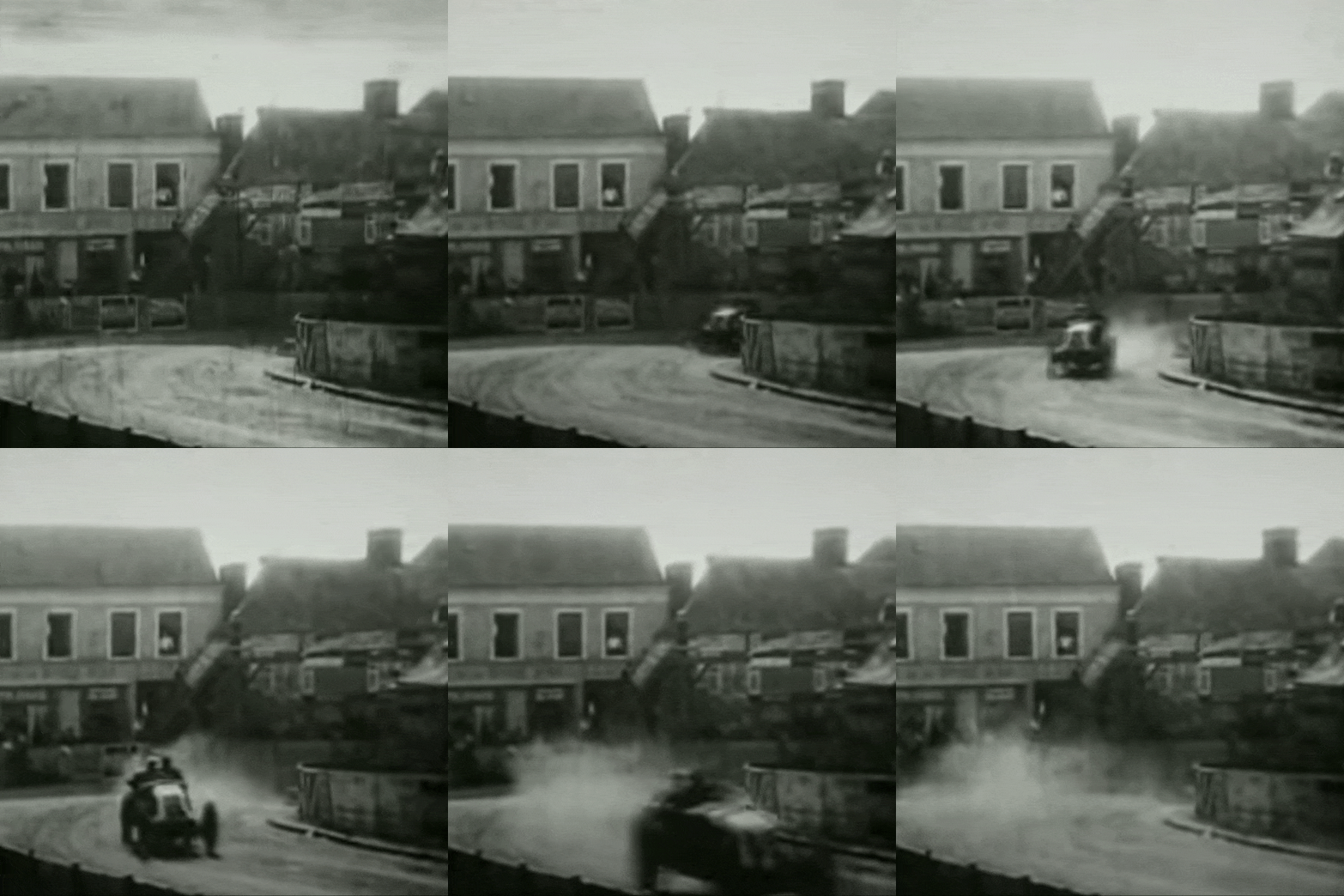
7. Movie clips from the 1906 Grand Prix.
1. 1906 Renault Type-K.
2. The Gatson Vinet / Michelin Split-Rim wheel.
3. Gaston Vinet Split Rim patent.
4. Vinet / Michelin detachable rim.
5. A Persian Chariot wheel 2800 B.C.
6. Marcel Renault in the 1903 race in which he died.