Posted on

100822 – Grand Prix Wheel

100822 – Grand Prix Wheel > words

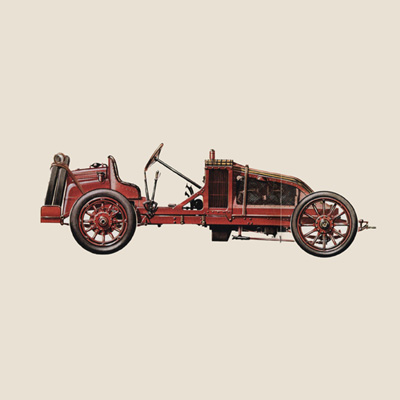
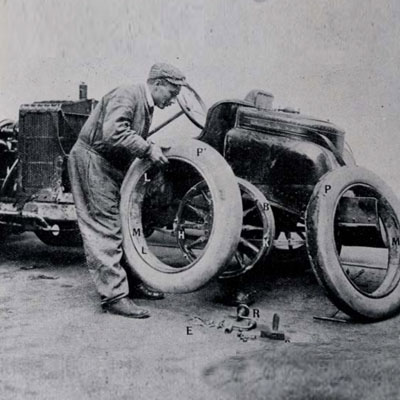
26th June 1906, the date of the first Grand Prix, Le Mans. The race was won by Ferenc Szisz in a 12.9 litre Renault (18.3 litre engines were also in the race). The car had its engine up front with its radiator fitted behind the engine, it was prop driven via the rear wheels but without the use of a differential. It had a three-speed gearbox with a leather cone clutch. The car covered 769.9 miles at an average speed of 63 mph but reached 92 mph on the straights. The Renault team used wire wheels during practice, with these the car had no wheel brakes and only engine braking to the rear wheels through the transmission. The life of a rear tyre was short. The cars had to carry both a driver and a mechanic and any repairs on the cars away from the pits were carried out by the driver and mechanic. Spare tyres were carried on the car along with the tools to fit. To fix a puncture on the track, the old tyre would be cut off by knife and a new tyre, with tube pre-inflated at low pressure was forced over the wire rim and then fully inflated, enabling the team to re-join the race. A good driver and mechanic could change a tyre in about 16 minutes. Tyre technology was in its infancy and punctures were often, meaning that a race could be won or lost on tyre changes. The Renault team had a trump card yet to be played.

The Renault Type K race car had a strong technological provenance. Of the eleven car makes taking place in the 1906 Le Mans, it was one of seven to use a shaft drive with U joints, which Renault had pioneered and had used in on all his cars from the 1898 prototype through to the Type K. It was one of six to have a three-speed gearbox, one of five to use a high-tension magneto ignition and one of two to use thermo-syphon cooling. More importantly, at the start of the race the Renault team had changed its wheels. Renault was one of the three teams running “la jante amovible”. In place of the 34×3 inch wire wheels were wooden artillery wheels. The rear wheels only incorporated a 290mm rod driven drum brake, Michelin tyres, and an eight-bolt detachable rim. With these split rim wheels it was possible to replace a tyre in under two minutes. Renault’s last-minute wheel change paid off, on the fourth lap Szisz and his mechanic changed all four wheels in 3 minutes 47 seconds, quick enough to gain a lead advantage that no other car was able to close. At the end of the first day’s racing, circa 6hrs of continuous racing, Szisz car number 3A, had a 26 minute lead. 

All the cars that finished the first day’s racing were then locked in a paddock overnight in the condition that they had finished the race and they were not able to be touched. The race would recommence at staggered times the following day. This meant that Szisz would leave first and set off at 5.45am. His car, car 3A had a flat tire, Szisz drove straight to the pits, where he replaced two wheels, refilled all fluids and lubricated all joints in 11.5 minutes, still setting off 14.5 minutes before the next starter. Szisz maintained his lead throughout the day winning the first Grand Prix. His 105 h.p. side valved Renault had beaten into second place a 135 h.p. o.h.v. Fiat by a margin of 34 minutes. A race won where reliability and sensible driving, conserving tyre wear whenever possible had bettered pure power and performance. The victory bade well with Renault factory orders, the Le Mans Grand Prix race cars were adapted road cars of the day. However, why in this race was a state-of-the-art Grand prix car running on wooden spoke wheels? 

The wheel was invented around 4000 BC, exact dates are unknown. This would have first been a circular wooden disc place upon an axle. The wooden disc most probably a crosscut from a tree. The spoked wooden wheel was invented around 2200 BC, it was lighter and could be used on faster moving vehicles such as chariots. The wooden spoked wheel remained in continuous use through to the 1870’s, a continuous run of over 3600 years, when it was slowly replaced by the tensioned wired spoke wheel. 

The wire wheel was invented by George Cayley in 1808 but further developed and applied to bicycles by William Stanley in 1849. By the late 1800’s the wire wheel was used mainly on bicycles, tricycles and early quadricycles and yet for the 1906 Grand Prix, the Renault Type K ran on 4000-year-old wooden wheel technology. Wire wheels in 1906 were still tied radially, the shortest route from hub to rim, these wheels were not strong enough for heavy race cars driven on poor roads. Radially spoked wheels although strong in compression (they could physically hold the weight of the car) were unable to cope with momentum forces, those of acceleration and braking. When accelerating using the colossal torque of a 12.9 litre engine, the rotation forces from wheel hub to rim would collapse a radially spoked wheel. Transmission braking would have the same affect in reverse. It was not until the invention of the tangential wire wheel, designed in 1907, that a resistance to the acceleration and braking forces could be accommodated. 

In 1907 John Pugh designed a tangential steel spoked wheel for Rudge-Whitworth that could safely be used on cars. These wheels owed their resistance to braking and accelerative stresses due to their two inner rows of tangential spokes. An outer row of radial spokes gave lateral strength against cornering stresses. These wheels were deeply dished so that steering pivot pins might lie as near as possible to the centreline of the tires. Their second feature was that they were easily detachable, being mounted on splined false hubs with knock-off fixings. This made changing a wheel quicker and easier. The pressed steel wheel was later invented by Joseph Sankey in 1908 and was quickly adopted by cost conscious car manufacturers. The Type K Grand Prix car had to use the technology that was available, and this meant reverting to the wooden spoke wheel.

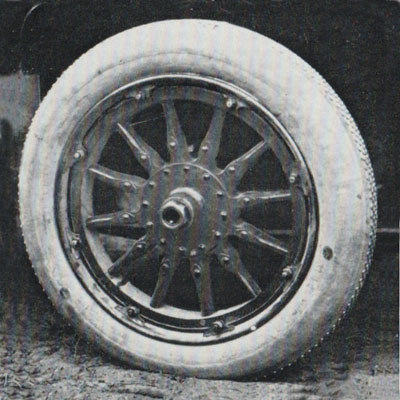
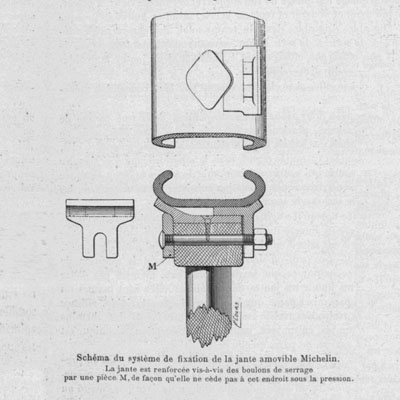
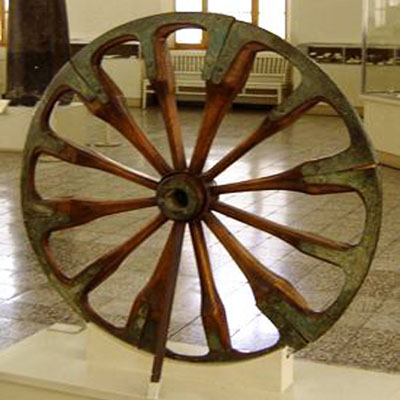
So how far could a wooden spoke G.P. race car wheel be upgraded from a wooden spoke wheel that had graced Persian chariots 4000 years prior? The Renault wooden artillery wheel had a large hub circa 240mm in diameter from which the twelve wooden spokes would radiate. The hub had a steel reinforcing plate bolted to both sides, through the wooden hub, making a steel plated sandwich and spreading torque forces over a wider circumference. Each spoke was then widened at a knuckle through which was bolted a 290 mm drum brake. The wheel and the drum brake were then one unit. The wheel then had a timber outer rim, as a conventional wooden wheel. The word tire comes from attire, as in a dressed wheel. The first tyres were a steel rim surrounding the circumference of the wheel. The steel rim would be preheated and then shrunk fit to the wheel by cooling. This provided a compression around the wheel holding it tightly together. The Renault cars had steel rims but the inner edge of the rim was turned up to support a pneumatic tyre. Around the rim were eight bolt on flanges that held the tyre in place. By undoing and removing these flanges it was possible to change a tyre without removing the wheel (see cross section detail). The technology is extremely crude, but every car related technology was still in its infancy. With early race cars design development focussed firstly on developing power from the engine, suspension, braking, roadholding would all have to wait.

Further to qualify for entry into the 1906 Grand Prix the cars had to have a maximum unladen weight of 1000kg (one metric tonne) but this is extremely misleading as to the actual weight of the car. To this weight all fluids, driver and mechanic, tools and spares would be added. These are the early days of the motorcar and there are design inefficiencies everywhere. A by-product of inefficiency is heat and with an engine as inefficient as a 1906 12.9 litre Renault the by-product is a lot of heat. To cool this heat the radiators were huge. On the earlier Renault Type K of 1903, (the car on which Marcel Renault died during the infamous 1903 Paris-Madrid race) the radiators were fixed along the full length of both outsides of the bonnet. This design inefficiency wrapped the engine in a hot water jacket making engine maintenance near impossible. The radiator was consolidated into a single unit on the 1906 Renault Type K, its sheer volume made its location a difficult problem to resolve. The radiator had an approximate volume of 1200x900x400mm and when full would have a weight of approximately 432 kgs. A radiator of that size has two pragmatic options for its location on a car, transversally mounted in front of, or behind the drivers. If mounted behind the drivers, while cooling a front engine car, its heat tubes would need to run past the driver’s, back to front of the car. Putting this much mass behind the rear axle would drastically affect handling. It was decided to put the radiator behind the engine and in front of the drivers, along the scuttle. This placed the weight central to the car but had its own issues. With the radiator behind the engine, it had almost no through ventilation and the steering column had to pass through the radiator to reach the front wheels, an insane configuration by contemporary engineering standards.

With water in this huge radiator and circulating a 12.9 litre engine, it is easy to see how quickly the car could gain additional weight on top of its unladen entry level weight of 1000kg. A 12.9 litre engine also requires a lot of oil and a car that at best returns 9 mpg requires a lot of fuel for a 700-mile race. Added to this additional weight is that of the driver, the mechanic, tools, jack and three spare wooden wheels (the rims and tyres alone weighed 18kg each). With the tank and the radiator full and the driver and mechanic on board, a 1000 kg entry car would be approaching a two tonne (2000 kg) race car. This would have been a two-tonne car capable of 100 mph, running on a dirt road with no shock absorbers, on wooden spoke wheels, with rod driven drum brakes only fitted to the rear wheels. A driver needed considerably more courage than skill to push these cars to their limits. A car without a differential would also mean that the rear wheels would need to skid round corners, as this is the only way to compensate for the difference in distance between the inner and outer radius of a bend. The huge torque of a 12.9 litre engine, with the car running on a dirt surface, the 3-inch-wide wheels would slip when accelerating or braking. This was to the benefit of the wooden wheel. A wooden wheel racing on a contemporary tarmac surface would better grip on the bends and the sheer force across the timber wheel when cornering would probably break the spokes. The slip on the 1906 Le Mans poor road surfaces made the tyres suffer but saved the wheel.

Car design was still in its early days, but competition was fierce and design development rapid. Design progress was greatly helped at first, by racing and then by mass production. Race car design in 1906 was still very crude but by the mid 1920’s cars such as the Bugatti Type 35 and the Delage 15S8 were racing with refinements recognisable today and still used on many modern cars. Racing forced designers to look at all aspects of car design, brakes, suspension, aerodynamics and to bring these design developments together into a refined whole. Ideas past swiftly from team to team and at each rejuvenation re-invented and improved. The early car designers paved the way for the millions of incremental improvements that have happened since.

Gaston Vinet was a French inventor, automobile and aviation pioneer who ran Maison G. Vinet in Courbevoie, a coachbuilding company founded in 1896. In 1900 he founded Automobiles Vinet in Neuilly-sur-Seine, which manufactured cars until 1904. He introduced the gummed wheel in France in 1893, and patented axles and brakes. His detachable rim was patented in 1905, the patent was bought by Michelin and the wheel was used on the Renault Type K that won of the 1906 GP de l’ACF. A significant win for Ferencz Szisz and Renault, but a win no less on a wooden spoked wheel.

Images

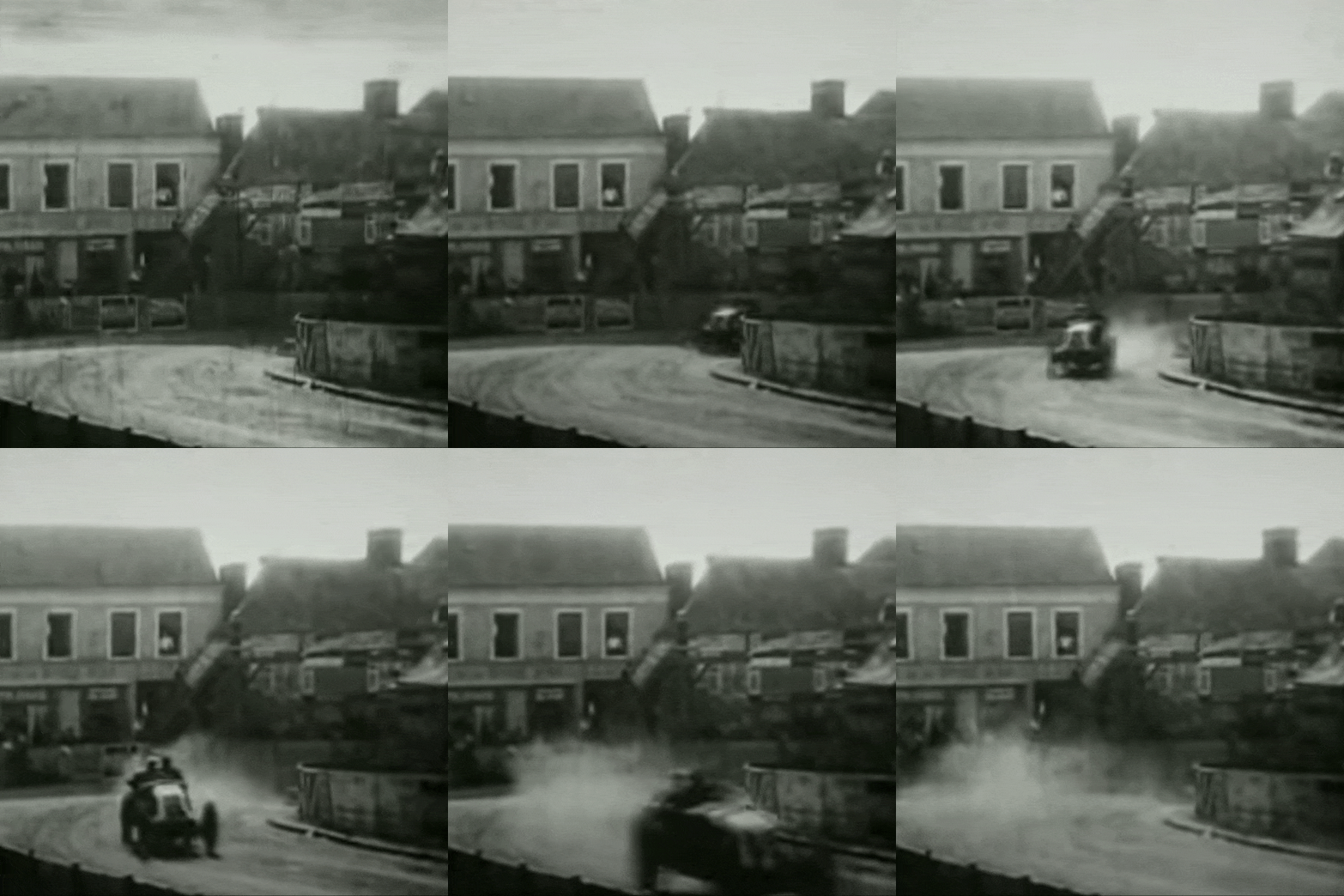
7. Movie clips from the 1906 Grand Prix.

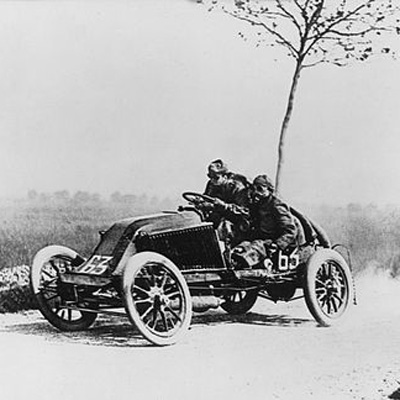
1. 1906 Renault Type-K.

2. The Gatson Vinet / Michelin Split-Rim wheel.

3. Gaston Vinet Split Rim patent.

4. Vinet / Michelin detachable rim.

5. A Persian Chariot wheel 2800 B.C.

6. Marcel Renault in the 1903 race in which he died.

Posted on

010822 – Model T, 1908-1927.

010822 – Model T, 1908-1927. > words

15,007,033 is a big number, even today, but in the 1920’s it was huge, unimaginable, incomparable as it was the number of Model T cars sold between 1908 and 1927. The Model T had a greater influence than any other man-made object on the American way of life, with only the washing machine as a possible comparable, today the personal computer would also need to be considered. The cars made accessible, affordable freedom, access to travel, it opened up the roads and therefor helped urbanise, numerous businesses developed using the Model T as its primary workhorse. As a utility vehicle it was the family car, the doctor’s coupe, the builders flat back, the local fire brigade’s truck, the milk wagon, the police car and the ambulance. The Pullford Company quickly accessorized the Model T, advertising to make it a ‘Practical Tractor’ in less than 30 minutes, to be able to carry out all the work that four horses can pull. The Pullford Company offered plows, harrows, drills, mowers, hay loaders, road graders all as adaptions or add-ons to the trusty Model T. It was everyone’s ultimate utility vehicle. Famously it cost $850 dollars in 1908, its price increase to $950 dollars in 1909 but as the production numbers increased the cost came down and by 1916 a two-seater runabout would cost $345 and a four-seater touring car $360. There was no other car on the market offering as much for so little. The systematic mechanization of mass production inspired numerous copycat industries and lead to the outstanding rise of American economic growth throughout the twentieth century.

With fifteen million happy customers, it would be difficult to argue that it was a poorly designed car, but it did have some very crude details that could have easily been improved during the normal evolution of a car production life. This however was contrary to Henry Ford’s belief and aim as standardization and methods of mass production took priority when it came to design decisions. The Model T’s slow design evolution was compromised by Ford’s obsession with the ideas of inter-changeable of parts. A component from a 1908 machine would fit on a 1927 machine, and new parts could also be retro fitted. This gave the Model T great endurance and adaptability but also eventually its design became dated as other cars makes allowed the increase cost of their cars to fund the increased design development.

The Model T was not the first Ford. Henry Ford built his first experimental quadricycle in 1896 (although sometimes quoted as 1892) but commercial production did not begin until 1901. Ford built thirty cars and then his company collapsed. In 1903 Ford took a new approach and built a sprint car for use in the popular local track events, this was primarily to attract publicity, this approach succeeded and procured backers. The Ford Motor Company was then incorporated with the sum of $28,000 and production began with the Model A 1903-04. The Model A had a two-cylinder engine under the driver’s seat and a chain drive to the rear wheels. It was an expensive car at the time and did not sell well. This was followed by the unsuccessful Ford Model B, this was Ford’s first four cylinder car. Which in turn was upgraded to the Models C & F, all unsuccessful. Bowing to the pressure of his financial backers Ford produced an up market, six cylinder Model K which was equally unsuccessful. Briefly a Model N was developed but this quickly morphed into the Model T. Ford’s primary objective was always to build an affordable quality car that the man of modest means could buy and use on a daily basis. Cars at the time were very much a rich man’s toy or status symbol. In an all or nothing last attempt The Model T was developed and put into production in 1908.

Fifteen million cars sold and a huge commercial success but was the Model T a well-designed car? What was it really like to drive and own? To criticize a design, the needs to be put into context, the context of the times, the available knowledge of technologies and the available material technologies. A design also has a context of use, is it appropriate for its purpose?

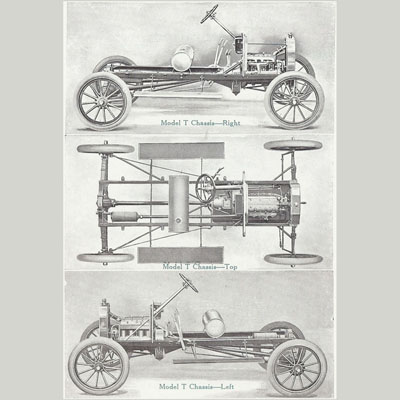
The chassis of the Model T is almost web like it is so delicate and fragile. The idea of a rigid chassis complemented with able suspension was not a design concept in the early 1900’s. The chassis consist of two thin parallel and narrowly spaced longitudinal C shaped channels with minimal cross bracing and thin radial rod diagonals to the rear axle. The track of the car was predetermined by necessity to run the cart ruts of the dirt roads. The chassis sat on transverse semi elliptical leaf springs back and front above the two axles. This gave the car a high roll centre, so it would sway or rock from side to side when on bumpy ground. The suspension, the chassis and the car body all flexed to soak up movements encountered when travelling. This would be nothing like a contemporary chassis, but it was fit for purpose, minimal and cheap to produce and could accommodate the poor roads. The flex through the chassis would eventually cause metal fatigue at all stiffening junctions and there were after-market solutions to this but in general the chassis was strong enough and appropriate for its intended use.

Henry Ford came across Vanadium steel at a racetrack on a crashed French race car. He was impressed by its strength, and weight and took a small sample for analysis and upon learning the production process he used this metal on the Model T. Vanadium steel was an advanced alloy of the time and the Model T used Vanadium steel in many places including the chassis. Vanadium steel was lighter and stronger than carbon steel, parts could be made smaller and lighter. This reduction of weight and minimalization of components, ease of assembly, access and repair were key concepts to Ford’s design philosophy. Cost was kept to a minimum by not having certain components. There was no brass, no footplates, no locks on the doors. There was no petrol pump as the tank was stored high under the seat and gravity fed to the carburettor. There was no fuel filter, any sediments fell into a bulb below the tank and could be drained. There was no water pump, water was circulated via convection, this was ok for the many open roads but not great for congested traffic, but most roads were open. There was no oil pump, the crank splashing through oil in the sump provided lubrication, a very primitive solution made worse by a very shallow sump. The gearbox used the same oil as the engine and rotated in a shallow trough of oil, the flywheel with its magneto splashing oil as it rotated. Even by using the two transverse semi elliptical springs, one per axle, saved weight, usually there would be two per axle one in each corner of the car. Running a machine that was missing all these components meant that the Ford Model T needed a lot of manual adjustments and a high level of regular maintenance. 

The engine was a cast iron four-cylinder, in line, longitudinal monobloc. The engine bloc incorporated the pistons with water cooling jackets and crankshaft top mounts. A cog driven camshaft run off the crank opened inverted valves via pushrods. All of this within the cylinder bloc. The cast iron cylinder head was separate and housed only the spark plugs. A copper asbestos casket separated the head from the bloc (a Ford invention). The combustion chambers were L shaped, flat over the piston chamber and extended to overhang the valves. By contemporary standard this provided a very poor combustion chamber configuration, but this was unknown at the time. Ease of fabrication and maintenance drove design decisions. The head and block design, separated by a gasket were state of the art in 1908. Engine block and cylinder heads were often cast as one unit, also a four-cylinder monobloc incorporating water jackets was up to date engineering in 1908. Cylinders would usually be built in pairs and then paired. The aluminium sump was also separate and bolted to the bottom of the engine bloc. The Model T’s sump lacked depth, this would cause bearing problems on all cars and the crank had no counter balance and very long levers, more nodding donkey than motorcar but again this was normal for the period. The camshaft is driven off the crank and these via pushrods operate a side valve head. The engine was 2.9 litres and develop 20hp or just under 7hp per litre a deplorable inefficiency by contemporary standards but adequate for the day where inefficient 6 litre plus engines were the norm as capacity was the easiest way to create power. The crank had three main bearings and the engine had a 1243 firing order (modern car 1342). The engine, like cars of the period had a long stroke, meaning that the crankshaft has a wide radius. This gave good torque but limited the engine to around 1800rpm as the moving components were heavy. The long stroke also made the engine bloc very tall. The low rpm, high torque and light weight of the car gave it 13mpg on unrefined 40 octane fuel, a high mpg for 1908. The compression was only 4.5 to 1 allowing the engine to run on kerosene, alcohol or other poor-quality fuels of the time. The low compression also made starting by hand cranking easier, electric starters were not available as an option for the Model T until 1919 (although invented in 1903).

The whole transmission fits via a bell housing to the engine bloc, this is again contemporary, around this time gearboxes tended to be separate components attached to the engine via shafts. The Model T engine and gear box were tidy and compact unit by the standards of 1908. However, the Transmission is nothing like a contemporary gearbox. It uses elliptical planetary gears that are in constant motion as the engine turns, this drives a gearbox drive that is also in constant motion. The gears are engaged by friction collars, initially made of steel clamped cotton, operated by three pedals. Each pedal tightens a collar around a spinning pulley. The pedal on the left is pushed down and held down to engage a low forward gear, its central position is neutral (it slips), when released, top position, it engages a high forward gear. The pedal in the middle is held down to engage reverse. The pedal on the right is held down to apply a brake to the engine rotation via the transmission. Transmission braking was the norm on the early cars, most had no wheel brakes at all and only later had rear wheel brakes. There was a rear emergency brake, operated by hand and this was rod driven, its primary role was as a parking brake.

There was no battery and no dynamo, there was no high voltage distributer as in modern cars but instead four multi-spark coils firing spark plugs one per cylinder. This provided multiple sparks in the combustion chamber. There were two levers on the steering column one controlled acceleration and the other controlled ignition advance and retard. The Flywheel magneto was a simple way to generate electricity using the rotation of the flywheel as the engine turned. Magnets mounted on the flywheel move past coils mounted behind the engine this generated the electricity that fired the spark plugs. The magneto would be dropped on later post Model T Fords. The Model T was a perfect example of precision engineering of its day. A Rolls-Royce, the obvious symbol of precision and quality, was hand crafted machine with each of its parts a one off, each car bespoke. The Model T factory produced interchangeable identical parts.

“Any colour as long as its black”. The Model T’s were at first produced in many colours, eventually as production numbers increased black was the primary option as black was the fastest air drying paint, the cars stood outside to dry. Every aspect of the Model T’s design was to cut costs and produce a machine at the lowest possible price. Making the car available to a wider cliental, instead of a car only for the rich, was Henry Ford’s social mission and this determined all design decisions. The car was an amazing success and socially revolutionary. It used the best materials, up to date technologies for both car design and manufacturing, all of which were amazing achievements for 1908. Model T sales peaked at 2,011,125 units sold in 2013 and then began their decline. In total 15,007, 033 units were sold through to 1927 and approximately 60,000 still remain. Today, the Ford Model T ranks ninth in all time car sales of one production model but this today is with a global population considerably greater than in 1908. Relative to population the Ford T would still be the number one selling car.

The Model T’s main design failure was that it failed to evolve over its production period. Cars that have long production runs such as the Volkswagen Beetle, selling 21,529,464 units evolved considerable between its 1938-2003 production dates. The Model T not only failed to evolve Ford’s had no other car to offer until the Model T was taken out of production. It was replaced by the Ford Model A, 1828-1932 that sold 4.8m units during it production run. However, by then the other car makers had caught up and competition was fierce. The Great depression first hit in 1929 but by 1931 was in fall momentum, this would affect all aspects of manufacturing as survival was the prime objective for the next decade.

The Model T is a very beautiful car, it is designed as, and is recognisable as a contemporary car. It has the engine in front, shaft drive, rear differential. It has an enclosed passenger compartment, it is operated by a steering wheel, foot pedals and hand controls and yet it is still possible to see its carriage routes. The transition from horse and carriage to horseless carriage was long and complex but the early 1900’s witnessed increased speed of consolidation of design and technological development. The racetrack became the testing ground and manufacturers quickly assimilated all the best ideas into each model. The two World Wars further hastened technological development, with cross-over technologies and skills migrating across the various engineering disciplines of aircraft, weaponry, product design and car manufacture.

The Model T was Henry Ford’s most famous car. However, Henry Ford will always be best remembered for his introduction of Mass Production design and techniques to the industrial world, a system that would be copied by every other volume producer in the following decades. The production line system of high-volume mass production would not be superseded until Toyota’s Lean Design systems on the 1980’s.

Images

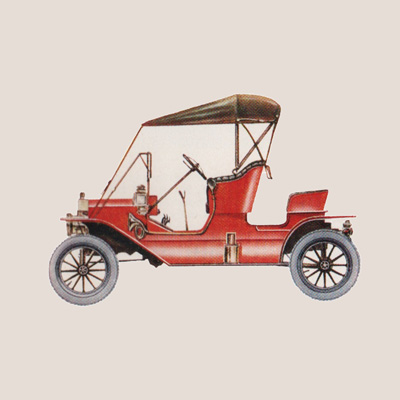
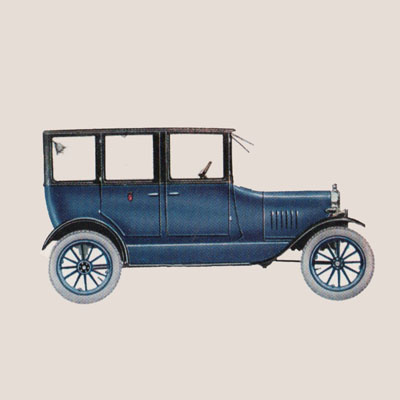
  • 1. Model T, 1911 Runabout
  • 2. Model T, Chassis
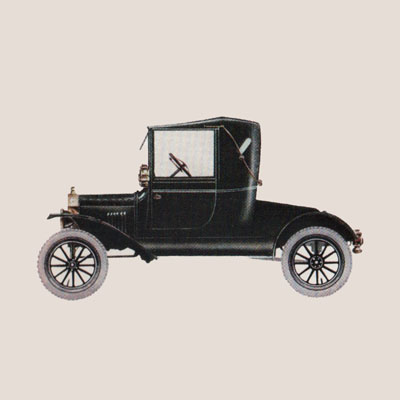
  • 3. Model T, 1916 Doctors Coupe
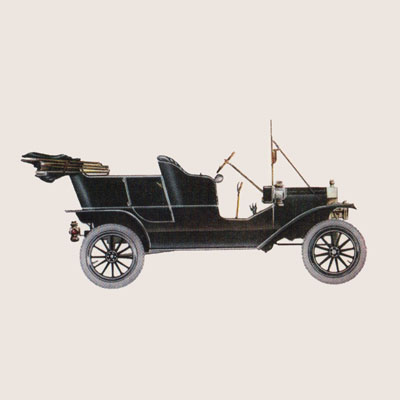
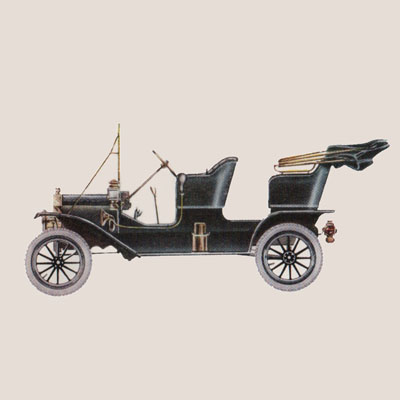
  • 4. Model T, 1911 Tourer
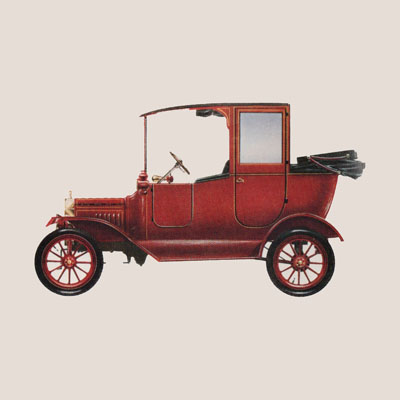
  • 5. Model T, 1915 Town Car
  • 6. Model T, 1923 ForDor Sedan
  • 7. Model T, 1909 Phaeton

Posted on

030320 – Future Nuclear – London

030320 – Future Nuclear – London > words

Disruptor is an on-trend word that we hear on a daily basis, it is used as if it has just been conceived. But a disruptor is intrinsic to our evolutionary, political and technological progress. Disruptors can be technological, the square-rigged sail, the invention of gunpowder, the production of electricity, or the understanding of flight. Disruptors can also be social political, famines, disease, wars, education, affluence. Disruptors are causal, they open some doors and close others, sometimes their consequences are predictable often they are not. They improve efficiencies in some industries while simultaneously destroying others. The current computer revolution is a present-day disruptor. Climate change may well be our next.

Disruption is by definition uncomfortable, it initiates displacement, displacement of norms and of ideals. There are several taboos that will soon need to be addressed as our present disruptors force their presence. Three of these will be nuclear power, population and CRISPR eugenics. The easiest of these to address, is that of nuclear power.

What Is Nuclear? Before the 1900’s the world was understood through the laws of classical mechanics, that of Newtonian physics. Laws relating to motion, gravity and energy of the everyday and practical. These laws were adequate for the building of engines, bridges, railways etc. These are the laws that most of us understand, the basics of physics that we were taught at school. Laws relating to velocity, time and distance, mass, momentum and conservation are extremely powerful in physics since they allow one to derive a predictable stable future from the present conditions. Likewise, complete knowledge of the future allows precise computation of the past. 

At the turn of the century mathematicians noted that reality deviated from Newtonian physics at all scales and that this was most notable as speeds approached the speed of light and at the microscopic scale of atoms. The macroscopic world, the one we live in, deals with concepts such as temperature and pressure. The microscopic world of atomic theory understands macroscopic quantities through the kinetic motion of atoms. In atomic physics all matter consists of atoms held together by electromagnetic forces. How tight these bonds are, determines the state in which matter exists: solid, liquid, gas or plasma. Solids have strong bonds, liquids have weak bonds, gases have no bonds and plasma is a conducive ionized gas. 

Note: Plasmas are only found naturally in the coronae and cores of stars but can be artificially generated and are an essential for the creation of nuclear power. A nuclear generator creates plasma by heating and/or subjecting a neutral gas to a strong electromagnetic field. This removes from within the gas an atom’s orbital electrons, leaving the plasma either positively or negatively charged. This ionized gaseous substance becomes increasingly electrically conductive.

Einstein’s famous 1905 equation E=mc2 sets up a relationship between energy and mass, anything that has mass has the equivalent amount of energy. Energy and mass are the same thing and are interchangeable. Energy cannot be created or destroyed it can only be transferred from place to place.

Uranium is a high-density heavy metal. It was fused, along with all heavy elements, in a supernova 6.6 billion years ago. A supernova is the collapse of a star triggered into runaway nuclear fusion. Uranium contains its own fused energy, occurs in most rocks at 3 to 4 parts per million and it is in the earth’s seas. It is one of the heaviest of all the naturally-occurring elements (hydrogen is the lightest), and like all radio-active isotopes, is in a natural state of slow radioactive decay (cooling). This decay is very slow, millions of years, so it is barely radioactive, however it generates 0.1 watt / tonne as decay heat and this is enough to warm the earth’s core, causing convection and continental drift in the earth’s oceans.

Energy and mass are the same thing. The energy contained within heavy metals was transferred there from the collapse of a star, a supernova. Energy is obtained from uranium by splitting its atoms, reversing the process of a collapsing star. The nucleus of the Uranium-235 atom comprises 92 protons and 143 neutrons (92+143=235). When the nucleus of a Uranium-235 atom is hit by a moving neutron it splits in two and releases some energy in the form of heat but it also releases two or three additional neutrons. If the additional neutrons released cause other uranium-235 atoms to split these in turn produce more heat and more neutrons. This creates the chain reaction caused fission. When this process happens multiple millions of times, a very large amount of heat is produced from a relatively small amount of uranium. Radioactive isotopes release heat naturally through the process of radioactive decay over millions of years. When forced to release this energy all at once, this creates an explosion. Controlling the speed of the release of this energy creates a useable resource in the form of heat.

A nuclear power station is similar to a coal, gas or oil fuelled power station, it uses a fuel to generate heat. The heat is used to create steam that turns a turbine, that is then converted into mechanical or electrical energy. The great environmental advantage of nuclear is in its energy density. A golf ball sized piece of uranium weighing 780 grams is enough to provide all the energy one would require for a whole lifetime, including electricity, flights, car transport, the manufacture of one’s food and goods, a total of 6.4 million kWh. In contrast, 3,200 tonnes of coal producing 11,000 tonnes of carbon dioxide would be required to produce the equivalent amount of energy. Other, more abundant heavy metals such as Thorium can be used to generate nuclear power. India has Thorium powered nuclear power stations. The UK has had on running nuclear power stations since 1956.

There are three principle ways of generating nuclear power, each is at a different phase of technical development and they all have differing levels of efficiency. Two are types of fission reactor, a fission once-through reactor and a fission fast breeder (fast neutron) reactor. Both of these split the atoms of heavy metals to release the energy trapped within from a collapsed star. The third type is a fusion reactor. Unlike nuclear fission that splits heavy atomic nuclei, fusion bonds (fuses together) lighter ones such as Hydrogen to give off energy. The sun and the stars are powered by nuclear fusion. These three methods of generating nuclear power are described in more detail in the text below.

Nuclear power is not a new technology and its development needs an historical context. In the 1920’s, using F.W. Astons measurements of the masses of low mass elements and Einstein’s 1905 theory of relativity E=mc2, Arthur Eddington proposed that large amounts of energy could be released by fusing small nuclei together and that this was the energy that powered the stars. The following years through the 1930’s, scientists made astonishing scientific achievements in the field of atomic physics. In 1932 Ernest Rutherford discovered that when Lithium atoms were split by bombarding them with protons, they released immense amounts of energy in accordance with Einstein’s mass energy equivalence theory. In the same year, 1932, James Chadwick discovered the neutron. The neutron has no electronic charge and was immediately seen as a tool for nuclear experimentation. In 1934 Frédéric and Irène Joliot-Curie discovered induced radioactivity by bombarding materials with neutrons. During the 1930’s Enrico Femi improved the effectiveness of induced radioactivity by bombarding uranium with neutrons. In 1938 German chemists, Otto Hahn and Fritz Strassmann, discovered that when a tiny neutron split a relatively massive uranium atom an immense amount of energy was given off along with additional neutrons, this process they called fission. Numerous scientists at that time realised that if fission reactions released additional neutrons a self-sustaining chain reaction could result. This was a eureka decade and a move nearer to unlocking the ideal of perpetual motion for energy. Once self-sustaining fission reactions were confirmed in the lab, scientists petitioned their governments for funding for nuclear research. 

Nearly all of the nuclear research throughout the 1940’s and 1950’s was related to weaponry, but in 1955 commercial applications for nuclear fusion began in Japan, France and Sweden. By the mid 1960’s fusion development had stalled in the West but Russia made claims of progress with continued development of the Tokamak reactor, of this the west was sceptical. In 1969, by Russian invitation, a UK team of scientists confirmed the achievements of the Russians and this led to a wave of Tokamak toroid reactor construction throughout the 1970’s financed by multi-million-dollar research funds. R&D continues through the 1980’s to 2010’s with incremental improvements and breakthroughs in sustaining a fusion reaction. In 2014 US scientists at the National Ignitions Facility – NIF, for the first time, generate more energy from fusion reactions than from the energy put in to achieve controlled fusion.

Three Variants of Nuclear Reactor

Fission – Once-Through

In a Fission Once-Through nuclear reactor the energy is harnessed by a controlled chain reaction. When a uranium-235 nucleus in a reactor splits, it produces two or more neutrons that can then be absorbed by other nuclei, this in turn causes them to undergo fission as well. More neutrons are then released and continuous fission is achieved. The reaction is controlled by controlling the quantity of free neutrons that are able to induce further fission. Control rods made of neutron poisons absorb free neutrons. When the control rods are pushed deeper into the reactor, its greater exposure absorbs more neutrons and this slows the fission reaction. Neutrons produced by fission have high energies and move extremely quickly. These so-called fast neutrons do not cause fission as efficiently as slower-moving ones so they are slowed down in most reactors by the process of moderation. A liquid or gas moderator, commonly water or helium, cools the neutrons to optimum energies for causing fission. 

Uranium-235 has an operating cycle of 4 to 6 years. During the fission process some of the uranium is turned into plutonium-239. Plutonium-239 does not give off as much heat so with time the fuel degrades and efficiency declines. A nuclear fission reactor is very inefficient and it uses only 1% of the fuel available. Economics determines the length of time a fuel is used before it is considered spent. Spent fuel however, still contains large amounts of energy but short-term financial concerns determine that fuel rods are replaced so that they can run at 100% efficiency. The spent fuel is highly radioactive and contains weapon grade plutonium. This waste requires long-term protective storage to cool and decay. However, it should be noted that a kilogram of uranium-235 releases three million times more nuclear energy than the energy produced by burning a kilogram of coal and unfortunately this encourages inefficiency.

Fission reactors are categorised by generation. Generation 1 reactors are the experimental reactors of the 1950’s. Generation 2 reactors, are the most common of the current reactors, developed between 1965-1996. Generation 3 reactors have evolutionary improvements from 1996 to present. Very few Generation 3 reactors have been built and development has been very slow as political opposition to and related funding for nuclear has been withdrawn and projects terminated. Generation 4 reactors include technologies still under development. Nuclear fission is already a very old technology, it is incredibly inefficient and wasteful of its fuel source with its waste still containing huge quantities of unspent fuel. Fission reactors have been able to run this inefficiently due the relative cheapness and availability of the uranium fuel.

FBR’s

The plutonium-239 within the waste of the nuclear fissions once-through process has been the biggest setback to its development. If stolen, plutonium-239 can be used to fabricate nuclear weapons, it still requires dedicated safe secure storage where it is allowed to cool and decay to be used in non-weaponry. The technology already exists to safely burn plutonium-239 in Fast Breeder Reactors – FBR’s. This technology could dispose of the existing waste problem, reducing the threat of radiation and nuclear proliferation, and at the same time generate vast amounts of low-carbon energy.

The majority of fission reactors use a once-through method taking the energy from uranium-235 which makes up 0.7% of the uranium and discards the remaining uranium-238. Our present commonly used technology burns under 1% of the fuel’s potential. FBR’s – Fast Breeder (fission) Reactors, also called fast neutron reactors, allow the continued chain reaction to completely use the uranium fuel but control of these is both difficult and dangerous. FBR’s are very efficient, they convert uranium-238 to fissionable plutonium-239 and obtain sixty times more energy from the uranium. They are expensive to build and difficult to control but they can also produce, when required, more plutonium than they consume and therefore can produce more fuel than they burn. However, development programmes have faltered with material and technical problems that still need to be resolved. 

The high costs of FBR’s and the relatively low cost of uranium fuel has helped the less efficient once-through fission burners to dominate. Although about 20 FBRs have already been operating, some since the 1950’s, they have covered some ground work for further design development. Russia and Kazakhstan have run reliable FBR’s since the 1980’s. FBR’s have the additional advantage that they can further burn the spent fuel from the once-through reactors and ex-military weapon plutonium because all plutonium isotopes in an FBR can fission. This would turn these waste and problematic resources into a useful energy supply. Fusion reactors should be the long-term goal but fast breeder fission reactors should be the focus of the short to medium term. 

FBR’s use a coolant, such as liquid sodium, that is not normally used in the once-through fission reactors. This coolant is not an efficient moderator so its neutrons remain fast moving high energy. Although these fast neutrons are less efficient at causing fission they are easily captured by uranium-238 which then becomes plutonium-239. Plutonium-239 can be reprocessed and used as more reactor fuel. FBR’s can be designed to maximise plutonium-239 production and in some cases can generate up to 30% more fuel than they consume. This is why they are called Breeder reactors. 

The process of producing more fuel than consumed is achieved because natural uranium consists primarily of uranium-238, which does not fission easily, and only 0.72% of uranium-235, which does. Natural uranium is therefore unsuitable for commercial reactors and its uranium-235 content has to be enhanced to 3 to 8% for it to be able to sustain a chain reaction. The uranium-235 is encouraged to fission but more than 90 percent of the atoms in the fuel are uranium-238. The fission process releases neutrons from the uranium-235 which are then absorbed by the uranium-238. When uranium-238 captures a free neutron, it becomes uranium-239, this rapidly changes by beta radiation (decay) into neptunium-239. Neptunium-239 continues to decay for a further 3 days to become plutonium-239. Plutonium-239 is more fissile than uranium-235 so additional nuclear fuel is produced.

125,000 nuclear weapons have known to have been built since 1945, the majority were constructed by the US and the Russians during The Cold War. As of 2019 17,000 of these weapons are known to still exist. In 1992 when The Cold War officially came to an end, nuclear weapons stockpiles were decommissioned and these flooded the market with cheap plutonium and uranium. This proved to be a setback to FBR development and the less efficient but easier to achieve fission once-through reactors benefitted from this surplus. Further, market lead capitalism unfortunately will always opt for the short-term gain over a wiser long-term objective. This is due to the fact that if one company decides to take the sensible long-term view they will be undercut by their competitors and this perpetuates short-termism. A further setback for FBR’s and nuclear in general, has been that companies sitting on fossil fuel assets, coal, petrol and now shale, will understandably encourage their consumption whilst promoting negative news on alternative competitor fuels. Governments are equally aware that disruption to the fossil fuel industries will displace a considerable workforce that would need to be re-employed elsewhere. Although a market lead economy is good for competition it is not necessarily good for setting sensible and sustainable long-term objectives. These need to be set as agreed global government policies with market competition encouraged and controlled to develop efficiencies within these directives. 

Fusion

Considering the potential benefits of nuclear fusion relatively little research and development work has been done since the oil crisis in the 1970’s. The Anti-nuclear movements, often naively linked to environmental campaigns, have forced nuclear R&D to stall and the considerable budgets required for fusion research have been withdrawn.

Nuclear fusion would be the alchemist’s elixir. It is the energy source that would power the future, on earth and in space. Its energy density is way beyond any comparative and as an energy source it is highly efficient, both in terms of minimum waste and energy production. Unlike nuclear fission, that splits heavy atomic nuclei, fusion bonds lighter ones such as Hydrogen to give off energy. The sun and the stars are powered by nuclear fusion. The concept of putting the power of the sun inside a box is enticing, the issue is that we don’t as yet know how to make the box. 

Fusion has more potential power than fission. With fission large unstable nucleons such as uranium and plutonium are split to produce energy. With fusion lighter elements are fused together to form heavier elements, such as deuterium and tritium yielding helium + neutron + energy. Fusion can yield eight times more energy than fission but fusion uses considerably more energy to initiate than fission. 

The Tokomak reactor has been one of the most successful fusion reactors to date. It uses extreme magnetic fields to confine a hot plasma into the shape of a torus. This forces the atoms together as they travel at high speed, 4 million meters per second, around the torus, whilst heated to 150 million degrees Celsius (ten times the heat of the centre of the sun). When deuterium and tritium fuse, they become an unstable isotope of helium that quickly becomes stable by releasing one neutron and 17.6 million electron volts of energy. This process has kept the sun and stars burning and releasing energy for billions of years. Every second the sun transforms 600 million tons of hydrogen into helium at a temperature of 15 million degrees centigrade. The problems with fusion, is not the principles of fusion but with the amount of energy required to jump start and sustain a fusion reaction. The basic science is solved and the problems that remain are technical ones to do with materials. The Tokomak reactor has to withstand extremes of force, speed and heat and this pushes the limits of our current technologies.

Nuclear fusion is still considered to be speculative and experimental as the energy required to cause fusion has, to date, been more than the energy commercially produced. The International Thermal Experimental Reactor – ITER is an international R&D project that is looking at the long-term reliable potential of nuclear fusion and as mentioned above the US NIF lab claimed energy positive fusion in 2014. When a fusion reactor is achieved that is energy positive it would also be easier to miniaturize. Recent billionaire backed funding (Bloomberg, Gates, Bezos) programmes have been looking to create fusion reactors small enough to be built in factories and shipped for assembly on site. With the new HTS magnet technology (High Temperature Semi-Conductors), a net-energy fusion device can be considerably smaller at about 2% of the volume and mass of ITER. A smaller size means lower costs, opening fusion design to the smaller, more agile organisation. Several start-ups that are pursuing nuclear fusion believe that this will be achieved by 2025 to 2030. Hydrogen fuels are widely available, when fusion reactors fail, they tend to burn out as opposed to meltdown, making them safer. Fusion reactors give off fast neutrons but these can be shielded by lightweight high-tech poly plastics such as Borated HDPE and this could be moulded making a seamless enclosure for smaller units. 

Miniature SMR’s

Small Modular Reactor’s SMR’s. The image of a nuclear power station is that of an enormous factory, ring fenced from the rest of the world, a preternatural industrial island. Why aren’t nuclear reactors small and if so, how small is small?

The smallest designed and prototyped, nuclear reactor known was built in 2012 for NASA deep space missions. The Lawrence Livermore National Laboratory LLNF-DUFF space reactor is just 24 watts. The energy was used to turn a Stirling engine electrical generator. A Stirling engine is a closed-cycle regenerative heat engine with a permanently gaseous working fluid. The first portable nuclear reactor “Alco PM-2A” was used to generate electrical power (2 MW) for Camp Century from 1960. Optimism towards nuclear in the 1950’s was such that Ford produced the Nucleon concept car. A car powered by its own nuclear reactor, with its toroidal reactor visually located behind the passengers.

More recently, in 2017, Kilopower a NASA initiative designed a nuclear reactor to provide one to ten kilowatts of electrical power continuously for twelve to fifteen years. The reactor is intended for space travel and exploration including future Mars missions. Designed, prototyped and tested in 2018, it measured approximately 2m high by 1.2m diameter and weighs 134kg, it produced 1kW of power. An Israeli research team designed a thermal heterogeneous reactor that weighed 4.95 kg and measured less than 19cm across, it would produce a few kilowatts of power. These are prototyped future projects but small nuclear reactors have been in use for many decades.

Nuclear powered ships were in use in the 1940’s. The first nuclear submarine was built in 1955. The majority of nuclear marine propulsion use nuclear power to heat water in a sealed primary system, that in turn heats water to turn a steam turbine. This can then provide direct propulsion or can generate electricity that provides both utility power and propulsion. Compared to earlier diesel fuelled submarines, nuclear fuel offers advantages of very long intervals before refuelling. All fuel is contained within the nuclear reactor saving the space that would usually be required for fuel and no air intakes or exhaust stacks are required. The relative fuel costs are low but are offset by high operating and infrastructure costs, so nuclear marine transport is mainly used by the military. 

Most nuclear submarines have one but can have two reactors, whilst aircraft carriers have two but the USS Enterprise has eight reactors. Marine nuclear reactors are much smaller than conventional land power generators, in both dimension and output. To compensate for this, they use a uranium of higher energy density that is safer than the uranium used on land but it comes at a cost. Marine reactors also use more innovative cooling and shielding systems. Nuclear ships operate for years (10 to 25) without refuelling. In the US the latest Virginia Class SSN-774 submarines designed by General Dynamics Electric Boats will be in service until 2060. The SSN-774 use a S9G nuclear reactor that delivers 40,000 shaft horse power (c. 30kW) and has a nuclear core life estimated at 33 years. These submarines use a quiet pump-jet propulsion instead of conventional propeller. Much of SMR future development will borrow heavily from the transfer of existing military applications. A fleet of nuclear-powered cargo ships would be wise replacement for those that burn heavy fuel oil with its high sulphur and nitrogen content.

At present nuclear fission and fission FBR’s are multi-billion-dollar developments. This financial commitment means that its asset value encourages longevity of use, to refurbish instead or renewing. This means that many nuclear power stations have been on running since their inception in the 1950’s and 60’s, long past their initial design lifespans. The smaller SMR’s would have a much shorter life and be decommissioned and replaced more often encouraging design development in line with other products such as aircraft and cars.

The majority of the cost overruns in building large nuclear power stations are not due to construction cost overruns, but instead are due to legislative costs related to delays called upon during the development and construction process. With billions involved in the financing of these mega projects any delay begins to rack up fees and adds to the project’s procurement inefficiency. With Small Modular Reactors the oversized expensive one-off nuclear power station becomes instead a factory product with all the benefits of factory design and development. Using recognised standards and technologies creates certainty with regard to both quality control and licensing procedures. Factory controlled product design provides control not only of the build but also of the design development process. Design feedback from product use can be quickly assimilated to improve and further develop the generic designs. 

SMR’s would provide a low cost, low carbon, safe and reliable energy source. In the developed world energy infrastructure has aged with many power stations, coal, nuclear or otherwise all running beyond their scheduled termination dates. With costs of one-off mega projects being multiple billions (£15b-£25b) there will always be the temptation to revamp and relicense existing power plants. This means the continued use of technologies developed in the 1970’s and this in turn hinders design development. Design development of SMR’s would increase efficiency, improve safety while simultaneously reducing product scale. Design development would continue to fit improved efficiency into a smaller package at a lower cost. A network of smaller SMR’s also mitigates risk of total loss of energy supply. A designed product is a globally exportable commodity and as such would develop with the benefit of global technological inputs. Several firms, established and start-ups are pursuing the development of SMR’s. Their designs range from 6 to 440MWe. A SMR creating 440MWe of electricity would be enough to power a city the size of Leeds. But SMR’s need to be smaller than this, around 100MWe, and spread into a grid that would also include solar inputs and battery storage.

Once a product is accepted by a market its development becomes exponential. Consider flight, from the Wright Brother first 1903 flight, a 37m, 12 second hop at 6.82 mph, to the SR-71 Blackbird Mach 3 (3x the speed of sound) flights in 1976, or to the moon landing of 1969. This development period is only 60 to 70 years. Computers are equally an obvious comparative, consider the whole buildings required to house NASA’s computers in the 1960’s. The Apollo 11 / iPhone 11 comparison is one, not only of computing power, but one that takes mankind’s most astonishing achievement and compares it with a mass produced, everyday pocket utility. The Apollo 11 computer had 32768 bits of RAM and a processor that ran at 0.043 MHz compared to the Apple iPhone 11 (basic model) 64 GB RAM that is 549,755,813,888 bits (16.78 million times more than Apollo 11) and 2x 2.65GHz of processing speed. This increase in efficiency and reduction in scale has been achieved in 50 years. Nuclear power needs to enter this phase of design development and it needs to do so quickly and SMR’s are a way to achieve this.

Waste

Nuclear waste, like all waste products from industry, remains unresolved. Nuclear fission reactors use only 1% of the fuel available. When fission reactors split heavy uranium nuclei into medium sized nuclei creating energy it gives off waste. The nuclear energy available per atom is approximately one million times larger than the chemical energy per atom of fossil fuels. This means that the amount of fuel and waste used and produced, would be one million times smaller than that for the equivalent energy produced by fossil fuels. For example, the ash waste from ten typical coal fired power stations would be four million tons per year, the equivalent nuclear waste would be four tons. The materials flowing into and out of nuclear reactors are small relative to fossil-fuel streams. Most nuclear waste is low-level waste. 7% is intermediate-level waste and 3% is high-level waste. From the above example of ten typical coal fired power stations with 4m tons of ash per year a once-through nuclear power station would produce 109kg of high-level waste. Nuclear high-level waste is highly radioactive and it is generally stored with the reactor for forty years in cooling pools. After 40 years the radio activity has fallen 1000-fold but it will remain a high-level contaminant for at least 1000 years. Nuclear waste is a problem but it is a physically small problem and with the use of the right reactors a resolvable problem. It should be remembered that this high-level waste is a very potent future fuel that at present cannot be commercially accessed but at some future date will have value. 

Radioactive isotopes eventually decay, or disintegrate into harmless materials. Some isotopes decay in hours or even minutes, but others decay very slowly. Strontium-90 and cesium-137 have half-lives of about 30 years (half the radioactivity will decay in 30 years). Plutonium-239 has a half-life of 24,000 years. By reprocessing separates residual uranium and plutonium from the fission products both can be used again as fuel. Most of the high-level waste (other than spent fuel) generated over the last 35 years has come from reprocessing fuel from government-owned plutonium production reactors and from naval research and test reactors. Most of this waste has a use as a future fuel source.

Industry, has as yet, never provided a circular economy where all waste is reused. The last two hundred years has burnt through fuels and materials at criminal levels of inefficiency. Metals are sent to ground fill or down-graded when reused and plastics are the current curse of the Anthropocene. With the coming of the global adoption of the electric car and with the addition of grid storage, disposing of spent batteries will be our next mountain of a problem to which no feasible solution, pre-adoption, has been tabled. Every aspect of industry should ideally be circular but society is taking a long time to get there. Nuclear waste obviously adds to this problem but volumetrically is almost insignificant to the mountains of existing and coming industrial waste. All waste at some point will need to feed back into a circular system.

Bad Timing

If nuclear power offers such opportunity why has development stagnated over the last fifty years. The Cold War was the political disruptor that pushed man to the moon before he was technically ready to go there, with plentiful reserves of oil and coal, energy has not had such a disruptor. Nuclear energy was an amazing scientific breakthrough but unfortunately a discovery made with very bad timing. Bad timing can often have the same conclusion as a bad decision. Nuclear power was first discovered in the 1930’s. This great decade for science and technology unfortunately fell in the midst of mankind’s cultural and political regression. The 1930’s sits inconveniently between the two World Wars. Governments, each believing that its neighbours were in the process of constructing atomic weapons poured funds into their making. In the US the Manhattan Project, ironically lead by European scientists that had fled fascist Germany, created the first nuclear chain reaction in December 1942. The United States tested its first nuclear weapon in July 1945 and within a month Hiroshima and Nagasaki were annihilated. The Enola Gay and Bockscar B-29 bombers may have ended World War 2 but the Cold War that endured post-war built up arsenals of nuclear weapons. 125,000 nuclear warheads have been built since 1945, 97% of them were American or Russian. There are a known 17,000 nuclear weapons in the world today. The words nuclear and bomb can no longer be separated, they have become culturally infused, joined by a hyphen that cannot be eradicated. 

In the 1950’s countries still had optimism for nuclear power. The UK built its first nuclear powered reactor in 1956 at Calder Hall (Sellafield) but government policies, along with world policies, changed during the 1970’s and 80’s and development stagnated. At the beginning of the 21stcentury interest in nuclear power has again picked up but has so far focused on multi-billion mega projects. Globally there are many different approaches to SMR nuclear design, some using innovative fuels or cooling systems, some explore new materials. Conventional, proven and understood systems will be developed first, however as soon as markets are established, new technologies will find funding and speed up design development. 

It is interesting that the majority of providers of SMR’s prioritise economic reasons for their development, as compared to the larger plants and mega projects that have struggled to be delivered on budget or at all. SMR’s would offer reduced overall capital cost that would enable conventional project financing. They would offer improved certainty of construction, manufacture, project delivery and a competitive cost for the production of electricity. These are all very pragmatic concerns, but the conversion of nuclear power station design, each as a one-off, to a product-based design approach of an SMR, will speed up design development. Design development will feed into new design fields, especially when the product inevitably tends towards miniaturisation and improved efficiency. At the same time knowledge from existing product runs, the car, aircraft, ship building industries, will feed into reactor procurement and production. Further, SMR’s should not be considered as single stand-alone power plants, they are designed to operate as a fleet in series. An SMR would require one tenth of the space needed by a conventional power station to produce the equivalent amount of electricity. Nuclear power, due to bad political timing, is a technology that has been left on the shelf for nearly fifty years.

The Way Forward

The energy hungry world has long been fossil fuel dependent. At the same time as the world begins to reduce the burning of fossil fuels, additional demands will soon put considerable pressure on electric energy generation and electric energy grid infrastructure. Renewables such as solar, wind and hydro, however efficient, will never deliver enough power, there simply isn’t the space for the required number of solar panels or lengths of coasts for suitable offshore wind. The energy hungry computer servers that support the cloud and the world of instantaneous communication. the coming global roll out of electric cars, electric transport, electric heating and the further development of solely electric factories, will put additional demands on an already creaking system. 

Immediate short-term transitional fixes should be applied to existing energy systems. This would need to be a coordinated global initiative. Carbon Capture – CCS should be fitted to all existing coal fuelled power stations and no further coal fuelled power stations should be built. Where possible coal fuelled power stations should be converted to gas. Heavy fuels should be removed from all trans-oceanic shipping, converting existing stocks to run on either lighter fuels, gas or by fitting heavy fuel scrubbers.

Nuclear power is an essential ingredient to a future sustainable energy mix and is possibly the only realistic alternative power source at this present time that can support present population levels and maintain existing quality of life expectations. In the near-term R&D should focus on Small Modular Fast Breeder Reactors – SMFBR’s (100-150MWe) and set up production lines where these are factory built. When nuclear power becomes a product, the natural efficiencies of product design, continued product refinement, product logistics and international IP, will increase efficiencies, shrink size, standardise components and systems and lower costs.

The lessons learnt by developing SMFBR’s as products would feed directly into R&D for nuclear fusion. SMR – Nuclear Fusion would not only provide the energy that the planet requires to maintain its existing level of population but it will also provide the power that is required for man’s next great exploration, that of space.

“We may be the only source of high intelligence in the cosmos, but our act of avoiding nuclear power generation is one of auto-genocide. Nothing more clearly demonstrates the limits of our intelligence.” James Lovelock

“We made the mistake of lumping nuclear energy in with nuclear weapons, as if all things nuclear are evil.” Patrick Moore

“Nuclear energy, in terms of an overall safety record, is better than other energy.” Bill Gates

“The sensible thing to do for a country like the UK, I think, is to focus on CCS, which the world needs anyway, and nuclear.” David MacKay.

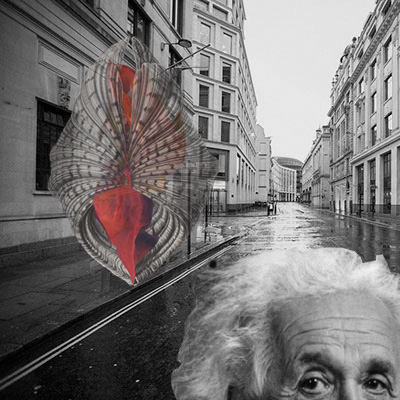
Images. Shelled Nuclear Fictive SMR’s

Posted on

130120 – The Electric Carriage – London

130120 – The Electric Carriage – London > words

In 600 BC Thales of Miletus, the Greek philosopher, wrote of the attraction of the lodestone to iron and other lodestones. The lodestone, a naturally magnetised piece of mineral magnetite. The navigational properties of the lodestone were known by the Middle Ages and the name lodestone probably dates from this time as its Middle English lodestone means ‘course stone’. The first modern treatise on electricity De Magnete, was published in 1600 by an English scientist William Gilbert. In this text he studied electricity and magnetism. He invented the new Latin word electricus (like amber, from the Greek word electron meaning amber). Amber when rubbed can hold a static charge. The journey from the magnetic properties of the lodestone to beginnings of understanding electricity took 2200 years. The words electric and electricity first appear in print in Thomas Browne’s Pseudodoxia Epidemica of 1646. The German scientist Otto von Guericke demonstrated properties of electromagnetic repulsion in 1663 and in 1791 Luigi Galvini published his discovery of bioelectromagnetics, demonstrating that electricity was the medium by which neurons passed signals to the muscles.

The Leyden jar, is a glass jar that was able to accumulate and store static charge, a type of primitive battery. It allowed users to discharge electricity when required and was discovered in 1745. Alessandro Volta’s battery or Voltic Pile made of alternating and paired zinc (-) and copper plates (+) separated by felt pads soaked in salt water was published in 1799. The Voltic Pile gave scientists a reliable source of electrical energy and from this date considerable progress was made in the studies of electricity. Rechargeable lead-acid batteries were invented by Gaston Planté in 1859. The basic understanding of the unity of electric and magnetic phenomena including electro-magnetic fields, electromagnetism was made by Hans Christian Ørsted and André-Marie Ampère in 1819. Shortly after in 1821 Michael Faraday invented the electric motor and George Ohm calculated and analysed forces in the electrical circuit. Electricity, magnetism and light were definitively linked and modelled mathematically by James Clerk Maxwell in 1861.

Faraday’s big contribution came when he discovered mutual induction. Faraday wrapped two insulated coils of wire around an iron ring, by passing a current through one coil he found that a momentary current was induced in the other coil. Faraday further discovered that by moving a magnet through a loop of wire an electric current flowed in that wire. The current also flowed if the loop was moved over a stationary magnet. Faraday’s experiments established that a changing magnetic field produces an electric field, this relationship was determined as a mathematical proof by James Clerk Maxwell and is known as Faraday’s Law. Putting an electric current through a wire creates a magnetic field, putting this electrically created magnetic field inside a magnetic field (between the opposite poles of two magnets) creates a force. This force can be used to create rotation and hence mechanical power. Using these principles Faraday would go on to construct the electric dynamo, the ancestor of modern power generators and the electric motor. An electric motor is an electrical machine that converts electrical energy into mechanical energy. An electric generator is mechanically identical to an electric motor, but operates in the reverse direction, converting mechanical energy into electrical energy.

In the early nineteenth century once the principles of electric rotation were understood and a battery storage source had been discovered, electrical engineering progressed rapidly. People such as Thomas Edison, Alexander Graham-Bell, Ottó Bláthy, Galileo Ferraris (three-phase induction motor), Baron Kelvin, established laws and invented uses for electricity. People such as Nikola Tesla and George Westinghouse helped turn electricity into an essential resource for modern life. 

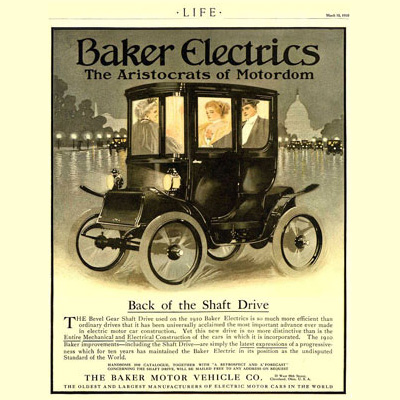
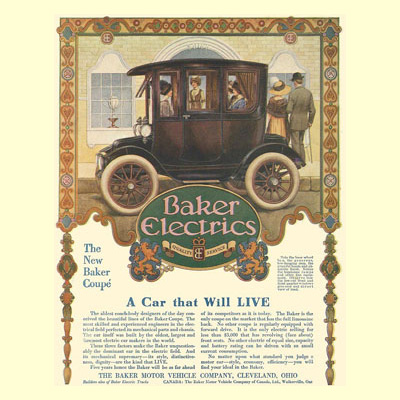
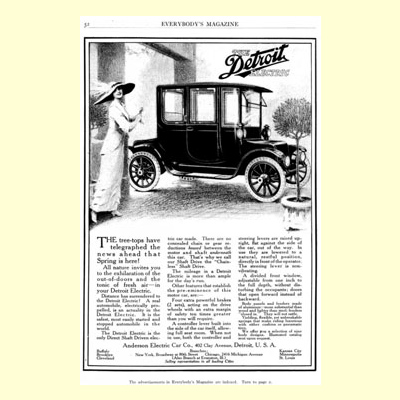
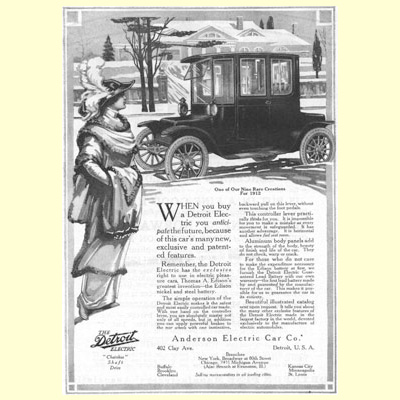
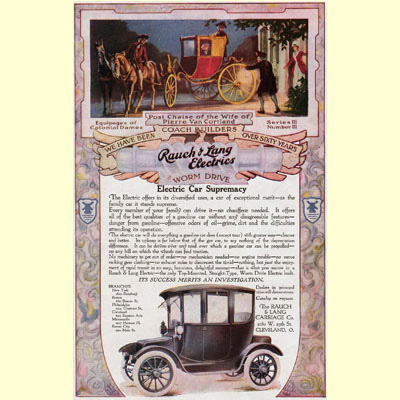
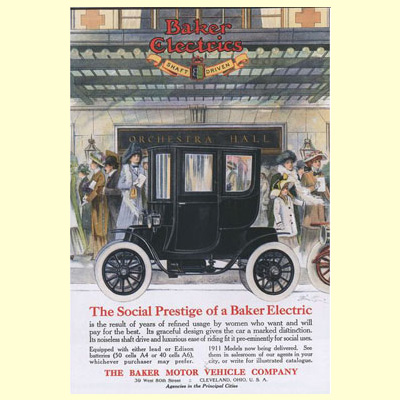
Over one hundred years ago electric cars were the most numerous vehicles in the world. During the late nineteenth and early twentieth century they out sold every other type of car. Electric taxis could be found in London, Paris, and New York. Electric cars were also the fastest in the world holding the land speed records through to the 1900’s. By 1912 many houses in the US cities had electricity and were therefore able to charge the cars at home and so the popularity of electric city cars increased. 

In the US in the early 1900’s 40% of cars on the road were steam cars, 38% were electric and 22% were petrol run. This may seem a strange mix today but car design was in its infancy and undergoing rapid transition. This transition was not only for the means to power propulsion but also cultural, away from the horse and carriage as an established typological norm. The most easily adapted transition technology was that of steam as it already had been well tested to power factory machinery and locomotives. Steam was noisy, heavy and ungainly, with the need to carry coal to stoke a boiler of considerable size. A steam car needed approximately an hour to prepare as the water in the boiler needed to be at steam before one could leave. The very early versions from the late 1800’s, were a strange hybrid of carriage, locomotive and what would become later recognisable as a car. Early steam cars were not at all user friendly and nor were petrol cars. The first petrol cars were noisy and temperamental. They had to be started by hand crank, had a crash gearbox, they had a series of knobs switches and dials that controlled ignition, advance and retard, fuel mix, often also hand pumped, in addition to the controls for acceleration, brakes & steering. They were complex machines to use, very smoky, smelly, dripping oil everywhere from total loss lubrication systems.

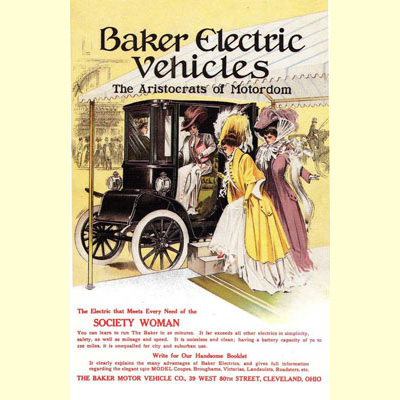
Early electric cars were popular for exactly the opposite reason, they were very user friendly and also used an existing and established transfer technology. Electricity had been used to propel rail carts in mines, as clean air in a mine was a necessity. Electricity was now quite common in the factory and companies such as Edison’s and Westinghouse’s had begun to connect houses to city grids. Electric cars required no gearbox, a simple lever pushed forwards or backwards controlled momentum. One could learn to drive an electric car within an hour. They started and stopped immediately, they were clean and could be charged at home. Their limited range was inconsequential as they were city cars designed for the short commute to and from near destinations. The energy density of the batteries was always their weakness. There were also cultural reasons why the electric car was a popular substitution for the horse drawn carriage. The concept of car as a utility did not exist. The people that could afford cars could afford servants. The carriage was a suspended interior room, softly sprung, sumptuously lined and protected from the elements. People sat on padded seats face to face, windows were curtained and ceilings were high, you stood up to get in and a tall hat did not need to be removed. Large windows accessed the view but equally allowed one to be viewed. Drivers and footmen sat outside exposed to the elements. The electric car was the best cultural replacement for the carriage and the society that were carriage drawn. It did not necessarily require a driver but the carriage component and its etiquette were kept whole and intact. The early electric cars were like the early electric lifts, both were rooms in which one moved from location to location, one vertically the other horizontally. These rooms had seats, often revolving seats, mirrors, flowers in hung vases and delicate lighting. One could wear hats, bustles and large voluminous dresses, one could wear a cape and carry a cane. These moving rooms were social spaces in which one could converse on the way to the theatre or to and from the newly fashionable multi-levelled department stores that had recently opened.

In America the early cars were called Brass Era cars 1896-1915 due to their ornate use of brass for details, lights and grills. Once again this is a cultural transfer of ornament onto engineering, a beautifying of the mechanically austere. This cultural transfer often has little to do with the car per se, as it is a transfer from the language of architecture and the interior. This interpretation of what a machine should be varies from our present day ideal of aesthetic convention. This is due to the altered perspective at the outset of the car destined typology, utility versus a social mobile room. As speed and distance began to take precedence, the utility aspect of the car developed over that of the mobile room. The speed, power and independence offered by the car as a utility replaced that of the leisurely, social discourse offered by the carriage. It is interesting that at the same time the movie house replaced the theatre, one a popular convenience and the other a social performance. The movie house as a building type diverged away from the theatre as it shed all of its ancillary social spaces. The anti-rooms where discourse, performance and the rituals of societies business people and voyeurs were entertained. The cinema stripped of these social spaces became streamlined, a foyer and a viewing room. As time became commoditised everything became more functional, functional used as a synonym for time efficient. Streamlining as a stylistic expression of time saving efficiency would spread in the coming decade through all aspects of the applied arts. Streamlining was quickly applied to cars and in the process the cultural language of design, with all its ritualistic and semantic overtones, were stripped away and replaced with the time saving language of functionalism. In this the technological advance overtakes cultural advance and in so doing shifts and realigns cultural agendas and values. It is impossible for us to look at the car anew with the values and from the perspective of the Edwardians. As we now transition from the internal combustion engine cars of our époque to the electric cars of the future, at first step, will be to simply replace the power plant. The car will be recognisable as a car. It will have a front and a back, a bonnet and a boot, some may even carry grills and transmission tunnels decades after either have need or use.

The very early 1900’s was the Golden Age of the electric car where sales peaked in 1910. This coincided with what in the US called the Brass cars and in the UK were called Edwardian cars. Brass, Edwardian and Electric were together all scheduled soon to be the past. Within fifteen years of 1910, electric cars had all but vanished from the streets and were replaced by cars powered by the internal combustion engine. So why from these three types of power source, steam, electric and petrol, did the petrol car from such a poor start soon dominate the roads. Firstly, reliable transport, both domestic and commercial, was beneficial to all markets and increased market capture through distance distribution. Transport was a growth industry fuelled by its ability to assist other industries. The fundamentals of logistic necessity put pressure on the fledgling transport industry to run with what was presently viable. There was no time to wait for battery technology to catch up and investment funds were quickly redirected towards the combustion engine powered motor car and its procurement. Secondly, huge reservoirs of underground oil had been discovered around the globe. It was estimated that these reserves were so large that they would last at least 3000 years. Oil, unlike coal, could be pumped and piped, making its distribution infrastructure easier to establish. Oil had greater energy density than anything else available and from the outset had multiple uses, it was a fuel, a lubricant and a preservative. Later with further research and advances in chemistry, oil proved to be incredible versatile and the basis for many varied industries to come. None of this was missed by the world of finance and the culture of capitalism. Thirdly, as roads improved it was possible to travel ever greater distances. A requirement of distance was range and speed, steam and the electric battery simply could not compete. Fourthly, Charles Kettering’s invention of the electric starter motor of 1911 greatly helped the petrol car as there was no longer a need to hand crank the engine to start it. A hand cranked engine not only required considerable strength it was also a dangerous activity, responsible for many injuries, even deaths when hand cranks took the full force of engine kick-backs. Fifthly, the final nail in the coffin of the electric car began in earnest in 1908 when Henry Ford streamlined mass production and with this managed to reduce the cost of and ease of, through standardisation, the assembly and repair process of the petrol-powered cars. 

The association of carriage to personal identity had little importance. The grand horse drawn carriage may be recognised as part of a wealthy estate but not as an item owned by an individual. The carriage was a shared mode of transport. The driver, footman and stable hands may have considered the carriage as their own, as although they didn’t own the carriage, they would have known considerably more about it and the team of horses that pulled it than the owner. The carriage was part of the estate shared by the family members that lived on the estate. The early Edwardian cars, including the electric car continued this relationship, with the car as a shared facility and not a status item. As the car became streamlined, with its design bias now being functional, its previous cultural role gave way to its new technological role, the carriage became the chariot. The car became a masculine fetish object of the successful representing speed, power and daring. By the 1930’s the car had become the status symbol for everyone who wanted to be anyone, consider the celebrity cars of this period and images of Clark Gable standing alongside oversized Duesenbergs. 

Post wars, the cars of the 50’s and 60’s were the youthful symbol of independence, films of the early 70’s such as Two-Lane Black Top (71), American Graffiti (73) and Vanishing Point (71) highlight the cars role in society. The car had become an essential expression of male virility, of status, of fashion and of tribal association. It became a means of escape, an expression of one’s values, it was the only confinement in which young couples could respectfully be seen alone. The car quickly became the ménage of all these things, a tin enclosure of adrenalin, courtship and competition, complete with Lucky Strikes and furry dice. By the 1970’s and 80’s a car was a necessity due to the suburban sprawl that now surrounded all cities, a pre-requisite for all youth as it gave independence and access to the now time organised week at work and the new weekend world of clubbing.

As service sector jobs replaced industrial jobs cities became re-urbanised, with many from suburbia moving back to the city centres. Today’s flat dwelling urban youth have no place for car ownership, cars are hired and shared. Cities have deliberately become car unfriendly, speed bumps, bottle necks, restricted roads, congestion charges, parking permits and fines all make car ownership very difficult. Modern apartments no-longer provide parking spaces in ratio with accommodation units or site density. Public transport is the norm, the cars iconic value and representative value has been diminished. Of necessity, society has become more social, flat sharing, co-working, cab sharing and car-pooling are the new norms, even small-scale transport, scooters and bikes, are hired by the hour. Ownership of any of these items is far less important. Greater urban density has created a new urban social class, flats, often beyond one’s financial means are now rented, kitchens, TV rooms, gyms, pools and a concierge service are included within the service charge. The new living room may be a private club or a local bar, people eat out, shower at their gyms and live within the social infrastructure of the city. A flat may serve only the functions of safe storage and sleep. 

In the 18th century, one would probably work in the same industry as one’s father, continuing generations of cobblers, farmers and farriers. One’s time followed the seasons or immediate market needs. A farmer’s day changed in length Winter to Summer, a cobbler or farrier waited upon the next client to arrive, each job bespoke. The worker was a crafts person, he had total knowledge of the full process of making, from raw material to finished product. Quiet periods were one’s own time. The crafts person had control over the quality of his product and the application of his time. Industry mechanised and commoditised time as consistent and regular. It organised our weeks and weekends and the main purpose of our labour became profit not product. One goes to work to produce goods that may have no known immediate market and in that we serve the machine. The machine may produce shoes of which one’s contribution may be to only to push the button to make the heel. One need not know how to make a whole shoe, or how much it costs to make a shoe, or where the materials come from, or where it will be sold, these jobs are all done by other people. Industry collectivised our knowledge, time and production. The pooling of knowledge could be alienating as one no longer had an overview but industry improved living standards and created known quantities of leisure time. Leisure time itself became commoditised but still forms the networks for social grouping. 

Leisure time will soon increase along with population increases and further automation. Within this new found leisure time new social groups will emerge and develop. Our changing relationship to ownership and product status is all part of this transition. The electric car during this transition will at first imitate the combustion engine car that it replaces but as more automation, increased connectivity and car sharing become the norm our cultural associations with the car will transform its form and purpose. The Edwardians saw the early cars as communal mobile rooms. The twenty-first century may revisit this approach to transport design or it may well invent the as yet un-invented as new technologies open up new cultural opportunities.

Images

1. Baker Electric 1910 – Aristocrats Ad

2. Baker Electric – Social Prestige Ad

3. Anderson Detroit Electric – Ad

4. Baker Electric – Society Woman Ad

5. Detroit Electric – 1912 Ad

6. Rauch & Lung Electric – Worm Drive Ad

7. Baker Electric – Will Live Ad

Posted on

230119 – The iconic 1967 Pontiac ‘Goat’

230119 – The iconic 1967 Pontiac ‘Goat’ > words

The 1960’s were a time when the two super powers, the USA and the USSR, went globally head to head, with the Cold War battle grounds of the Middle East, Cuba, China and Vietnam. The Cold War had already begun post World Wars and as early as 1951-53 Iran became the pawn in a battle of power. Iran sat on huge reserves of oil and was unable to realise these without outside help. It was also strategically located in the heart of the Middle East, a gateway to Asia. Following the lessons learnt from the two World Wars, oil was the new black gold and no country could do without it. Britain, America and the Soviet Union all at first tried for control of this region, once known as Persia, but this soon became a two horse race as the Soviet and the US each saw Iran as a crucial stepping-stone on the road to world domination. The Soviets were wanting to expand south and move into the Middle East spreading the Communist word and the US wanted to contain Soviet power. A head to head developed, fought over a small and poor country, in the land of that country.

The Middle East had become the new frontier, a bulwark to stop Soviet expansion. This was both a battle of ideologies, Communist versus Democratic Capitalism, as well as a control of economic and energy infrastructure. The Baghdad Pact of 1955 was indirectly a means of US control over an area of strategic and economic importance. On a global stage the US had stepped in to adjudicate where historically the British Empire had once set the law. Military bases, spy stations and communications networks, both Soviet and American, sprung up across the Middle East and North Asia. The Cold War between the new two world Super Powers was well underway. But Superpower conflict was not only centred on the Middle East and Oil, global strategic positions also came to a head, with further Soviet and US conflicts erupting in Korea, Vietnam and Cuba. Every Super Power conflict quickly became a propaganda exercise of opposed world ideologies. When the Cold War reached a stale mate The Space Race became the arena for one-upmanship. By the early 1960’s, the two Super Power’s were each taking pot shots at the moon just to prove that they could hit it, sending their latest missiles at the ball in the sky to keep score of their so-called impact landings. Several of the rockets missed their lunar target and flew forever onwards into space; they are probably still travelling.

In 1900 the US was still a wild frontier and the British Empire still had considerable standing on the world stage but by the 1950’s, Europe, the Old World leaders, had been crippled by The Wars and the ensuing dept. The UK went from governing the world’s largest empire to begging the IMF for a loan in one generation, a mere fifty years. Britain had lost its global political seat and the US would now take its place as a new world superpower with its role in international politics. Oil was the new gold and control of energy was the basis of infrastructure for any new world power. As the US flexes it’s political muscles, it’s car industry introduces the muscle car. Sheer brute force, the fastest in a straight line across the shortest route, expedient, efficient, conclusive, a total political beast. Here the industrial lion that once represented The British Empire is devoured in one great petrol guzzling bite. In the US there is a new confidence, a new wealth and a growing middle class. For this market the US motor industry builds the Pontiac GTO, the first muscle car, a symbol of the US’s new place in the world, representative of it’s control and abuse over oil, a symbol of it’s newfound wealth. Size is everything, big houses, big fridges and big cars, a world of excess, what better way to express the dominance of the new world over the old.

The 1967 Pontiac GTO has always been a favourite car. Not just because it’s a beautiful flat slab of 60’s American culture, but also as an icon of an era, symbolic of a rapidly changing world, the expression of the countries growing confidence. It’s a sports car that wants to be a saloon, that wants to grow up, at the same time it’s a saloon that wants to be a sports car. The Pontiac Motor Division made the first generation Pontiac GTO’s from 1964 to 1967. Personal preference may dictate the best first generation car but it is hard to beat the 1967 360 bhp 400 cubic inch V8. The car was optioned with a 3 speed Turbo Hydramatic TH-400 automatic transmission equipped with a Hurst performance dual gate shifter, called the ‘his and her’ shifter allowing either automatic or manual selection through the gears. Although it could be argued that the ’66 car was slightly better looking due to the front grill and rear lights, the ’67 was the car to have. There were three models, the Sport Coupe, the Hardtop and the Convertible. The Hardtop car without ‘b pillars’ was preferred. Rally 2 wheels allowed for the fitting of the recently introduced all round disc brakes and the ’67 cars had a whole load of other safety equipment fitted as standard, padded dash, energy absorbing steering wheel, shoulder seat belts and dual reservoir brakes as examples.

During 1963 a ban on auto racing advertising had shifted Pontiac Motors marketing focus onto the youth orientated street performance market. The name GTO was used in reference only to the 1960’s ‘Gran Tourismo Omologato’ cars that were officially certified for racing, but the Pontiac GTO was never built to race and it soon picked up the nickname as the ‘Goat’. The car was straight line fast with a 0-60 time of around 6 seconds and a standing quarter time just under 15 seconds with the car passing through the gates at 98mph.

Bigger and Better was not only to be seen throughout the propaganda of The Cold Wars between the US and the USSR it was also to be seen on the US highway between the rival US motor companies. Other US Muscle Car icons of this time should include:

1970 Dodge Charger RT 440 Magnum Six Pack.

1970 Dodge Challenger RT 440 Magnum Six Pack.

1970 Plymouth Barracuda 440 Six Pack

1968 Ford Mustang 428 ci, GT500 Shelby Cobra, Twin four Choke Holleys.

Muscle cars dominated youth culture from the mid 1960’s through to the early 1970’s. With the event of the 1973 oil crisis came speed restrictions and pollution controls, the reign of the US Muscle Car was over.

There were 65,176 1967 hardtop cars made so they are not rare but as an iconic reference of American motor memorabilia its hard to beat a 1967 Pontiac Goat Triple Black, 400 ci, Four Pack, Hurst Shifter, Mean.

The Surrogate Twin

Posted on

170817 – Space Drifter – London

​170817 – Space Drifter – London > words

When it is time to leave our planet to explore the unknowns of the Solar systems what form of craft will enable such exploration. To cross the huge distances of space humans require either some form of stasis in which we sleep throughout the journey or a multi generational ship. The idea of the tin can spaceship loaded with sufficient supplies to cross these vast expanses would seem naïve. In space there are no drive thru’s or convenience stores (as yet) from which to resupply. (Ref. Diary 271216 – Distance) To put Space distance into perspective the recent discoveries of the Kepler potentially habitable planets, 2011-2015, range from 500-2700 light years away. A light year is almost 6 trillion (6,000,000,000,000) miles. The space shuttle orbits the earth at 18,000mph at this speed it would need 37,200 years to travel one light year. The scale and breadth of space is still, to the human mind, incomprehensible. Spaceship Earth, a phrase coined by Buckminster Fuller, is the spaceship we need to replicate to traverse the above distances. Huge sail boats, drifting farms, acres on a wing.

In the Arizona Desert in the early 1990’s The Biosphere 2 experiment in which eight people were kept within a sealed enclosure for a period of two years. This experiment tried to create a fully self sustaining closed environment, producing its own air, water, food whilst recycling all of its waste. The Biosphere 2 was a three-acre by nine-story volume maintained as an independent controlled circular system in which all that was required by the eight inhabitants was provided from within its own ecosystem. This supposedly balanced system was supposed to completely support its eight inhabitants, a tall order and one that was doomed to fail. Ecosystems are multi complex elaborate symbiotic systems; they do not travel well in part. Biosphere 2 consisted of five biomes that replicated terrestrial biomes each working as an interconnected vivarium. The biomes were a rainforest, a grassland savannah, a mangrove wetland and an ocean and coral reef all enclosed via space frames and glass. The name Biosphere 2 was chosen as it was to be the second self-sufficient biosphere after that of Earth. There has been no valid follow up to the Biosphere 2 project and any hope of traversing the endless expanse of space requires a self-sustaining system. The Biosphere projects need to be reinstated and be of international concern and collaboration. The knowledge required to maintain a self regulatory sustainable Biosphere would not only be useful for space travel but of obvious use to the management of planet earth. 

So space travellers are faced with immense distances and slow speeds. To cross the vast stretches of space, ships would need to be vast self-contained multi generational enclosed ecosystems. Flying farms designed by horticulturalists as well as by engineers. Sail boats that drift, as early plant life first propagated earth, randomly drifting, following the solar winds, clinging to outcrops of inhabitable surface wherever found. These would be delicate fragile structures that maximise surface areas to catch energy and produce food. The nearest prototype to a future Space Drifting craft would be the plankton clouds of the oceans. Plankton are simple intelligent life forms that work collectively as producers, consumers and recyclers, a collaborative team of ocean farmers. There is much to be learnt from plankton’s photosynthetic creators, they have the ability to use the energy of light and to soak up carbon dioxide whilst producing sugar and releasing oxygen. Around half of the world’s oxygen is produced via phytoplankton photosynthesis. The need to fully understand and be able to replicate photosynthesis will be a key component is long distance space travel and future space colonisation. To be able to build and maintain algae farms and understand and control cyanobacteria films may be an early prerequisite to both earth’s maintenance and space terraforming. It will be impossible to terraform any future planet without some form of panspermia. Controlling this seeding, monitoring and modifying its outcomes over millennia, will be an essential component of space conquest. 

Mankind is a long way from being able to cross the distances required to reach any potential habitable extra terrestrial world. In the first instance there is a need to create fully autonomous circular systems/environs on earth. Then these would need to be tested by creating orbital habitats that can capture and store the suns energy. The most obvious orbital habitat would be the moon and it is here that the early experiments in space habitation should commence but only after we have achieved a fully self-contained biosphere on earth. At the same time autonomous robotic drifters could be sent out to initiate colonisation of planets and asteroids by seeding cyanobacteria. Simultaneously these autonomous robots could set up staging posts throughout space that would enable and assist future colonists on their long crossings through time. Autonomous robotic drifters could collect and assemble space debris, small asteroids and meteorites, using these as the building blocks of perhaps future habitable stations. This in turn would be a test bed for building planets or moving planets to within our own habitable zone (Goldilocks Zone) as this may also be key to maximising the few future habitable zones that exist throughout the many solar systems. 

One can only speculate on what these space ships of the distant future may look like but they will probably look more like farms than space ships. So images below.

The Surrogate Twin

Images. 1-7 Space Drifters for the Infinite Abyss.

Posted on

200217 – Murano – London

200217 – Murano – London > words

It was fear of the spread of fire that 13th Century Venice moved its glassmakers and glass foundries to the island of Murano. Venice at that time consisted of mainly wooden buildings and Murano, that had been a commercial port since the 8th century, was well suited to what would be its future industry. By the 14th century glassmakers were the most populous people on the island. As the reputation and commercial importance of Venetian glass grew the glassmakers of Murano were the recipients of favourable circumstance. The glassmakers of Murano were allowed a leniency of Venetian law with regards to carrying arms and their new found status found them mixing and marrying into the nobility and aristocracy.

17th and 18th century Murano glass is unique in its compositional eccentricity. It is neither classical, Baroque or Rococo, its craft history and the skills established after centuries of working with secretive techniques allowed each artisan license to explore these techniques. The Rococo supplied the market place but the work was very idiosyncratic with established artisans composing using the techniques of their studio. Milk glass (lattimo), multicoloured glass (millefiori), enameled glass (smalto), gold threaded (aventurine) crystalline glass, large bead and small bead glass, were all used along with the skills of the ciocca (flowers) and glass figurine makers. The final compositions were part vessel, part sculpture, part bricolage. The pieces were heavily decorative, rich in ornamentation and colour, each an excessive exuberance of skills, technique and confidence. 

In 1988 Dale Chuhily made a trip to Venice to view the artisan glassmakers studios and this trip was to become the inspiration for a collection of pieces produced as a homage to Venice. Dale Chihuly’s The Venetians consist of 70 pieces some with Putti (cherubs) others inferred with the characteristics and techniques of the old Venetian masters but all of the pieces are new in both composition and aesthetic. Historical referencing recomposed for the 21st century, simultaneously beautiful and haunting.

Images – 1-7 Dale Chihuly The Venetians. 8-14 17th & 18th Century Murano glass.

The Surrogate Twin

Posted on

060217 – Electric 2 – London

060217 – Electric 2 – London > words

In 1934 Adolf Hitler asked Ferdinand Porsche to design a peoples car. The car had to be economical to run, cheap to build, seat two adults and three children, easily maintained, air cooled, and was to be sold for 990 Reichsmarks (ten months average salary). The Volkswagen ‘Beetle’ Type 1 was the conclusion and it was to become the most successful mass manufactured car ever. Production ran from 1938-2003 in which over 21.5 million were made all using the same platform. Hitler introduced the car as the Kraft-durch-Freude-Wagen (KDF-Strength Through Joy Car); Kraft-durch-Freude being the official leisure organisation of Nazi Germany but it would soon become the KDF car for everyone. The car was produced in small numbers until post World Wars, when the bombed out Volkswagen factory was saved by the English army. In 1949 Heinz Nordhoff was appointed director and production increased dramatically. The car was particularly successful in the 1960’s as the post War baby boom took off and it is synonymous with the hippy and beach boy music culture of the period. Cost, efficiency and ease of maintenance all aided to the cars longevity and endurance but the versatility of its platform base not only kept the cars forever on the road but often gave them a second life; a life incognito.

The VW Beetle platform proved so popular and versatile that it soon became the basis for several replica cars. Many small companies set up business using the VW Type 1 platform for their products e.g. Chesil, Karmen, Nova, Puma, Meyers-Manx, R.A.T. between them producing replicas such as Porsche Speedster, Piper P2, McLaren M6GT, Beach Buggy, Ferrari Dino, Bugatti T35. The flat platform with the bolt on body, although popular, was not the direction that the car industry would take as it developed ever more sophisticated monocoque designs. The monocoque with its bolt on sub-frames provides a level of passenger safety unobtainable with the early flat platform designs. The modern mass produced car body is made from a lightweight sophisticated origami of folded steel, pattern cut and welded into a strong protective carapace exoskeleton; a beautiful object in itself. Contemporary car design would seem to have changed direction once again and the flat ‘skateboard’ platform has returned with the development of the electric car.

The electric car is a battery deck with wheels; its components and assembly resemble that of a simple electric toy car. Nissan, Renault and Mitsubishi share an electric car platform, others will follow suit. Open source platforms have already appeared although most of these are crude and little better than the Beetle Type 1 chassis of 1938. The battery has determined the design of the electric car skateboard platform. Batteries are heavy, still have relatively low energy density and are therefore required in considerable numbers. The desire for as low a centre of gravity as possible, easy access for complete battery swaps, electric motor maintenance and quick recharging also contribute to the flat platform design. If electric cars continue along this design path to its logical conclusion, even when battery energy density is greatly increased, all platforms will be very similar if not identical and interchangeable. The electric car platform would consist of a battery deck with whole interchangeable battery packs accessible from below, four small electric motors, one per wheel, set inboard with floating drive shafts, inboard brakes and four wheel steering. With this combination and computer controlled independent wheel speeds, direction and steering, the platform would be at its most versatile. Only a unique or unforeseeable battery innovation or alternative fuel source would disrupt this outcome. Computer controlled wheel speed, direction and steering would allow the car to turn 360 degrees on the spot by reversing opposite wheel direction. Four wheel steering would allow side drift parking as well as performance options at speed. Vans, cars and cabs would all share the same platform, whether autonomous or manual.

So will the electric car become a milestone within the continued evolution of the petrol car or will it become a completely new product. The autonomous vehicle with a greatly simplified, computer-controlled interface, will affect transport evolution both on the road and in the air (see text 191016 – A.I.viation). Is the destiny of the electric car to be a range of accommodation shells set upon a utilitarian shared platform? Possibly for example in the form of – the dispenser, the bedroom, the boardroom, the short commute, the prestige, or will other design dynamics influence development direction. The indeterminate criterion of present electric vehicle design is hinged around range. This is both the weakness of the electric car and yet the greatest potential for informing future designs. In the ideal, everyone has two cars, a city car and a rarely used distance car, though this is obviously impractical. These issues change from country to country and are dependent on other infrastructure developments. Dense European cities have different needs to sprawling LA suburbs. Improved public transport would negate the need for a city car just as shared car-pooling of long-range cars negates the need for a Grand Tourer. To resolve both issues with one product is a probable interesting design challenge. The small compact city car that morphs to a Grand Tourer is not necessarily science fiction. A compact car that extends its wheelbase to increase stability at speed is not a new concept. Buckminster Fullers D-45 of 1942 would be an early example and other designs have followed. The cars shell remains the same and the wheelbase extends to increase luggage and battery storage space. The second battery unit could well be the home storage battery interchangeable with the cars.

Either development of the electric car, the platform with a range of bodies, sleep pods and the like, or the extendable transformer car creates a new product type. The electric car has already greatly reduced the number of components and moving parts compared to its carbon fuelled alternative. This simplification of the base platform combined with increases in software sophistication, including autonomous driving, shifts the emphasis and purpose of this product. The car may no longer be solely a utility for transportation but instead a multi purpose extension of the home complete with shared IT and energy storage facilities. It was noted in the text of 290716- Electric 1 that the horse and carriage was never intended to be an owned utility but instead a shared resource hired when required and the contemporary electric car may well revert to this role. It should also be noted from the same text, that just as the first petrol cars adopted the typology of the horse and carriage, vis-à-vis, with driver sitting outside and on top, the electric car adopts the form of the petrol car. The petrol car was a new product and not a horse and carriage and the electric vehicle is again a new product.

Images from left to right. 1-2 VW Beetle, 3 Tesla, 4 Tesla & Nova, 5 Tesla & Disco 6 Tesla & Sleep Pod, 7 Tesla & Carriage.

The Surrogate Twin

Posted on

220117 – 3D Collage – London

220117 – 3D Collage – London > words

Collage, from the French coller ‘to glue’, the art of assemblage of different forms combined to create a new whole. Known examples of collage date back to 200BC but this use is mainly as assemblage or Bricolage. Collage as an art form is a twentieth century invention and a by-product of mass production and industrialisation, especially with regard to the printed or photographic image. Juxtaposition is a key element in modernist collage, references and signifiers often used to add conceptual depth to the composition of cubist and surrealist works. By the 1960’s photomontage had replaced many modernist ideas of collage and the photomontage space often occupied compositions with real perspective. In art collaged products are assembled to create something new. In car design this sometimes also happens.

The 1960’s was a strange time for car manufacturing. The US the automotive industry had grown on the back of the US oil industry and general Post War US dominance. Asian car makers were still in their early development stage. European car makers lacked the financial backing post war to re-tool their factories or spend lavish sums on R&D. As the US built muscle cars, the Asians built imitations and the Europeans were on make do and mend. Out of this unusual mix came a new type of inventive entrepreneur, that of the component car builder, building cars using off the shelf parts supplied by other manufacturers. TVR, Lotus, De Tomaso and ISO are four makes that immediately come to mind. De Tomaso (Mangusta and Pantera) and ISO (Grifo and Rivolta) had Italian bodies over US mechanics; these cars were aesthetically enticing but crude. Early TVR’s (Grantura, Griffith and Vixen) still had a hand made kit car feel. The master of component car production, despite continued poor build quality, was Lotus.
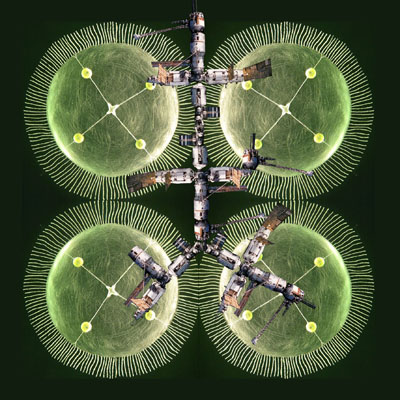
Colin Chapman (1928-1982) began modifying cars to use in competitions as early as 1948. This began with the Lotus 1, a modified Austin 7, and concluded with the Lotus 6. The early experiments gained public interest and with the production of the Lotus 6, (1952-57) Chapman was able to fabricate and supply kits for sale out of which Lotus Engineering was born. These early cars had a tubular space frame chassis and an aluminium body. The kits used parts from the Ford Prefect and were mainly used by privateers and enthusiasts for hill climbs and competitions. In 1958 Lotus cars produced the Elite for public sale as a factory built complete car (although this was also available as a kit). The car was innovative with the use of its load bearing glass fibre monocoque, had independent suspension all round and was low drag coefficient. The monocoque was advanced, but beyond the material technology available at that time it incorporated a bonded steel structure at the front to support the engine and bonded steel reinforcement in the body to support the doors. All bonding to, and junctions with the monocoque were never fully resolved. The car was expensive to produce, fragile and sold in low numbers (approximately 1000). 

The Lotus Elan and Elan +2 (1962-75) was the design of Ron Hickman (of Workmate fame). The Elan was the beginning of commercial success for the company and a master class in component design. Putting a purpose built body over inherited mechanical components is fairly straightforward. Creating a pure seamless aesthetic whole whilst incorporating windscreens, bumpers, lights, door handles etc. from the parts bins of others is far more difficult. The Elan design was beautiful, the engineering ideas revolutionary and as an example of applied design collage one of the most successful to date. The Elan was a collage of economic necessity. 

Key to the Elan concept was the 18SWG steel backbone deep box section chassis with Chapman suspension struts. It was strong, economical to produce and light at 75kg. This chassis would be used on the Elan, Elan+2, Elite and reversed to be use on the Europa. Further downstream the chassis would evolve for use in the Esprit. The chassis of the MG R-Type of 1935 may have inspired the Elan chassis but this was an all new revolutionary platform. The chassis has a V at either end where the opening of the V at the front houses the engine and at the rear the trans axle (Vice versa in the Europa). The car is light and nimble with a very good power to weight ratio (685kg /128bhp), the handling phenomenal with excellent cornering and braking ability and steady directional stability at speed.

Onto this backbone chassis would sit the Lotus GRP monocoque and a whole menagerie of components from Triumph, Ford, Alfa Romeo, MG, Wolseley, Hillman and others. The monocoque was fabricated in seven pieces and bonded together as one whole. The design of the monocoque is the outcome of various inputs including ergonomics, aesthetics, aerodynamics, structure, brand identity and styling. GRP is little more than a stiff glue, held solid in space, holding a three dimensional form that supports this collage of assorted parts. In the 1960’s art world high collage was the photomontage works of Richard Hamilton. In the design world of three-dimensional applied collage the Lotus Elan is hard to beat.


So was the Elan a good design? The answer has to be yes and no. It’s innovation, power to weight ratio and interior and exterior styling were all ahead of their time. Lotus’ work in Formula One influenced the design of the road cars. The biggest design fault was that the Elan chassis offered no side impact protection. The Elan build quality faults were in part a condition of the economically challenged 1970’s. It was a difficult time to start a company that sold motorcars. 

Lotus Elan and Elan +2 

Some of the parts that make up the Elan Collage

Alfa Romeo rear lights

Austin 1100 door handles

Ford Anglia front bumper +2

Ford Capri Front windscreen 

Ford Capri door window glass

Ford Capri brightwork

Ford Consul Corsair or & Austin Maxi transmission

Ford Consul Classic rear differential with a Lotus designed aluminium housing

Ford Kent 116-E four cylinder cast iron engine block with a five bearing crank

Hillman Imp drive shafts 

Lotus Harry Murray designed aluminium twin cam, two valves per cylinder, head

MGB interior door handles

Sunbeam Alpine filler cap

Triumph Heralds steering rack

Triumph Vitesse front suspension

Triumph Spitfire modified radiator

Triumph discs

Vauxhall Victor rear lamps (early models)

Wolseley Hornet modified, cut in half, rear bumper for the +2

Images left to right – 1 Picasso Bull, 2 Elan collage, 3-7 Lotus Elan.

The Surrogate Twin

Posted on

061216 – Lessons – London

​​​061216 – Lessons – London > words

Natures R&D

Mankind’s ability to produce and assimilate knowledge is increasing exponentially along with the products and technologies associated to this newfound knowledge. This has left many of the world’s population socially and intellectually displaced and has been a catalyst for the political unrest across the globe as people pursue popular political doctrines. This new knowledge is mainly used to create fiscal products and efficiencies that in turn increase pressure on global problems such as population and capital consolidation. Progress moves forward at ever increasing speed whilst not tackling the issues of priority urgency. The world’s ability to be able to support the human population is running close to maximum capacity, there is a requirement to slow down to buy time to better manage and direct future development. With access to plentiful resources and energy mankind has achieved via brute force, he now needs to achieve with balance a fully sustainable agenda that has scope for equilibrium and longevity. This will include a managed global fiscal/population, terraform earth projects that allow us to inhabit ever more extreme regions, a move to a fully solar economy and the beginning of space colonisation. Ever increasing computer power is slowly decoding the complexities of molecular and genetic biology. As our understanding of bioengineering increases our control over its uses and applications will increase. Initially this knowledge will be used to repair and prevent medical issues, gene strengthening will lead to gene splicing which in turn will lead to complete remodelling and genetic design for specific requirements.

Man still has much to learn from natures millions of years of R&D. To inhabit ever more extreme environs, including space, man would do well to maximise on nature’s millenniums of development. Perhaps at some point in the future man will take control of his own evolutionary path as he continues to adapt and evolve in relation to the ever more extreme environments in which he will inhabit. This short accumulative essay on the marvels of the natural world lists nature’s considerable achievements in living within extreme environments. The list has no particular order and will be added to as time permits. The purpose of the essay is based on the premise that humans living in extra-terrestrial environments will evolve independently from earth-based humans. The human species will split and diversify to accommodate the new imposed conditions of their chosen future environ. Science will enable and enhance the speed at which humans evolve through bioengineering, fine-tuning each human strain to its new or predicted environ. All life on earth is genetically similar as we have evolved and diversified over time from common ancestors. During the evolution process a multitude of natures wonders have developed unique and very specific skills many of which would be beneficial to increase the pallet of the human bioengineer. The list below begins to sample possible source traits.

Flamingos

Thermoregulation – The Flamingo thermoregulates keeping its body at a constant temperature regardless of the surrounding ambient temperature. This allows the flamingo to inhabit regions of severe diurnal range where day night temperature may vary from -30 to a day temperature of +40 °C. Using a system of counter current blood flow heat is efficiently recycled and not lost, extremities such as the long legs and large feet are highly vascularized and these can be used for either cooling or conserving heat. The body works as a heat pump so heat loss is minimized when the ambient temperature is cold and heat gain minimized when the ambient temperature is hot. A flamingo’s legs are primary heat conductors. It will stand on two legs when the ambient temperature is hot so as to aid heat loss and on one leg when wishing to minimize heat loss. The efficiencies gained through thermoregulation allow better use of energy during other activities such as flight where flamingoes have been known to travel up to 600km between habitats. Flamingos are also able to use evaporative heat loss methods such as, cutaneous evaporative heat loss and respiratory evaporative heat loss. Cutaneous evaporative heat loss lacks efficiency in hot dry climates due to moisture loss during the evaporative process. Respiratory heat loss, panting like a dog, is a more efficient method of cooling. The flamingo’s respiratory system, its long neck, trachea and membranes within the neck are all part of a sophisticated cooling system. 

Osmoregulation – Flamingos inhabit hyper-saline lakes with high alkalinity, often called soda lakes. They ingest food with high salt content and mostly drink salt water, whilst also being able to drink fresh water at near boiling point from geysers and volcanic springs. The flamingo desalinates this water with the use of its kidneys, the lower gastrointestinal tract and its salt glands, these work together to maintain the homeostasis between ions and fluids. Although salts from food and water pass through the kidney first it is dissipated via the salt glands in the flamingos beak. As such the flamingo is an organic water conservation and desalination plant.

Brown Bears

Many mammals hibernate, some much more efficiently than bears but the principles are the same for each. When food and resources are limited and environmental conditions harsh lowering ones metabolic rate conserves energy over prolonged periods. When the bodies metabolic rate is lowered the body temperature drops and the heart rate and breathing are slower. The hibernating body exists on reserves of stored fat built up before hibernation. Whilst hibernating bears are able to recycle their urine and proteins, this stops muscle atrophy and the need to urinate for many months. Bears also have cubs during hibernation and the cubs also hibernate until warmer weather arrives. If humans fully understood how hibernation works and how to induce it in humans this would have many uses including medical and space travel.

The Artic Wood Frog

Many insects, reptiles and fish posses a level of freeze tolerance but the Artic Wood Frog is the master and can be frozen alive. Up to two thirds of the frogs body water can be frozen and it will still live. When frozen, the Artic Wood Frog stops breathing, its heart stops beating and it can endure this state for many weeks with temperatures as low as -16°C. Upon thawing the frog returns to a healthy life. The Artic Wood Frog uses cryroprotectants that lower the freezing temperature of the animal’s tissue to protect its cells. Cryoprotectants include urea (usually excreted in urine) and glucose (blood sugar). Being able to freeze living human tissue without damaging cells would have immediate medical implications including its use for organ transplants. If humans could survive an induced frozen state this may be useful for space travel and space survival.

Microbats

Many mammals, birds and fish use bio sonar or echo-location. It is used for navigation and hunting.

Microbats such as Townsend’s big-eared bats are masters of echo-location. Man-made sonar is multi beam. Bio sonar has one point to transmit sound, the mouth, and two points to receive sound the ears. Bio sonar is extremely efficient at analyzing size, speed, distance and surrounding environments these can all be sensed using bio sonar with incredible accuracy, microbats hunting moths being one example. Microbats use sound waves above the range that humans can hear, ultrasound. For humans bio sonar would be useful for mapping, modeling and navigation.

Hydractinia

Starfish, sea urchins, the Mexican axoloti, newts, some lizards and frogs can all regrow body parts. Every species is capable of aspects of regeneration but this regeneration can be complete (total replacement) or incomplete partial replacement or repair where full or total regeneration is prevented by fibrosis. The salamander can regrow its tail but not its limbs whilst closely related frogs can also regrow their limbs. Sharks regrow teeth throughout their lives, something humans are unable to do, and deer annually regrow antlers. The planarian worm has impressive regenerative abilities, chop them into tiny pieces and each piece will regrow a body but a small marine creature the hydractinia can better all this and regrow its head. The key to regeneration is the retention of embryonic stem cells for life and it is possible that humans may have this form of tissue regeneration but it is genetically dormant. The embryo has the genetic structure to fabricate a body and its associated parts to maintain complete regeneration throughout ones life one would need to retain this ability at a cellular level. The bodies ability to fully self-repair would have immediate use wherever our future explorations may lead, however distant we are from the nearest hospital or donor bank.

Limpet teeth

Abalone shell, spiders silk and tooth enamel are all tough. Tooth Enamel is the hardest substance in the human body and is 96% mineral. Abalone shell an extremely hard ceramic composite (see entry 071116 Composites) made from platelets derived from chalk and glued together with an elastic protein. This combination of rigidity and flexibility gives the shell its unique characteristic and its strength. Spider’s silk is also a composite that combines the properties of two spun proteins. Spiders produce three types of silk each with a different purpose. Dragline silk forms the diagonal spokes of the spiders web, bridgeline silk the point of connection to the webs support and a third more elastic silk that is used to create the continuous spiral of the web itself. Dragline silk is the strongest of the spider’s silks and has a tensile strength of 1.3 GPa (gigapascals). Steel by comparison is 1.65 GPa but spiders silk is less dense and therefor much lighter than steel, so weight for weight spiders silk is 5x stronger than steel. 

Limpets are molluscs that spend most of the day scraping their food from the surface of rock with their teeth. Limpet teeth have replaced spider’s silk as the strongest organic material known to date. Limpet teeth have a tensile strength well beyond most alloys at 3.0 to 6.5 GPa. The teeth consist of a protein base interwoven with a tightly packed webbing of nanofibers made of an iron-based mineral called goethite. Like all of nature’s materials it is fabricated at ambient temperature from readily available materials. If we understood, at a molecular level, how limpet teeth are made (grown) we could make (grow) body armour stronger than Kevlar and perhaps eventually use that knowledge to build spaceships and space stations.

Barnacle Glue

Barnacles, a crustacean, have two natural larval stages, the first nauplius is common to most crustacean, it swims freely once it hatches out of the egg feeding on the plankton. The second cyprid larvae stage is unique to barnacles. The cyprid larvae searches for a surface that is exposed to water flow, either a moving surface such as a boats hull or whale torso or a surface within strong tidal flow. The cyprid larvae attaches itself to its chosen surface for the rest of its life and from here feeds on passing plankton.

Barnacles are fixed with an excreted cement. Most bio-adhesives consist mainly of proteins such as gelatin and carbohydrates such as starch. Barnacles adhere by first excreting an oily substance that clears the water from the rock or surface to which it wants to attach, it then excretes a phosphoprotein adhesive (a protein containing phosphorus). Proteolytic activation of structural proteins help bond the protein with other proteins and the chosen surface whilst transglutaminase cross-linking reinforces cement integrity. It is believed that this is similar to blood clotting so the barnacles cement bond is a form of wound healing.

If we understood exactly how the barnacle bonds we could adhere in moving wet conditions with an environmentally benign glue. If the bonding process was fully understood the reverse would be easily achievable creating surfaces to which the barnacle was unable to attach. This would have priority for ships where friction efficiency equates to more speed with less fuel consumption.

Gecko Feet

The Gecko is renowned for being able to climb vertical smooth surfaces such as glass, it can even hang inverted from such surfaces, and yet its feet are neither sticky or use suction to adhere. The gecko’s feet are a type of dry adhesive using millions of fine hairs as contact at a micro scale.

The gecko’s foot spreads wide for maximum contact with the underside of each toe having a series of ridges that are covered with uniform ranks of setae (fine hair). Each setae subdivides into hundreds of split ends with flat triangular tips called spatulas. A geckos’ satae is approximately 110 micrometers long and 4.2 micrometers wide. The spatula end is about 0.2 micrometers long and 0.2 micrometers wide. There are about 14,400 setae per square millimeter on the foot of a tokay gecko, over 3.2 million on its front feet. The geckos feet work by attraction and repulsions between atoms, molecules and surfaces. A molecule is a group of atoms bonded together, the smallest fundamental component of a chemical compound. Atoms consist of protons and electrons. Positive atoms are attracted to negative atoms and this is the basic principle of molecular bonding. The geckos’ feet do not bond as in the chemical description to a surface but use this attraction to grip. 

Human design application of this knowledge would include gloves, suits or any interlocking surface that needs an immediate on/off.

I will continue to add to this text when time and relevance permits.

The Surrogate Twin