Posted on

011019 – China Scale of Intent – London

011019 – China Scale of Intent – London > words

Empires have existed for millenniums. Squabbles over land and resources by various groups or tribes continue until eventually a dominant player emerges, subordinating its rivals and bringing order to a larger populace. To strengthen its resolve and maintain order it improves its armies. Once order exists, its armies are usually then employed on further conquest on land and resource acquisitions. Acquisitions are taken by force. Throughout time this has been the principle means of empire building, where the strong extort the weak. Subordination followed by resource drain of mineral, fiscal and human capital eventually consume all benefits of the acquired land mass and populace. The growing empire has to look further afield for new resources to acquire and exploit. This process continues until the acquired resources can no longer support the growing empire and the empire implodes and collapses returning again to smaller self-governed states. Empires acquired by force are short lived. The British Empire colonised in much the same way, with the stronger more technologically advanced nation controlling the weaker nations. British Colonial rule differed in that it partnered rather than dominated its colonies. The British Empire formed business partnerships with the indigenous elite using a countries existing controlling elite and structures to incite its order. The role was exploitive, but the countries also benefited from provisions of governance and infrastructures. An increased longevity was gained from this relationship.

The American Empire has been more subtle. Although American military power dominates every other nation by numerous factors, America was built primarily through the propaganda of media, its film industry and its adverts. The chief weapons were jeans, t-shirts and Coca-Cola, symbols of the good life obtainable within a commoditised world. Post World Wars, America not only controlled global debt, it also provided the majority of the goods that that borrowed capital could purchase. On this America grew very rich and the globalised world became Americanised adopting America’s clothes, its music, its eating habits, its skyscrapers, its finance and its governance. This was a new type of empire led by TV and media but without land acquisition. American military bases are strategically located around the globe within other nation states. America maintains peace and conformity through dominant presence rather than action, although when required they act swiftly and conclusively. American military presence lubricates global trade allowing resources to be allocated uninterrupted, a policed order. Markets are left to find their own natural equilibrium and are only policed when all else breaks down. An empire built by creating the desire for the American way of life and providing the commodities to fulfil such desires.

Empires grow slowly, the ancient dynasties of China, The Greek, The Roman, The Ottoman, The Habsburgs. These empires took hundreds of years to grow, to mature and eventually fade. Businesses took multiple generations to become fully established, The Rothschild’s, The Morgan’s, The Rockefeller’s, The Ford’s, for these industrialists and bankers it took a considerable amount of time to grow their businesses. The grandfathers of modern business, as of 2019, Apple and Microsoft are respectively 43 and 44 years old. Amazon (25) Google (21) and Facebook (15) are in their teens or early twenties. These businesses have incomes beyond many smaller countries. Empires today like businesses grow quickly. The American country can be dated from the Declaration of Independence 1776, but the American Empire is really a post war phenomenon putting it in its mid-seventies. Perhaps this stretches one’s interpretation of empire, as traditionally we consider empires within contained perimeters. We think of the world map painted pink under the British Empire, strict locations with enforced borders. The American Empire is an empire of influence. Its borders are not fenced, they are not straight lines, thresholds between inside and outside. They are not best represented by Trump’s Mexican wall. Its boundaries are permeable, they overlap and bleed into other sovereign states and cultures. It grows as its influence grows by its rate of adoption. The modern businesses listed above are also without borders permeating all aspects of societies and cultures. What empires and businesses have in common are the infrastructures that facilitate their adoption.

Networks, the control of the infrastructures and gateways are key to building any business or any Empire. Whether they were the Minoans or Phoenicians controlling the Mediterranean shipping routes in the second millennium BC, the Venetians controlling the silk and spice gateway connecting The East to The West in the fourteenth Century or the British controlling the shipping routes in the eighteenth century. All these conduits of communication facilitate trade and allow their owner to generate a rentier income from their use. America grew its commodity focussed empire through the use of magazines, radio and TV encouraging free global trade whilst all protected by numerous discreetly located strategic defence ports spread across the globe. These trade networks, when they function smoothly are often an invisible occurrence on our everyday lives. Today these infrastructures are best exemplified by the networked logistics of companies such as Apple and Amazon that make commodity culture so effortless with click to door retailing. To enable the ease of search engines, like the abilities of autonomous driving, require huge amounts of input for them to function and considerable hardware to enable procurement and delivery.

China, once the greatest empire on earth, lost out to The West through inward looking and protectionist policies. At the dawn of the Enlightenment and as the following Scientific and Industrial Revolutions took off in the West, China was left behind, losing its lead through two hundred years of stagnation. China as we all know has been catching up. Slowly at first from the 1970’s but everything changed from 09.11.1989 onwards with the fall of The Berlin Wall. China’s change of speed has caught the West off guard. Immense capital allocation delivered with direction and focus has grown China’s GDP an average 15.8% every year for the past 32 years. China was the fifth largest economy in the 1950’s sitting just above India but now sits second only to the US. China is building its new empire. Its ambition started in the 1970’s but its growth began from 1989 making the upcoming Chinese Empire barely thirty years old, younger that Microsoft or Apple and yet it is growing at such a phenomenal speed and its ambitions are truly global. The upcoming Chinese Empire is growing not by conquest but by controlling integrated networks. China’s hardware, the huge infrastructure and gateway projects and its software, the purchase of existing businesses and patents whether in part of in full, a controlling and influencing proportion of global businesses. The rights and wrongs of empires are for history to judge, it is their actual strategy and procurement, their engineering and governmental achievements on route that are of interest here.

The Belt and Road Initiative, BRI – “Purpose – to construct a unified large market and make full use of both international and domestic markets, through cultural exchange and integration, to enhance mutual understanding and trust of member nations, ending up in an innovative pattern with capital inflows, talent pool, and technology database” (Wiki) 

BRI – To create a market and build trust. This over simplification fully exaggerates the difference between an idea and the delivery of that idea. ‘To create a market and build trust’ translates to the largest global infrastructure project in world history. The delivery of which requires strategic, financial and engineering expertise at scale previously unprecedented.

China is looking to establish a new Middle Kingdom and become the dominant state in the Asia-Pacific region. To achieve this China needs to develop an educated middle class, it needs resource security and it needs to export innovation as noted in the points below. 

1 The transition from a rural to a consumer-based society

2 To increase high quality imports

3 To invest abroad

4 To innovate and develop 

In 1990 China was still largely a rural country with 75% of the population living in the countryside. Today half of China’s population are urban city dwellers. As China has opened up from a communist country of the 1970’s to a capitalist-communist country in the 1990’s the economic development has increased inequality. Educated early starters have been able to increase their economic lead over the adapting rural class. China has set up a strong educational policy with emphasis on maths and sciences and is now a world leader for the standards achieved at maths at secondary level. Asia are world leaders in academic achievement with China, Korea and Singapore leading the way. Education is key to growing both a middle class and a consumer-based society, lifting living standards across the country whilst creating liquidity for the internal markets through increased disposable income.

China has long been the factory of the world, where labour, prices and margins were all low. It grew its reputation by making other people’s goods at a fraction of the price. As China’s standard of living improves its labour prices also have increased and China now needs to move on to produce higher margin products. Increasing quality imports educates the consumer, it sets new consumer product standards and increases government revenues through churn and taxation. To improve liquidity China needs to make the transition from a country of savers to a country of spenders. Imports are also a means of international negotiation and trade. Buying from other countries wins friends and partners which are required to grow a network. Although imports will inevitably be replicated via the internal markets.

Since 1980 the industrialised world has been underinvesting in transport related infrastructure, instead seeking an export (commodities and services) orientated development model. China has pursued an infrastructure development strategy, at first at home and then by creating physical links with future trading partners. In so doing China has developed expertise in both infrastructure investment finance and in engineering and project procurement. The BRI may well be a means by which China intends to extend its influence at the expense of the US, as the two superpowers, old and new, go head to head. However, the ancient Silk Roads just like the BRI were never just Chinese, roads never travel in just one direction. The US has been the world’s largest national economy since 1871. Its 2019 GDP is forecast to exceed 21Trillion USD. In 1978 China was the ninth largest economy with a GDP of 214 Billion USD, in 2019 it was ranked second with a GDP of 9.2 Trillion USD.

China has been heavily investing abroad especially to secure resource commodities and raw materials. It has often done this in Third World countries by offering infrastructure expertise, finance and development in exchange for long mining leases. The Third World countries get ports, roads and railways for allowing China to dig in their back yards. China gets the resources it needs and much of the infrastructure it builds as payment for the leases it would have had to build anyway to shift the resources, yet for both sides this is still a win-win deal. Securing copper, iron-ore, lithium, coal and oil means that China’s development remains uninterrupted. China’s currency is pegged to the dollar and commodities trade in dollars, so investing in resource security also cushions dollar price swings.

Made in China was once a euphemism for a low-cost poor-quality copy. China is now spending money on R&D and innovation. Developing high quality products and patenting its innovations and IP. This will be a huge transition from poor quality copy-cat products to a world innovator. China is already a world leader for solar panel and wind turbine design. It also now manufactures more cars p.a. than the US and is now second only to the US in its annual output of scientific papers and its supercomputing capability. A less regulated Chinese market also allows for increased research into genetics and bio-engineering. China is a secretive country and there is much going on in the background away from the western press. This is conjecture but one should expect China to throw some surprises into the space race within the very near future.

For China, there will of course be internal friction, any empire that grows this fast will leave many behind. Access to the net combined with the leverage of globalisation means that the difference between the haves and have-nots will at first be extreme and this could create internal social and political conflict. China has strong governance and the people of China have a strong autonomous national identity, so lengthy internal conflict, even with the recent Hong Kong riots, is unlikely. China will also be aware that they were once world leaders and were reduced to an opium den in colonial servitude, a world third class citizen, from which it has taken 200 years to recover. Collectively their sights are firmly set and set very high.

As an upcoming nation state China has little competition. Its huge territory and population are considerable assets. Imports are a short-term fix as they will soon be replicated by the internal markets. It would seem unfortunate that the Chinese have rushed to emulate Western Imperialism grown on energy hungry, finite resource exploitation. In 2009 China consumed 46% of global coal production and similar percentages of aluminium, copper, nickel and zinc. A consequence of this rapid development has been China’s high level of ground, water and air pollution. A slower strategically better planned development route may have avoided all of these issues, prevention is always better than cure. There are also many aspects of Western culture that would be best edited out. Post war global values have become Americanised. In a commodity culture, possession is valued over ability, ownership over education, emphasis on the winner takes all. Excessive consumption and disposable consumerism have given us a materialist Bling culture, huge wealth discrepancy, obesity and environmental degradation. Western Scientific Enlightenment gave us a homocentric concept of our world and this we have practiced for 400 years. Today the planet desperately needs a Gaia-centric model. It would have been a far more progressive goal to have seen China lead the way to achieving this as the planet does not need a ‘more of the same, business as usual’ approach. It is time to change and the next Empire needs to lead the way. 

Fundamental to China’s ambition is the Belt and Road Initiative. The BRI was set up in 2013 although its steering committee was not announced until 2015. The Belts are overland corridors and the Roads are maritime shipping lanes. The BRI has been compared historically to The Silk Road and Maritime Silk Road that connected The East to The West throughout the late middle ages. The BRI is far more ambitious and is nearer to the protected shipping lanes, ports and infrastructure that was set up to build the British Colonial Empire. The BRI is truly global in ambition and influence, it eventually will have developments and investments in 152 countries and a target completion date of 2049. The BRI will be the largest infrastructure project in world history. The project consumed 40% of China’s GDP in 2017. The project tries to address the infrastructure gap between the developed and the developing worlds and in so doing improve trade links and create markets.

The North Belt moves through Central Asia and Russia to Europe. The Central Belt passes through West Asia to the Persian Gulf. The South Belt runs from China to South East Asia to the Indian Ocean and Pakistan. At the same time the 21st Century Maritime Silk Road, a sea route corridor, crosses the South China Sea, the South Pacific Ocean, the Indian Ocean, the Red Sea and via the Suez Canal on to Europe. There is further an Ice Silk Road, a Northern Sea Route in the Artic and a Super Grid that will develop high voltage electricity across the whole of the Asian Continent.

Since the 1980’s Asia and Eastern Europe have pursued export orientated strategies, this has created an infrastructure-based development expertise in bridges, roads, tunnels dams, airports, ports and high-speed rail. These are Chinese Mega-Infrastructure projects. In comparison, during the same period, the industrialised world has underinvested in transportation infrastructure.

The BRI achievements to date are impressive, from its concept in 2013, through steering committee 2015, to procurement as of 2019, this is only six years. It is already the largest infrastructure and investment project in history, it covers 68 countries, 65% of the world’s population and 40% of the world’s GDP. It has been difficult to write a text about the BRI without simply writing an endless list of projects, this would be both tedious and beyond the remit of this essay, an abbreviated list however is required to give an idea of the scale and scope of these projects. In Africa – Djibouti the BRI has provided a new port and an international airport. In Ethiopia, completed in 2015, 750 km of standard gauge railway line, connecting Ethiopia to Djibouti. In Kenya, completed 2014, 470 km of standard gauge railway. In Nigeria further railways and the facilities to access satellite TV across 10,000 African villages. In Europe The China-Britain route launched in 2017 and as of 2018 connects 48 Chinese cities with 42 European cities. This line was extended towards Vietnam in 2018. In Russia the China-Belarus Industrial Park covers 91.5 sq. km. There is a 140 km high speed rail route in Indonesia commenced in 2016. In Laos a 414 km of railway project began in 2016. In Malaysia new rail and pipeline projects have begun. There are further projects and ports in Pakistan and Sri Lanka. In Thailand, solar parks, industrial Parks and a high-speed railway have all begun. There are two Hydropower projects on site in Argentina and numerous economic and infrastructure agreements have been signed with other countries with projects waiting to come on line. For example, instant port cities Bagamoyo, Mlingotini, Sihanoukville, Colombo, Kyaukpyu and Gwadar, Inland instant cities, Khorgos, and further railways planned for Thailand. The huge scale and scope of these projects is difficult to comprehend. Many of the above countries didn’t even have standard gauge railways let alone high-speed rail links. All of these projects move freight and people to and from China and the projects are financed by long-term Chinese loans, a very similar strategy to Post War American Imperialism. The difference is that these have all happened within the last six years.

The Karot Hydropower Project in Pakistan is typical of the agreements. The $2B project is funded by China’s Silk Road Fund and developed by The Karot Power Company which indirectly is a subsidiary to China’s Three Gorges Corporation. Upon completion The Karot Power Company will run and maintain the project for thirty years at a pre-agreed tariff rate. At the end of the thirty years the hydropower project will be transferred to the Punjab government. The project is a lease with a guaranteed return minimizing the risk for both parties but the primary beneficiary are the Chinese. There will also be collateral business opportunities during the thirty-year management period where both the Chinese and Pakistan businesses may benefit. The Chinese have been accused of Neo Colonialism and Debt trap diplomacy for many aspects of its BRI projects but this is not so dissimilar to America’s silent Empire building in post war Europe and Japan. The BRI has been called the Chinese Marshall Plan. In both the above cases at the time of the agreements, this was the best win-win solution. Could Pakistan afford a $2B hydropower plant without outside finance and expertise? Pakistan is better off for the next thirty years with a reliable energy supply upon which it could establish economic growth than it would be without this aid. Pakistan has a growing middle class. Two thirds of its population are under thirty and it is the fastest growing retail market in the world. China invests in links that can help access these markets and into which it can sell its goods.

Additionally, China benefits through these schemes from its excess capacity in the mainland, creating new markets for its goods. In Sri Lanka when the government struggled to make the repayments on the Hambantota port as payment the Sri Lankan government leased the port and 15,000 acres of the surrounding land back to the Chinese company for 99 years. This is a kind of land grab and territorial expansion that worries many of the neighbouring countries and is cause for political concern. Any port that can house and trade goods can equally be used for military purposes. There is now a Chinese military base at the port of Djibouti and one would expect others to follow to protect Chinese investments and assets. The BRI is not only about road and rail, hard infrastructure projects it is also about striking legal agreements on conditions relating to loans. There is then a soft infrastructure being put into place where China can exert its influence. 

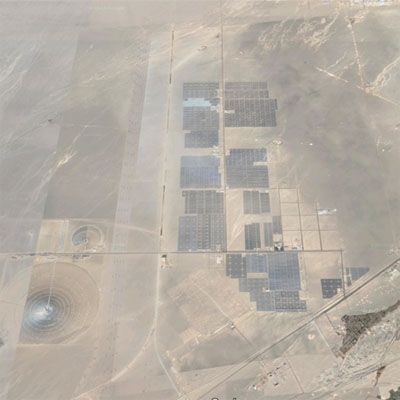
At home China’s energy infrastructure is undergoing a profound transformation. Early growth was fuelled by oil and coal power stations, too quickly set up and poorly executed, causing well publicised pollution within its cities. To counter this China’s new energy mix will include 110 new nuclear power stations due for completion in 2030. Off the coast of Jiangsu province, the Three Gorges Sea project, due for completion in 2027, will be the largest off shore wind farm in the world. On a Tibetan plateau, in the Qinghai province is the world’s largest solar park. New hydroelectric projects include the 16,000 MW Baihetan Dam in Sichuan province due to open in 2022 and the Suwalong project on the Upper Yangtze River, its dam is 112m high and it is due for completion in 2021. To ensure that all of these renewable energy generators work continuously and at their most efficient five new pumped storage power plants are currently under construction and all of this is integrated into a new national grid. Some of China’s scheduled infrastructure will not be seen by satellite, several highspeed rail tunnels are due for completion. The Zhoushan and the Taihu tunnels are subsea tunnels that will allow trains to travel at 250 kmph. The Bonhai high speed rail link, under the Bonhai Straight connecting the cities of Dalian and Yantai will be 123 km long and in places over 70m deep. It will be over twice the length of the Channel Tunnel connecting the UK to France. Not all tunnels are for trains, a 1000km tunnel will carry 15 billion tonnes of water p.a. from the high wet plains of Tibet to the dry densely populated Xinjiang province.

China has 20% of the world’s population but only 6% of the worlds fresh water, further, most of its water is in the South and not in the North. China has built the South – North Water Transfer Project, three canals that together move 45 billion cubic meters of water from the Yangtze river in the south to the less fertile regions of the North. These canals are also used for shipping as part of the BRI. Along its rivers China has 22,000 large hydro-dams half of the global total, each dam has an upstream and downstream consequence. Large rivers often flow through several countries. New China Hydroelectric dams on the Mekong have caused issues with five poorer countries that rely on its water and fish further down-stream. There will be continuing issues with the scale and speed of these infrastructure developments. China is set for further growth and territorial/market expansion. The Chinese government provides the infrastructure to allow development and then floods the markets with billions of dollars of cheap loans encouraging entrepreneurs and business. This push for market capture that has continued for the past three decades will not slow any time soon.

China, is a member of the Paris Climate Agreement. China is both a world leader in the take up of renewables but it is also the world’s leading polluter, its fossil fuel emissions exceed all of Europe’s combined. Most of China’s carbon dioxide emissions come from burning coal in new power stations to generate electricity. Many new coal-burning power stations have yet to be finished just as the rest of the world is closing them down. As part of the BRI infrastructure projects China has set aside $30bn to build coal-fired power stations in other third-world countries, including Pakistan. The world can ill afford more CO2 emissions being released into the atmosphere especially from countries where lower levels of regulation allow very inefficient and highly pollutive burning of coal. 

The environmental consequences have been made worse since 2017. Under president Donald Trump, America’s withdrawal from the Paris Agreement, America’s trade war with China, the recent Hong Kong riots have all diverted China’s attention away from green initiatives. In 2018 all subsidies to solar and wind generation were dropped without warning and investment in these industries have shrunk 39% so far in 2019. In the mean-time the use of coal as a cheap and convenient option has increased. The short-termism, the rush to build empires sacrifices the long-term prospects both of China and the planet. The British Empire consumed, wasted and polluted through ignorance and primitive technologies. The American Empire consumed, wasted and polluted, through greed, self-obsession, power, control and wealth accumulation. The Chinese have the chance to take a new strategic approach and not to follow the errors of others and previous empires. The world no longer lives in ignorance, we watch by satellite and monitor daily the continued destruction of our planet. We are fully aware of the consequences of what we are doing and yet still ‘business as normal’ proceeds. When this approach is taken by an individual it is shameful. When it is taken by a great nation in the process of building a truly global empire it is unforgivable and the damage caused will be irreversible. The ambition, engineering and funding achievements for the BRI are extraordinary but the scale and speed of these projects, that focus solely on economics, have huge international environmental impact. Each infrastructure project, carried out in whatever country has an immediate environmental consequence. Infrastructure by its very nature generates further development along its lines of communication and this sets up huge areas as future development zones each with a further environmental consequence. The planet is a finite resource that we all share and is already over populated, projects of this scale will encourage further population growth and should be of international concern. For the rest of us mere mortals all we will be able to do is watch and monitor our forever changing planet by satellite.

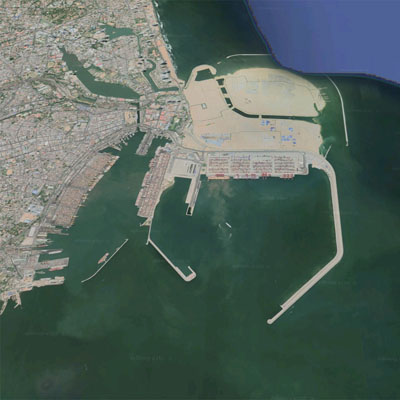
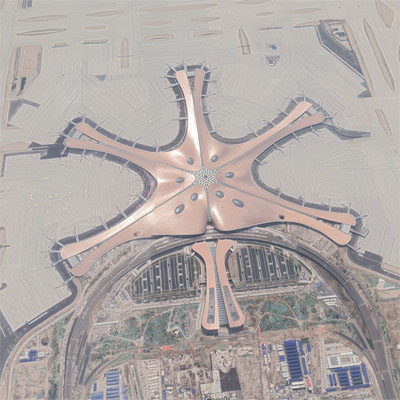
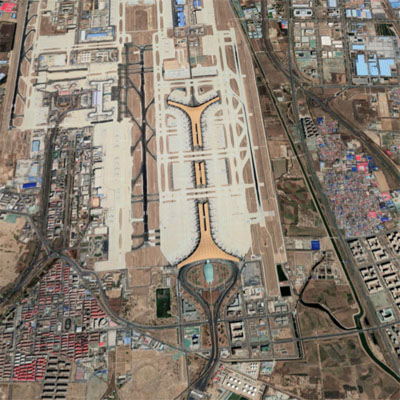
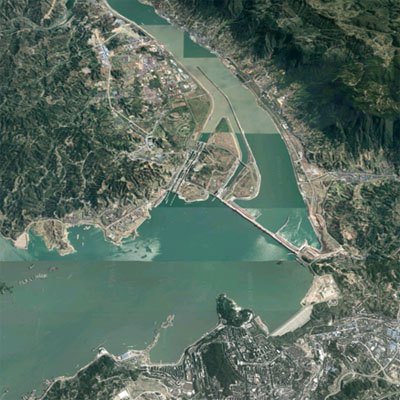
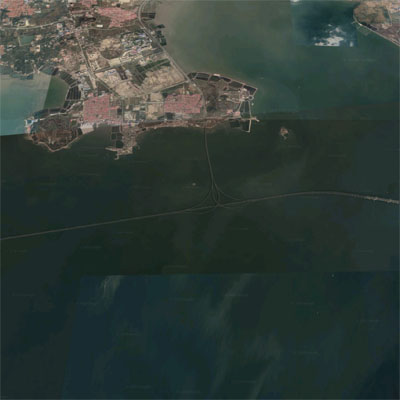
Many of the BRI projects are utility projects that have little architectural or cultural quality, elementary roads, bridges and railways. I have selected images of projects that can be viewed via satellite to show their scale and that also offer quality design. All images are from Google maps, which in itself is an incredible resource for watching and supervising our planet.

1. Columbo Port City, Sri Lanka

2. Beijing Daxing International Airport by Zaha Hadid Architects

3. Beijing Capital International Airport by Foster and Partners

4. Shouhang Dunhuang CSP and Solar Park

5. Three Gorges Dam

6. Haiwan Bridge, Jiaozhou Bay China

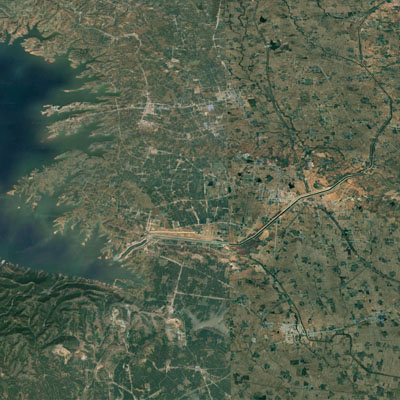
7. The Danjiangkou Reservoir and Canal, South to North water Diversion, China
Posted on

280219 – John Hejduk – London

280219 – John Hejduk – London > words

The 60’s rode the wave of post war euphoria filled with youthful optimism and confidence. The Wars were over and out of the rubble a new world would be built. Music culture had made many young working-class extremely rich, they found themselves in the position to be able to buy up the large country estates of the now cash-poor landed gentry. Times they were most certainly ‘a changin’. Architecture and design quickly followed suit, with large urban commissions such as the Pompidou Centre going to young inexperienced and unheard-of architects. New fashion designers sprung up to capture the ready-made markets selling groovy clothes in loud colours and man-made materials. Everything seemed to be going fine but there were many hidden problems that were soon all about to unravel in the 70’s.

The Vietnam war had continued throughout the sixties, as had the Cold War. By the late 60’s and early 70’s both these wars had lost the popular vote and the Peace and Love movements displayed active resistance. These wars had minimum disruption on the global economies but this was about to change when the Middle Eastern conflicts of the mid-70’s deprived the developing world of the one resource that it could not do without – oil. Markets crashed, industry stagnated, welcome to the world of the three-day week, mass unemployment, garbage stacked six feet high on city streets, power cuts in the developed world and union and political chaos. With no money, contemporary culture made do, making clothes out of rags and songs out of two chords and spit. Punk was on the streets and in the shops. 

The academic world reacted differently to the chaos of the mid-70’s. The big machine of the Modern Movement had failed. The pre-cast concrete towers were now slums, and were soon about to be felled. The machine aesthetic, a bland clean ergonomic production was no longer enough. Corporate culture itself was questioned, perhaps it had led us all astray, it had already left many behind. There was a search to start anew, a naïve poetic, a reaction to the global industrial machine, both to its products, its finance and its philosophy. This was the beginnings of the Postmodern and Postmodern representation, it looked for meaning through semantics and narrative, for the sensorial through colour and form and it looked for the emotive through typology and juxtaposition.

The emotive was an awkward concept in the late twentieth century where rationalism and logistics dominated the manufacture of most goods. It had a Freudian childlike quality. Words such as melancholy, anxiety, profound, romantic, morbid, feverish, voluptuous, prosaic, banal, spectral, oppressive, exuberant, have little currency in the logistics of construction. Yet these emotive states were missing from much of Post War international design. They were part of a language that had been lost, we no longer knew how to read it or see it. To explore and to communicate these emotive states one needed to begin again, to go back to basics, the child’s crayon drawing where all is simplified, flattened and without scale. A dreamscape of how things should be as opposed to how they actually are. 

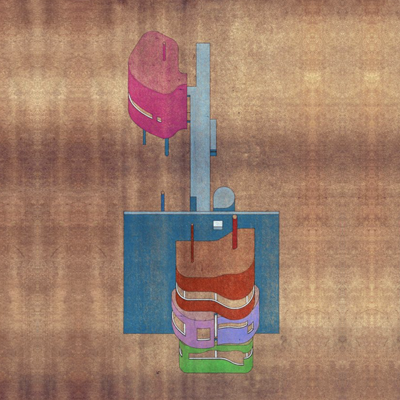
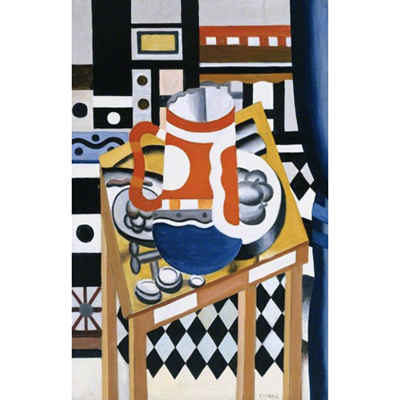
Dreams are fragmentary, they reference through juxtaposition, they are often without context, they are idealised virtual worlds which we are able to inhabit without conflict or rule. Their conception comes not from the rational but instead from the other worldly. The later drawings of John Hejduk explored these phantom places. Inspired by dreams and memories, dislocated from context and reassembled as metaphor. The architectural work from the early 70’s compares compositionally to that of the paintings of Ferdinand Leger becoming more surreal like the sculptural work of Le Corbusier. They form a dreamy landscape where all is possible, where the rational world no longer exists. Hejduk’s break with the architectural functionalism of the time did not revert back, with a nostalgia for an architecture of the past but instead from within, personalised and esoteric, a collection of incidences, incurred and recalled. The work of Hejduk spans many years and these are framed by time. Recalled experiences from within each time frame are the raw materials for assemblage. Each time Frame is several years. 

In the early work there is also an ongoing conversation between the biomorphic and the biotechnic. These are two terms used by Hejduk to describe man-made and machine-made forms. But these are also metaphors, representing the emotive, hand sculpted forms in search of the sensorial and the rational of the logistical forms of the International Modern. Curvaceous forms are used for the biomorphic and grids are used for the biotechnic. The work can best be described as a tentative, uncertain laboured struggle, a long walk in the dark. The early work up to time Frame 2 manipulates the grid. The grid in terms of architectural language is an abstract. It has no predetermined or proportional scale, it has no up or down, it can be fully rotated in 3D and is an infinite system. By manipulating the grid, the abstract can be pursued as a formal system, a form generator in its own right. By time Frame 3 the biomorphic is inserted into the grid enclosing fluid transitional and activity spaces. There is very little compositional rapport between the biomorphic and biotechnic, a curved line in plan is extruded to enclose a particular volume. There is not the juxtaposition of ritualistic to abstract spaces that can be found in the work of Michael Graves of the same period. The resulting volumes enclose by Hejduk’s biomorphic forms house activities and not rituals and they are very much an insertion. Towards the end of time Frame 3 the curved forms begin to take over from the grid, this Frame also continues from the late 60’s into the early 70’s.

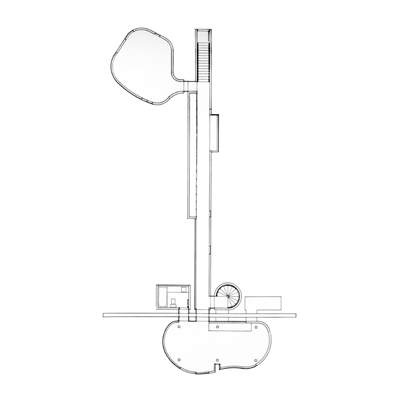
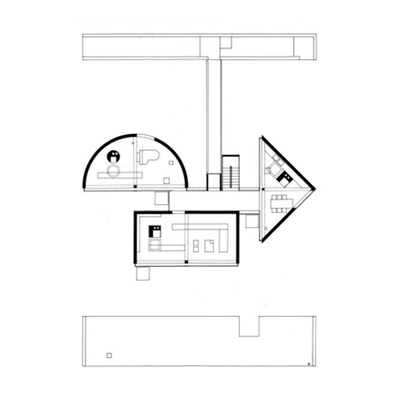
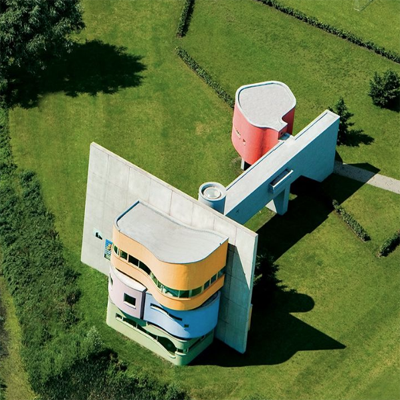
In the work of Hejduk of the 70’s the biotechnic has become subservient to the biomorphic but now a third component has entered the conversation and that is the wall. The wall is considered as neutral, painted grey, a thin membrane through which a discourse exists, it is described as a thin momentary condition. The wall has no functional purpose it is simply the initiator of a conversation. The wall sets up a condition on the site around which the spaces can begin their dialogue. Spaces become grouped, living, bedroom, circulation, and then become separated from each other, elongated journeys, pushed out into the site. Each space develops its own language, they soon become identifiable individual objects, the staircase, the space, the corridor, the wall, and are assembled sculpturally. The houses sit as sculptural objects in the landscape, but architecture is experienced through movement and time, a series of experienced fragments. Here the Hejduk buildings are very much like the compositions of Leger. Each individual component has a recognisable use or point of reference but the assemblage re-phrases conventional understanding.

It is interesting that the work of the New York Five, Eisenman, Meier, Graves, Gwathmey and Hejduk were each exploring architecture’s semantic role post International Style. Eisenman and Meier continued to explore the mathematical abstract as a means of space generation, although Meier’s buildings were always very site specific. Graves began to re-incorporate traditional ritualistic spaces into the abstract grid, typically kitchen and central fireplace rituals. Graves eventually turns to historic referencing with classical Postmodern. Gwathmey and Hedjuk try to reinvent architectural language from scratch using either pure or biomorphic form (Hedjuk) or by re-assembling recognisable typological architectural components (Gwathmey). The work from this group during the late 60s and very early 70s was incredibly potent, stimulating many of the Postmodern architectural dialogues that were pursued through the late 70’s and early 80’s. Meaning, Language and Local, being key to the enrichment of architectural and design dialogue through to the 90’s.

Hejduk’s works stands out from the others for its simplicity, perhaps even its naivety, as a generator of form, the emotive, the recollection of a dream, a feeling, a personal experience by definition. The subject of the conversation, the architectural language post International Style has historical relevance but by personalising the response Hedjuk’s work was a cul-de-sac to mainstream architectural discourse. Hejduk’s work quickly moved on, his later experiments were even further removed from modernism with his use of typological reference. In these, preceding building types were caricatured, e.g. wind tower, water tower, bell tower. When no precedent typology exists, a new type is invented e.g. House for a Musician. The language of this Typological referencing is simplistic and mono syllabic. The whole object is the reference signifier, it does not break down into further semantic components, as time has yet to invent or agree these. The work is more in tune with the that of Aldo Rossi and Bruno Minardi and as such recalls the empty and melancholic landscapes of De Chirico. With this work the Postmodern is an historical invention explored by the generations that had deliberately, and for good reason, forgotten how to think historically.

Hejduk’s works falls into the transition phase between Modernism and Postmodernism. It ignores the established conventions of The International Style and Functionalism and searches for a new means to communicate, through content and metaphor. The simplicity of its language and its use of assemblage make it easily accessible. The work has a poetic charm, it’s escapist, fragmentary and non-site specific. The compositions are idiosyncratic visions, spawned from the consequence of a chance meeting or event from years gone by. These visions inspired perhaps from yesterday’s dream or elements recalled from that scrapbook we call memory, a collection of cinematic intensities that linger forever in the back of one’s mind. Together these fragments help shape who we are, they shape our character, our purpose, and for Hejduk they shape his buildings. 

Hejduk describes the wall in his compositions as neutral and grey, as such perhaps, the wall is supposed to form the background in the same way as the flattened collage of wallpapers fill in the background of many cubist compositions. Perhaps the wall was a necessary framing devise, a back drop or enclosure for composition. Perhaps the wall was a necessary structural means to allow the compositions to ride up the picture plane in denial of perspective and in support of the flattened three dimensionality of the axonometric. However, Hejduk’s work tends towards metaphor and the elements in it are read as such. The wall read metaphorically is a long way from neutral, it cuts the site as clean as any cut of a Samurai’s sword. Figuratively elements form this side of that, neither both and this is ruthless, without exception. However, in space time the wall is almost invisible, a mere moment of the present, a crossing barely 200mm wide, inconsequential. 

In Hejduk’s work, if one were trying to interpret metaphor to read meaning through composition, or to speculate on what drives the mind of the architect, the wall would be a good place to start but I doubt the answer would be either neutral or grey.

Images

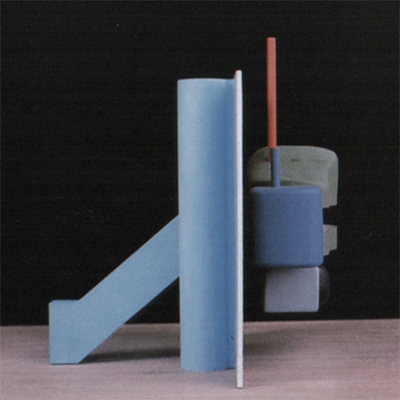
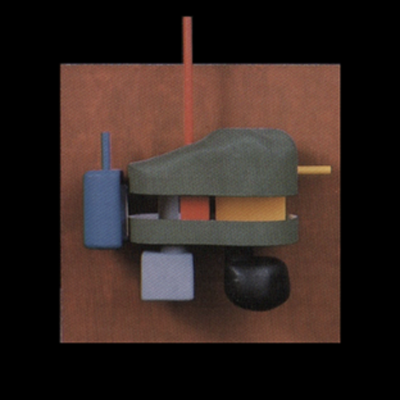
1. Wall House 1973

2. Drwg Wall House 1973

3. Plan Wall House 1973

4. Half House 1968

5. Leger Still Life with Beer Mug 1927

6. Cemetery for The Ashes of Thought 1975, Side Elevation

7. Cemetery for The Ashes of Thought 1975, Front Elevation

Posted on

090119 – Teatro Del Mondo – London

​​090119 – Teatro Del Mondo – London > words

“The Modern Movement originated as a great pluralistic program attempting to rectify the spirit of the time, the Zeitgeist, catching in its initial stages in the different cultural realities of the European and American horizons. After thirty years of free experimentation, (Art Nouveau, Protorationalism, Expressionism, the modern classicism of Behrens, the creative eclecticism of Sullivan and Wright) the Modern Movement beginning in the twenties, tended to translate into a set of constraining rules, into a real orthodoxy, three fundamental dogmas:  the functionalist analysis  – as a starting point for architectural research;  the annihilation of the traditional grammar of architecture – with all its differences corresponding to places and civilisations;  the identification between architectural progress and the use of new technologies  – understood as potential generators of language.

The above quote from Paolo Portoghesi’s “The Fear of Heresy”, best surmises the convergence of the Modern Movement from the many reactions to the consequences of the Industrial Revolution. The three fundamental dogmas outlined above in turn become the basis for Post Modern reactions at the beginning of the Electronic Revolution. These reactions have in themselves been pluralistic, evoking eclectic exercises in classicism, semiotics, structuralism, de-constructivism, formalism and sensorialism, manifesting in a resurgence of the figurative, the fable and the myth. The Post Modern as a generic all encapsulating term used across many disciplines from literature through art, fashion, music, film, dance, design and architecture has been a period of reappraisal. The poetic, the narrative, the tactile, the referential and the metaphysical have all been explored to escape the formulaic and the authoritarian. Many of these reactions have been explored by individuals practicing in artisan studios or have been tested in the Universities around the world. Much of the work is collagist with the Electronic Revolution aiding easy access to other disciplines and cross-pollination of influences where working methods have proved a very progressive experimental environment for all disciplines. Out of this petri dish come exercises in the unimaginable, breaking the shackles of science and production to venture into the minds where fictive possibilities blend seamlessly into the real.

Memory

It is impossible to be Italian without also being nostalgic. The memories of past great civilizations whisper along the streets and cobbles of every major Italian city. Typological icons invented by The Roman Empire, The Powers of the Papacy and The Renaissance adorn many Italian city center’s and are echoed across the world as copies of copies reiterated throughout time. From this the Italian architect sees the city as a great vessel, a carrier of history and memory. Nostalgia is metaphysical, a pathway to romantic interpretations of happier and simpler times, times of clarity and order, of truth and virtue, where the sublime and the theatrical are emphasized over the pragmatic or syntactic. The great typological icons, the temple, the coliseum, the galleria, the arcade, all back drop the piazza with its on-going theatre of life. Memory, the psychic vapor that oozes from every faded fresco, eroded stucco and crumbling frieze fills the streets with an invisible but perceived memory mist. The picturesque is the Italian city, it physically exists, it is no longer the painting, it is a physical living, working, reality. The Italian courtyard, the balcony house, washing lines hanging over narrow streets, the loggia curtain flapping in the wind, the silent figurines, all bear witness. The statues, histories spectators, have watched and recorded all that has walked before them, hundreds of years of monumental events, Iconic moments that shaped the narrative that in turn became the country and its people. The echo never stops, every street whispers to the next – I was this, I did this, I am this – a relentless schizophrenic, multi faceted ghost upon a ghost. 

The Italian city can be seen as a receptacle, an accumulation of collective and individual memory. The city derived from the analysis of political, social and economic systems drawn upon by the ruling class at each relevant time, a perpetual re-concluding product. But the city can also be seen as a spatial construct, with individual responses that are an additive to an on going ‘histoire’. In each interpretation the narrative dominates, leaving its traces, its reveres, layer upon layer. The onward fight against the inevitable conclusion that all invariably returns to dust. The crumbling, the exfoliation, peeled and scrubbed, returned to its former glory only to slowly return back into the ground to be carried as dust in the wind. The empty piazza, this negative volume is a forum for reflection, a time traveller’s portal to previous worlds. This void, walled perhaps with a Fifteenth Century Town Hall, a Sixteenth Century Church, a Nineteenth Century Galleria, all punctuated with statues from every century and from many lands. At the piazza’s center a fountain what better way to represent ongoing life, here water cascades timeless and continuous through every century over dropped lover’s coins carrying their wishes and dreams of better things to come. This is the living tapestry of the Italian city.

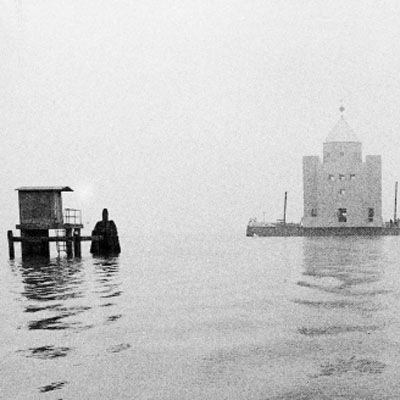
As Venice sinks slowly back into the sea where better to explore memory and nostalgia by emphasizing the ephemeral, that even the monumental is ephemeral. The Theatre, an iconic symbol of every city, a typological giant among a cities many monuments, the Theatre that confirms a cities success, its solidity, security and culture. Rossi takes the typologically monumental and to set it adrift on a barge to visit the sinking city. The theatre here is a player that plays its part with its exits, entrances and scenes. During its short life the “Last scene of all, that ends this strange eventful history, is second childishness and mere oblivion, sans teeth, sans eyes, sans taste, sans everything.” The passing of an event captured by photography in the same way that every empty coliseum and outdoor amphitheater echo with the silent sounds of gladiatorial battles, chariot races and the great crescendo of historic oratory. 

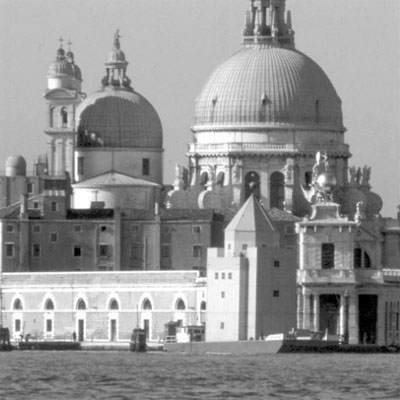
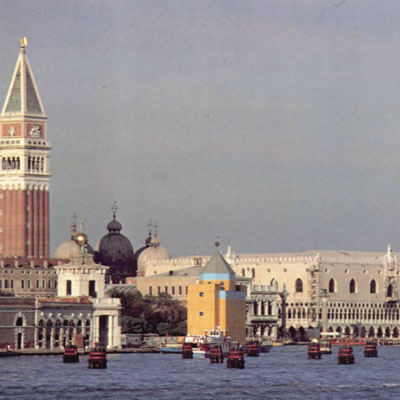
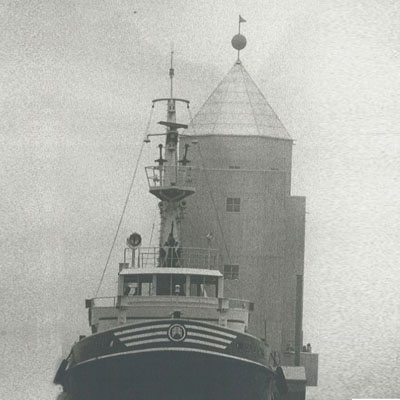
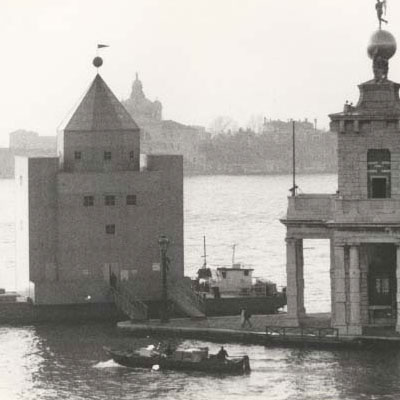
Aldo Rossi’s Teatro del Mondo of 1979, no small title for a small timber clad temporary building, offers the power of typological referencing, a form, the signifier, pregnant with the genetic heritage of its typological brothers and sisters, a reinforced collective, an authority. The Teatro here instead of solid and eternal is delicately floating and vulnerable, its height too tall to have stability, a wooden sail on a barge, timber the colour of sandstone. This is an exercise in how to take the monumental and to make it a shell of timber and paint, the inflammable, floating unstable over a murky sea, an ephemeral reminder of the transience and fragility of everything, including Venice.

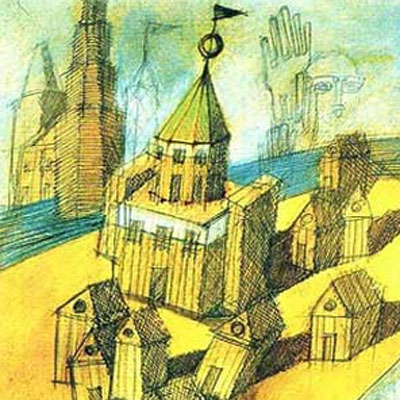
Rossi wanted to recall the tradition of the sixteenth century theatrical floats from the period when Venice was the playground of Europe. The dialogue for Rossi’s Teatro would not be prioritized for actor and audience but instead with the City of Venice itself. From the outset the Teatro was to be a tower, a voluminous space and not simply a floating stage. It would speak with the city, the domes and the cupolas, the piazzas and the arcades, an architectural conversation of form and typology, of history and fragility. A tower hunched between two shoulders that would conceal two staircases, the central volume terminated with an octagon and an octagonal roof, as often in Rossi’s work tinted blue that brings the sky into the form. Just below the roof a blue band representing the classical cornice, the beginnings of a grand architecture skinned in paint and wood over a structure of scaffold tubes. Rossi’s architecture is associative, its forms are read via intellect to references of the past. It is not sensorial and it is not to be experienced sequentially as a modernist building may be. It is in itself, meditative, reflective and nostalgic. There is a need in Rossi’s work for human absence, as there is in the work of De Chirico. Human absence leaves us, the viewer, alone with the work, solitude, isolation and silence and only within these conditions can we drift through time back to spaces as yet unoccupied by the seething masses, by the here and now.

To Rossi architectural design was an extension of theoretical analysis. The architecture moves between the real city and the imaginary city, the Teatro Del Mondo sits somewhere in between, it is a gateway, a metaphorical link. With its towers and cupola it references the traditional city in which everything is solid and stationary but in the Teatro de Mondo solidity floats from location to location, event to event, a stage set that creates the stage set. The Teatro draws upon Elizabethan theatres, lighthouse structures and the architecture of Venice. A floating fragment of the city, a place where architecture ends and the world of imagination begins. It creates an architecture through action, the insertion, the intervention, forces reinterpretations of the historical fabric, an interloper that temporarily alters the landscape of a city. It invades on-going centuries old discussions and intrudes upon the comfortable fellowship of existing volumetric connections. It interrupts Venice and its scenic space, politely gate-crashing the old boys club by wearing an old school tie.

Aldo Rossi (1931-1997) 

The Surrogate Twin

Posted on

​281017 – Terracotta – The Natural History Museum, London SW7

​​281017 – Terracotta – The Natural History Museum, London SW7 > words

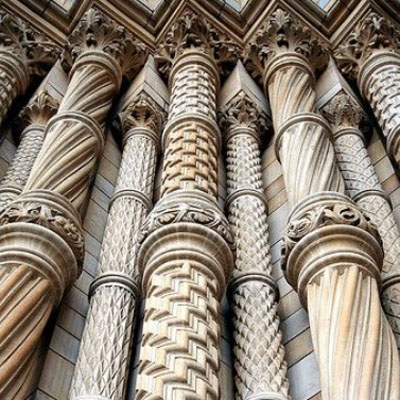
Terracotta figurines have been found that date back to 3000 BC, making it one of the oldest moulded materials used by man for utilitarian and decorative purposes. It has been used for the prosaic, roof tiles, drain pipes and flower pots but also used in the high arts for sculpture and religious buildings. In the 1800’s its use for architectural adornment was promoted through the work of Alfred Waterhouse. Waterhouse was a well-connected, well-educated architect; he had already completed numerous high profile commissions including Manchester Town Hall when appointed to undertake The Natural History Museum. Following in the tradition of the ceramic covered buildings of Louis Sullivan and Karl Friedrich Schinkel, Waterhouse was known to work in a wide range of architectural styles but his Gothic Byzantine style became the face of his public buildings in the late 1800’s.

The Natural History Museum (1873-81) was to be an exemplar of the use of architectural terracotta and in turn this became the best-known work of Alfred Waterhouse and the original study drawings can be found on the NHM website/archives. The London firm of Farmer & Brindley were the collaborating sculptors providing the three dimensional realisation of the Waterhouse drawings. Farmer & Brindley worked with Waterhouse on over one hundred buildings, the most significant being The Natural History Museum. For the NHM project, Farmer & Brindley employed a little know French sculptor named Dujardin who made one-twelfth oversize clay models of each piece (to allow for shrinkage when fired). Gibbs & Canning then made plaster moulds of these from which the final terracotta blocks were cast. 

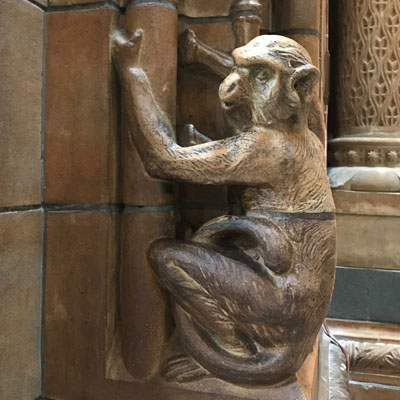
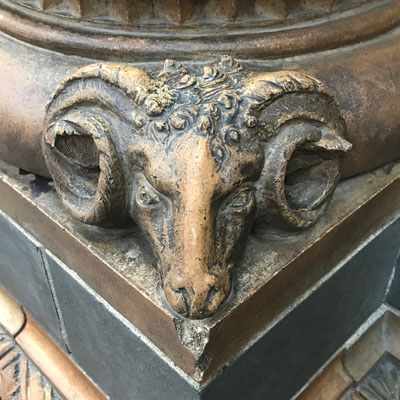
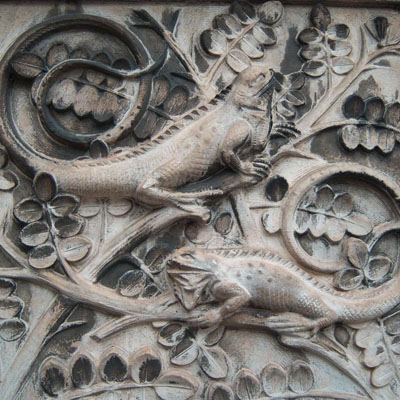
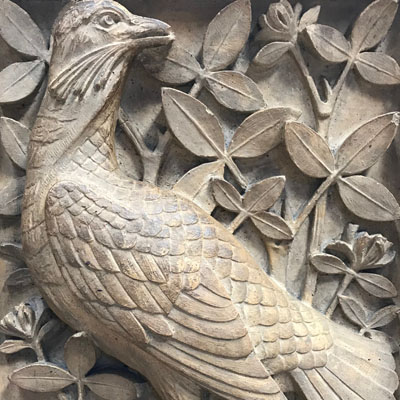
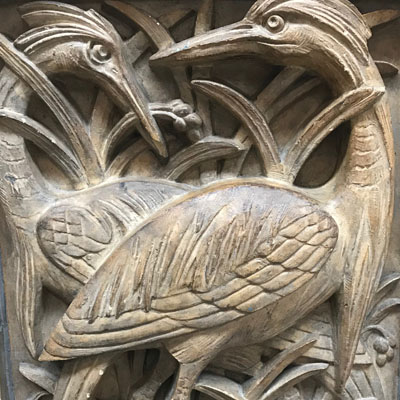
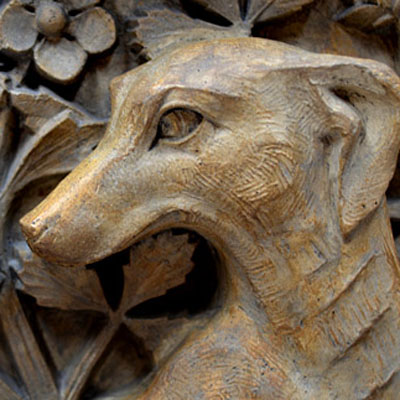
One hundred years on and the museum is still one of the most popular in London, its architecture full of humour and eloquence. Beasts peer down from the parapets, foliage adorns the windows and columns and monkeys, lizards and birds cling to every available crevice.

Posted on

071017 – Space Port Venice – London

​071017 – Space Port Venice – London > words

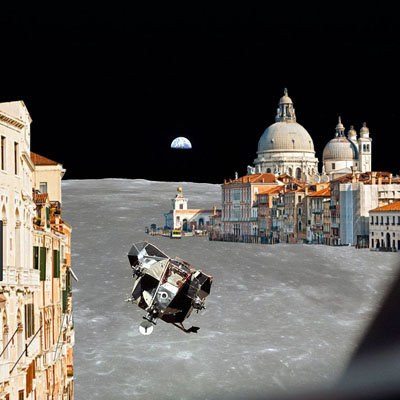
Venice is a surreal island, a level plateau built on mud enshrouded by its lagoon. The Grand Canal, a truncated ‘river’ that starts and finishes as if cut from the mid section of another river from a distant land. The lagoon shelters the island. Venice is an island protected by spits and shallow mudflats and throughout its history these have foiled many a sea-based invasion, leaving antagonistic armies stranded in the shallows. Venice was originally little more than a swamp, a site chosen by the dispossessed and victimised, a marshland where its residents could reside in safety and start anew.

Early Venetian dwellings were little more than wooden huts on stilts clinging to the highest silt banks, an environment with poor natural resources, no farmland, few trees just marshes, reeds and bogs. Locally the residents could fish for crab, shrimp and silt dwelling fish. With stifling hot summers and brutally cold winters the original occupants were survivors, there to avoid persecution but also there to search out a better life, to start afresh without landlord or feudal lord. Soon they would learn to navigate their lagoon and become fishermen trading the surplus for what they needed. As their confidence grew they would venture further out into the Adriatic Sea trading along the coast of what is now Italy, Slovenia and Croatia. A natural progression to trading fish for goods or money was then to trade on the goods bought, so up and down the coasts they would travel buying and selling. With this the Venetians found wealth, their wooden huts soon replaced by large wooden buildings. Larger ships were built to carry more goods and to travel greater distances. As their success grew new inhabitants were attracted to their island home and soon it was full on its way to becoming a city. 

The larger ships carried the Venetians south down the Adriatic hugging the Albanian coast to Greece, here they would turn east eventually to reach Constantinople to trade with the Turkish traders at one end of the Silk Road. When Marco Polo returned to Venice after 24 years of travels to the East, his stories told of the huge wealth of the orient merchants who were keen for this new trade. The Silk Road travelled from China to Constantinople and the Venetians controlled all water born trade from Constantinople to the West via Venice. The areas around the Rialto developed into a market where all types of exotic goods could be bought and sold. Ships from Constantinople would harbour in the mouth of the Grand Canal and unload here at sea. Narrow boats took the goods from the ships along the network of canals and into the merchant’s houses. Venice was a port, a distribution and logistics centre but a centre like no others. The Venetian merchants houses developed into a unique type of wholesalers. Water gates at the base of the buildings open onto the canals allowing boats to access, unload and sell their wares. Floors immediately above this were storage and sales spaces. Floors above the sales spaces were domestic living accommodation. These were family businesses and the families grew very wealthy expressing their wealth in forever finer buildings. Early banking and insurance began here to aid the merchants and the infrastructure of trade developed. The Venetians were wise enough to appreciate that although their interests were personal their strength was as a collective so their ‘port’ was soon adorned with large pubic squares, churches, bridges, sculptures and monuments.
The trade routes along the Silk Road picked up ‘travellers, adventurers, explorers, rogues and vagabonds’. Service industries sprung up along route, food stalls, bars, theatres, gambling dens, dancers, faith healers, barbers, costumers, mercenaries, body guards, assassins, prostitutes, and at its terminus Venice soaked up this huge influx of cross cultural immigration that supplied these services. Intercontinental trade needs liberal conditions, in Venice, Christians, Moors, Asians and Jews all added to the mix. Their streets and their buildings an endless collage of cross pollination, an exquisite assemblage of adoption and adaption. 

When travelling considerable distances and when trade is exposed to substantial risk the best goods to ply have high value, low baulk. So trades in spices, gold, precious jewels, silks, perfumes and porcelain dominate. These suit the caravans of the land route, the rowed and square sailed ships of the sea route, the souks, bazaars and markets and the merchants houses of Venice.

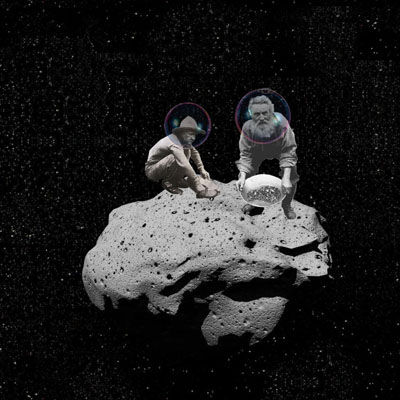
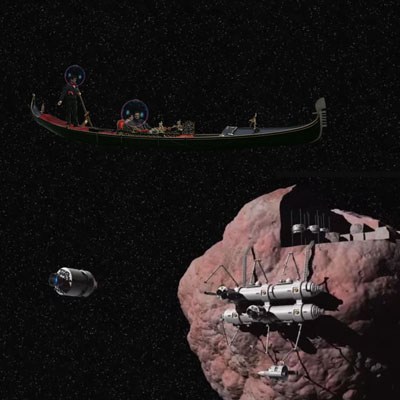
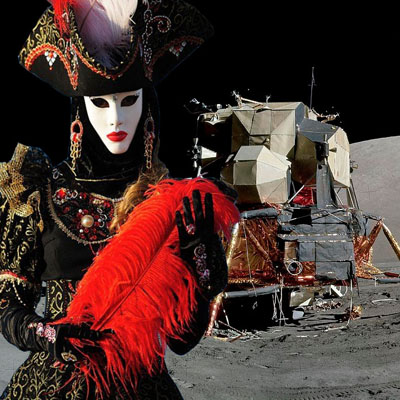
The first privateers to venture into space will be looking for goods to trade. Asteroid mining will probably be one of the early businesses to be established. Small towns, space shanties, will settle on the asteroids they are mining and with time these settlements will grow attracting the many subsidiary industries that feed upon a primary industry. Not unlike the growth of Venice the asteroid towns will soon attract ‘travellers, adventurers, explorers, rogues and vagabonds’ all looking to get rich quick, to escape the established regime, to seek out a new life. 

Billions of years ago asteroids and planets were accreted from the same starting materials. The stronger gravitational force generated by a planet pulled all siderophilic (iron-loving) elements into their cores during the stages of their molten youths, leaving the surface crusts depleted of such materials. On earth asteroid impacts have re-infused the surface crust with these valuable elements. Typically these include metals such as gold, cobalt, iron, manganese, molybdenum, nickel, osmium, palladium, platinum, rhenium, rhodium, ruthenium and tungsten all with considerable economic and technological value. On asteroids due to their lack of sufficient mass and gravitational pull these elements may often be found lying on or near the surface, easing their discovery and recovery. Of these asteroids there are several Easily Recoverable Objects (ERO’s) and Near Earth Objects (NEO’s) that could feasibly be reached and mined. 

Asteroids are categorized by their spectra into Types. C-Type asteroids have a high abundance in ice and therefore these asteroids would have a significant infrastructure role in space. C-Type asteroids would be logical bases on which to set up space depots to provide, water, fuels (splitting water into hydrogen and oxygen) and ingredients for fertilizers (organic carbon and phosphorus). In time Ceres would be a logical C-Type asteroid (now classified as a dwarf planet) for such an infrastructure base. Space fuels, water and food from the C-type asteroids would support the mining outposts on the S and M-Type asteroids.

S-Type and M-Type asteroids contain numerous metals including rare metals. As soon as trade between asteroids and between asteroids and earth commences subsidiary industries would grow along and around the new trade routes opening a new frontier. At present economic rather than technological conditions have prevented space initiatives, development and progress. However, as of September 2016, there were 711 known asteroids with a market value exceeding US$100 trillion and it is only a matter of time before the equation tips towards the economically feasible. The vastness of space contains an economic vastness of resources, although the total mass of the asteroid belt is only 4% that of the moon, asteroids are resource rich.

Early asteroid mining may well resemble the Privateers of the Fifteenth Century. Pirates on the high seas backed by National Governments. In a world that had yet to be claimed and with all eligible parties fighting for their share, this was a very grey area for any form of legislation. Earth has drafted The Outer Space Treaty and The Moon Agreement that outline laws and procedures with regard to space and space mining but only a few countries have signed these and as the prospects become more feasible the rules will change. It will be corporations backed by investors and not governments that will fund early space exploration. The East India Company immediately comes to mind, controlling key ports and Trade Routes, the gateways, will be the desired path of most corporations, to encourage anyone with a bucket, a spade and spaceship to ride out, stake a claim and strike gold.

The early days of space mining may well be Gung Ho but just as Venice was the initiator of this essay, by establishing trade and controlling the gateway to the Silk Road, out of the swamp grew an amazing rich and diverse city. There will be space cities equally magical, their stories told by Marco Polo astronauts. But just as Venice had its day, its day also passed. Wars with Turkey lost the Venetians control over Constantinople and with it control of the Silk Road land route to the East. Soon Columbus would discover the New World and Vasco Da Gama would round the Cape of Good Hope establishing a sea route to India. Venice’s monopoly on Eastern trade would be broken and its oared galleys were now outdated and of little use on the open seas. I see no reason why the rise and fall of future space cities should be any different. According to CNEOS, “It has been estimated that the mineral wealth resident in the belt of asteroids between the orbits of Mars and Jupiter would be equivalent to about 100 billion dollars for every person on Earth today.” It is difficult to imagine the asteroids belt being left untouched forever, dwindling terrestrial resources may well force our hand. To fully explore space we would need resources beyond those that could be supplied by Earth. 

An important test bed for mankind’s ambitions for space would be with our own moon. The moon’s surface is believed to be rich in cobalt, iron, gold, palladium, platinum, titanium, tungsten, uranium and the gas helium3. Water has been discovered at the poles which would be used either to sustain life or split and be used as a fuel. The moon could also function as the earth’s lifeboat housing data stores of information including genetic, technical and historic should an asteroid ever fatally hit the earth. How many more years will we wait for the first moon base?

The Surrogate Twin

Posted on

170817 – Space Drifter – London

​170817 – Space Drifter – London > words

When it is time to leave our planet to explore the unknowns of the Solar systems what form of craft will enable such exploration. To cross the huge distances of space humans require either some form of stasis in which we sleep throughout the journey or a multi generational ship. The idea of the tin can spaceship loaded with sufficient supplies to cross these vast expanses would seem naïve. In space there are no drive thru’s or convenience stores (as yet) from which to resupply. (Ref. Diary 271216 – Distance) To put Space distance into perspective the recent discoveries of the Kepler potentially habitable planets, 2011-2015, range from 500-2700 light years away. A light year is almost 6 trillion (6,000,000,000,000) miles. The space shuttle orbits the earth at 18,000mph at this speed it would need 37,200 years to travel one light year. The scale and breadth of space is still, to the human mind, incomprehensible. Spaceship Earth, a phrase coined by Buckminster Fuller, is the spaceship we need to replicate to traverse the above distances. Huge sail boats, drifting farms, acres on a wing.

In the Arizona Desert in the early 1990’s The Biosphere 2 experiment in which eight people were kept within a sealed enclosure for a period of two years. This experiment tried to create a fully self sustaining closed environment, producing its own air, water, food whilst recycling all of its waste. The Biosphere 2 was a three-acre by nine-story volume maintained as an independent controlled circular system in which all that was required by the eight inhabitants was provided from within its own ecosystem. This supposedly balanced system was supposed to completely support its eight inhabitants, a tall order and one that was doomed to fail. Ecosystems are multi complex elaborate symbiotic systems; they do not travel well in part. Biosphere 2 consisted of five biomes that replicated terrestrial biomes each working as an interconnected vivarium. The biomes were a rainforest, a grassland savannah, a mangrove wetland and an ocean and coral reef all enclosed via space frames and glass. The name Biosphere 2 was chosen as it was to be the second self-sufficient biosphere after that of Earth. There has been no valid follow up to the Biosphere 2 project and any hope of traversing the endless expanse of space requires a self-sustaining system. The Biosphere projects need to be reinstated and be of international concern and collaboration. The knowledge required to maintain a self regulatory sustainable Biosphere would not only be useful for space travel but of obvious use to the management of planet earth. 

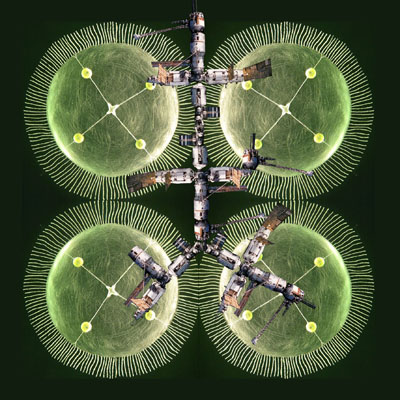
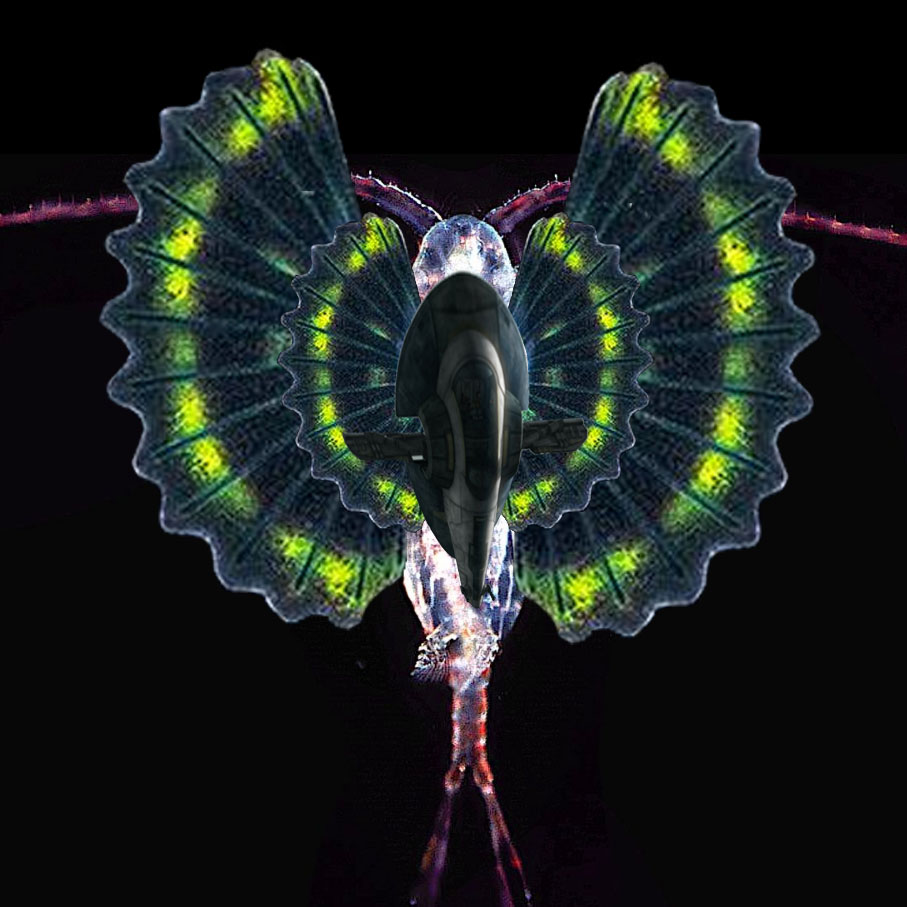
So space travellers are faced with immense distances and slow speeds. To cross the vast stretches of space, ships would need to be vast self-contained multi generational enclosed ecosystems. Flying farms designed by horticulturalists as well as by engineers. Sail boats that drift, as early plant life first propagated earth, randomly drifting, following the solar winds, clinging to outcrops of inhabitable surface wherever found. These would be delicate fragile structures that maximise surface areas to catch energy and produce food. The nearest prototype to a future Space Drifting craft would be the plankton clouds of the oceans. Plankton are simple intelligent life forms that work collectively as producers, consumers and recyclers, a collaborative team of ocean farmers. There is much to be learnt from plankton’s photosynthetic creators, they have the ability to use the energy of light and to soak up carbon dioxide whilst producing sugar and releasing oxygen. Around half of the world’s oxygen is produced via phytoplankton photosynthesis. The need to fully understand and be able to replicate photosynthesis will be a key component is long distance space travel and future space colonisation. To be able to build and maintain algae farms and understand and control cyanobacteria films may be an early prerequisite to both earth’s maintenance and space terraforming. It will be impossible to terraform any future planet without some form of panspermia. Controlling this seeding, monitoring and modifying its outcomes over millennia, will be an essential component of space conquest. 

Mankind is a long way from being able to cross the distances required to reach any potential habitable extra terrestrial world. In the first instance there is a need to create fully autonomous circular systems/environs on earth. Then these would need to be tested by creating orbital habitats that can capture and store the suns energy. The most obvious orbital habitat would be the moon and it is here that the early experiments in space habitation should commence but only after we have achieved a fully self-contained biosphere on earth. At the same time autonomous robotic drifters could be sent out to initiate colonisation of planets and asteroids by seeding cyanobacteria. Simultaneously these autonomous robots could set up staging posts throughout space that would enable and assist future colonists on their long crossings through time. Autonomous robotic drifters could collect and assemble space debris, small asteroids and meteorites, using these as the building blocks of perhaps future habitable stations. This in turn would be a test bed for building planets or moving planets to within our own habitable zone (Goldilocks Zone) as this may also be key to maximising the few future habitable zones that exist throughout the many solar systems. 

One can only speculate on what these space ships of the distant future may look like but they will probably look more like farms than space ships. So images below.

The Surrogate Twin

Images. 1-7 Space Drifters for the Infinite Abyss.

Posted on

​170708 – Canton – Guangzhou

​170708 – Canton – Guangzhou > words

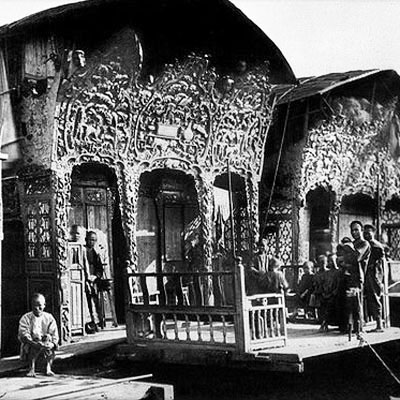
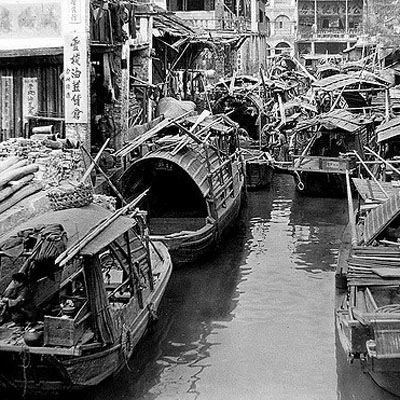
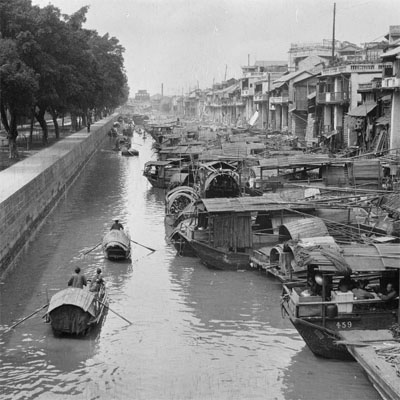
North West of Hong Kong in the south of China where the Pearl River spreads its fingers into The South China sea lays a level land of canals, estuaries, deltas and silt banks. These rich soils connected by a labyrinth of waterways would eventually grow into the great trading port of Canton. Since the 16th century Canton had been connected to the west through trading with the British, French and Portuguese and in the process inheriting a tapestry of cross-cultural influences.
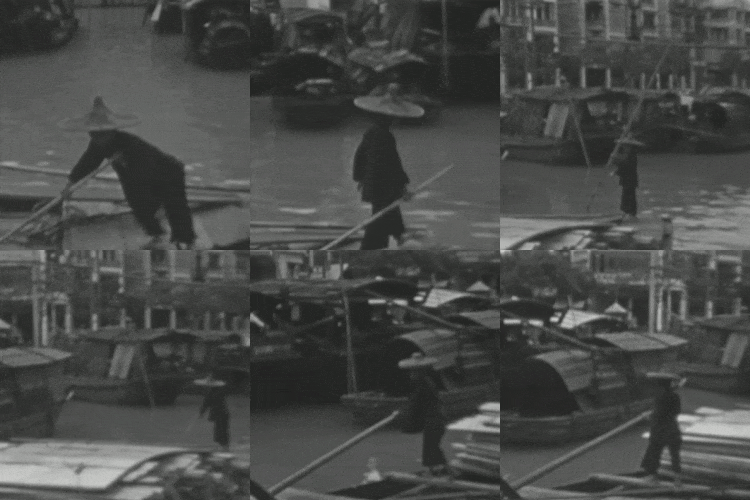
Sheltered and fed by the Baiyun mountains to the north, the Pearl River Delta is formed by the convergence of three major rivers, the Xi Jiang (West River), Bei Jiang (North River), and Dong Jiang (East River). The flat lands of these alluvial deltas are crisscrossed by a network of tributaries and distributaries forming a natural network of communication conducive to trade. Inevitably a people at one with the navigation of these terrains thrived, a boat people that were as happy on land as they were on water. To live, work, eat, sleep, sail and sell, a composite synergy of activities on one floating platform. Floating villages formed, together moored to the banks of trading towns. The transition from land to floating communities lost within the density of it all. 

These romanticized images perhaps could only be formed from a European perspective, where history and culture are so intrinsically intertwined they are read as one without differentiation. Canton, now Guangzhou is today an economic powerhouse, much of its former history has been erased, first by the Communist Party and of late by the onslaught of Capitalism. The Guangzhou International Finance Centre, an exquisite 21st century tower at the heart of a thriving metropolis could not be further removed from trading dry fish under a bamboo canopy off the deck of a sampan. Yet each generation stands on the shoulders of those that preceded it, upon the accomplishments of others, knowledge is passed down reappraised and assimilated. 

I am soon off to Guangzhou, perhaps to collaborate with a truly 21st century company with an expanding commercial empire, a logistics machine that opens a new shop every four days, an impressive trajectory even in these heady days of online globalization. But when in Guangzhou as I walk among its four lane highways, dwarfed by its 400m towers and lost within its multi million population I will be searching for the scent of Canton, searching as only a romantic can for the essence of what makes something unique. Only by identifying the ‘what and why’ that makes a product special can one hope to enthuse others to enjoy and share in that same experience. My romantic walk may well be just a day dream on the plane as the reality of the 21st century dynamism of this Chinese economic hub will hit next week and my schedule leaves little time to muse a thousand years of history. Idealised and naively romantic this may be, but to extract the essence of what is Chinese is the objective of my visit. Only by selling what is Chinese to the West will a Chinese company be successful, neither undercutting nor imitation will have longevity in a crowded market. So somewhere under the layers of what now is the metropolis of Guangzhou the cultural riches of a hidden Canton are waiting to be rediscovered. 

The Surrogate Twin

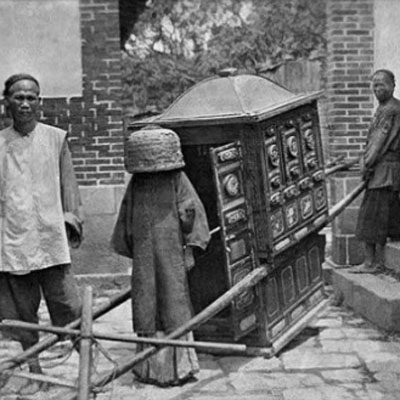
Images left to right, 1 Canton River, 2 Canton Style, 3 Flower Boats, 4-6 Busy Waterways, 8 A Wedding Bride.

Posted on

030517 – Ecdysis – London

030517 – Ecdysis – London > words

Life never quite goes as planned, sometimes events happen, often many at once that completely throw ones direction. Foundations that one believed were positive, stable and progressive, at another’s whim simply vanish. When hit by such events there are no options but to re-evaluate and adjust, set a new course and navigate the new conditions. This is life. Some are able to control and maintain ones pace and path but most of us are just so much flotsam and jetsum bounced around in the storm. Some events can take months to recover from, others may take many years. Such an event occurred in March and these essays have been put on pause whilst we respond to the new conditions. This recoiling, reassessment and reorganisation recalls an exhibition viewed back on 070317 but never reviewed. Whilst viewing this exhibition I considered how one orders and collates aspects of time to influence decisions so it would seem apt to now add this text as we begin to catch up and carry on.

All animals, including humans, shed their skin. With mammals it is an unnoticed continuous process but with reptiles skin is shed periodically. A reptile’s skin, its colour and pattern are intrinsic identifiers to the reptile. Snakes often shed all of their skin in one piece. Skin is shed as part of the rejuvenation, cleansing and growing process. Unlike mammals snakeskin does not grow but instead stretches to accommodate the growing body. When the limit of the snakeskin has been reached by stretching the snake grows a new skin below the old. When the new skin is ready the old skin is discarded, it will break at the nose and the snake moves forward through it. The skin rolls back like a discarded sock. The discarded skin leaves a trace of what the reptile was, a period of its life left as an etched veil, a record of its size, its health, its scars, its species and itself. The skin is a memory that has been solidified for all to see, a testament to a period of development, a fragment of a lifetime logged and chronicled. The snake has no use for its old skin so it is discarded. The snake has no need for a personal photo album to aid its memory, to help it recall what it is and where it has come from. The snake has no necessity to collect these sheaths of its former self and has no need to use these to direct its future self or quantify and justify its past. The snake is a snake its persona is not modified by continued self-assessment or configured by external forces.

Humans continually rejuvenate their skin as old skin cells die and are replaced by new, but what today is the skin of a human. Man lost his body hair around 1 million years ago but he did not start wearing clothes until 170,000 years ago. At first the function of clothes was simple, to retain heat, to stay warm and dry but with time clothes became a means of identity. Clothes also became chameleonic, changed daily, seasonally, according to activity or festivity. Clothes at the same time became a means of collective identity, the uniform, the tribe, the social signifier. Man magnifies his capabilities with clothes and tools, they are prosthetics that add leverage to his abilities. A man is clothed as much by his home or his city as these are extended prosthetics that enable habitation. The enclosing environ does more than simply shelter us from the elements it is a record of our values, our achievements, our beliefs and our technological prowess. Historically each manifestation or built work is eventually discarded, shed as a snake’s skin, that records who we were and what we did within a particular period of time.

The work Passages of Do Ho Suh at the Victoria Miro continues this analogy. “I see life as a passageway, with no fixed beginning or destination” a journey through our environs recorded and discarded. An anthology of memory and modifier, the cause and effect that becomes us, here shed as a snakes skin, encoded and documented, fragments, surfaces and spaces. The solidification of past time and its use as a modifier of present time is unique to humans, a self selected memetic evolving. Our memory is never strictly chronological, it is bias and loaded, we rearrange and re-collate aspects of memory to put emphasis into message and meaning. Here the rooms from many cities, from different times are re-sequenced to form a seamless walkthrough. These are the porous boundaries of identity, chronicled and reassembled into a placeless fragmentary walkthrough of intimate memories. The discarded skin reused to establish identity and yet each is transient, ghostly, vulnerable both to interpretation and to the elements, fragile in its structure and its relevance, a mortal passing through a micron of evolutionary time. When we reach the limits of each skin we discard it and move on and create another.

Images left to right 1 Ecdysis, 2-7 Do Ho Suh

The Surrogate Twin

Posted on

020517 – les petits rats – London

020517 – les petits rats – London > words

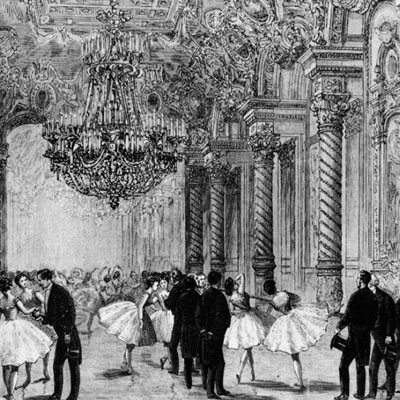
It is 1881. The Belle Époque is at its peak, midway between the Prussian War that ended in 1871 and the First World War that was yet to commence in 1914. The peace and optimism of the intervening years produced a flourish of engineering and artistic achievements with Paris at the epicenter. Café society, opera, fashion, cabaret, philosophy and art attracts the talented and this invigorates Paris with energy and productivity.

Two centuries prior in the Royal Courts at Versailles the only way to get ahead was to get noticed and then to slowly work ones way up through the ranks via friend, family and favour. The gardens, the courtyards, the corridors and the bedrooms were where the business of promotion and patronage were discussed. The principal destination and ultimate objective, was the kings bedroom, where all matters of importance or of State were decided. Lifetimes could be consumed waiting for your chance to be presented. If you were female, life at Court was considerably more difficult. The female courtesan was expected to be a woman educated in the arts of dance and singing. Her role was to provide entertainment and companionship to the rich and powerful, from this she could gain independence, wealth and access to education and the affluent Court society. Options for females during the Renaissance were few. Women of nobility with a rich dowry may have been able to achieve a political marriage to a powerful partner but a woman without lineage, dowry or independent means had few opportunities and the Courtesan route was often the chosen career path. There have been many famous courtesans but inevitably considerably more not so famous ones.

Two hundred years and two Republican Revolutions had passed between the Royal Courts and the Belle Époque. An aristocracy and the upper middle class have now replaced the Royals, a Nouveau riche of industrialists and financiers that now hold political and fiscal power. However, The Belle Époque was only Belle for a small percentage of the population. In Paris two thirds of the people still lived in poverty.

In 1881 Degas unveils La Petite Danseuse de Quatorze Ans to the shock of the critics. The wax model of a fourteen year old would be ballerina defied the classical laws of beauty expected by the Academies of the day. Wax as a medium was also an issue of contention, sculpture should be made in marble or bronze, lesser pieces perhaps in terracotta, but wax was the medium of the medical profession or the arcade. The Little Dancer was a peculiar thing, created from a steel frame, covered in clay then covered in wax, dressed in real clothes. The sculpture of a young girl posed in the fourth position right leg forward, hands behind her back. She wears a real tutu and ballet shoes. She has a wig of real hair and a fabric bodice both overlaid with wax, half real and half sculpture. Wax emulates reality with wax stockings complete with wrinkles. The whole figure two-thirds life size was to be shown on a plinth in a glass case. Offered as a specimen, reality captured and encased, a pose, an expression, hermetically sealed, straight from the dance class and into the art gallery. Degas was 45 when he began work on the Little Dancer and he rarely left Paris with the city as his inspiration, he was a painter of modern life. Degas came from a wealthy banking family, had no wife, no known mistress, no children, he was a loner, the voyeur that would paint some of the harsh realities of the Belle Époque. 
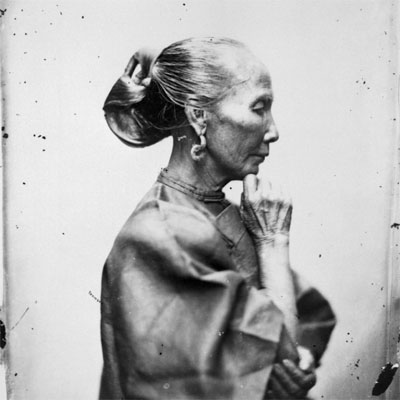
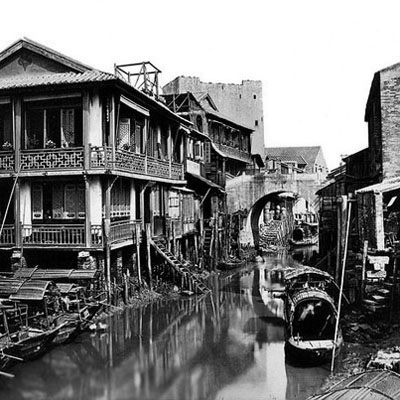

Dance was one of the few opportunities available for young poor women. Girls as young as ten were apprenticed to the ballet school, they were known as the ‘little rats’, as if ‘little rats’ could ever be a term of endearment. This Little Dancer was a real person. Her name was MarieVan Gœthen from Boulevard de Clichyin MontmartreShe was the middle of three sisters who all became dancers. Marie turned fourteen in 1879 and Degas drew Marie numerous times before he decided on the position of the sculpture. Degas was an artist trained in the classical tradition, to draw the body naked and to clothe it later, to draw with line and to clothe with colour and he drew Marie naked and clothed. One can imagine the naked wax sculpture before it was dressed. Not quite a pet, or a doll or a sculpture. 

The Little Dancer was first to be shown at the 1880 Impressionist show but was unfinished, famously leaving an empty glass case in the midst of a gallery for a month. It eventually premiered in the 1881 Impressionist show. When unveiled the shocked audience did not see a dancer but instead a prostitute, ‘une fleur de la gouttière’. The sculpture was compared to a monkey, a primate, a criminal, a medical curiosity. It was accepted that teenage working class ballet dancers were expected to pay their way through school with patronage or favours. Their clients were the wealthy season ticket holders, the men in black with top hats that haunt many of Degas’ pictures. These were the privileged few that had access to Le Foyer de La Danse at the heart of the Opera House. Le Foyer de la Danse was a kind of gentleman’s club that only men and ballet girls could enter. After two hundred years of progress the clandestine and illicit workings of a Versailles plan have simply been rotated 90 degrees and can be clearly seen in the Opera House section.

Charles Garnier built the Paris Opera House between 1861-75. The Opera house is of an opulent Beaux-Arts Second Empire style with extravagant Neo-Baroque details. The commission was won by open competition from 170 entrants. A commission Garnier won at the age of thirty-five. Built at the time of the Emperor Napoleon III the Paris Opera was to be an extravagant national symbol and monument. The Opera was always to be a meeting place of the rich and powerful, housing ample foyers, corridors and alcoves for private meetings. Yet the Paris Opera House has an unusual plan and section and these reveal a lot about the society that created it. In the heart of the plan and section, located directly behind the stage is a huge ornate room that serves as a mirror to the society that created it. The Foyer de la Danse was a space designed specifically for the meetings between the dancers and the wealthy patrons of the Opera. A space where a young dancer may find a patron or finance for favours that would help pay her way through training. This was not a space for a discrete casual meeting, the meeting that may have taken place in the bar or restaurant. Here it has been formalised, monumentalised at the heart of the building. This gentleman’s club is very much part of the internal mechanism that is the Ballet and also very much part of the society that supports it.

From a twenty-first century perspective this formalisation of exploitation is beyond belief, especially when the space has such scale and ornate embellishment. In the Paris Opera house Le Foyer de la Danse sits within the upper hierarchy of all its spatial types. In the city the Opera House is typologically within the upper echelons of public buildings. In Paris in this post revolution, post republic building we see revived the age of the Courtesan. Except here, in this public building, unlike the respected Courtesans of the Royal Courts the women are replaced with desperate fourteen year old girls that have little option outside of dance to make any life for themselves. Here the established relationship between the vulnerable and the powerful is formalised and adorned in Baroque splendour, built into the heart of a public building, vetted through councils and competition. The space of the Foyer de la Danse sits unashamedly, architecturally, central to both the plan and the mechanism that financed the ballet. In the pictures of the Foyer by Degas the dancer is the point of focus, the opulent space recedes and the men in top hats hover and haunt. The drawings are the reality sketched over the grand illusion proposed by the architecture. An architecture that is representative of a system that had changed little since the Royal Courts of Versailles.

Things did not go well for Marie Van Gœthen after the Little Dancer was unveiled. She first began missing classes that in turn incurred fines. Eventually in July 1882 she was sacked. Marie had been known to frequent Le Chat Noir, a notorious bar where her elder sister had been charged with theft and was now in prison. Marie’s younger sister Charlotte, would continue in dance at the Opera for the next fifty years eventually becoming Professeur de Danse. Nothing is known of Marie Van Gœthen after 1882.

Images from left to right 1-4 Degas, Little Dancer, 5-7 Palais Garnier 

The Surrogate Twin

Posted on

150117 – Kinetic Fresco – London

​​​150117 – Kinetic Fresco – London > words

The forgotten techniques of Mannerism and Baroque.

Di sotto in sú 

Quadratura

Anamorphosis

Trompe-l’oeil 

Fresco and Fresco-secco

Perspective theories developed in the 17th century to a point where enclosed space could be opened up using illusionistic painting techniques. Walls and ceilings became surfaces that could be expanded into other fictional worlds. The techniques were adopted from the theatre and were often used to open up a space to the outside world typically with garden vistas or soaring skies. These fictional painted spaces contained other worlds that were often mythical or biblical. They were spaces in which to escape or to be reminded of ones humble place on earth, a space to explore but also an over looking space who’s inhabitants watch and judge. ‘As the gods look down’ the physical space is monitored by the fictional space. Story telling, myths and fables complete the interaction between the two spaces and the physical space becomes a transitional space to another world, a gateway. Religious spaces have often been rendered as such.

Trompe-l’oeil – Fresco is painted into plaster that is still wet (fresh) whilst fresco-secco is painted onto dry plaster. The technique for transferring the images to the plaster is dependent upon the type of fresco used. On fresco an outline drawing would be sketched on the under layer in a red pigment that then bled into the fresh top layer prior to pigmentation. In fresco-secco the drawings were transferred from paper sketches or cartoons in the same way as all large paintings were created. Outlines on the cartoon are pricked with a series of fine holes through which soot or chalk powder is rubbed to mark out the areas to paint. Fresco painting is a slow process with large ceilings and walls often taking years to complete. Once complete it is a static image, a static illusion.

The technique of Quadratura created single point spatial perspectives. This false architecture of perspective when painted onto a flat or shallow vaulted ceiling would continue the real architectural space. The perspective had one focal point and used foreshortening of figures, architectures and landscapes to create the illusion of a deeper space often opening to an infinite sky. Fresco painting is the technique ideally suited to the Grand Manner of the Baroque. The ambition of scale and subject complement the vast canvas of the walls and ceilings of the palaces of the nobility. Whole spaces were transformed as each enclosing surface was expanded with an illusionistic space. A dialogue would begin between each expanded space that conversed across the room and in so doing dragged the real world into the fictional and vice versa.

Baroque Quadratura was only convincing when standing at one point. Augmented and animated ceilings could shift this perspective as the viewer walked around the room. The shopping mall is already an augmented space, a real space overlaid with wireless fed information about products, information or events, a rich and dynamic multi-media experience. It will be interesting to see whether these augmented spaces develop into a new medium of spatial experience or whether they will remain merely as information overlay options to be turned on or off as desired. As virtual reality (VR) becomes mainstream, at first adopted for home and public entertainment, the overspill of this spatial type onto the city will create another layer to be explored by artists, architects and designers. Layering the fictional onto a real space, exploring time, place, sound and activity dislocation, the consequences of such experimentation are yet to be known. What is certain is that the augmented real space will be a hyper-real alternative to the space we experience today. The layering of the augmented onto the real will be read as one single spatial experience in the same way as the fictional ceiling frescos and real time volumes read as one space. What is new is that the augmented space will be dynamic and interactive and that we experience it in two ways, one as a space and two via a device. If there is a further layer of augmentation via a device, a cell phone, pad or wearable, a hybrid interpretation of space materialises. The space has a public domain and numerous subjective, simultaneous personal domains. The urban spaces of Tokyo, Hong Kong and Seoul, where walls of electronic media enclose public spaces, are a precursor of this spatial type. The information the media walls support is pragmatic and informative as opposed to purely cultural or experimental.

The 1990’s offered VR parallel worlds and the internet created cyberspace. Whilst VR is still waiting for technology to catch up and commercialise, cyber space has been domesticated, taken over by the big brands and normalised and is now little more than an ‘electronic suburb’ (Norman Klein). However within cyberspace new obsessions have emerged that create a constant and continuous dialogue between the data of cyberspace and occupied real space. Selfies, the use of GoPro or dog cams are all forms of video surveillance that turn real space into cyberspace. Cyberspace when recalled upon a device informs real space. Every real time object with embedded information becomes a cornerstone to cyberspace, simultaneously a three dimensional reality and a two dimensional on screen character. Once in cyberspace it can be edited, altered, layered with text of further information such as music or sound. It becomes something else, neither a copy nor an original, neither fact nor fiction. Space has never been experienced with this type of dynamic duality before.

When every object in a physical space has been embedded with some level of technological tangible interface the centralised computer becomes obsolete and a reader is all that is required. All of the surrounding physical space becomes part of the human computer interface. When tracking a users interface to provide localised information the users data is collected. Augmented space is both an experiential and monitored space (‘as the gods look down’ text from above). Augmented space is a 4D physical space (when 4D is 3D plus time) with an additional fifth dimension of information, a 5D space. Augmented space is never permanent and exists within a feedback loop. As information is collected and uploaded from interactions with the physical space the augmented space is modified to accommodate new incoming information that is in turn fed back to the physical space. Augmented space is therefore a space of collective learning and experiencing. At present the user needs an interface device to access and then interpret the augmented space. When the interface device is no longer electronic but biological it is feasible that collective learning or collective experiences could add a further perceptual dimension. The collective experience would have multiple experiential responses; these may be polar or assimilated into a generic.

With the augmented electronic space, the dynamic or kinetic fresco, choreography is added to the skills required of the electronic fresco painter. Unlike previous frescos, in the kinetic fresco every constant has been replaced by a variable and every variable is a fiction. In this world the image has a greater inherent value than the original, as the image is hyper-real, super-intense, edited and associative. The image is the myth that the object aspires to and possession of the object is the means of acquiring that myth. Through this image and its associative context the original object is loaded with additional values and aspirations and as such the real becomes more fictional. When the object is a space we inhabit and that space is further continuously augmented, updated and refined. The two spatial types, real and fictional are blended, their differences become indistinguishable, and we inhabit this new spatial type with blind religious fever.

The Blue Journey dance performance (gif image four) is a work that consists of two elements that happen at different times and are then re-sequenced in the present. The backdrop is a pre-recorded animation that draws upon a limited pallet of black on blue (the work of choreographer David Middendorp). It is two-dimensional and flat, an animated picture plane presented as a vertical surface, as a border enclosing a real space, a boundary. The events on this flat animated space are fantastical, they defy gravity, have no fixed scale, they are able to morph in form, disappear and reappear, they can float, fly and become ephemeral. This fiction is a dream space edited and rehearsed, it tells a story, it is an animated locale, a fresco, a Trompe l Oeil. The fictional space is a space from the past, a historical space that has already happened elsewhere, perhaps only happened in the digital space of the computer screen. A transplanted fiction from another time and place. A space that never existed is presented as a spatial extension of the real.

The Blue Journey performance happens in real time in a physical space, the stage in front of the animated space and consists of a dance, a dialogue between two characters, over viewed by a third party, the animation. To cement the relationship between the performers and the backdrop, two events happening at separate times, the backdrop first takes the role of shadow to the performer. This is introduced simply, as the male dancer walks across the stage followed by his shadow. This simple act of walking with ones shadow apparently falling onto a wall sets the premise for the full extent of the credibility of the following journey. By locking these two dislocated movement pieces into one time frame, the fantastical and the real merge and a mythological landscape materialises. The boundary that contained the real world has been breached and space is extended into an animated augmented world. The transition is seamless; the audience are given no instruction other than this simple introduction that the shadow follows the walking male. This is all that was needed to link an imaginary world to the real world, to link two distinct time zones. When the female dancer begins to move she is beautiful, graceful and poetic, her shadow follows and the audience is dragged further into the illusion of synchronised time. Then the shadow stops, it no longer follows the dancer, but the idea of synchronised time is not lost as the audience is convinced that the shadow is that of another dancer working back stage. Not losing the illusion of synchronised time is essential to maintaining the extension of the real space into the fictional. 

The fact that this space is animated and choreographed gives it a power that traditional fresco was unable to achieve. The extended space becomes a walk into an occupied fictional space as opposed to the previously Mannerist viewed only space. It is important to note that this spatial extension has been achieved simply by silhouette, in a flattened two-tone, two-dimensional space. This is a space that never imitates the real and has none of the full richness of a Baroque Quadratura. In the Baroque, sculpture was often used as the transition from the real to the fantastical, a peripheral border linking the two worlds, sculpture as foreground, imaginary space as background. Sculpture was a static transition; its dynamic comes from gesture and association. Further movement of the viewer and the changing fall of shadow and light would animate the Baroque sculptural transition.

As the Blue Journey performance continues, the space of the fantastical begins to take over and separate from the real. The audience are drawn into the fictional animated space, as this (background) has greater dynamic than the real time performance (foreground). This shift in dynamic from real to fictional is essential for taking the eye from the real to the fantastical and this will be a key component of future augmented space. The Blue Journey animated space continues to increase the credible limits of fantasy as figures dissolve in mist, float without gravity, multiply instantaneously and eventually the silhouette dancers fall as if rain from the sky. The bonds between the real and imaginary are choreographed through sequencing, gesture and touch, keeping the two spaces locked in one time zone simultaneously happening in the present. This interaction is best exemplified when the dancer leaves the real world to join the animated world only to reappear back in the real. This seamless link of the real and fictional connects the two separate time and location zones in which each space was made into the one space of the present.

Future augmented space will explore the possibilities outlined above and as a consequence the delineation between what is real and imaginary will continue to evaporate. At the same time in a crowded world of physically finite space extended virtual space is infinite.

Images left to right. 1 Chiesa di San Pantaleone Venice – Gian Antonio Fumiani 1645-1710. 2 Chiesa di Sant’Ignazio, Rome – Andrea Pozzo 1642-1709, 3 Palace of Liechtenstein – Andrea Pozzo 1642-1709. 4 Blue Journey Dance.

The Surrogate Twin