




Posted on

100117 – The Yoko Towers – London c10/1991

​​​100117 – The Yoko Towers – London c10/1991 > words

Termites and Butterflies

The Amitermes Meridionalis also known as the Magnetic or Compass Termites of Western Australia build their tower homes aligned to the sun. The termite mounds are elliptical in plan. The termites build the long axis of the ellipse north south; this aligns with the sun offering the smallest solar exposure with the narrow edge of the nest fronting the midday sun. The east and west facades of the nest are expansive and maximise morning and evening solar gain. The base of the termite mound goes deep underground, sometimes as low as the water table; here temperatures are low and stable. The sidewalls of the nest contain ventilation shafts that have a two-fold purpose; they insulate the inner nest from the sun whilst allowing the escape of hot air vertically up through the vents in the sidewalls. As the stack effect of heated air climbs the vents, cool air is drawn in at the base or from the voids created below ground. This form of natural solar ventilation helps maintain the lower and steady interior temperature of the nest that is required for egg laying and fungus farming.

Iridescence may not always be caused by pigmentation but by structural colour. Structural colour is a microstructure that refracts rather than reflects light. Structural colour is produced by microscopically structured surfaces that interfere with light. This is one of several photonic devices used by animals to induce and enhance colour. Some butterfly wings and birds feathers being common examples. e.g. a peacocks feathers are pigmented brown but reflect and refract iridescent blues, greens and turquoise. Morpho butterflies appear coloured with metallic blues and greens by using structural colour and not pigmentation.

The Yoko Towers are a generic office type designed to be located within the equatorial belts. The office towers are flattened spheroidal forms that align north south, presenting their narrow facades to the noon sun. The perimeter enclosure has two distinct layers. The inner skin is double-glazed. An outer tertiary skin has a thirty per cent photovoltaic frit allowing light through whilst collecting and converting solar energy. There is a 1200mm gap between the inner double-glazed skin and the outer tertiary fritted skin. This gap collects passive solar gain through the tertiary skin and uses the stack effect between the two skins for venting the internal offices. Deep below ground are the cooling tanks. Water is drawn up, to and through waffled ventilated concrete floor slabs combined with chilled ceilings. Air is drawn through these floor slabs by controlled vents that open onto the heat stack created behind the tertiary skin, this in turn cools the offices.

The building in section consists of six floor stacked ‘villages’ that each sit on a double height communal zone. The double height communal space is a water garden with excessive planting that assists to humidify and oxygenate the six floors of offices that sit directly above it. Below ground a huge cooling plenum and water storage space serves the water gardens. There are several stacked villages in each tower. The offices consist of a vertical series of concrete waffle floors enclosed by a double glazed skin. The external wings of the tertiary skin enclose the passive solar zone and heat stack that vents the office waffle floors. The heat stacks are in turn vented at roof level. At night or when the towers wish to retain heat, the vents at the top of the heat stacks are closed and the gap between the inner and outer skins becomes an insulating barrier. In plan the service cores are moved off centre to the façade that faces the noon sun forming a thermal defensive mass by day and a heat sink by night. The Yoko Towers apply the lessons learnt from the constructions of the termites. 

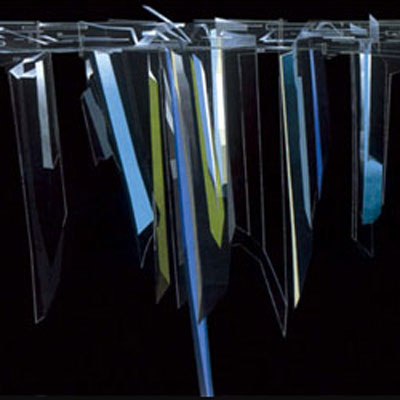
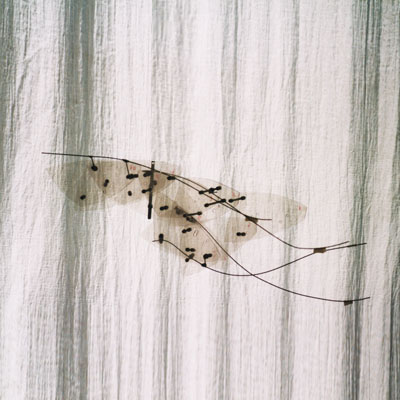
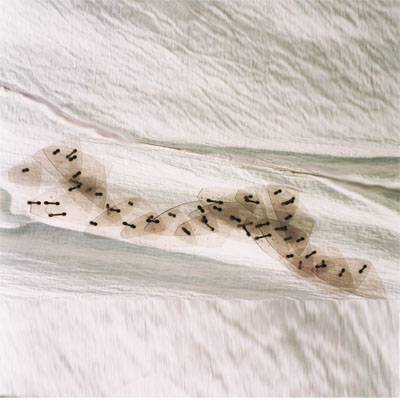
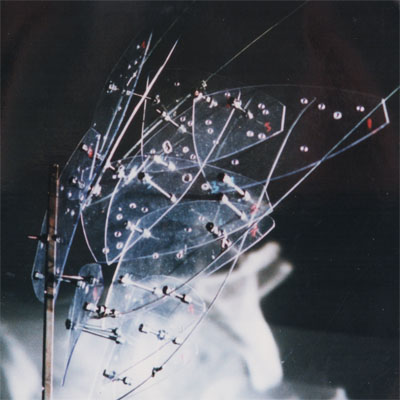
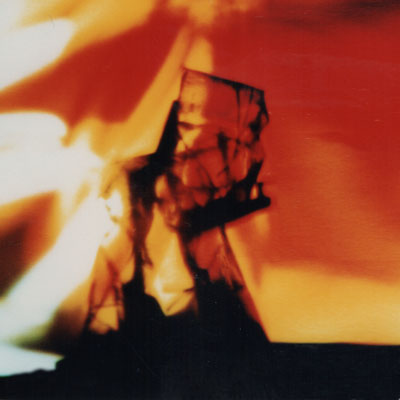
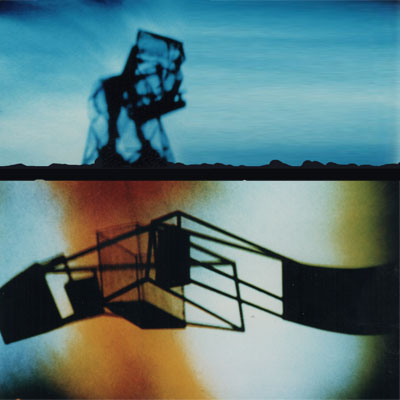
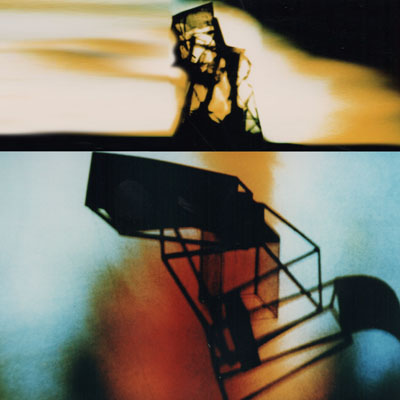
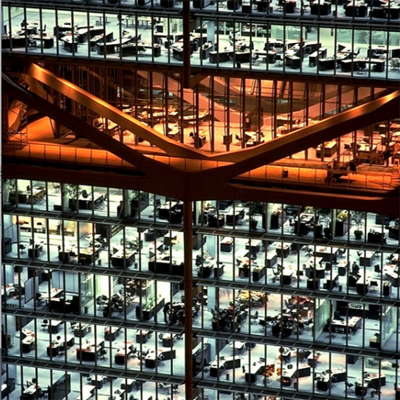
The outer photovoltaic fritted skin converts the suns energy to electricity. Each floor has its own battery storage, distributed where required throughout the plan. The localised battery storage is fed during the day by the sun and at night by low cost electricity. Electricity is also produced via turbine generators driven by escaping air at roof level at the top of the heat stacks. The outer skin of the building attempts to mimic the structural colouration of a butterfly’s wing. In 1991 when the project was conceived, glass could not be etched at a micro scale so a coating was applied to attempt to achieve the equivalent colour refraction. It was assumed that the coating could be choreographed through controlled wave interference to refract light within a prescribed colour range. Exact intonation of colour would depend upon the lights direction. At night when the office lights are on and the skies dark, the refractive skin reverses to emit coloured light. The image is of an early maquette of the Yoko Towers with the offices against a night sky.

This project like many other personal projects included within the diary text were completed in my twenties and early thirties. Unfeasible at the time of conception the projects deserve review, as many of the ideas from which they evolved are as relevant today as they were unpopular when first drawn.

The Surrogate Twin

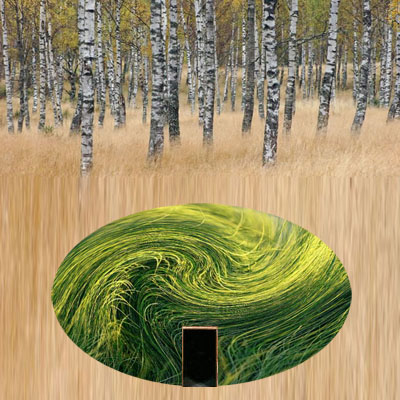
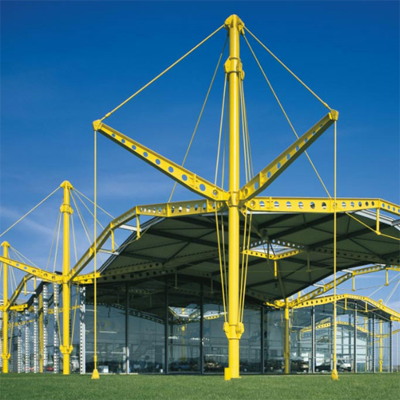
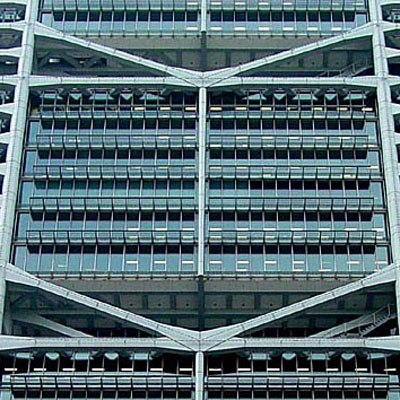
Images left to right. 1 Compass Termite Mounds of Northern Australia.  2 Yoko Towers.
Posted on

291216 – Story Board – London, W2

​​​291216 – Story Board – London, W2 > words

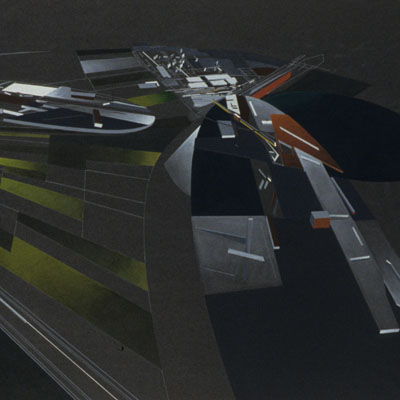
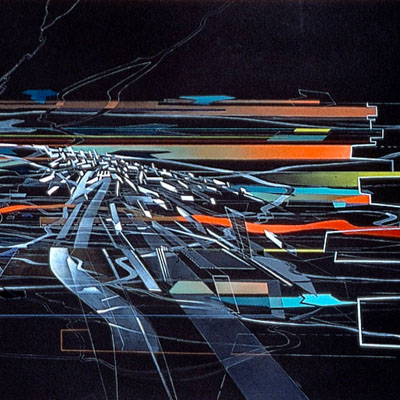
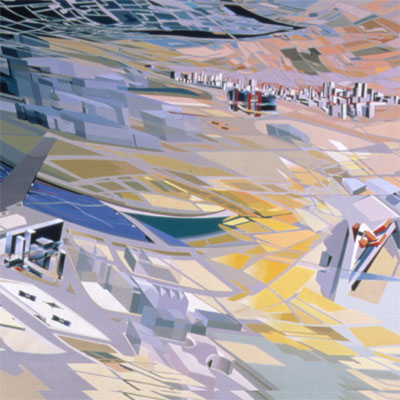
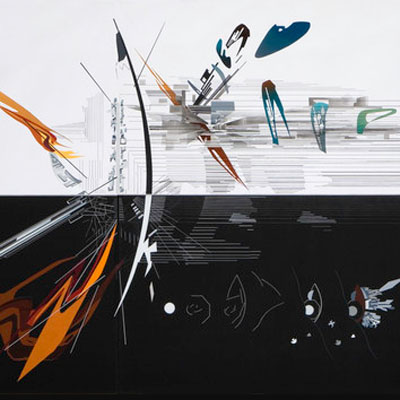
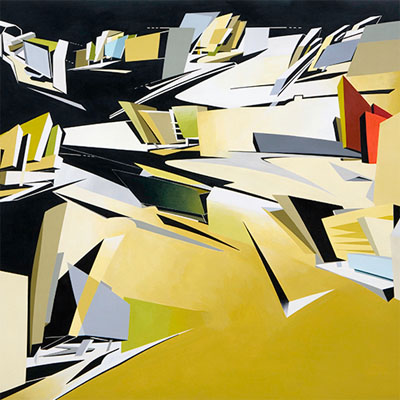
Zaha Hadid, paintings, The Serpentine Sackler Gallery. It is impossible not to reflect on the influence of the AA on architecture during the 1970’s. It has been over thirty years since I last saw these paintings and with retrospect the AA and Zaha’s work are impossible to separate. There is the influence of Tschumi, Koolhaas and Zenghelis all plain to see etched across each canvas. Each painting is multi layered, a storyboard that builds the presence of the idea for a building. The drawings are elaborate sketches, they are produced before, during and after a project. They do not conclude but are instead thoughts in progress with notes from the margins all overlaid. A drawing may have two or three perspectives. The same drawing may be redrawn, recomposed using a different colour palette. The painting is the storyboard of this process but it is also a stepping-stone, it surmises and collates ideas about a project to a point in time from which the next part of the journey may begin. The drawing collates and inspires, it is fluid, has calligraphic speed it is poignant and expectant.

Traditional architectural drawing is a static conclusion of the work to date, it is slow and time consuming to produce and the drawing process often does not keep pace with the thought or development process. Traditional working drawings are also very much about resolving issues, structure, services, composition, context or massing. Zaha’s drawings search more for feeling, they are more intuitive, where intuition is the combined reaction of knowledge and experience. The space is painted as a sequential viewing, forcing the viewer to move back and forth as if they were walking around a sculpture. 

But the paintings are also more than a storyboard. The shifting perspectives and the changing light capture the essence that space and time are intrinsically linked and that we experience space by walking through and around it. That space itself is a moving entity on a spinning planet orbiting a star that is its life-blood. As the space follows this trajectory it encompasses the diurnal range of light and dark, the seasonal range of hot and cold, wet and dry and the passage of time. The building ages and with aging its context is changed, both the historical context from which the space is viewed, the physical context in which the space is grounded and possibly also the utilitarian context in which the space is used. Through all these movements the space is slowly forever in constant flux.

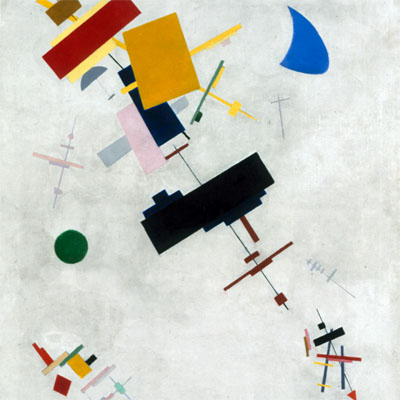
In Zaha’s paintings we can see the influence of Tschumi, where space and event are a symbiotic filmic sequence. The paintings are optimistic, devoid of history, forward looking. The drawings are also a way to focus and direct the conversation by editing out all that interferes. Block colour simplifies the context to hue, light, shade and mass. Poetic license allows for the sweeping statement and through the sweeping statement we have access to the vision of what could be. Whole urban landscapes simply become faceted planes into which insertions are made (Zenghelis again). Then there is Koolhaas and the link to the Suprematists, the block axonometric that rides up the page like a medieval perspective. The Malevich Tektonik, the colour bock composition.

These are drawings of initial ideas and sketches, intuitively procured and then elaborately drawn by teams. They are large drawings that take time to set up as each is not a single drawing but is made up of multiple layers and perspectives. Some take months, the Trafalgar drawings would be one such example. They depict the Trafalgar Square project over a 24hour period, they show the square by day and night, from the back and the front, from near and far, they have elements that are transparent as both the inside and the outside are viewed. Zaha’s exquisite ‘eye’ for composition gives the paintings credence and beauty. Zaha’s aesthetic skill is one that few can match across an oeuvre of work that transcends so many mediums and scales.

The paintings are without question beautiful and are now very much part of brand Zaha, they surmise the direction, aesthetic and aspirations set by the designer. As tools for communicating a project they require considerable decoding, they are an additional language one needs to learn to decipher. Within the historical context at a time when all is ephemeral, transitory and evolving at such pace building a static representation of the movements and energies that shape a site may be, at this point in time, a necessary response. To represent the fluid is to build with fluid forms.

See also text 310316 – Zaha Hadid – London.

Images left to right – Details from – 

1 Kazimir Malevich (1878-1935) 2-7 Zaha Hadid.

The Surrogate Twin

Posted on

271216 – Distance – London WC2

​​​271216 – Distance – London WC2 > words

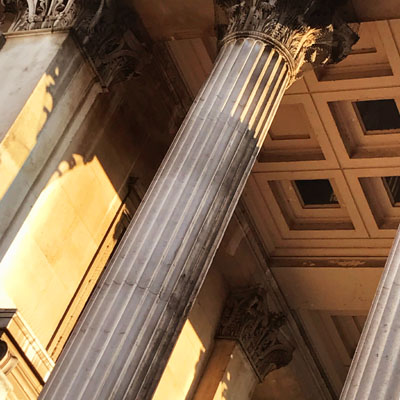
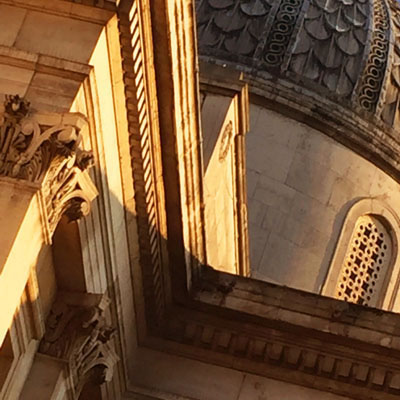
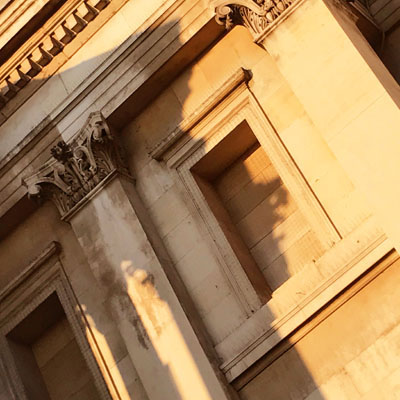
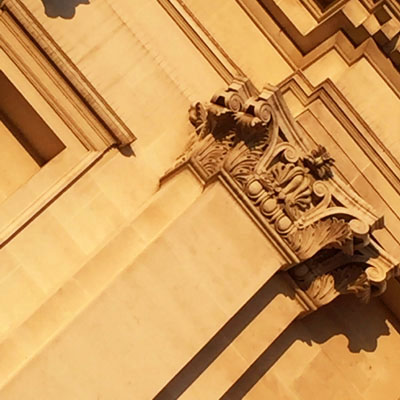
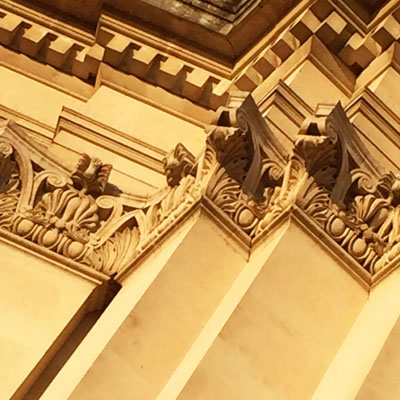
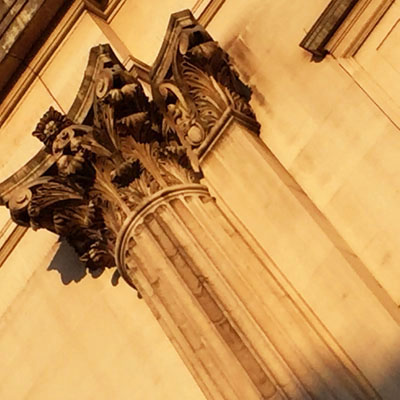
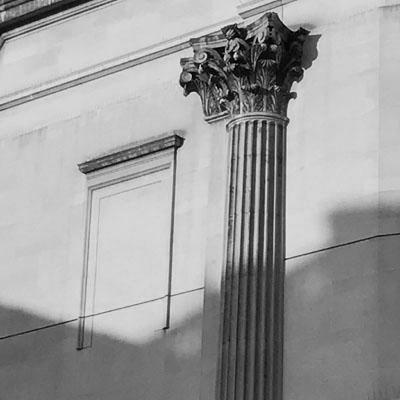
We are off to visit the Caravaggio exhibition for a second time. As we turn the corner to approach Trafalgar Square from the west the low winter sun hits the National Gallery hard on its face; the lights beauty stops us in our tracks. The low sun brought relief to the moldings and cornices, adding definition, warming the yellow Portland stone whilst articulating all of the details of William Wilkins façade. It was a rare opportunity to fully appreciate a London building so often hidden by English overcast skies. Ruskin’s Seven Lamps promptly came to mind, Venice at sunrise or sunlit cobbles in a sleepy Italian hill town….but then there was a pause as I said that light had travelled 149 million miles to hit that façade. We Googled the travel time, light travelling at 186 thousand miles a second took eight minutes to travel from the sun to the National Gallery.

It is difficult to comprehend space speed and distance, 149 million miles in eight minutes, 18.6 million miles a minute. We understand space-time only from speeds that we regularly experience, long distances are most frequently experienced through car travel and this forms our all-encompassing concept of scale. At 60 mph, a mile a minute, quite fast and a legal speed, London to Bristol, 120 miles is 2 hours, London to Manchester, 210 miles is 3.5 hours. If we had lived in the 18th Century our all-encompassing concept of scale would be the horse and carriage with a speed of approximately 6 mph, London to Bristol 20 hours, London to Manchester 35 hours. Our experiential conditioning of space-time prevents us from fully comprehending our insignificance within the universe.

A light year, the distance light travels in a year, is six trillion miles, again a meaningless number, even more incomprehensible when written 6,000,000,000,000 miles. Our VW Golf is happy at 60 mph. one light year at VW Golf speed is 100,000,000,000 hours or 47,915,668 years. So in our VW Golf, assuming we would need a couple of sandwich breaks it would take 48 million years to travel one light year. The nearest star to the sun is Alpha Centauri 4.4 light years from earth, the Golf’s not up to it.

There are approximately 300 billion stars in the Milky Way, if, assuming 10% of them have planets, there are 30 billion planets in our galaxy alone and there are over 100 billion known galaxies in the observable universe. Our concept of space-time is so wonderfully inadequate and our present ability to cross such distances is so far out of our reach that it will be some time before we can ”boldly go”.

If Einstein’s Theory of Special Relativity is correct and that energy and mass are interchangeable, speed of light travel is impossible for material objects that weigh more than photons. The energy needed to move a material object at the speed of a massless photon moves to an infinite requirement as it approaches the speed of light. Warping space to move an object instead of increasing its kinetic energy is a purely theoretical solution to the problem although one adopted by many science fiction writers. Star Treks warp drive is a scalable measure using the formula v=w3c where v is velocity, c the speed of light, and w the warp factor. Therefore warp factor 1 is the speed of light, warp factor 2 is eight times the speed of light (23) and warp factor 3 is twenty-seven times the speed of light (33). Warp factor 10 theoretically reverses time.
Discovering the means by which to cross such colossal distances will be the equivalent to the wake up that followed the Hellenistic astrologers proof that the world is spherical and not flat. (The world as a sphere was conceived by the Greeks in the 6th century BC and proven in the 3rd century BC). Until we are able to cross such immense space-time distance our only interplanetary explorers will be Hollywood movie stars, the occasional Vulcan and of course the suns photons.

Images 1-7. The National Gallery at Sunrise. 7 Robert Venturi’s Post Modernist Trace.

The Surrogate Twin

Posted on

211216 – Electronic Gallery – London c06/1992

​​​211216 – Electronic Gallery – London c06/1992 > words

Flock Project June 1992.

Invented in 1904 the air curtain is a pragmatic form of invisible non-material boundary. A sheet of energy separates two temperature zones with a fast moving airflow screen preventing the internal and external air pressure from equalising. The air curtain is a primitive form of invisible architecture, a type of force field protecting an interior enclosure.

In the late 1960’s the work of Super Studio montaged an architecture that had been reduced to pure energy, there are no buildings or monuments, no borders or boundaries but instead environs that facilitate and enable life. These were politically conceptual projects conceived for an idealised continuous space, the space of John Lennon’s 1971 Imagine.

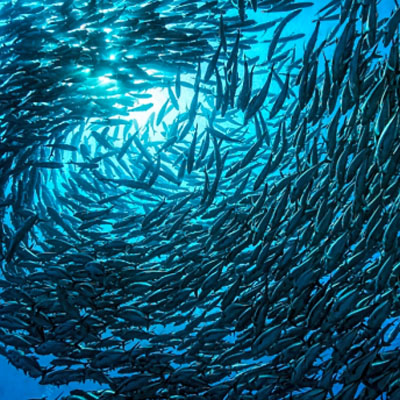
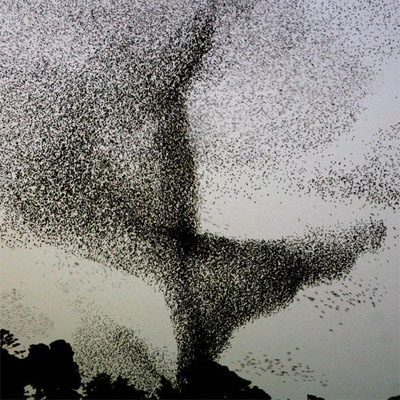
Architecture is organised simplistically, usually with serve and servile zones punctuated by service cores that provide for and support programmes. It is possible to organise a more liberal architecture directly from the programme by deconstructing, re-writing and overlapping programmes. Destructed programmes form compositions that are multi-layered like a musical score, the resulting spaces more liquid and transitory. Flock swarming or fish schooling describe types of organised collective motion of numerous individual members that move as a combined whole. This is usually used as a means of defence by magnifying the spatial consequence of the colony. The flock or school move together with equal speed and direction, instantly and collectively responding to events, actions and dangers. The swarm or school is a kinetic spatial organisational system producing a fluctuating architecture appropriate for software driven spatial typologies.
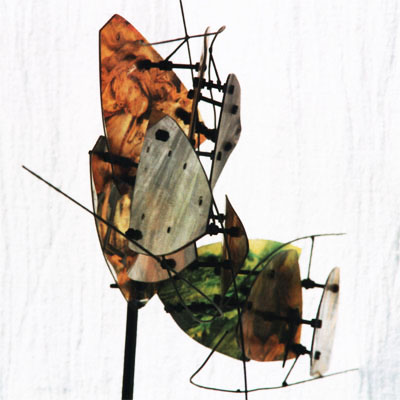
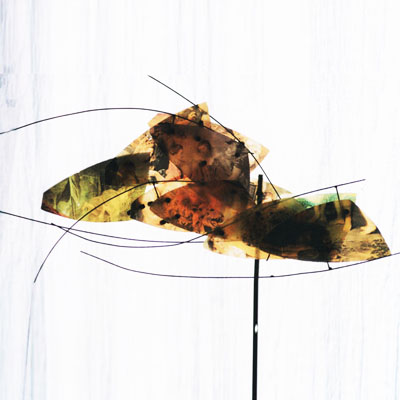
The Light Flute was an initial experimental maquette, it was deliberately shaped like a flute, one end was held and from the other streamed ‘notes’. The ‘notes’ were interchangeable transparencies on stems. Hold the Light Flute to the sun and light through the transparencies modulates the physical space upon which the light falls. The purpose of the Light Flute was not to throw image onto surface, although that was part of its function, but instead to represent the dualism within the concept. When the Light Flute was offered to someone, they would hold it, study it, enquire about its purpose but almost always eventually hold the Light Flute to their mouths and mimic playing. Here without any causal or rational reason an object had directed the behaviour of the user. The Light Flute is an instrument that both modulated space and behaviour. The Electronic Gallery is a larger instrument of the same type.
Film space is an instantaneous scale less space, it can compress and extend time, slow it down and speed it up, it can advance or recede the picture plane expanding and collapsing our perceived physical enclosure. In film space the subject may be viewed simultaneously from several directions, close up or from afar and as such it portrays space as a group activity or a collective Borg experience. The space may also be described by the experience of the subject, the dog running through the woods, the bullet cartridge being discovered. Film space plays forwards and backwards, it loops and replays, it zooms in and out, becomes focussed an unfocussed, it can be colour intense or de-saturated. Film space is a constantly narrated and orchestrated space, well edited and cropped, perfect, hyper-real as it makes public the most intimate whilst normalising the most brutal. Film space is a ride, the viewer is carried through a sequence of pre-determined events, shown what to see, when to laugh, when to walk away. The space is shared, emotions shared, fear as a group activity, we are dragged into the fight; we stand alongside the assailants, within the circle of aggression. The viewer experiences the car chase, the motorbike ride, the crash and the inevitable recurring death. The death can be experienced from inside the subject, as all focus is lost, eyes slowly close and the skies turn black. Through constant saturation we have become immune to film space we accept it as a normal interpretation of physical space, yet it is nothing like the real space we inhabit.

The Electronic Gallery set out to explore the impasse between our understandings of film space and physical space, between conceptual synthetic space and real space. It set out to explore the synchronistic potentials within the simultaneous experience of both spatial types. The Electronic Gallery reinterprets a real time walk by wrapping it in a swarm of choreographed spatial sequencing. The brief questioned both the cinema and the traditional gallery as an appropriate typology, it made a pragmatic shortcut into an abstract meander with a spliced array of alternative spatial experiences en route. The architecture was to be reduced to the liquid medium of film. There are no service cores, no secondary programmes, there is no enclosure and the structure is removed from the immediate spatial experience. Each picture plane, a two-dimensional surface, becomes a tesseract of evolving spatial types working in isolation or together as a hive mind collective. The synthetic space of the picture plane modifies the physical space through its discourse. A building consists of hardware and software, form and event, the Electronic Gallery moves towards the presentation of pure software, the space as energy, liquid, volatile, a womb or an abyss. 

The space of fire is a space created by pure energy, it has its own dynamic, is self-forming, it is not a space of enclosure, skin or structure. The Electronic Gallery is a self-morphing space fuelled by the energy of information, sequenced interactive software. It can be fire, water or woods, it can be macro or micro, inter planetary travel or journeys through nano landscapes. The space can be subjective and personal, augmented solely for private consumption. As architecture becomes more kinetic, responsive, space modulating, the system that organises it will need to be more fluid. The Electronic Gallery would be an ongoing experiment, an instrument, a spatial research tool for assessing space-time juxtapositions.

Synthetic space is a timeless medium, it can represent a space that is happening elsewhere simultaneously, represent a space that happened several years previously or be a space that has never existed at all. In it one can listen to spaces from other times, smell fields and factories, interact with it, push through the synthetic forest to discover past or future worlds. In synthetic space the real world has been decontextualized, manipulated, edited, tempered. This hyper-real intensity makes the synthetic space more real, more violent, more exotic. There is a constant dialogue and discourse between real and synthetic space, as synthetic space intensifies to become more real, real space emulates it to catch up. The fictional and the real interact, one directs the other. As real space tries to imitate its super-intense fictional counter part, the fictional space increases its intensity to further distance the real. The fictional synthetic space has been edited and recomposed to deliver hyper-real intensity. One subjectively and subconsciously edits real space-time to align with the concepts and expectations of constructed synthetic space-time. Real and synthetic are mutually interactive, influential and directive this is a self-propelling cultural relay loop.

The early maquettes of the Electronic Gallery explored the spatial ideas of swarm organisation and were left clear. Other early maquettes employed the use of a previously created synthetic space, Peter Paul Rubens (1577-1640) paintings of Marie de Medici, Queen of France. These were painted as a series of twenty-four four meter high frames that depict events throughout the Queen’s life; by default they incorporate time and could easily have been a storyboard for a film and of course they were pure fiction. Marie de Medici was an unremarkable person with an unexceptional life. Rubens paints her as a divinity taught by the Gods, a French heroine of extraordinary adventures, noble deeds and fearless undertakings. Thus immortalised this is the image that history adopts and with the adoption of the myth her real world powers increase.

In a world that is a copy of a copy of a copy, that is simulated and re-assimilated there is little attachment to anything natural. i.e. strawberries not tasting like strawberry drinks, that in turn make suppliers genetically modify strawberries to taste more like strawberry drinks. This is our world, the world in which we live and architecture and film should explore this space.

See also Fruit Pastels 161216

Images Left to Right. 1 Herrings School, 2-6 Electronic Gallery, 7 Starlings flock.

The Surrogate Twin

Posted on

​​​231116 – UK Infrastructure – London

​​​231116 – UK Infrastructure – London > words

It is a point of national embarrassment that UK politicians are famous for their endless indecision. Brexit has further diverted valuable political time away from more urgent global concerns and these include: Climate Change, how to reduce the UK’s dependence upon fossil fuels especially the immediate reduction in the use of coal and UK infrastructure, the need to replace and update the UK’s outdated Victorian infrastructure. The two concerns are inter-woven; infrastructure and the decentralization of the UK energy supply should be tackled holistically. Decisions of this type are long term and should be made outside the remit of the four yearly political cycles. The Infrastructure Commission is a start and one hopes that they will have the power to do more than just churn reports.

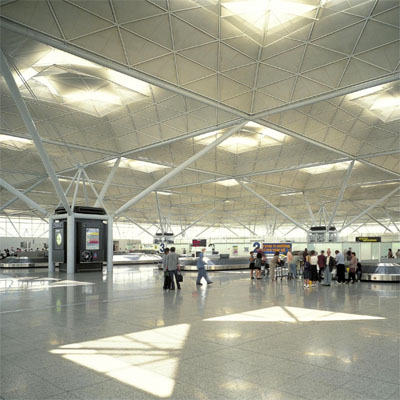
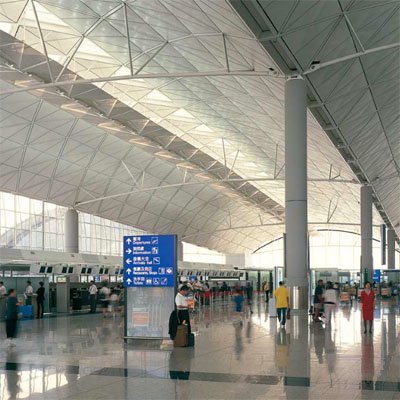
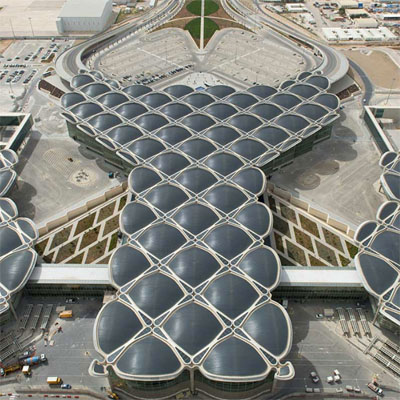
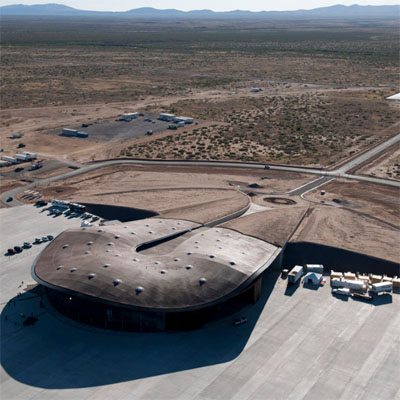
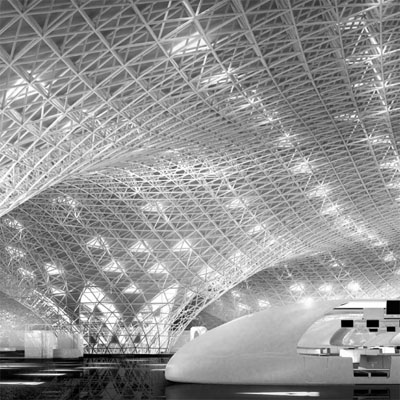
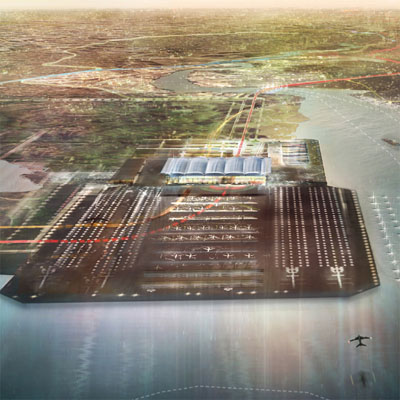
Fortunately for the UK the most qualified to provide infrastructure solutions have their main office at Riverside on the Thames. So when Foster and Partners offers the UK a solution to its infrastructure problems the UK would be wise to listen. Foster and Partners have been consistently providing quality infrastructure solutions for decades their CV is beyond reproach. Thames Hub is Foster’s solution and although strategically I differ on how best to deliver this, (see the 2014 letter to City Hall copied below in the postscript) the UK needs to make this call. An airport is the gateway to and from a country. As a building type it is beyond a pure utility, a machine of logistics, but also is a built representation of a countries values and ambitions.

Foster’s early approach to airport design was to capture the excitement of the pioneer open grass airfields. These were little more than tents around a field but the sequence of arrival, boarding and the visual connection to the planes has been a generating concept even in the largest and most complex of Foster’s airports. The ground plane is kept clear and uncluttered, all air conditioning and services are removed from the roof scape and ceilings and natural light floods the forecourts. All of the mechanisms that make an airport work are below the ground plane and out of sight. This enables the mechanisms that facilitate the utility component of an airport to be contained within an efficient lower level metaphorical black box whilst freeing up the ground plane and the architectural component. This concept is not new and can be seen in Mies Van Der Rohe’s Berlin National Gallery but applying and delivering such a concept with clarity to extremely large and complex airport projects is no small achievement. It is this clarity from concept to execution that makes Foster and Partners apt at infrastructure design. As a design consultancy they have the ability to assimilate huge quantities of data, statistical, political, financial, engineering, architectural, logistical etc. and from it deliver a coherent, rational, achievable and poetic conclusion. Additionally to this Foster and Partners are able to see further opportunities and potentials that can be incorporated into a fully all-inclusive design solution.

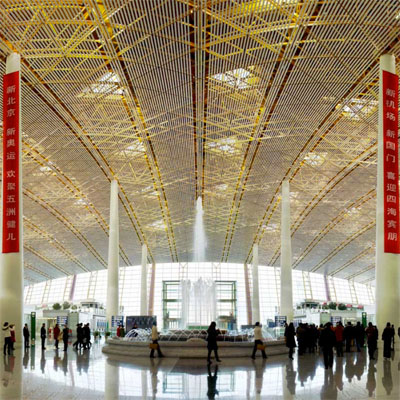
To be able to do all of this and still deliver an architectural poetic is extremely difficult and very few practices attain such skills. The gem of the gems is Beijing airport as it not only resolves the complex issues of airport design but it is also has incredible culturally site specific personality.

The images above provide seven reasons why the UK needs to replace continued indecision by making the right decision so that she can remain a country of ambition and conviction.

The Surrogate Twin.

Postscript. Letter to the London Mayor 080914,

The past year has seen the debate over how to improve Britain’s airports fall into unproductive disarray with each protagonist fighting for his corner. Business, Contracts, Licenses, Capital allocation and Politics have taken all clarity from the underlying problem of how to prepare Britain’s infrastructure for generations to come. This is most apparent in the fight for individual airports and not how best all airports may serve the countries needs.

Historically the two principle airports of Gatwick and Heathrow have developed South and West of the capital. This has been due partly to the available space and sensible location of the original recreational and military airports and later reinforced by surrounding affluent and educated market catchment areas. These conditions have changed dramatically as demographics have moved east along the Thames corridor. The building of Stansted acknowledged this demographic shift and for two decades London has been served by three airports Gatwick, Heathrow and Stansted all working together. Each airport provides an overlap with its neighbours in catchment area and services provided. The triangulation of the airports around London and the influences on the areas beyond has provided a balanced infrastructure organization. However this balance has now dramatically changed as population density increases along the Thames corridor replacing redundant industrial sites and disused quarries with housing, offices and retail centers. The growth eastward will continue for decades to come and the balance of the serving infrastructure needs to accommodate this. 

There is of course an additional need to better link the North with the South with an improved railway spine to revitalize the ’Industrial North’ that has been neglected by successive policies favouring service industries over manufacturing industries. There is also a need to link and encourage collaboration between the main university and research centers of Cambridge, Oxford and London as the UK’s IT, Robotics and Biochemistry development and procurement has fallen behind the US and other developed nations.

Looking at how to best improve UK airports without having to steer through the thick political fog one may well note the following points:

It is understandable that UK politicians have neither the confidence or the finances of the Victorians………..the Empire is long gone.

Increasing flights to Heathrow is at best unwise. Heathrow is a major international accident is waiting to happen.

There is only one London airport that was designed from the outset to accommodate growth and potential future increase in flight traffic and that is Stansted.

And arrive at the following conclusions:

Stansted should be allowed to increase capacity as this would provide the most efficient short-term fix.

Simultaneously Thames Hub to be developed as a two Phase scheme with 50% of the proposed scheme developed as Phase one.

On completion of Thames Hub Phase One flights to Gatwick and Heathrow would be diverted to Thames Hub.

Thames Hub Phase Two to commence.

All flights from Gatwick diverted to Thames Hub and Gatwick closed and the land re-developed.

On completion of Thames Hub Phase Two the majority of flights from Heathrow diverted to Thames Hub. Heathrow to continue but with much reduced capacity. Heathrow could be developed as a new short haul airport west of the reservoirs with its existing buildings and land re-allocated for industrial/office use.

The then three remaining airports of Thames Hub, Stansted and Heathrow would be better balanced to serve the infrastructure needs of future Britain. Valuable land re-claimed from Gatwick and Heathrow would contribute to infrastructure funding.

Not using Foster and Partners to develop a credible infrastructure plan could be the UK’s greatest mistake.

Posted on

​​​161116 – Fruit Pastels – c09/1991 London

​​​161116 – Fruit Pastels – c09/1991 London > words

Fruit Pastels – When will my apple taste as good as my apple drink? 

Aspirational Living and the Predator House Project September 1991.

In the early 1970’s we ate Instant Whip in day glow bright orange, greens and pinks, we wore platform shoes finished in metal-flake purple fauve leather with snakeskin toes and heart shaped buckles, we listened to Glam Rock and lengthy concept albums. The Bounty bar arrived from its tropical island delivered by a dusky mistress of the sun. A would be Bond risks life and limb to transport his gift of Milk Tray. Manikin cigars, those that make ‘you’ the real man, are hand rolled by a husky voiced exotic Amazonian, she’s curved with ample everything. We dressed as genderless rock stars, we jacked up our cars, added false bonnet scoops and spoilers, covered our seats in leopard print. We were sold the dream of this aspirational life and we soaked it up as the reality of the 1970’s with its poverty, unemployment and endless strikes was just so bad. The 1970’s were escapist and fake, a dreamland created for a society that needed diversion from dissolution. This aspirational life became our reality. As our presold dream always outperformed our real life we soon began converting reality to daydream and in this, and only in this space, could we bare to exist. Club life, football life, fanzines and groupies anything to replace the soulless decanting of the nine to five. The TV screen became the primary habitable space. Decades on the separation between reality and imagined lifestyle continues to grow, it blurs and strengthens until the line between real and unreal is so normalised that we all now live suspended within the dream hoping for a better tomorrow.

How can we exist in a world where our dreams by far exceed our obtainable reality without falling under the blanket of depression weighed heavy by our own obvious inadequacies. Our expectations are pre-set so high that life is now solitary as one is never quite able to meet the ideal, perfect in everyway partner, the one we were supposed to meet through our TV ad compatible surrogate.

Predator House explored the potential of these issues to create a house for those that enjoy being marginalised and disenfranchised. With the adaptive camouflage of the chameleons skin, LEDs in the glass mimic the surroundings. Above ground the house does its best to be invisible, an anonymous wallflower, the critic in the corner, the shadow. The outside world is viewed at a distance the house offers a safe arms length third party lifestyle. The Predator House hides as a Rene Magritte’s Le Blanc-Seing, a visual static breakdown, a glitch in the system, the home of a misplaced, misled, misfit. The space above ground, the glasshouse, has no intent to be lived in but instead is the guise of the voyeur, a hidden space from where reality can be viewed. It is below ground where one inhabits ones preferred well-edited, non-confrontational, aspirational realities, the daydreams. Space here is in constant flux, it adapts to ones moods, it can be pre-set and predetermined, its intensity can be turned up and down as wished, just as one sets mood and volume for music. The space could be left on constant shuffle or instead explore a pre-chosen compilation based around the theme of happy yellow or whatever one wishes. The virtual plan of the below ground far exceeds its physical enclosure as it can be both room or landscape, a country walk or a comfy sofa. The space is a virtual space that exists in real space-time blurring the edges of what’s real and imaginary. It is the celebrity space I want and not the mildewed, rental, rat infested, HMO micro pad, four jumpers and a set of thermals, space that I got.

See also 211216 The Electronic Gallery

Images from left to right.  1-3 Predator House; 4-6 below ground Synthetic Space, 7 Rene Magritte’s Le Blanc-Seing.

The Surrogate Twin

Posted on

041016 – Collaboration – V&A London, SW7

​041016 – Collaboration – V&A London, SW7 > words

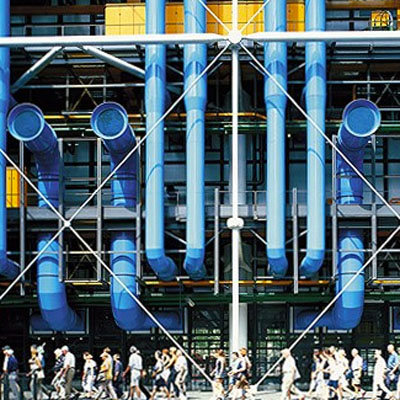
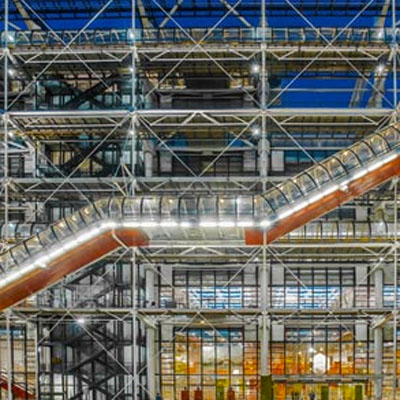
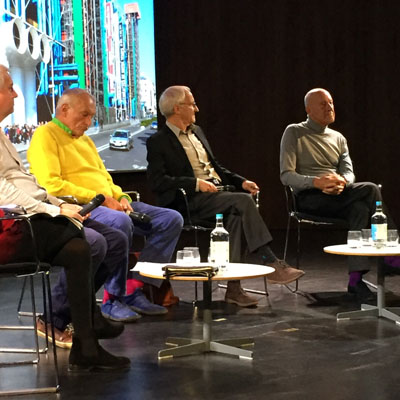
Engineering High Tech Architecture continues the V&A’s 1960’s revolution theme across many of its current exhibits. Foster, Rogers and the Arup engineers discuss the collaborative projects of the early days of High Tech Architecture. The talk was an informal discussion as opposed to a lecture explaining engineering issues and how they were resolved so in some ways disappointing. However, there was a powerful naïve optimism to the early 60s and 70’s architectural movements. Architects almost straight out of college landed huge competition wins and established themselves as the ‘Rock Stars’ of architecture. All architectural students, myself included, would have pawed endlessly over their projects so each project is very well known. The evening was without doubt nostalgic, like watching the Rolling Stones play a pub gig in 2012. Superstars all in one room, you could ask them questions, shake their hands, scream Beatles style (though no one did) or sing along. The stories of the early projects have been told so many times the responses, punch lines and musings could have been pre-quoted by most of the audience. I guess we were all fans saying thank you one last time. The evening was warm and heroic, the speakers had all lived such influential and fantastic lives and together had achieved so much.

We didn’t leave with improved knowledge but it was an evening we would never have missed. A salutation and a big thank you to Lord Foster, Lord Rogers and the Arup team.

The Surrogate Twin

Posted on

040816 – Synthetic Landscapes 4 – Canopy

​040816 – Synthetic Landscapes 4 – Canopy > words

Synthetic Landscapes should be read 1 through to 4.

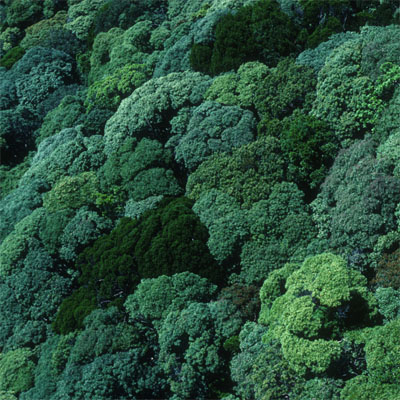
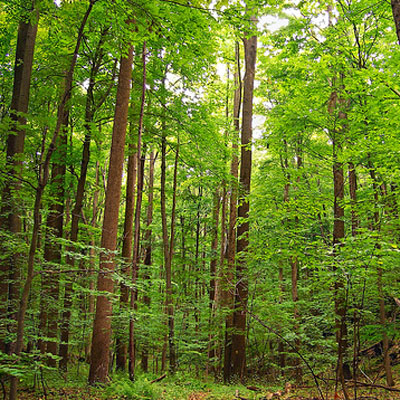
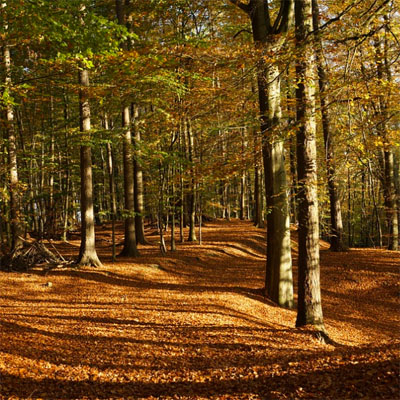
Canopy is not a synthetic landscape, it is the natural three dimensional immersive responsive environment in which we are both actuators and reciprocals of its system. It is the landscape that we have forgotten as it has been removed from nearly all of the developed world. We continue to see nature as pastureland, viewed from the comfort of our car, a continuous surface of green rolling hills. Today’s pastureland was once forest, ancient, wild and untamed, a dense impenetrable mass of moss, lichen and fern, dark, damp and full of life. We wiped these systems away to graze our cows and grow our corn. There is a need to reintroduce the tropical and temperate forest so that it can again become an integrated part of the sustainable world.

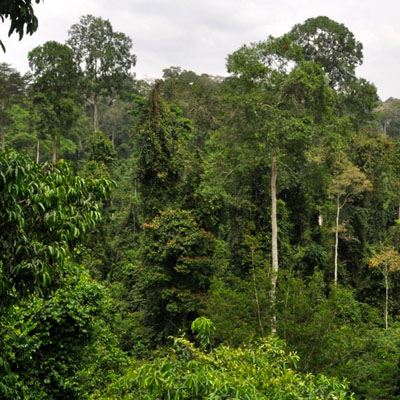
The rain forest is a complex system of interrelated species. The rain forests are a dense layered mass of vegetation with each layer having a specific role and housing its own eco system and yet together they work as a symbiotic system. The rain forests are typically wet and tropical and are home to the majority of all species on earth, they re-oxygenate the air and consume carbon dioxide. The forest floor is a rich but shallow new earth and the symbiosis within this ecosystem’s layers continues below ground. Rain forests are dynamic living environments and as such the stratification is not always clear with many overlaps throughout the forests development. The rain forests water cycle is an efficient circular system. Plants roots take up moisture and nutrients into the canopy, falling rain is often caught by the canopy. During the day as the forest heats up water evaporates forming clouds that in turn become the next days rain. The process feeds the forest and purifies the water, the nutrient cycle is self-feeding. Rain forests have constant climate and constant rainfall allowing the trees to be deciduous yet evergreen, continuously growing and shedding leaves. Rain forest soils are often infertile, shallow acidic and stained red due to high concentrations of iron oxide. The soil needs the forest as much as the forest needs the soil.

Layer Stratification

The emergent, the tallest of the trees are those able to withstand strong winds and excessive heat, these may rise fifty meters above the ground (seventeen stories), some are able to reach heights of eighty meters. Their role is to break new ground to form the shelter under which new forests may grow.

Below this is the canopy layer a continuous coverage of foliage 30-40m above ground. The canopy is one of the richest unexplored habitats on earth with over a quarter of the world insects and half the worlds plant species. Many species never leave the canopy either to venture up to the emergent layer or down to the forest floor. Epiphytic plants grow within the canopy range, they attach themselves to trunks or branches and obtain all of the water and nutrients they need from falling rain and debris.

The understory or under canopy sits below the canopy, only 5% of the light that hits the emergent layer falls to reach it. Leaves become huge waxy plates that try to absorb as much light as possible. The understory is home to larger mammals.

The forest floor, the lowest level with only 2% of light reaching its surface where plants adapted to low light can survive. The forest floor is relatively clear with less diversity and speciality species that can grow with such low light levels. The floor is made of decaying plant and animal matter that decomposes quickly due to the humidity and heat. Fungi feed on the decaying organic mass that is rich in nutrients but poor in humus. Buttress roots are common in the shallow soil as there are few nutrients or minerals at depth. The buttresses are structural and the roots spread to a wide supportive base. Where the roots break the surface ridges help to channel water and fresh nutrients into the root system. Collectively interlocking root systems stabilise the soil and protect the weak soil from erosion. On average rain forests receives 2m of rain per year and this amount of water leaches soluble nutrients from the ground. Large mammals are able to roam the forest floor as it is has sparse vegetation.

Below the forest floor are the decomposers and these are vital to a nutrient dependent forest. Decomposition rates are high due to temperature and humidity levels as well as armies of microorganisms, bacteria and fungi each with a decomposition role. Nutrient recycling is essential as the below ground resources support the above ground biomass and all of its inhabitants. In breaking down leaf litter microbial organisms turn organic compounds into inorganic forms of carbon that can be used by plants. The microbial community respire taking up oxygen and releasing carbon dioxide.

Ecosystems benefit mankind in numerous indirect ways primarily through cleaning, air and water, and decomposing and recycling wastes. Ecosystem services have recently been given economic values and categories such as; supporting, provisioning, cultivating and cultural. The purpose of this is to try to add a comprehensible value to systems that work in the background supporting other economic or social criteria. The problem with this is that the values and assessments are still homocentric and not planet focused. Of the four criteria:

Supporting – services that are necessary to support all other ecosystems.

Provisioning – includes the provision of food, medicines, mining, water, minerals.

Regulating – carbon detoxification, waste decomposition, water purification, prevention of soil erosion. Cultural – would include scientific, educational, recreational, spiritual.

In summation the natural landscape, that of the forests, are three-dimensional immersive environments with complex integrated systems supporting a multitude of diverse species.

What is the difference between our concepts of landscape and wilderness? Landscape is allowed to be farmed as farming is conceived of as part of landscape. Wilderness is the unknown, undiscovered wild. It is conceived as the primitive romantic allocated to pockets of other worldliness kept somehow in isolation and suspension. The ecological and environmental as opposed to spiritual concept of wilderness is historically relatively new. The vital influence of independent beings outside of mans homocentric notions and rules is difficult for us to comprehend. The idea of coexistence, that we are part of a much greater whole alienates. The domestic landscape in any form is not a true wilderness, species diversity and proliferation need to remain untouched by humans. So in this over populated world how can the concept of natural exist?

Modern landscape is determined by policies, government directives, subsidies, global markets, where land only has a value measured by its economic return and the bias of that return is manipulated according to policies. This problem is compounded as all land is now owned, split into networks of estates and small holdings each with their own agenda. The concept of ecological coexistence is meaningless in such an environment. Short sighted political competition strives to support short-termism to appease the demographic popular mass. Global policies are powerless and perhaps only patronage can collect, save and set aside natural landscape. The constant depletion of resources through monoculture is unsustainable and their replacement with variations of polyculture at present unrealistic. We live in an ever-increasing synthetic world supported by synthetic systems and a reduction in human population is the only way to attain a balance.

So what can be learnt from these short essays on synthetic landscapes? Firstly we view things incorrectly, we are too close or too far away. The heart zooms in close and the intellect seeks overview but both of these approaches misses the point as they reduce landscape to surface, the landscape as the rolling plane or the flower as a smooth petal. We read landscape in the abstract, in books, from IT, from above high, in our towers or from the cliffs, or we walk on lawns and admire two dimensional compositions of arranged fauna. We flatten to overview, to control and understand and in so doing we have forgotten that nature is not like this and that we are part of it and not above it. In the essay Synthetic Landscape 4, The canopy landscape is truly three dimensional and we are engulfed by it, it consumes us and orders us, to inhabit it we have to live within its rules.

Secondly after surface we desire objects, totems, souvenirs, monuments, effigies. Our elementary three-dimensional understanding loves products. Architects are living proof as they have for centuries built objects to be viewed from above, studied first as drawings then as models but always viewed on the desktop. Even when built high in the city buildings are visualised in the mind as a totality, as a clearly defined object with an enclosing perimeter. Natural landscape is a dynamic, ever adjusting variable, an emerging responsive nebular conclusion of interrelations. 

In conclusion, system diversity is essential to efficiency.

The Surrogate Twin

Posted on

030816 – Synthetic Landscapes 3 – The Automaton Gardener

​030816 – Synthetic Landscapes 3 – The Automaton Gardener > words

Synthetic Landscapes should be read 1 through to 4.

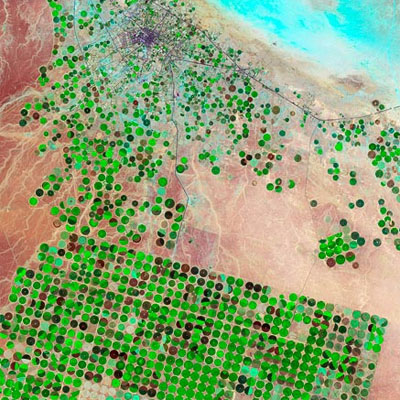
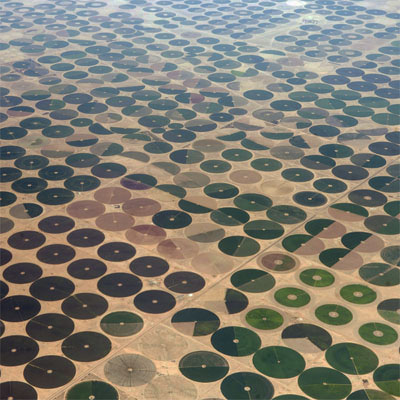
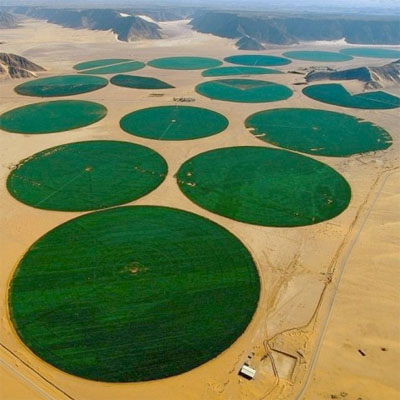
Landscapes in extreme environments are heavily nursed. Central pivot irrigation provides the most common form and these create surreal circular patterns that are seen clearly from above. The simple technology, invented by Frank Zybach in the 1940’s, consisted of a boom sprinkler system fed from a central point. The interlocked booms can be 500m in length, these rotate about the central point so a 500m length would create a 1km diameter circle but an 800m diameter circle (400m boom) is the common norm. The sprinkler booms are supported by trusses, these in turn are supported by wheeled towers driven by electric motors. The outer edge of the boom, the perimeter of the circle makes a full rotation every three days. Water is evenly spread and the outer edge of the boom travels at a faster pace than the inner parts and therefor covers a greater area. Holes that distribute the water from the boom are correspondingly larger towards the ends of the radii. Central pivot irrigation best suits large areas of flat land and are often located over subterranean aquifers. The more efficient systems employ hoses that deposit the water directly onto the ground next to the plants and cutting evaporative losses that are high. Central pivot irrigation systems can use hundreds of gallons of water per minute but are still considered to be more water efficient than traditional farmland in specific locations. However by allowing farming to exist in areas where climatic conditions would not normally support farming, pivot irrigation quickly depletes underground water supply. It makes no long-term ecological sense to continue using central pivot irrigation in arid regions without controlling evaporative loss and better sustainable management amongst farmers. The aesthetics however are seductive; lush green circles carpet the desert sands creating extravagant geometries that can be viewed from space.

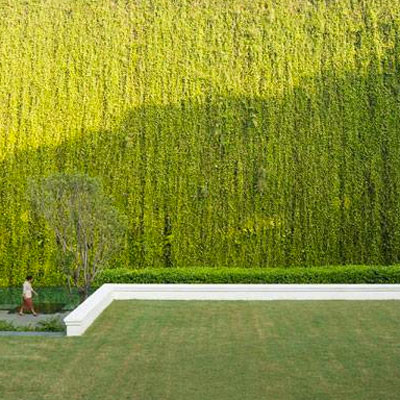
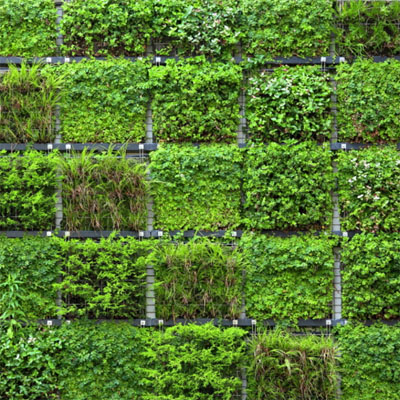
Vertical landscapes, Green Walls or Living Walls are indoor or outdoor vertical gardens. The vegetation grows on substrates of either loose dirt in trays, felts, woven mats or polyurethane sheet media. The media used is dependent upon wall height, scale and location but all consist of a grid system that has a feed of water and substrate panels. The walls are high maintenance, earth needs to be replaced at least yearly and matting panels every three years, replacement requires disrupting both the established aesthetics and planting. Vertical Landscapes using structural media have become increasingly popular as a means of covering large vertical surfaces and fifteen year life spans have been achieved. As the benefits of the vertical planting become better understood and with increased use further efficiencies will incur, including assisted natural ventilation of buildings.

Vertical Landscapes are of interest at the larger scales and could function and offer positive for both the built and the urban environment. Cities are heat sinks, acres of concrete paving, roads and walls all of which absorb solar radiation and re-radiate the absorbed heat allowing a heat build up in cities. Vertical Landscapes can help negate the affects of the heat sinks associated with building materials. Urban areas lack adequate green space, green walls can humidify, add oxygen, remove carbon dioxide and lower ambient temperatures. On a building they could help recycle grey water, shade and humidify, assist and filter ventilation, encourage biodiversity and increase habitats. Green walls offer an addition to the architectural vocabulary of the façade, increasing its depth and its texture.

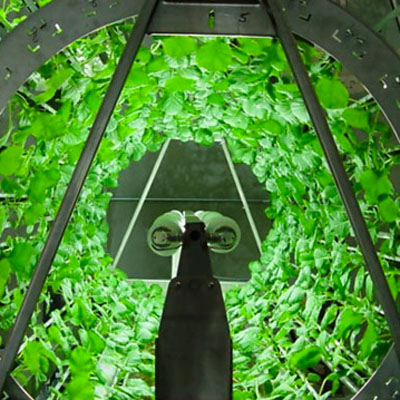
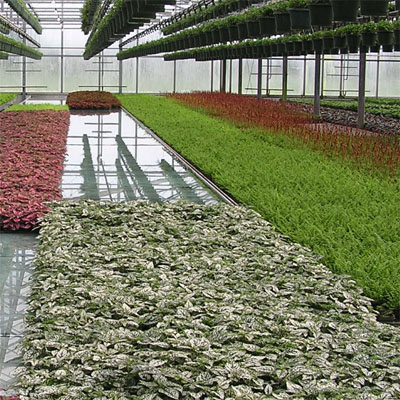
Hydroponics has a history of over 300 years and is a method of growing plants in water without soil. The plants are drip-fed mineral nutrient solutions that can be from organic waste products such as food waste, fish waste and manures. One advantage of hydroponics is the efficiency with which the plants roots can have constant access to both oxygen, water and nutrients, taking as much or as little as required. Excess water can be drained, aerated to eliminate anoxic toxins, supplemented with minerals and recycled back to the plants. Although hydroponics may use a static solution culture a continuous flow nutrient film is preferred it is easier to manage and can obtain higher crop yields. It is possible to grow plants using aeroponics where the roots are fed with nutrients via an atomizing mist. A wide range of plants can be grown together in this way as each plants microclimate can be finely controlled and pathogen spread can be greatly reduced. Aeroponics uses 65% less water than hydroponics and produces a greater biomass. There are available a wide range of substrates and nutrient feeds but the method of feeding is consistent. The hydroponic mechanised landscape offers an unusual aesthetic potential.

These mechanised, highly serviced, landscapes may have a much greater role in a post-industrial urban environment. Automation, robotics, micro drones may soon be cost effective gardeners fussing over rooftops and facades. Responsive systems moving in and out of the sun, opening and closing, moving to allow light through or clustering to prevent hard rains reaching ground. Systems that capture sunlight, wind and rain and hold and release these when required, turning rain into humidity, turning solar into coolant, modulating its own microclimate. In this system architecture is not a pre-determined form but instead a conclusion to a series of responses set around a desired environment.

In conclusion, a landscape of choreographic intensity.

The Surrogate Twin

Posted on

020816 – Synthetic Landscapes 2 – Toxic Beauty

​020816 – Synthetic Landscapes 2 – Toxic Beauty > words

Synthetic Landscapes should be read 1 through to 4.

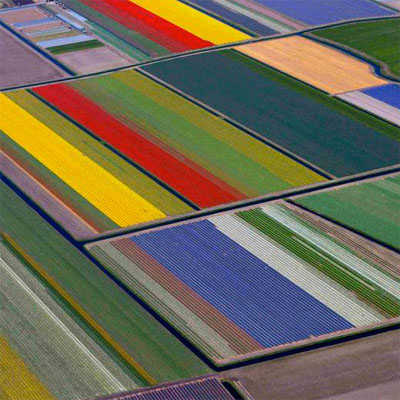
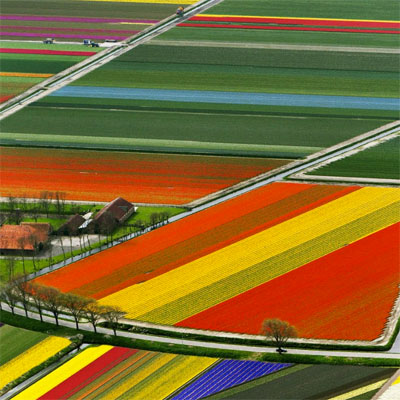
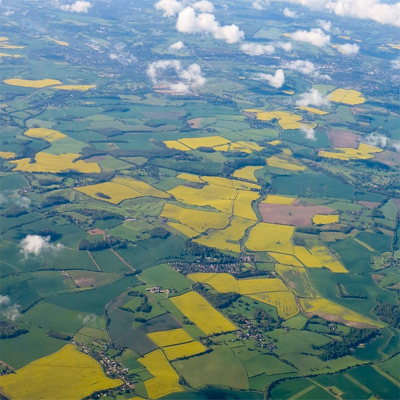
There is something incredibly seductive about order and pattern. Partly as organised regimentation signals stability, control and efficiency all desirables built into the human psyche and partly the appeal of manmade geometric aesthetics. Humans crave simplicity from chaos, structured geometry over natural disorder; endless fields of blocked colour in rectilinear patchwork tapestries are easy on the eye and easy to comprehend. The tamed landscape concurs that we are in control and that we can make nature do as we please. Of course nature isn’t chaotic. It has hierarchy and order but it is not an order that most humans understand. We feel vulnerable in its presence, we order to organise and dominate, control is calming, it is safe and secure. In pleasing the eye the abstract patterns of monoculture, the chequered fields of blocks of colour, neat rows of subservient trees that line up to assist man and make his life easier and more pleasant hide a broken order.

Man has been farming for at least ten thousand years, he learnt to save seed and plant so that food would appear on his doorstep, he no longer had to live a nomadic life as a hunter-gatherer. Steady and reliable food quickly increased population and as population grew more farmland was cleared. Natural landscapes, indigenous species and habitats have all been wiped away. Historically every time a farmer cleared a small land holding habitats are swept aside but since the 1950’s this has been done on such a colossal global scale with thousands of square miles cleared to plant a single crop. Farmland is protected, sheltered and nurtured but the more we parent our crops the more they are dependent on us for their survival. Todays crops are genetically so far removed from their wild ancestors that they are unable to exist without their daily fix of fossil fuel derived pesticides and fertilisers. In our quest of forever increasing yields we leached the soil and bred out the crops inner defence systems. Annuals replaced perennials and with each season the plough weakened the soil losing the topsoil that will take a thousand years to replace. Below ground the microfauna and microflora that adheres and regenerates the soil are broken apart. Hard compact surfaces become windswept dust plains or washed away in heavy rains as water cannot penetrate to the depths required. Topsoil ultimately gets washed into rivers or drains and eventually ends in the sea. Some parts of the Mid West US lose 30mm of topsoil every two years. The soil is no longer a rich black fecund of life and death, the ongoing circle of perpetuity but instead a chemically enhanced anaemic rock like mass. In our never-ending search for increased production we have turned farmland into a synthetically supported factory system. Even our extensive manicured lawns are a form of monoculture.

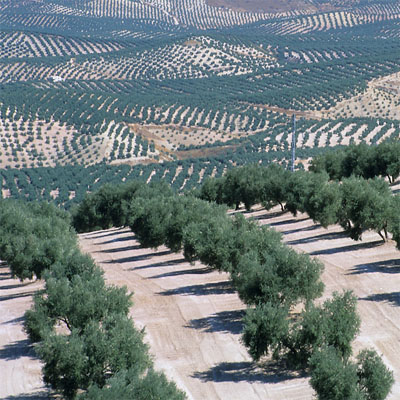
The industrialisation of farming methods that have developed over the past two centuries favours monoculture, farming of one crop or one breed continuously. There are short-term efficiencies in this system as a single species has the same requirements and runs one timetable. Planting, maintenance, harvesting, marketing and logistics can be standardised. Sadly there are long-term inefficiencies such as soil degradation, low biodiversity and high risk of disease through pathogen spreads. The negatives can be offset with pesticides and fertilisers, usually made from petrochemicals and delivered with diesel miles. The efficiencies of monoculture increase yields that in turn increase with scale, so monoculture farms benefit as they grow and in so doing consume neighbouring farms and land. Eventually thousands of acres may fall under a single ownership and are harvested by subcontractors that move from farm to farm following the seasons. The Corn Belt of the Mid-Western United States, olive groves of Southern Spain or cut flowers from the Netherlands would be typical examples. Concentrated production of cash crops from within a confined area feeding a world through global distribution systems are particularly vulnerable to disruption including political, logistical and environmental. The long term negatives of monoculture have long been known and efforts to obtain equivalent yields from polycultures are being tested. The transition to polycultures will not be easy as increased labour, tooling and logistics costs are off set by longevity and less dependency on fertilisers.

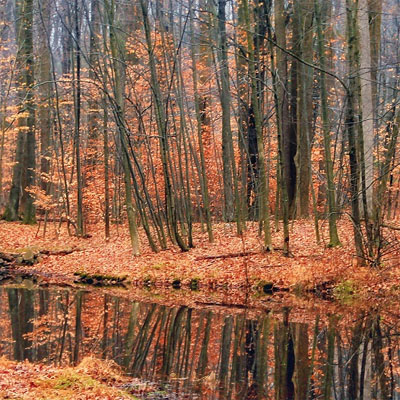
The world’s natural state is forested but forests now cover less than 30% of the planets surface. The depletion of the Amazon rain forest is a sad atrocity but that depletion has occurred in every developed nation. In the US there was once 440 million acres of forest now there is only 25 million acres a 95% depletion. Tropical rain forests are depleting at a rate of 35 million acres a year. The consequences of de-forestation are well known first soil erosion followed by polluted water tables. Every nation should be re-forested and not micro managed agrarian forest but natural forest left to assume its own natural balance and eco system. This would not only help the biosphere to the benefit of all the planet but would also start to put a slow squeeze on land available for development or agriculture which in turn would begin to put pressure on a reducing population. Managed forests have little diversity, trees are planted at one time and harvested, clear cut, at another putting strains on habitats. Natural forests have a mixture of trees of various types, ages and scales. In the mix dead trees have an important role housing all types of wildlife that are essential to a thriving living forest system. We have become so use to associating farmland with nature that we now accept farmland as nature. We have no concept for the wilderness without human intervention.

In conclusion, regimented order does not guarantee the most efficient system.

The Surrogate Twin