
231116 – UK Infrastructure – London > words
It is a point of national embarrassment that UK politicians are famous for their endless indecision. Brexit has further diverted valuable political time away from more urgent global concerns and these include: Climate Change, how to reduce the UK’s dependence upon fossil fuels especially the immediate reduction in the use of coal and UK infrastructure, the need to replace and update the UK’s outdated Victorian infrastructure. The two concerns are inter-woven; infrastructure and the decentralization of the UK energy supply should be tackled holistically. Decisions of this type are long term and should be made outside the remit of the four yearly political cycles. The Infrastructure Commission is a start and one hopes that they will have the power to do more than just churn reports.
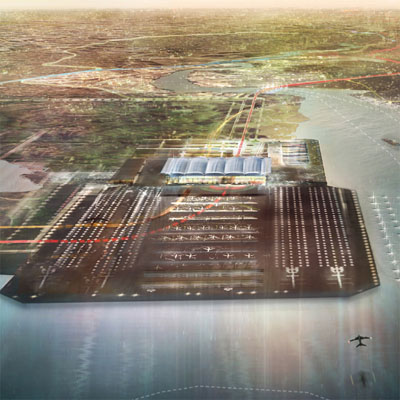
Fortunately for the UK the most qualified to provide infrastructure solutions have their main office at Riverside on the Thames. So when Foster and Partners offers the UK a solution to its infrastructure problems the UK would be wise to listen. Foster and Partners have been consistently providing quality infrastructure solutions for decades their CV is beyond reproach. Thames Hub is Foster’s solution and although strategically I differ on how best to deliver this, (see the 2014 letter to City Hall copied below in the postscript) the UK needs to make this call. An airport is the gateway to and from a country. As a building type it is beyond a pure utility, a machine of logistics, but also is a built representation of a countries values and ambitions.
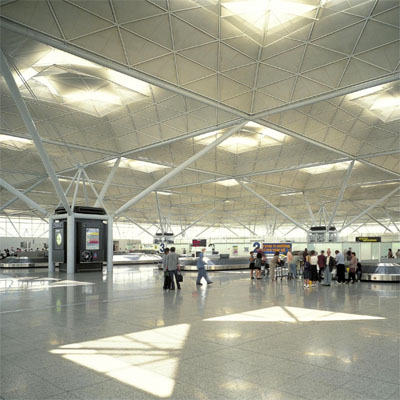
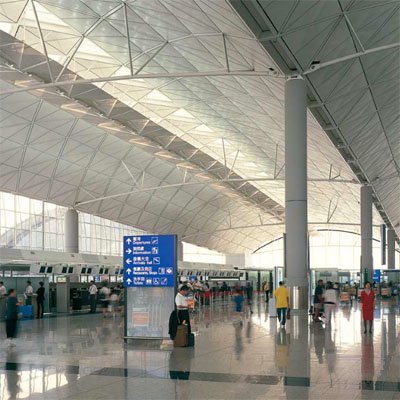
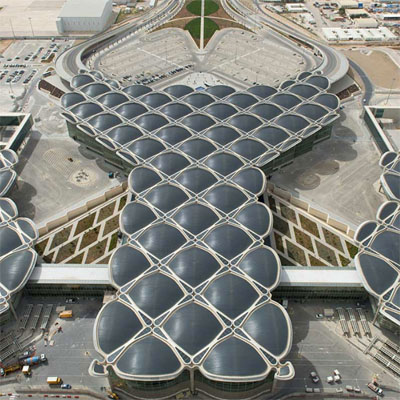
Foster’s early approach to airport design was to capture the excitement of the pioneer open grass airfields. These were little more than tents around a field but the sequence of arrival, boarding and the visual connection to the planes has been a generating concept even in the largest and most complex of Foster’s airports. The ground plane is kept clear and uncluttered, all air conditioning and services are removed from the roof scape and ceilings and natural light floods the forecourts. All of the mechanisms that make an airport work are below the ground plane and out of sight. This enables the mechanisms that facilitate the utility component of an airport to be contained within an efficient lower level metaphorical black box whilst freeing up the ground plane and the architectural component. This concept is not new and can be seen in Mies Van Der Rohe’s Berlin National Gallery but applying and delivering such a concept with clarity to extremely large and complex airport projects is no small achievement. It is this clarity from concept to execution that makes Foster and Partners apt at infrastructure design. As a design consultancy they have the ability to assimilate huge quantities of data, statistical, political, financial, engineering, architectural, logistical etc. and from it deliver a coherent, rational, achievable and poetic conclusion. Additionally to this Foster and Partners are able to see further opportunities and potentials that can be incorporated into a fully all-inclusive design solution.
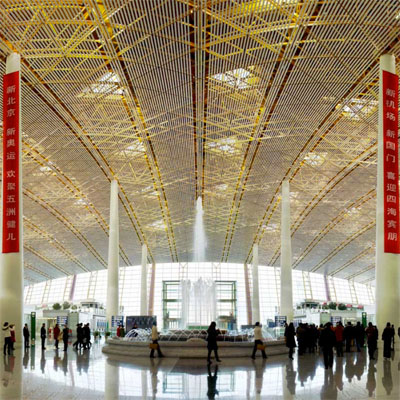
To be able to do all of this and still deliver an architectural poetic is extremely difficult and very few practices attain such skills. The gem of the gems is Beijing airport as it not only resolves the complex issues of airport design but it is also has incredible culturally site specific personality.
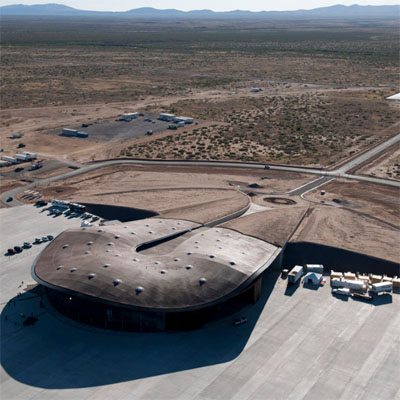
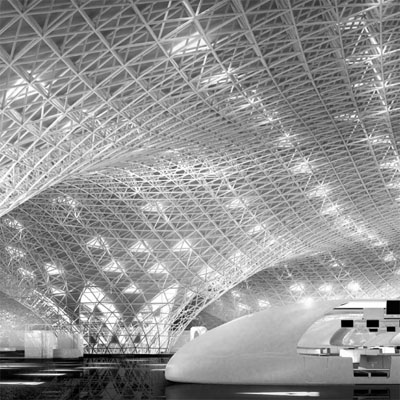
The images above provide seven reasons why the UK needs to replace continued indecision by making the right decision so that she can remain a country of ambition and conviction.
The Surrogate Twin.
Postscript. Letter to the London Mayor 080914,
The past year has seen the debate over how to improve Britain’s airports fall into unproductive disarray with each protagonist fighting for his corner. Business, Contracts, Licenses, Capital allocation and Politics have taken all clarity from the underlying problem of how to prepare Britain’s infrastructure for generations to come. This is most apparent in the fight for individual airports and not how best all airports may serve the countries needs.
Historically the two principle airports of Gatwick and Heathrow have developed South and West of the capital. This has been due partly to the available space and sensible location of the original recreational and military airports and later reinforced by surrounding affluent and educated market catchment areas. These conditions have changed dramatically as demographics have moved east along the Thames corridor. The building of Stansted acknowledged this demographic shift and for two decades London has been served by three airports Gatwick, Heathrow and Stansted all working together. Each airport provides an overlap with its neighbours in catchment area and services provided. The triangulation of the airports around London and the influences on the areas beyond has provided a balanced infrastructure organization. However this balance has now dramatically changed as population density increases along the Thames corridor replacing redundant industrial sites and disused quarries with housing, offices and retail centers. The growth eastward will continue for decades to come and the balance of the serving infrastructure needs to accommodate this.
There is of course an additional need to better link the North with the South with an improved railway spine to revitalize the ’Industrial North’ that has been neglected by successive policies favouring service industries over manufacturing industries. There is also a need to link and encourage collaboration between the main university and research centers of Cambridge, Oxford and London as the UK’s IT, Robotics and Biochemistry development and procurement has fallen behind the US and other developed nations.
Looking at how to best improve UK airports without having to steer through the thick political fog one may well note the following points:
It is understandable that UK politicians have neither the confidence or the finances of the Victorians………..the Empire is long gone.
Increasing flights to Heathrow is at best unwise. Heathrow is a major international accident is waiting to happen.
There is only one London airport that was designed from the outset to accommodate growth and potential future increase in flight traffic and that is Stansted.
And arrive at the following conclusions:
Stansted should be allowed to increase capacity as this would provide the most efficient short-term fix.
Simultaneously Thames Hub to be developed as a two Phase scheme with 50% of the proposed scheme developed as Phase one.
On completion of Thames Hub Phase One flights to Gatwick and Heathrow would be diverted to Thames Hub.
Thames Hub Phase Two to commence.
All flights from Gatwick diverted to Thames Hub and Gatwick closed and the land re-developed.
On completion of Thames Hub Phase Two the majority of flights from Heathrow diverted to Thames Hub. Heathrow to continue but with much reduced capacity. Heathrow could be developed as a new short haul airport west of the reservoirs with its existing buildings and land re-allocated for industrial/office use.
The then three remaining airports of Thames Hub, Stansted and Heathrow would be better balanced to serve the infrastructure needs of future Britain. Valuable land re-claimed from Gatwick and Heathrow would contribute to infrastructure funding.
Not using Foster and Partners to develop a credible infrastructure plan could be the UK’s greatest mistake.