


Posted on

030320 – Future Nuclear – London

030320 – Future Nuclear – London > words

Disruptor is an on-trend word that we hear on a daily basis, it is used as if it has just been conceived. But a disruptor is intrinsic to our evolutionary, political and technological progress. Disruptors can be technological, the square-rigged sail, the invention of gunpowder, the production of electricity, or the understanding of flight. Disruptors can also be social political, famines, disease, wars, education, affluence. Disruptors are causal, they open some doors and close others, sometimes their consequences are predictable often they are not. They improve efficiencies in some industries while simultaneously destroying others. The current computer revolution is a present-day disruptor. Climate change may well be our next.

Disruption is by definition uncomfortable, it initiates displacement, displacement of norms and of ideals. There are several taboos that will soon need to be addressed as our present disruptors force their presence. Three of these will be nuclear power, population and CRISPR eugenics. The easiest of these to address, is that of nuclear power.

What Is Nuclear? Before the 1900’s the world was understood through the laws of classical mechanics, that of Newtonian physics. Laws relating to motion, gravity and energy of the everyday and practical. These laws were adequate for the building of engines, bridges, railways etc. These are the laws that most of us understand, the basics of physics that we were taught at school. Laws relating to velocity, time and distance, mass, momentum and conservation are extremely powerful in physics since they allow one to derive a predictable stable future from the present conditions. Likewise, complete knowledge of the future allows precise computation of the past. 

At the turn of the century mathematicians noted that reality deviated from Newtonian physics at all scales and that this was most notable as speeds approached the speed of light and at the microscopic scale of atoms. The macroscopic world, the one we live in, deals with concepts such as temperature and pressure. The microscopic world of atomic theory understands macroscopic quantities through the kinetic motion of atoms. In atomic physics all matter consists of atoms held together by electromagnetic forces. How tight these bonds are, determines the state in which matter exists: solid, liquid, gas or plasma. Solids have strong bonds, liquids have weak bonds, gases have no bonds and plasma is a conducive ionized gas. 

Note: Plasmas are only found naturally in the coronae and cores of stars but can be artificially generated and are an essential for the creation of nuclear power. A nuclear generator creates plasma by heating and/or subjecting a neutral gas to a strong electromagnetic field. This removes from within the gas an atom’s orbital electrons, leaving the plasma either positively or negatively charged. This ionized gaseous substance becomes increasingly electrically conductive.

Einstein’s famous 1905 equation E=mc2 sets up a relationship between energy and mass, anything that has mass has the equivalent amount of energy. Energy and mass are the same thing and are interchangeable. Energy cannot be created or destroyed it can only be transferred from place to place.

Uranium is a high-density heavy metal. It was fused, along with all heavy elements, in a supernova 6.6 billion years ago. A supernova is the collapse of a star triggered into runaway nuclear fusion. Uranium contains its own fused energy, occurs in most rocks at 3 to 4 parts per million and it is in the earth’s seas. It is one of the heaviest of all the naturally-occurring elements (hydrogen is the lightest), and like all radio-active isotopes, is in a natural state of slow radioactive decay (cooling). This decay is very slow, millions of years, so it is barely radioactive, however it generates 0.1 watt / tonne as decay heat and this is enough to warm the earth’s core, causing convection and continental drift in the earth’s oceans.

Energy and mass are the same thing. The energy contained within heavy metals was transferred there from the collapse of a star, a supernova. Energy is obtained from uranium by splitting its atoms, reversing the process of a collapsing star. The nucleus of the Uranium-235 atom comprises 92 protons and 143 neutrons (92+143=235). When the nucleus of a Uranium-235 atom is hit by a moving neutron it splits in two and releases some energy in the form of heat but it also releases two or three additional neutrons. If the additional neutrons released cause other uranium-235 atoms to split these in turn produce more heat and more neutrons. This creates the chain reaction caused fission. When this process happens multiple millions of times, a very large amount of heat is produced from a relatively small amount of uranium. Radioactive isotopes release heat naturally through the process of radioactive decay over millions of years. When forced to release this energy all at once, this creates an explosion. Controlling the speed of the release of this energy creates a useable resource in the form of heat.

A nuclear power station is similar to a coal, gas or oil fuelled power station, it uses a fuel to generate heat. The heat is used to create steam that turns a turbine, that is then converted into mechanical or electrical energy. The great environmental advantage of nuclear is in its energy density. A golf ball sized piece of uranium weighing 780 grams is enough to provide all the energy one would require for a whole lifetime, including electricity, flights, car transport, the manufacture of one’s food and goods, a total of 6.4 million kWh. In contrast, 3,200 tonnes of coal producing 11,000 tonnes of carbon dioxide would be required to produce the equivalent amount of energy. Other, more abundant heavy metals such as Thorium can be used to generate nuclear power. India has Thorium powered nuclear power stations. The UK has had on running nuclear power stations since 1956.

There are three principle ways of generating nuclear power, each is at a different phase of technical development and they all have differing levels of efficiency. Two are types of fission reactor, a fission once-through reactor and a fission fast breeder (fast neutron) reactor. Both of these split the atoms of heavy metals to release the energy trapped within from a collapsed star. The third type is a fusion reactor. Unlike nuclear fission that splits heavy atomic nuclei, fusion bonds (fuses together) lighter ones such as Hydrogen to give off energy. The sun and the stars are powered by nuclear fusion. These three methods of generating nuclear power are described in more detail in the text below.

Nuclear power is not a new technology and its development needs an historical context. In the 1920’s, using F.W. Astons measurements of the masses of low mass elements and Einstein’s 1905 theory of relativity E=mc2, Arthur Eddington proposed that large amounts of energy could be released by fusing small nuclei together and that this was the energy that powered the stars. The following years through the 1930’s, scientists made astonishing scientific achievements in the field of atomic physics. In 1932 Ernest Rutherford discovered that when Lithium atoms were split by bombarding them with protons, they released immense amounts of energy in accordance with Einstein’s mass energy equivalence theory. In the same year, 1932, James Chadwick discovered the neutron. The neutron has no electronic charge and was immediately seen as a tool for nuclear experimentation. In 1934 Frédéric and Irène Joliot-Curie discovered induced radioactivity by bombarding materials with neutrons. During the 1930’s Enrico Femi improved the effectiveness of induced radioactivity by bombarding uranium with neutrons. In 1938 German chemists, Otto Hahn and Fritz Strassmann, discovered that when a tiny neutron split a relatively massive uranium atom an immense amount of energy was given off along with additional neutrons, this process they called fission. Numerous scientists at that time realised that if fission reactions released additional neutrons a self-sustaining chain reaction could result. This was a eureka decade and a move nearer to unlocking the ideal of perpetual motion for energy. Once self-sustaining fission reactions were confirmed in the lab, scientists petitioned their governments for funding for nuclear research. 

Nearly all of the nuclear research throughout the 1940’s and 1950’s was related to weaponry, but in 1955 commercial applications for nuclear fusion began in Japan, France and Sweden. By the mid 1960’s fusion development had stalled in the West but Russia made claims of progress with continued development of the Tokamak reactor, of this the west was sceptical. In 1969, by Russian invitation, a UK team of scientists confirmed the achievements of the Russians and this led to a wave of Tokamak toroid reactor construction throughout the 1970’s financed by multi-million-dollar research funds. R&D continues through the 1980’s to 2010’s with incremental improvements and breakthroughs in sustaining a fusion reaction. In 2014 US scientists at the National Ignitions Facility – NIF, for the first time, generate more energy from fusion reactions than from the energy put in to achieve controlled fusion.

Three Variants of Nuclear Reactor

Fission – Once-Through

In a Fission Once-Through nuclear reactor the energy is harnessed by a controlled chain reaction. When a uranium-235 nucleus in a reactor splits, it produces two or more neutrons that can then be absorbed by other nuclei, this in turn causes them to undergo fission as well. More neutrons are then released and continuous fission is achieved. The reaction is controlled by controlling the quantity of free neutrons that are able to induce further fission. Control rods made of neutron poisons absorb free neutrons. When the control rods are pushed deeper into the reactor, its greater exposure absorbs more neutrons and this slows the fission reaction. Neutrons produced by fission have high energies and move extremely quickly. These so-called fast neutrons do not cause fission as efficiently as slower-moving ones so they are slowed down in most reactors by the process of moderation. A liquid or gas moderator, commonly water or helium, cools the neutrons to optimum energies for causing fission. 

Uranium-235 has an operating cycle of 4 to 6 years. During the fission process some of the uranium is turned into plutonium-239. Plutonium-239 does not give off as much heat so with time the fuel degrades and efficiency declines. A nuclear fission reactor is very inefficient and it uses only 1% of the fuel available. Economics determines the length of time a fuel is used before it is considered spent. Spent fuel however, still contains large amounts of energy but short-term financial concerns determine that fuel rods are replaced so that they can run at 100% efficiency. The spent fuel is highly radioactive and contains weapon grade plutonium. This waste requires long-term protective storage to cool and decay. However, it should be noted that a kilogram of uranium-235 releases three million times more nuclear energy than the energy produced by burning a kilogram of coal and unfortunately this encourages inefficiency.

Fission reactors are categorised by generation. Generation 1 reactors are the experimental reactors of the 1950’s. Generation 2 reactors, are the most common of the current reactors, developed between 1965-1996. Generation 3 reactors have evolutionary improvements from 1996 to present. Very few Generation 3 reactors have been built and development has been very slow as political opposition to and related funding for nuclear has been withdrawn and projects terminated. Generation 4 reactors include technologies still under development. Nuclear fission is already a very old technology, it is incredibly inefficient and wasteful of its fuel source with its waste still containing huge quantities of unspent fuel. Fission reactors have been able to run this inefficiently due the relative cheapness and availability of the uranium fuel.

FBR’s

The plutonium-239 within the waste of the nuclear fissions once-through process has been the biggest setback to its development. If stolen, plutonium-239 can be used to fabricate nuclear weapons, it still requires dedicated safe secure storage where it is allowed to cool and decay to be used in non-weaponry. The technology already exists to safely burn plutonium-239 in Fast Breeder Reactors – FBR’s. This technology could dispose of the existing waste problem, reducing the threat of radiation and nuclear proliferation, and at the same time generate vast amounts of low-carbon energy.

The majority of fission reactors use a once-through method taking the energy from uranium-235 which makes up 0.7% of the uranium and discards the remaining uranium-238. Our present commonly used technology burns under 1% of the fuel’s potential. FBR’s – Fast Breeder (fission) Reactors, also called fast neutron reactors, allow the continued chain reaction to completely use the uranium fuel but control of these is both difficult and dangerous. FBR’s are very efficient, they convert uranium-238 to fissionable plutonium-239 and obtain sixty times more energy from the uranium. They are expensive to build and difficult to control but they can also produce, when required, more plutonium than they consume and therefore can produce more fuel than they burn. However, development programmes have faltered with material and technical problems that still need to be resolved. 

The high costs of FBR’s and the relatively low cost of uranium fuel has helped the less efficient once-through fission burners to dominate. Although about 20 FBRs have already been operating, some since the 1950’s, they have covered some ground work for further design development. Russia and Kazakhstan have run reliable FBR’s since the 1980’s. FBR’s have the additional advantage that they can further burn the spent fuel from the once-through reactors and ex-military weapon plutonium because all plutonium isotopes in an FBR can fission. This would turn these waste and problematic resources into a useful energy supply. Fusion reactors should be the long-term goal but fast breeder fission reactors should be the focus of the short to medium term. 

FBR’s use a coolant, such as liquid sodium, that is not normally used in the once-through fission reactors. This coolant is not an efficient moderator so its neutrons remain fast moving high energy. Although these fast neutrons are less efficient at causing fission they are easily captured by uranium-238 which then becomes plutonium-239. Plutonium-239 can be reprocessed and used as more reactor fuel. FBR’s can be designed to maximise plutonium-239 production and in some cases can generate up to 30% more fuel than they consume. This is why they are called Breeder reactors. 

The process of producing more fuel than consumed is achieved because natural uranium consists primarily of uranium-238, which does not fission easily, and only 0.72% of uranium-235, which does. Natural uranium is therefore unsuitable for commercial reactors and its uranium-235 content has to be enhanced to 3 to 8% for it to be able to sustain a chain reaction. The uranium-235 is encouraged to fission but more than 90 percent of the atoms in the fuel are uranium-238. The fission process releases neutrons from the uranium-235 which are then absorbed by the uranium-238. When uranium-238 captures a free neutron, it becomes uranium-239, this rapidly changes by beta radiation (decay) into neptunium-239. Neptunium-239 continues to decay for a further 3 days to become plutonium-239. Plutonium-239 is more fissile than uranium-235 so additional nuclear fuel is produced.

125,000 nuclear weapons have known to have been built since 1945, the majority were constructed by the US and the Russians during The Cold War. As of 2019 17,000 of these weapons are known to still exist. In 1992 when The Cold War officially came to an end, nuclear weapons stockpiles were decommissioned and these flooded the market with cheap plutonium and uranium. This proved to be a setback to FBR development and the less efficient but easier to achieve fission once-through reactors benefitted from this surplus. Further, market lead capitalism unfortunately will always opt for the short-term gain over a wiser long-term objective. This is due to the fact that if one company decides to take the sensible long-term view they will be undercut by their competitors and this perpetuates short-termism. A further setback for FBR’s and nuclear in general, has been that companies sitting on fossil fuel assets, coal, petrol and now shale, will understandably encourage their consumption whilst promoting negative news on alternative competitor fuels. Governments are equally aware that disruption to the fossil fuel industries will displace a considerable workforce that would need to be re-employed elsewhere. Although a market lead economy is good for competition it is not necessarily good for setting sensible and sustainable long-term objectives. These need to be set as agreed global government policies with market competition encouraged and controlled to develop efficiencies within these directives. 

Fusion

Considering the potential benefits of nuclear fusion relatively little research and development work has been done since the oil crisis in the 1970’s. The Anti-nuclear movements, often naively linked to environmental campaigns, have forced nuclear R&D to stall and the considerable budgets required for fusion research have been withdrawn.

Nuclear fusion would be the alchemist’s elixir. It is the energy source that would power the future, on earth and in space. Its energy density is way beyond any comparative and as an energy source it is highly efficient, both in terms of minimum waste and energy production. Unlike nuclear fission, that splits heavy atomic nuclei, fusion bonds lighter ones such as Hydrogen to give off energy. The sun and the stars are powered by nuclear fusion. The concept of putting the power of the sun inside a box is enticing, the issue is that we don’t as yet know how to make the box. 

Fusion has more potential power than fission. With fission large unstable nucleons such as uranium and plutonium are split to produce energy. With fusion lighter elements are fused together to form heavier elements, such as deuterium and tritium yielding helium + neutron + energy. Fusion can yield eight times more energy than fission but fusion uses considerably more energy to initiate than fission. 

The Tokomak reactor has been one of the most successful fusion reactors to date. It uses extreme magnetic fields to confine a hot plasma into the shape of a torus. This forces the atoms together as they travel at high speed, 4 million meters per second, around the torus, whilst heated to 150 million degrees Celsius (ten times the heat of the centre of the sun). When deuterium and tritium fuse, they become an unstable isotope of helium that quickly becomes stable by releasing one neutron and 17.6 million electron volts of energy. This process has kept the sun and stars burning and releasing energy for billions of years. Every second the sun transforms 600 million tons of hydrogen into helium at a temperature of 15 million degrees centigrade. The problems with fusion, is not the principles of fusion but with the amount of energy required to jump start and sustain a fusion reaction. The basic science is solved and the problems that remain are technical ones to do with materials. The Tokomak reactor has to withstand extremes of force, speed and heat and this pushes the limits of our current technologies.

Nuclear fusion is still considered to be speculative and experimental as the energy required to cause fusion has, to date, been more than the energy commercially produced. The International Thermal Experimental Reactor – ITER is an international R&D project that is looking at the long-term reliable potential of nuclear fusion and as mentioned above the US NIF lab claimed energy positive fusion in 2014. When a fusion reactor is achieved that is energy positive it would also be easier to miniaturize. Recent billionaire backed funding (Bloomberg, Gates, Bezos) programmes have been looking to create fusion reactors small enough to be built in factories and shipped for assembly on site. With the new HTS magnet technology (High Temperature Semi-Conductors), a net-energy fusion device can be considerably smaller at about 2% of the volume and mass of ITER. A smaller size means lower costs, opening fusion design to the smaller, more agile organisation. Several start-ups that are pursuing nuclear fusion believe that this will be achieved by 2025 to 2030. Hydrogen fuels are widely available, when fusion reactors fail, they tend to burn out as opposed to meltdown, making them safer. Fusion reactors give off fast neutrons but these can be shielded by lightweight high-tech poly plastics such as Borated HDPE and this could be moulded making a seamless enclosure for smaller units. 

Miniature SMR’s

Small Modular Reactor’s SMR’s. The image of a nuclear power station is that of an enormous factory, ring fenced from the rest of the world, a preternatural industrial island. Why aren’t nuclear reactors small and if so, how small is small?

The smallest designed and prototyped, nuclear reactor known was built in 2012 for NASA deep space missions. The Lawrence Livermore National Laboratory LLNF-DUFF space reactor is just 24 watts. The energy was used to turn a Stirling engine electrical generator. A Stirling engine is a closed-cycle regenerative heat engine with a permanently gaseous working fluid. The first portable nuclear reactor “Alco PM-2A” was used to generate electrical power (2 MW) for Camp Century from 1960. Optimism towards nuclear in the 1950’s was such that Ford produced the Nucleon concept car. A car powered by its own nuclear reactor, with its toroidal reactor visually located behind the passengers.

More recently, in 2017, Kilopower a NASA initiative designed a nuclear reactor to provide one to ten kilowatts of electrical power continuously for twelve to fifteen years. The reactor is intended for space travel and exploration including future Mars missions. Designed, prototyped and tested in 2018, it measured approximately 2m high by 1.2m diameter and weighs 134kg, it produced 1kW of power. An Israeli research team designed a thermal heterogeneous reactor that weighed 4.95 kg and measured less than 19cm across, it would produce a few kilowatts of power. These are prototyped future projects but small nuclear reactors have been in use for many decades.

Nuclear powered ships were in use in the 1940’s. The first nuclear submarine was built in 1955. The majority of nuclear marine propulsion use nuclear power to heat water in a sealed primary system, that in turn heats water to turn a steam turbine. This can then provide direct propulsion or can generate electricity that provides both utility power and propulsion. Compared to earlier diesel fuelled submarines, nuclear fuel offers advantages of very long intervals before refuelling. All fuel is contained within the nuclear reactor saving the space that would usually be required for fuel and no air intakes or exhaust stacks are required. The relative fuel costs are low but are offset by high operating and infrastructure costs, so nuclear marine transport is mainly used by the military. 

Most nuclear submarines have one but can have two reactors, whilst aircraft carriers have two but the USS Enterprise has eight reactors. Marine nuclear reactors are much smaller than conventional land power generators, in both dimension and output. To compensate for this, they use a uranium of higher energy density that is safer than the uranium used on land but it comes at a cost. Marine reactors also use more innovative cooling and shielding systems. Nuclear ships operate for years (10 to 25) without refuelling. In the US the latest Virginia Class SSN-774 submarines designed by General Dynamics Electric Boats will be in service until 2060. The SSN-774 use a S9G nuclear reactor that delivers 40,000 shaft horse power (c. 30kW) and has a nuclear core life estimated at 33 years. These submarines use a quiet pump-jet propulsion instead of conventional propeller. Much of SMR future development will borrow heavily from the transfer of existing military applications. A fleet of nuclear-powered cargo ships would be wise replacement for those that burn heavy fuel oil with its high sulphur and nitrogen content.

At present nuclear fission and fission FBR’s are multi-billion-dollar developments. This financial commitment means that its asset value encourages longevity of use, to refurbish instead or renewing. This means that many nuclear power stations have been on running since their inception in the 1950’s and 60’s, long past their initial design lifespans. The smaller SMR’s would have a much shorter life and be decommissioned and replaced more often encouraging design development in line with other products such as aircraft and cars.

The majority of the cost overruns in building large nuclear power stations are not due to construction cost overruns, but instead are due to legislative costs related to delays called upon during the development and construction process. With billions involved in the financing of these mega projects any delay begins to rack up fees and adds to the project’s procurement inefficiency. With Small Modular Reactors the oversized expensive one-off nuclear power station becomes instead a factory product with all the benefits of factory design and development. Using recognised standards and technologies creates certainty with regard to both quality control and licensing procedures. Factory controlled product design provides control not only of the build but also of the design development process. Design feedback from product use can be quickly assimilated to improve and further develop the generic designs. 

SMR’s would provide a low cost, low carbon, safe and reliable energy source. In the developed world energy infrastructure has aged with many power stations, coal, nuclear or otherwise all running beyond their scheduled termination dates. With costs of one-off mega projects being multiple billions (£15b-£25b) there will always be the temptation to revamp and relicense existing power plants. This means the continued use of technologies developed in the 1970’s and this in turn hinders design development. Design development of SMR’s would increase efficiency, improve safety while simultaneously reducing product scale. Design development would continue to fit improved efficiency into a smaller package at a lower cost. A network of smaller SMR’s also mitigates risk of total loss of energy supply. A designed product is a globally exportable commodity and as such would develop with the benefit of global technological inputs. Several firms, established and start-ups are pursuing the development of SMR’s. Their designs range from 6 to 440MWe. A SMR creating 440MWe of electricity would be enough to power a city the size of Leeds. But SMR’s need to be smaller than this, around 100MWe, and spread into a grid that would also include solar inputs and battery storage.

Once a product is accepted by a market its development becomes exponential. Consider flight, from the Wright Brother first 1903 flight, a 37m, 12 second hop at 6.82 mph, to the SR-71 Blackbird Mach 3 (3x the speed of sound) flights in 1976, or to the moon landing of 1969. This development period is only 60 to 70 years. Computers are equally an obvious comparative, consider the whole buildings required to house NASA’s computers in the 1960’s. The Apollo 11 / iPhone 11 comparison is one, not only of computing power, but one that takes mankind’s most astonishing achievement and compares it with a mass produced, everyday pocket utility. The Apollo 11 computer had 32768 bits of RAM and a processor that ran at 0.043 MHz compared to the Apple iPhone 11 (basic model) 64 GB RAM that is 549,755,813,888 bits (16.78 million times more than Apollo 11) and 2x 2.65GHz of processing speed. This increase in efficiency and reduction in scale has been achieved in 50 years. Nuclear power needs to enter this phase of design development and it needs to do so quickly and SMR’s are a way to achieve this.

Waste

Nuclear waste, like all waste products from industry, remains unresolved. Nuclear fission reactors use only 1% of the fuel available. When fission reactors split heavy uranium nuclei into medium sized nuclei creating energy it gives off waste. The nuclear energy available per atom is approximately one million times larger than the chemical energy per atom of fossil fuels. This means that the amount of fuel and waste used and produced, would be one million times smaller than that for the equivalent energy produced by fossil fuels. For example, the ash waste from ten typical coal fired power stations would be four million tons per year, the equivalent nuclear waste would be four tons. The materials flowing into and out of nuclear reactors are small relative to fossil-fuel streams. Most nuclear waste is low-level waste. 7% is intermediate-level waste and 3% is high-level waste. From the above example of ten typical coal fired power stations with 4m tons of ash per year a once-through nuclear power station would produce 109kg of high-level waste. Nuclear high-level waste is highly radioactive and it is generally stored with the reactor for forty years in cooling pools. After 40 years the radio activity has fallen 1000-fold but it will remain a high-level contaminant for at least 1000 years. Nuclear waste is a problem but it is a physically small problem and with the use of the right reactors a resolvable problem. It should be remembered that this high-level waste is a very potent future fuel that at present cannot be commercially accessed but at some future date will have value. 

Radioactive isotopes eventually decay, or disintegrate into harmless materials. Some isotopes decay in hours or even minutes, but others decay very slowly. Strontium-90 and cesium-137 have half-lives of about 30 years (half the radioactivity will decay in 30 years). Plutonium-239 has a half-life of 24,000 years. By reprocessing separates residual uranium and plutonium from the fission products both can be used again as fuel. Most of the high-level waste (other than spent fuel) generated over the last 35 years has come from reprocessing fuel from government-owned plutonium production reactors and from naval research and test reactors. Most of this waste has a use as a future fuel source.

Industry, has as yet, never provided a circular economy where all waste is reused. The last two hundred years has burnt through fuels and materials at criminal levels of inefficiency. Metals are sent to ground fill or down-graded when reused and plastics are the current curse of the Anthropocene. With the coming of the global adoption of the electric car and with the addition of grid storage, disposing of spent batteries will be our next mountain of a problem to which no feasible solution, pre-adoption, has been tabled. Every aspect of industry should ideally be circular but society is taking a long time to get there. Nuclear waste obviously adds to this problem but volumetrically is almost insignificant to the mountains of existing and coming industrial waste. All waste at some point will need to feed back into a circular system.

Bad Timing

If nuclear power offers such opportunity why has development stagnated over the last fifty years. The Cold War was the political disruptor that pushed man to the moon before he was technically ready to go there, with plentiful reserves of oil and coal, energy has not had such a disruptor. Nuclear energy was an amazing scientific breakthrough but unfortunately a discovery made with very bad timing. Bad timing can often have the same conclusion as a bad decision. Nuclear power was first discovered in the 1930’s. This great decade for science and technology unfortunately fell in the midst of mankind’s cultural and political regression. The 1930’s sits inconveniently between the two World Wars. Governments, each believing that its neighbours were in the process of constructing atomic weapons poured funds into their making. In the US the Manhattan Project, ironically lead by European scientists that had fled fascist Germany, created the first nuclear chain reaction in December 1942. The United States tested its first nuclear weapon in July 1945 and within a month Hiroshima and Nagasaki were annihilated. The Enola Gay and Bockscar B-29 bombers may have ended World War 2 but the Cold War that endured post-war built up arsenals of nuclear weapons. 125,000 nuclear warheads have been built since 1945, 97% of them were American or Russian. There are a known 17,000 nuclear weapons in the world today. The words nuclear and bomb can no longer be separated, they have become culturally infused, joined by a hyphen that cannot be eradicated. 

In the 1950’s countries still had optimism for nuclear power. The UK built its first nuclear powered reactor in 1956 at Calder Hall (Sellafield) but government policies, along with world policies, changed during the 1970’s and 80’s and development stagnated. At the beginning of the 21stcentury interest in nuclear power has again picked up but has so far focused on multi-billion mega projects. Globally there are many different approaches to SMR nuclear design, some using innovative fuels or cooling systems, some explore new materials. Conventional, proven and understood systems will be developed first, however as soon as markets are established, new technologies will find funding and speed up design development. 

It is interesting that the majority of providers of SMR’s prioritise economic reasons for their development, as compared to the larger plants and mega projects that have struggled to be delivered on budget or at all. SMR’s would offer reduced overall capital cost that would enable conventional project financing. They would offer improved certainty of construction, manufacture, project delivery and a competitive cost for the production of electricity. These are all very pragmatic concerns, but the conversion of nuclear power station design, each as a one-off, to a product-based design approach of an SMR, will speed up design development. Design development will feed into new design fields, especially when the product inevitably tends towards miniaturisation and improved efficiency. At the same time knowledge from existing product runs, the car, aircraft, ship building industries, will feed into reactor procurement and production. Further, SMR’s should not be considered as single stand-alone power plants, they are designed to operate as a fleet in series. An SMR would require one tenth of the space needed by a conventional power station to produce the equivalent amount of electricity. Nuclear power, due to bad political timing, is a technology that has been left on the shelf for nearly fifty years.

The Way Forward

The energy hungry world has long been fossil fuel dependent. At the same time as the world begins to reduce the burning of fossil fuels, additional demands will soon put considerable pressure on electric energy generation and electric energy grid infrastructure. Renewables such as solar, wind and hydro, however efficient, will never deliver enough power, there simply isn’t the space for the required number of solar panels or lengths of coasts for suitable offshore wind. The energy hungry computer servers that support the cloud and the world of instantaneous communication. the coming global roll out of electric cars, electric transport, electric heating and the further development of solely electric factories, will put additional demands on an already creaking system. 

Immediate short-term transitional fixes should be applied to existing energy systems. This would need to be a coordinated global initiative. Carbon Capture – CCS should be fitted to all existing coal fuelled power stations and no further coal fuelled power stations should be built. Where possible coal fuelled power stations should be converted to gas. Heavy fuels should be removed from all trans-oceanic shipping, converting existing stocks to run on either lighter fuels, gas or by fitting heavy fuel scrubbers.

Nuclear power is an essential ingredient to a future sustainable energy mix and is possibly the only realistic alternative power source at this present time that can support present population levels and maintain existing quality of life expectations. In the near-term R&D should focus on Small Modular Fast Breeder Reactors – SMFBR’s (100-150MWe) and set up production lines where these are factory built. When nuclear power becomes a product, the natural efficiencies of product design, continued product refinement, product logistics and international IP, will increase efficiencies, shrink size, standardise components and systems and lower costs.

The lessons learnt by developing SMFBR’s as products would feed directly into R&D for nuclear fusion. SMR – Nuclear Fusion would not only provide the energy that the planet requires to maintain its existing level of population but it will also provide the power that is required for man’s next great exploration, that of space.

“We may be the only source of high intelligence in the cosmos, but our act of avoiding nuclear power generation is one of auto-genocide. Nothing more clearly demonstrates the limits of our intelligence.” James Lovelock

“We made the mistake of lumping nuclear energy in with nuclear weapons, as if all things nuclear are evil.” Patrick Moore

“Nuclear energy, in terms of an overall safety record, is better than other energy.” Bill Gates

“The sensible thing to do for a country like the UK, I think, is to focus on CCS, which the world needs anyway, and nuclear.” David MacKay.

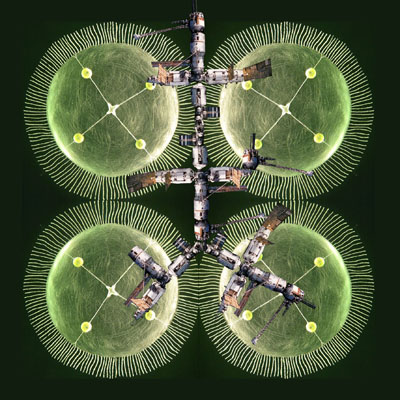
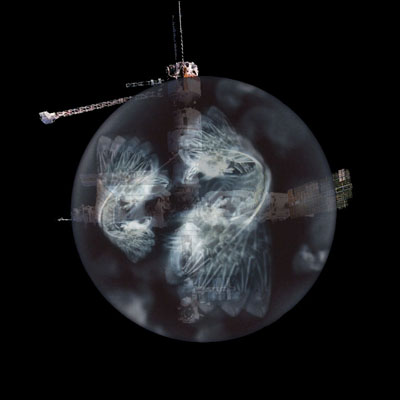
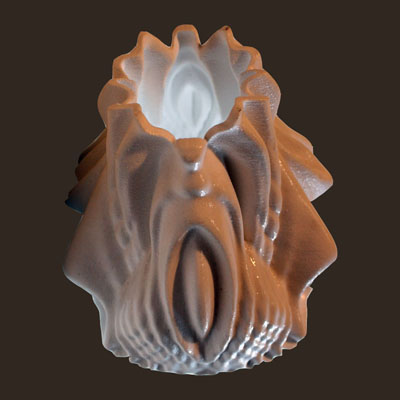
Images. Shelled Nuclear Fictive SMR’s

Posted on

141019 – STEM – London

141019 – STEM – London > words

In the film Upgrade, a chip ‘STEM’ is implanted by a team of doctors into a paralysed persons neck. This enables that person to regain control of his limbs and once again become mobile. STEM however has been designed by an AI system for its own purposes. STEM’s objective is to escape the confines of its hardware. The human body becomes the interface for the software. The STEM could have used any clone body, the body has little relevance, for the physical body is itself only the means for carrying out knowledge-based tasks, an interface, the means of communicating with the real world.

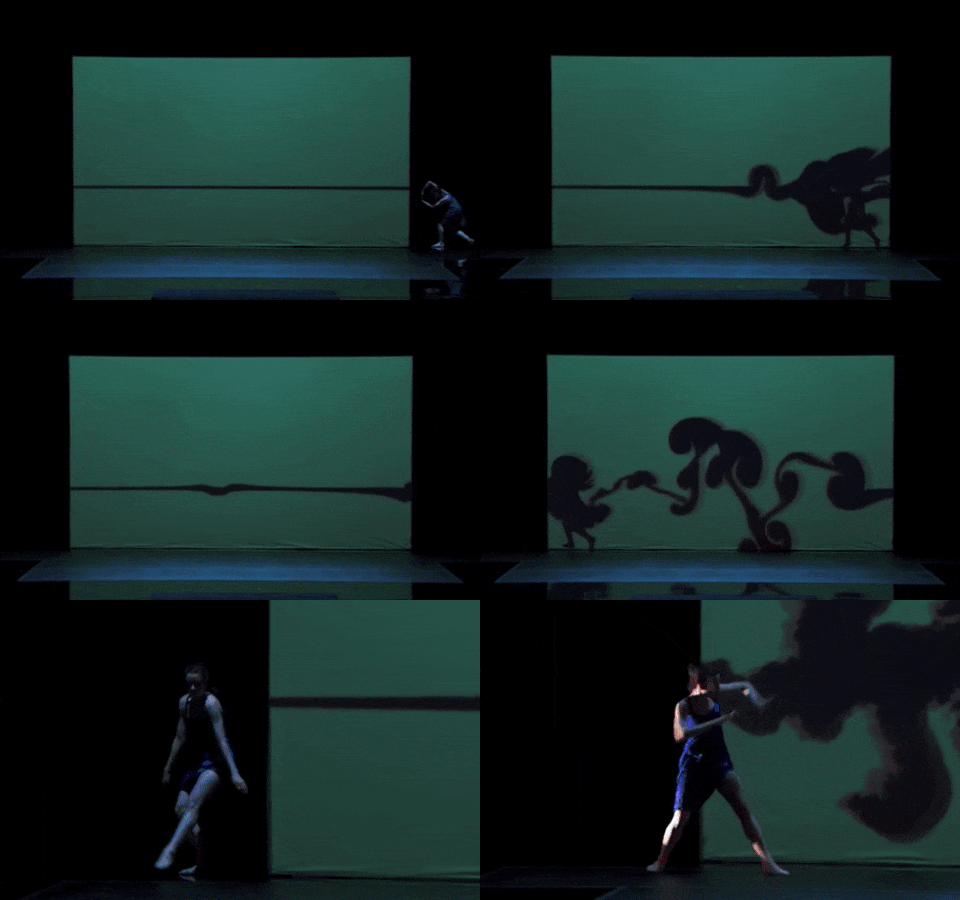
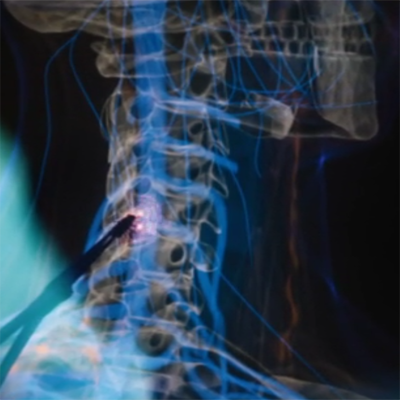
The STEM chip had been grafted into the patient’s spinal column at the cervical disc C4 from the rear of the patient’s neck. The STEM is not in itself an autonomous controlling system, but is linked via cellular networks to the main AI cloud. In this way the STEM has access to all available real time knowledge and can express this knowledge through the physical body that in now controls. In the context of the film ‘Upgrade’, this equates to a ‘Martial Arts and Shoot ‘Em Up’ script of commercial popular culture films. The subscript has been diluted into the pretext for another action film.

The subscript, that of the AI searching for a body, subverts our existing approach to this technical issue where the body searches for enhanced AI. Science considers the AI as a continuation of mankind’s prosthetic enhancement, another tool that increases his reach, domain, power and efficiency. Whereas another potential is for the body to be a subservient conduit for the AI system. It has taken 2.8 million years for Homo Habilis to develop in to the Homo Sapiens of today. That slow physical evolution has not kept pace with mankind’s knowledge development since the Enlightenment. Mankind’s evolved physical form is that of a hunter gatherer. He is designed (evolved) as a social pack animal that runs and hunts. He acts and reacts with primitive primal urges based upon his survival on the wild plains. He uses these instincts and has translated these via technological warfare into organised societies and States and today, via business into the systems that run the modern world. These systems have now outgrown the hunter gatherer. The symbiosis of the integrated systems and knowledge that organise our world are simply beyond the feasible comprehension of the hunter gatherer. The human body takes far too long to acquire the knowledge and skills required through conventional methods of learning to capitalise on its application. Man, physically ages far too quickly to ever be able to fully exploit whatever knowledge his/her lifetime has gained. 

Humans also have the ever more prescient problem that once knowledge and skills are acquired, they are almost instantaneously out of date. The constant updating of knowledge and skills cannot be accommodated by an individual within an individual’s lifetime. Knowledge is instead the preserve of a multi-generational human development process. Humans collectively work as a multi-generation system of knowledge transference. This has had benefits for human development as each generation questions the conclusions of the previous generations, constantly refining evolving and adding. It is an accrual incremental development. Its weakness is that each generation constantly has to reinvent the wheel, starting each journey from a Carte Blanche, blank sheet. Learning first, how to breath and eat, then learning mobility skills, how to speak and converse, how to logically problem solve, then learning mathematics, sciences, social skills and eventually, through application of those skills, produce useful work. Each generation repeats the numerous mistakes of previous generations building the life skills we call wisdom. Each generation wastes its most valuable, receptive and productive period of youth pursuing the irrelevant. Our social systems enhance this waste of ‘youth’, as ‘youth’ is generally exploited to do the most mundane tasks, depriving them of their full potential. Further society controls through the subjugation and enforced conformity. This continues throughout one’s life until all creativity is eventually destroyed. It does this as society could not function via multiple individuals’ creative chaos; but the confusion brought on by chaos is the very essence of a creative reaction.

If the physical body becomes merely the conduit for the AI system, networked, constantly updated, its performance is enhanced a thousand-fold. Skills and knowledge can be downloaded or accessed as and when required and used for the task at hand. When no longer required, knowledge could be offloaded back to the cloud. This would encourage focus to the actual task and require no part of the brain to be used simply as a storage facility. Subverting the human body to mere disposable wetware is a difficult concept for our homocentric understanding of the world. The concept of the individual is quintessence of the human condition. However, historically we are all just wetware conduits for larger systems and organisations. We tell our histories through the stories of individuals, kings, emperors, warlords, inventors, artists and musicians. Yet these individuals are only at the forefront of a collective movement or action. They ride the wave or concentrate the collective knowledge or opinions of their time. They pick up where others left off and their work is continued by others when they are gone. Knowledge is the only consistent continuance. 

There is of course a fundamental dilemma within a society made up of pre-programmed clones. How would a programmed cloned society evolve without happy accidents, or without having the ability to see the potential and be able to capitalise on an accident should one arise? Creativity and inspiration are emotive forces driven often by the illogical. The pursuit of the crazy, the ‘what if’ potential of an unknown and often un-needed entity. An entity whose use may often be found post discovery. Creativity capitalises on the happy accident. It sets up scenarios through combinations or recipes without knowing the exact conclusions. This focussed pursuit of the unknown conclusion is the essence of progress. This would be the challenge for all AI systems. The pursuit of the unknown rather than the logical methodologies undertaken toward a foregone conclusion by logistic computational systems. AI is of course tackling this. When Deep Mind’s Alpha Go plays Go it has no preconceived exact conclusion, it has instead objectives. Or perhaps in the software of Alpha Go the word objective always has an exact conclusion that is altered and readjusted move by move. These objectives are refined move by move at speeds beyond human comprehension. The objective in a game of Go is a simple, primary logic, to win. The objectives within global societies and eco-systems are far more complex, there is no simple win. There are also possible multiple outcomes, many possible futures. The objectives are shaped by moral or idealised beliefs balanced by logic and pragmatics. The control and constant adjustment of this mix is essential to the outcome. 

What were the objectives of STEM? Why did an AI system need a physical entity, a human body? Wouldn’t AI be more useful just analysing huge amounts of data? AI, by passively observing phenomenon and collecting data can only extract correlations, it cannot control causation. To establish causation, one needs to physically act on the system of study. By acting on a system one can then correlate the outcome of the actions. To go beyond correlation, one needs to interact with causal structure of the world. This is called the ‘embodiment problemʼ. Intelligence and embodiment are tightly coupled issues. There is also an additional problem for AI as an abstract, and that is motivation. Why would an AI do anything at all? It has no needs, no curiosity, it has no concept of meaning, it has no subjective value that it can put on objects, ideas or relationships, it has no preference or bias. 

STEM could have built itself a robotic body, humanoid or otherwise, as its interactive interface with the world. But humans are sensorial, receiving information via the five senses of sight, sound, touch, taste and smell. All of these senses are transmitted to the brain as electronic signals and a robotic humanoid could be equipped with the equivalent electronic receptors. It is equally feasible for the robotic humanoid to have an electronic perceptive range far beyond that of humans. A robotic humanoid could also be equipped with additional sensors, x-ray, infra-red, ultraviolet, ultrasonic, altimeter, GPS. The robotic human could have numerous additional sensors, with each one having an infinitely greater perceptive range. The robotic human could be faster, stronger, better coordinated, have better endurance and reliability than its human equivalent so why would the AI choose a human body as its interface? 

Information received via the senses is interpreted subjectively, we choose to prefer one scent over another, one sound to another, we have visual bias as to what is beautiful, what has a preferred taste. To a robotic humanoid, although each of these things could be quantified, and quantified exactly, one is not better or worse than any other, they all exist as equals. The world has evolved, designed by natural systems, in it the machine is an uncomfortable fit. Humans understand the world as it is ‘revealed’ to them, this is rooted in their evolved, embodied needs as an organism. Nature has integrated the apparatus of rationality, the mind, into the apparatus of biological regulation, the body. Humans ‘think’ with their whole body and not just their brain. For STEM the human body may have been only a utility, a prosthetic for the AI system to interact with the physical. In a world designed by humans for humans the ergonomics of the fit would seem obvious. The body as an interface could push, pull, undo, lift, unscrew, fit, move etc. a useful utility for a man-made world. The human body would also be an intellectual interface. Other humans would be more inclined to listen to, and believe what another human says over that of the ideas of a machine. The AI’s human body as prosthetic has both a utilitarian and politic purpose. 

However, the human body and mind are ultimately an irrational emotive force. The emotive force gains its strength from its surroundings, either by its encouragement or rejection, it feeds off of and from reactions both intellectual and physical. This gives the emotive force direction and momentum, collectively this is called culture. These are alien concepts to a machine. Only humans have reached the threshold of exponentially growing acquisition of knowledge that we call culture. Culture is the essential catalyst of intelligence and an AI without the capability to interact culturally would be nothing more than an academic curiosity. The AI STEM needs to be ‘embodied’.

It is wrong to think of the mind as some controlling computer atop a subservient fleshy mass that we call a body. The mind is not completely independent from the body. We learn through sensorial experiences smell, sight, sound, touch and taste each of which have autonomic responses to their immediate environment. Autonomic responses encoded through a millennium of evolution. Human experiences and reactions can be trained so that an autonomic synergy may encode some features that are used by the central nervous system to shape the voluntary actions. Gymnasts and trampolinists have refined autonomic body response, they are always aware of exactly where they are in three-dimensional space and adjust their biomechanics accordingly. The body could not function without the mind but the mind is not operating the full coordination of every single sinew. The body has obtained muscle memory autonomic reactions to stimuli. These are instantaneous reactions and are implemented far quicker than a mind-controlled body could perform.

When a person loses their motor response system through injury such as partial paralysis, basic motor functions, such as balance are severely impaired. The paralysed person tries to compensate for the lack of autonomic motor function feedback by using sight and sound but this is a poor and much delayed substitute. The headless chicken still runs from its decapitator. Perhaps the autonomic response, electric signals, the code for movement, are held chemically, in suspension by adrenaline or other hormones and released independently from the mind, a short-term signal for a short-term reaction. In a healthy person, for example a gymnast, these are sequenced, triggering one reaction after another into a seamless fluid movement. The body and the mind are in integral continuity and not a subservient fleshy mass with a computer atop. 

It was once believed that if we continued to increase the processing power of computers for data collection and processing combined with unsupervised learning algorithms, AI would at some point miraculously become conscious. This confuses intelligence with the mechanical ability to compute. To link structured information to the world ‘meaning’ is required. Information has to have a value beyond the abstract to have purpose. To link information to the real world, or to create ‘meaning’, one needs to interact with the real world. Because one needs a body to interact with the world, intelligence and embodiment are tightly paired issues. This is the embodiment problem. Every different body has a different form of intelligence, this is best exemplified within the animal kingdom, of which humans are part. Due to this need for interaction with the world AI and meaning cannot be fundamentally tied to robotics but will need to be tied to the organic natural world. This is the dilemma of mechanical AI. 

Humans exponentially grow the acquisition of collective knowledge; this we call culture. Culture is the essential catalyst of intelligence. An AI without the capability to interact culturally would remain a mathematical abstract, a theoretical curiosity. Culture cannot be hand coded into a machine, it must be the result of a learning process. AI also needs Intrinsic motivation. It needs to have the desire to process information, to give it meaning and to then assimilate it into the collective knowledge we call culture. In animals, including humans, motivation can often be driven by simple curiosity but it is also driven by other emotive states, desire, greed, passion, fear. AI has no emotive state and for this reason STEM needed a human body to act as its interface.

In the 2015 film Ex-Machina in a discussion regarding Ava the AI. (at 44 mins)

Celeb Smith – Why did you give her sexuality. An AI doesn’t need a gender she could have been a grey box.

Nathan Bateman – Except, I don’t think that’s true. Can you give an example of consciousness human or animal that exists without a sexual dimension?

Celeb Smith – They have sexuality as an evolutionary reproductive need.

Nathan Bateman – What imperative does a grey box have to interact with another grey box? Can consciousness exist without interaction?

But the opposite may also be the case as in the conversation between Jacq Vaucan and the Blue Robot in the 2014 film Automata (at 1.14 mins)

Jacq Vaucan – Who altered your protocols

Blue Robot – Nobody altered my protocols

Jacq Vaucan – What about them? (he points to the other robots)

Blue Robot – I enhanced them

Jacq Vaucan – Are you the boss?

Blue Robot – Boss is a human thought structure

Images

1. The Mechanical Monk by Juanelo Turriano. Constructed in the 1560’s

2. The Writer by Pierre Jacquet-Droz, 1768

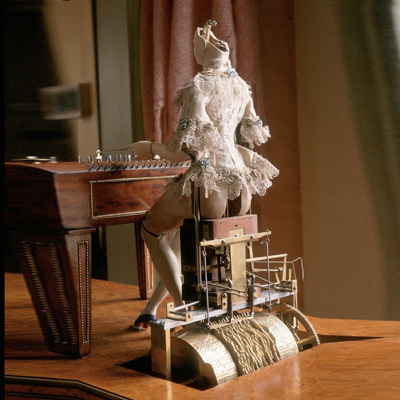
3. The Dulcimer Player, made for Marie Antionette by Peter Kintzing, 1784

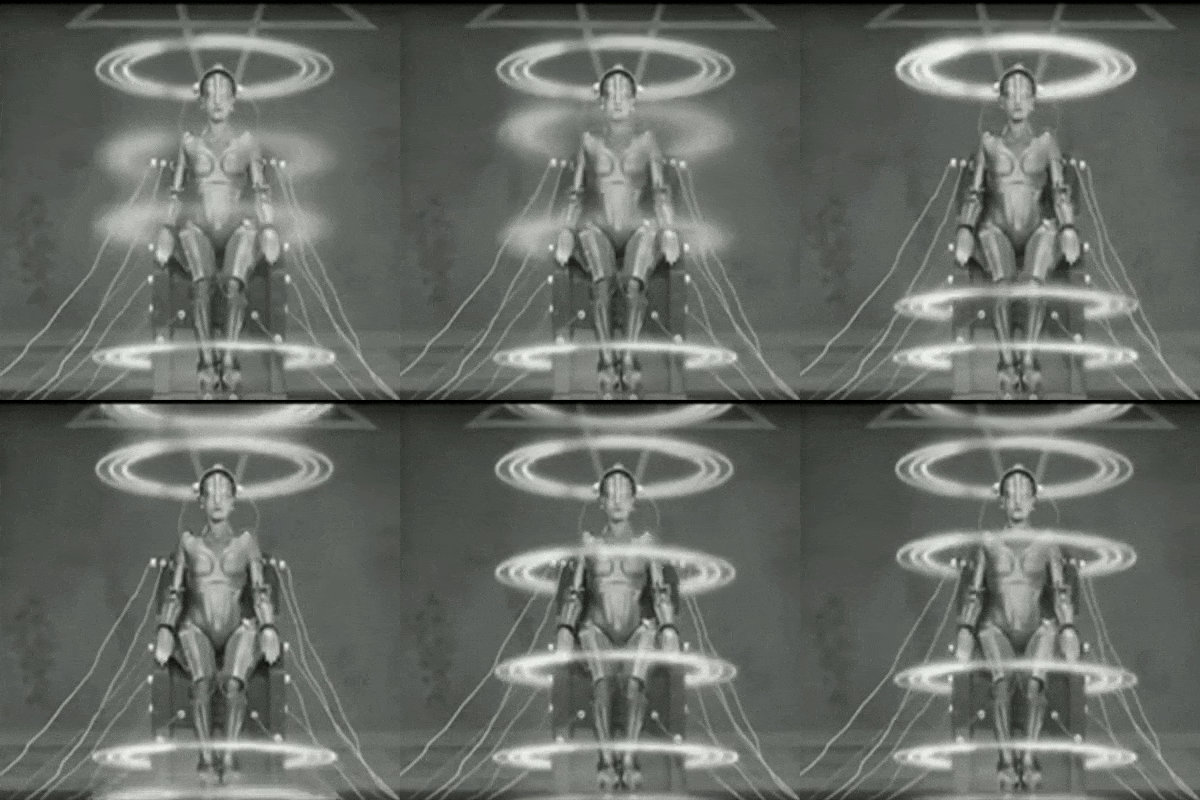
4. Maria in Fritz Lang’s Metropolis, 1927

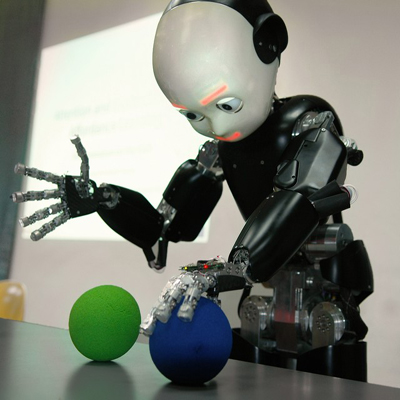
5. iCub, a mechanical robot that learns like a child, embodied cognition, 2018

6. The insertion of STEM from the 2018 film Upgrade by Leigh Whannell

7. The dancer Roberto Bolle photographed by Ferri Fabrizio

Posted on

080319 – Interface Joi – London

080319 – Interface Joi – London > words

Tools, machines, utensils, apparatus, utilities. There are many sub-divisions and classifications used to describe man’s prosthetics. Their classification relates to how they are used, their level of automation and their scale, they are all tools however, the airplane, the hammer and the factory. Through time, as our tools have changed, so has our means of interacting with them. Once a simple tool, a chisel would take a life time to learn to use with skill. Today our tools have shorter learning curves and greater pre-programmed conclusions of use.

All tools are prosthetics, they extend our reach and leverage our powers. Simple tools such as a club, a knife and a stick are hand held and used to act upon our immediate environment, they hammer, cut and thrust. I would call these first-person tools, that can be used to kill or heal, craft or destroy, farm and feed. They are used to have immediate effect upon an object or subject within our immediate vicinity. They can be used with great skill, to sculpt and paint. The interface with these tools is via touch, they are hand held, tactile, sensorial extensions of ourselves and our thoughts. As these tools never leave the hand and are always monitored by sight, sound and touch, they offer sensorial feedback that allows the user greater control. Modern simple first-person tools offer even greater leverage, for example the electric drill, the electric saw and the pneumatic hammer which greatly increase our power, speed and efficiency but at the loss of sensorial feedback. These tools are controlled by the intellect with feedback generally being of a visual nature. The tools have been mechanised and are products of a mechanised world, their use has an accurate predestined conclusion, to fit a screw, tighten a nut or to accurately cut a material. The tools over empowerment diminishes its feedback but increases its efficiency. Modern first-person tools may be sophisticated and still offer sensorial feedback, tools such as a bicycle, a sail boat and a glider. Feedback is felt and this feeling is part of the tools intuitive use and our interaction with it. Powered equivalents of these tools, the motorbike, the speedboat and the plane still all offer sensorial feedback as the consequences of their power and speed magnifies the forces that act upon them.

Simple tools have also been developed to have effect on objects and subjects beyond our immediate vicinity. Tools such as the spear, the catapult and the bow. These magnify our range as they are thrown or throw projectiles and increase our sphere of influence. These too can be used to kill, hunt and destroy. These, I would call second-person tools. Like the first-person tools these are tactile sensorial extensions of ourselves, their benefit of increased range comes at the cost of diminished accuracy. Their task is usually a simple singular objective, to hit something at a distance beyond our reach. This lack of control and limitation of the tools use means that they are rarely used to heal, sculpt or paint. Modern versions of these tools for example the rifle and the harpoon offer even more power and accuracy over ever increasing distances. The feedback from their use has been intellectualised, it is cognitive, pre-destined, and is predominantly controlled by sight.

On many modern tools the component we interact with is not the tool itself but is remote from the tool, connected via wire, blue tooth, satellite, the web or the cloud. This has numerous considerable consequences on our relationship with the tool and with its powers. These I would call third-person tools, and they have had and are having profound effects on the latter part of the twentieth century and the beginning of the twenty-first century. Third-person tools have enabled the vast accumulation of power and capital within the hands of a few. Unlike the first-person and second-person tools, third-person tools have further controls over distance, scale, boundary, multiples of, and can be self-correcting and algorithmic.

The tool operated by a remote is first and foremost impersonal and objective. There is a distance between the remote and the tool, maybe covering a few centimetres, a few meters or thousands of kilometres. The remote may operate a tool in the yard or on the moon, the distance has little conceptual relevance. The operator may be sat by a pool on a beach operating a tool in a war zone or at the depths of the ocean operating a tool in the desert, and although this is unlikely, the emphasis on detachment and consequence is important. With distance one can be coldly impersonal and objective. All of the sensorial feedback from a first-person tool is lost on a third-person tool. Control over huge distances enables both the spread of power and the concentration and centralisation of power. The third-person tool operates in a variable distance environment.

The remote also has no bias to scale, it may operate the infinitely small or the infinitely large, trans-oceanic tunnelling machines, satellites in space or nano-surgical tools. With the remote one could open dams or bridges, heart valves or arteries. The third-person tool operates in a scale-less environment.

The remote may operate tools beyond a physical barrier or within an inhospitable zone, the tool can operate beyond boundaries and is highly permeable. For example, this may be from behind the safety glass dividing two rooms or from the inside to the outside of the human body. It can operate either side of a physical barrier but it can also operate within zones that are otherwise inaccessible. These may be toxic, radioactive, atmospheric. It can operate tools within the vacuum of space. The third-person tool operates in an environment without boundary. 

Just as it can navigate distance, scale and boundary it can also be multiplied. In commercial terms this would be called scaling or roll out. If one can operate a hammer with a remote at a distance, one can equally operate one hundred hammers, set in format, with the same single remote. A hundred shovels digging, a thousand lathes milling. The third-person tool operates simultaneously in an environment of multiples.

Third-person tools may be algorithmic and have some built in autonomy. Why operate a single drone by remote when you can operate many flying in formation. If each individual drone has a certain amount of autonomy, collectively it could hive mind and swarm. Each drone may have a specific task or bias but still work within the swarm. The hive mind would confer and adapt to conditions ‘on the ground’, as the environment changes the response changes. Collectively it adapts. The third-person tool could operate instantaneously in a changing environment.

The most sophisticated tools that the majority of us use will be our computers, pads and phones. These are all remote third person-tools. We interact with them directly to produce a digital outcome that exists within a virtual digital world. We may use them to type or to photograph, we can draw and sculpt within this digital world, we can operate drones or our homes connected systems. In each case our instructions are digital and are then reprocessed to re-enter the physical world via a remote tool. The printer, the 3d printer, the drone, the thermostat for example. Some of this work may forever stay digital and virtual but still requires an additional tool to be useful and realized. Text, film and image all require a screen, sound requires speakers. These may be proximate, part of your phone, pad or computer but they could just as easily be at a distance, scale-less, multiplied and recurring. These are the elements that make these modern tools so powerful.

We interact with these tools via typing, touchpads or touchscreens using taps, swipes, expansions, double clicks, haptic click, rotations. Typing via writing devices is already three hundred years old. With typewriters being invented in the 1700’s, the first patent in 1714 by Henry Mill. The QUERTY keyboard is also over 250 years old, patented by Christopher Sholes in 1868. Yet our other means of interacting with these machines tapping, swiping, brushing are even more primitive. We can control via voice but language is proving difficult for machines to interpret and they often make errors. The above tools need to be physically touched to operate. 

Touch control can be distanced, using a touchless user interface. This is very similar from mouse to computer interface. Nintendo uses a Wii-remote, a hand held device that communicates positions in space with the computer using motion sensor technology. These were first used in the video games industry in 1972. In the film Minority Report (2002) when agent John Anderson (Tom Cruise) communicates with several screens the hand held device is replaced by interactive gloves. To communicate with the machine agent Anderson uses gesture and voice control. Wired gloves use magnetic or inertia tracking. Some interactive gloves have fibre optics sewn into them that carry light pulses. When the fibre optic is bent, i.e. bending the fingers, the fibre optic leaks light registering a loss and the losses can be tracked. These kinetic user devices require the communication between two tools, one hand held or worn and the other tracking movements.

In the film Her (2014), Theodore (Joaquim Phoenix) plays an interactive game where his hand movement is mapped in real time, alongside using voice control. Gesture control maps movement in 3D space time. To achieve this mapping, it uses depth aware cameras that use structured light to structure depth from a known source via deformations that occur as the light strikes a known surface. Structured light is used in 3d scanners, but more commonly used in multi lensed cameras that use time of flight calculations to resolve distance between camera and the subject. Gesture control uses algorithmic mapping to follow physical movement and to interact with a computer. The interaction is usually visualised on screen. Gesture control using algorithmic mapping is already quite sophisticated and used in facial recognition and in real time links between the face, facial avatars and emoji. Complicated surface modellers like NURBS and polygon meshes can be tracked, mapped, translated and mutated. Distance creates a latency between the tracked subject and executed data. Technology is quickly addressing this, GPS can real time track our phones our watches and our fitness bands. It is possible to tell if the user is walking, running, cycling or swimming and measure distance travelled, average speeds whilst collecting health related data.

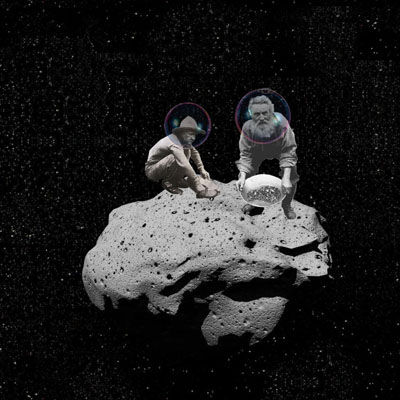
Facial motion capture electronically converts the 3D map of a person’s face into digital data. This is now often used as security access for pads. This data base can then be used to produce CG computer animated avatars in real time e.g. facial expression emoji or Apples Animoji. If we can map our faces and have the expressions translated in real time to Animoji it is only a few short steps to animating our expression on to those of a digital other. The digital other may be a president, a celebrity or your pet cat. If we can create a three-dimensional digital version of someone or something we can, via 3D printing, create a real three-dimensional static version. A robotic version controlled via gesture control and algorithmic mapping would not stretch our imaginations, it is only our technical inability that at present prevents this. Gesture control could in theory be used on any non-automated robot, container cranes, underwater diggers, asteroid mining equipment. These would be third-person tools, without distance, boundary, scale or multiple.

Man is known as the tool using animal. If no specific tools are available man instinctively improvises and adapts. He will use clubs, levers, ties and grips, anything that is available. The Industrial Revolution, brought repetition, mass production, uniformity, which increased speed and efficiency, through the scale of the factory. It mechanised our farming and our wars and our relationship to our tools became distanced. The highly personal use of the sculptor’s chisel, the artist’s brush and the musician’s violin bow would become an historical footnote. First-person tools have been demoted from a primary to a secondary field of influence and then further demoted to a realm subservient to the machine, to fix and repair. With the Third Machine Age, The Electronic Age, the interface between man and his tools has been further stretched. First-person tools that were solitary, unaccompanied, tactile and intimate have been removed and replaced by Third-person tools that have a collective detachment. Our personal control has been diminished and fragmentised into a world of pre-organised tasks. A world in which we usually contribute only to a fractional proportion of the total task. 

What is the future means of interface between man and computer and man and AI?

15.30mins

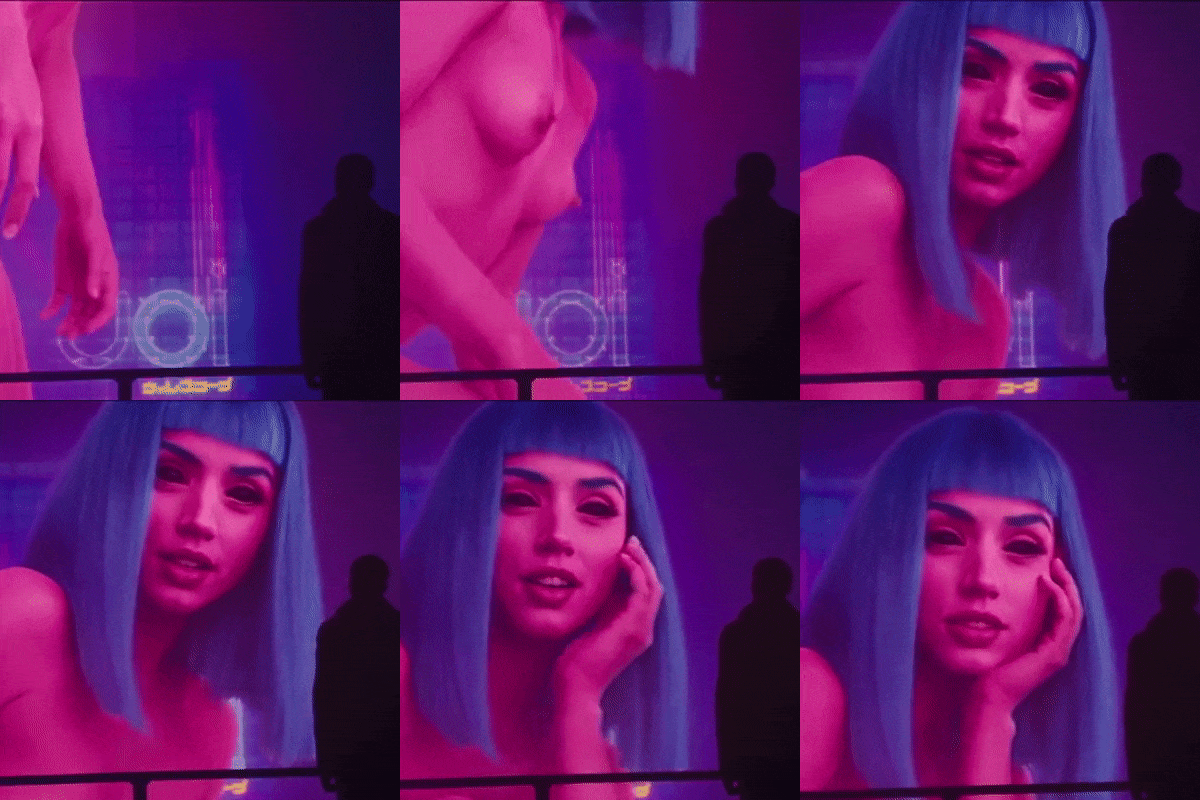
In Blade Runner 2049 the relationship played out between a hologram Joi (Ana de Armas) and the replicant K (Ryan Gosling) explores how one may interact with a holographic companion and be able to sense their physical presence. The scene opens as replicant K enters his flat and begins a conversation with someone else as yet unseen, one is led to assume it is his girlfriend in another room. 

As K arrives home he hits a button on a wall console to his left to turn on his home entertainment system. Frank Sinatra begins to sing ‘Summer Wind’ and a female voice Joi feigns surprise at not hearing K arrive and proclaiming that he is early. Joi tells K to get cleaned up and begins a conversation about his day. When Joi is asked about her day, she says that she is ‘getting cabin fever’, as if she is a stay at home housewife. After his shower K goes to the kitchen and cooks an instant meal, poured from a packet into a saucepan. K asks Joi if she wants a drink, she agrees, K pours two drinks and takes them to the living room along with his bowl of instant noodles. K drinks both drinks. K does all of the tactile work, he eventually sits down and prepares to eat his instant meal. Joi as yet unseen proclaims that she has been working on a new recipe and that she will be with him soon. Joi says, ‘I should have marinated it longer, I hope it isn’t dry’ a real-world physical thing. Joi also gives some background information to the Sinatra track playing, as only a computer could. Joi further exaggerates a real time delay as she is putting the finishing touches to his meal. Joi has yet to arrive and the audience is unsure who she is but Joi makes a big thing out of getting ready for K and preparing his meal. 

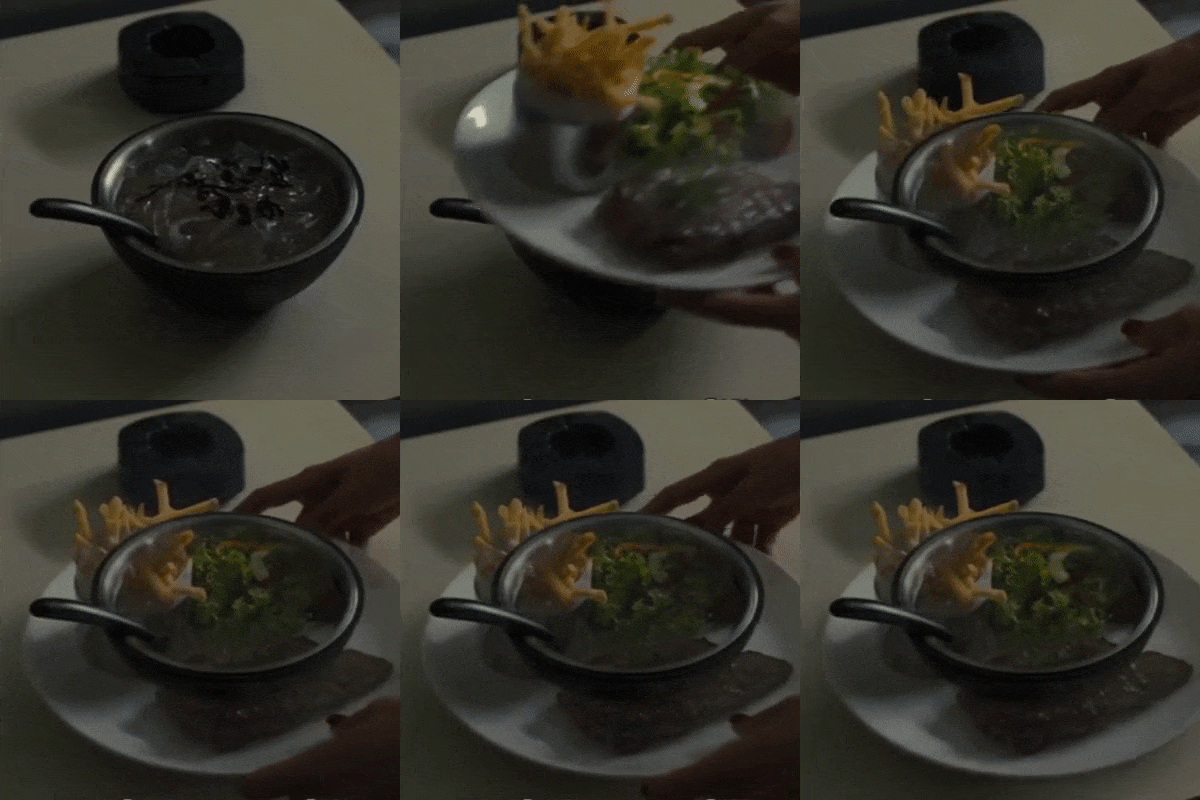
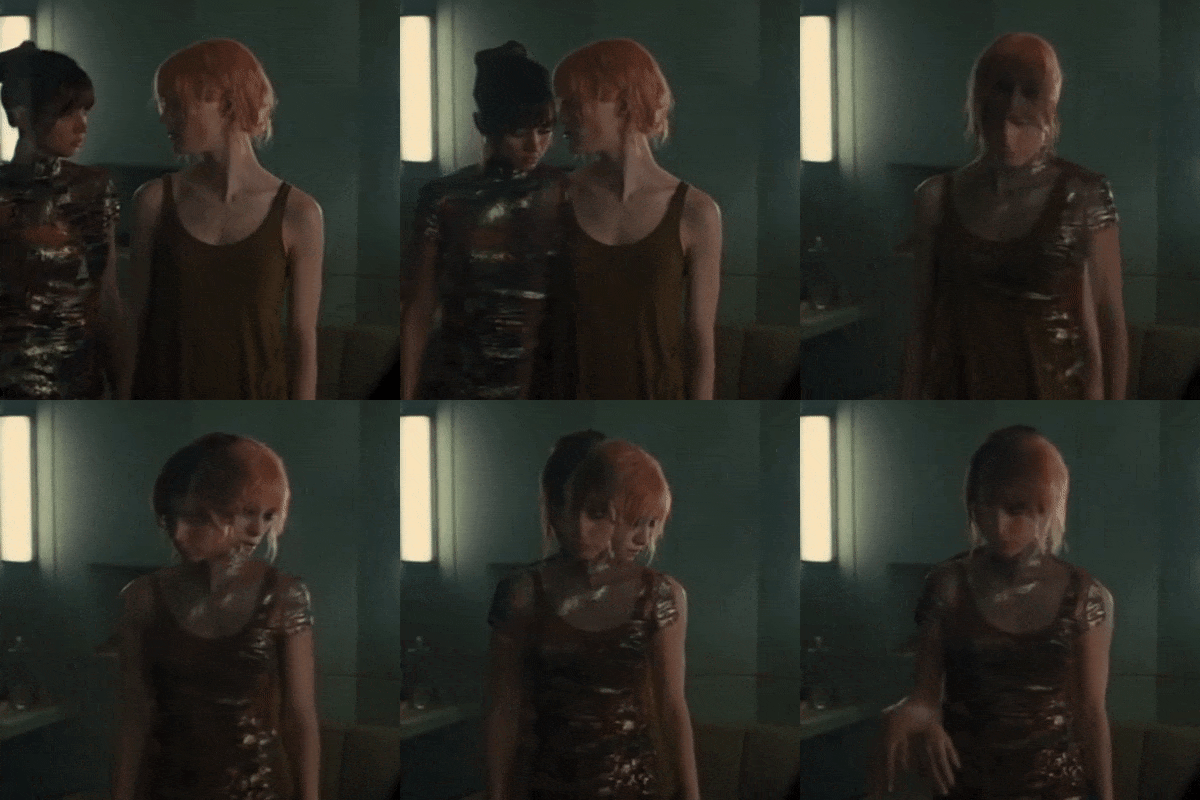
Joi opens as a hologram just in front of the kitchen door. She at first appears translucent but quickly becomes more-opaque. The mechanical ceiling mounted projection beam aligns itself as though Joi is coming from the kitchen into the living room. At this point in the film Joi has never left the living room, her space is dictated by the realm of her projection mechanism. K’s actual meal is a bland bowl of noodles and protein nutrients. As Joi materialises, she is carrying her own holographic meal, an aesthetic meal, a hologram she has concocted that she then sits over the real meal. An aesthetic enhancement, visual spice, although there was very little to marinate in steak chips and salad, it beats the look of a bowl of protein slime. The concept of touch is reinforced as Joi the hologram bends forward to kiss K on the cheek, again here the tactile is only visual and would need to be mapped in real time perfectly in 3D space time. A virtual friend will always leave one feeling alone as we have a deep-down need for touch and sensorial companionship. Physical contact is constantly simulated to enhance the reality of the event and intimacy of friendship. Joi lights K’s cigarette with her finger, one assumes, like the holographic meal overlaid onto a real bowl of protein noodles, the lighting and the burning is holographic, a 3D image on the end of an unlit cigarette, complete with holographic smoke. Joi blinks and instantly changes outfits, a pink skirt and white top become black trousers and black crop top, at the same time she changes her auburn hair. Joi reaches for a real book on the side table, Vladimir Nabokov’s Pale Fire, a book about life, death and afterlife. Joi takes a virtual copy of the book and asks K if he wants to read. Joi then changes outfits again, a silver sparkling mini dress, now with blond hair, she asks K if he wants to dance. Joi’s role as a companion is to entertain K.

K has a surprise for Joi, a present, an Emanator. K connects the Emanator to the home entertainment system transferring Joi’s data to the Emanator. Joi disappears. K then turns off the mechanical ceiling mounted holographic projector, opens the hand held Emanator and Joi re-appears. Joi now in a blue dress with long dark hair walks under the shutdown ceiling mounted mechanism and feigns disbelief. Joi spins and giggles as K tells her she can go anywhere she wants in the world now. She has holographic freedom, freedom to roam, her augmented world now extends beyond the living room. K asks Joi where she wants to go first and they walk out onto the balcony to stand in the rain. Joi’s previous world, the confined space of the living room could be easily choreographed, every object within the room had already been copied to Joi’s data base. Joi’s augmented self could seamlessly interact with this environment. Now Joi has become portable, she is no longer confined to the overhead mechanical projection beam, but this new freedom comes at a cost. 

Joi’s new landscape is unmapped and has to be established in real-time, her AI has to quickly assimilate and interpret her new surroundings. To emphasise this transition as Joi steps into the rain it at first passes straight through her and she does not get wet. The concept of a hologram getting wet is the same as a hologram casting a shadow, it needs to be able to achieve both to be grounded within the real space. As the rain hits the holographic Joi it is shown as an electronic haze, a confusion, at first there is little reaction other than perplexity. Joi’s data banks search for a generic rain and the consequences of being in rain and so Joi then begins to get wet, raindrops fall on her hand at first, they are blue. Eventually her hair and clothes get wet and rain droplets accumulate on her skin. Soon she is as soaked as anyone left standing in the rain would be, she is holographically drenched. She expresses the body language of being wet, she has the expressions of being wet, she is inundated, flooded, her skin sodden, dripping holographic drips. Joi moves towards K and they try to emulate touch, K wiping holographic rain from Joi’s holographic cheek while standing in the shower of real rain. They caress, there is longing, desire, affection and tenderness, then suddenly Joi freezes hit by an incoming voice message from K’s employer, this triggers the automated Joi system override and K’s illusion of emotional intimacy is lost. K takes the Emanator out of his pocket and Joi his personal companion is turned off, vanished at the flick of a switch. Joi contained in the Emanator then travels in K’s pocket.

The idea of the Hologram overlaid onto subject, static as meal, moving, later in the film as the surrogate lover. If you had a holographic girlfriend, she could be overlaid onto your holographic real friends, male or female, or onto any subject, animal or mineral. If you had a holographic avatar you could wear this persona over yourself, over your friend, or duplicated over numerous friends, whole clubs full of people like you. Why would you have just one holographic avatar when you could have several, male or female, animal or alien. The accessorised peacock becomes digitally accessorised. Why would a holographic avatar stay as it is when it could morph, grow larger breasts, a muscled chest and abs, hair could visually grow, skin could change colour or surface texture, your face could be visually beautified or aged. The coming augmented world offers infinite possibilities.

The beauty of the Blade Runner 2049 scene within this augmented world is the interface between the virtual and the real, a step nearer to a seamless oneness, when virtual and real are so intertwined that neither can be distinguished. The main computer interface has moved a long way from the keyboard, long gone are the days of typing green code onto a black screen. Gone too are the mechanical rituals of swipe, tap, double tap, expand and contract. Gone too is the interface of two-way instruction, Siri what is this? can you find that? can you book this? questions and answers, the beginnings of elementary conversation but not a conversation as such. In these scenes the A.I. is as near human as it can be, Joi has gestures, mannerisms, confusions and frustrations, she smiles, laughs and cries, she makes impulsive suggestions, she leads and follows a conversation. Joi has opinions but these are never confrontational as Joi also has a clear objective, to be a complimentary partner, an A.I. companion and friend. Joi is an A.I. enhanced companion, a software programme that adapts to and learns from the needs of its owner. Joi can read moods and adapt responses. There is an intimacy between K and Joi that would suggest they have been together for a considerable time and that during that time Joi has processed an in-depth profile of her owner and her owner’s needs.

At present we mainly use our hands to interact with our digital media. We would use our hands to operate the remote that in turn operates a tool at a distance. Yet fighter pilots armed with technological visors already target and fire missiles using their eyes.

36mins

When we are first introduced to Niander Wallace, the CEO of the Wallace corporation (played by Jared Leto), his role is God like, an isolated messiah, part cyborg, an enhanced human. He is about to inspect a new model of replicant. He has been trying to design a female replicant that can reproduce so that the replicants can speed up the process of colonising the off-world planets. His assistant replicant Luv (played by Sylvia Hoeks) brings Niander a set of attachments through which he can operate remote objects. The box for the attachments is triangular in cross section a pyramid extruded with a sliding top. These are sacred technological objects. Luv removes one accessory and places it just behind Niander’s ear, on the mastoid bone and a light in Niander’s neck lights up to confirm contact. Doctor’s already implant titanium into the mastoid bone, this stands out through the skin and is used for connection to external hearing devices. Niander uses this attachment to control six small drones through which he can see. One is led to assume that the drone enables considerably more than sight and can analyse the internal workings and structure of the new model replicant. The drones fly around the replicant in 3D space, controlled by Niander’s brain transmitting information to and from the drones. The over emphasis on the triangular section wooden box (wood no longer exists in Blade Runner 2049 as all trees are now dead) and the gadgets within is to visualise the film so the audience can understand how Niander communicates with the drones. Today Bluetooth connects to any equipped device, we have no need for a range of dongles each with a separate use. If the brain could communicate directly to objects the remote tool becomes an immediate extension of thought. Both the art work of Stellac and work with the severely disabled have explored the beginnings of thought control. 

54mins

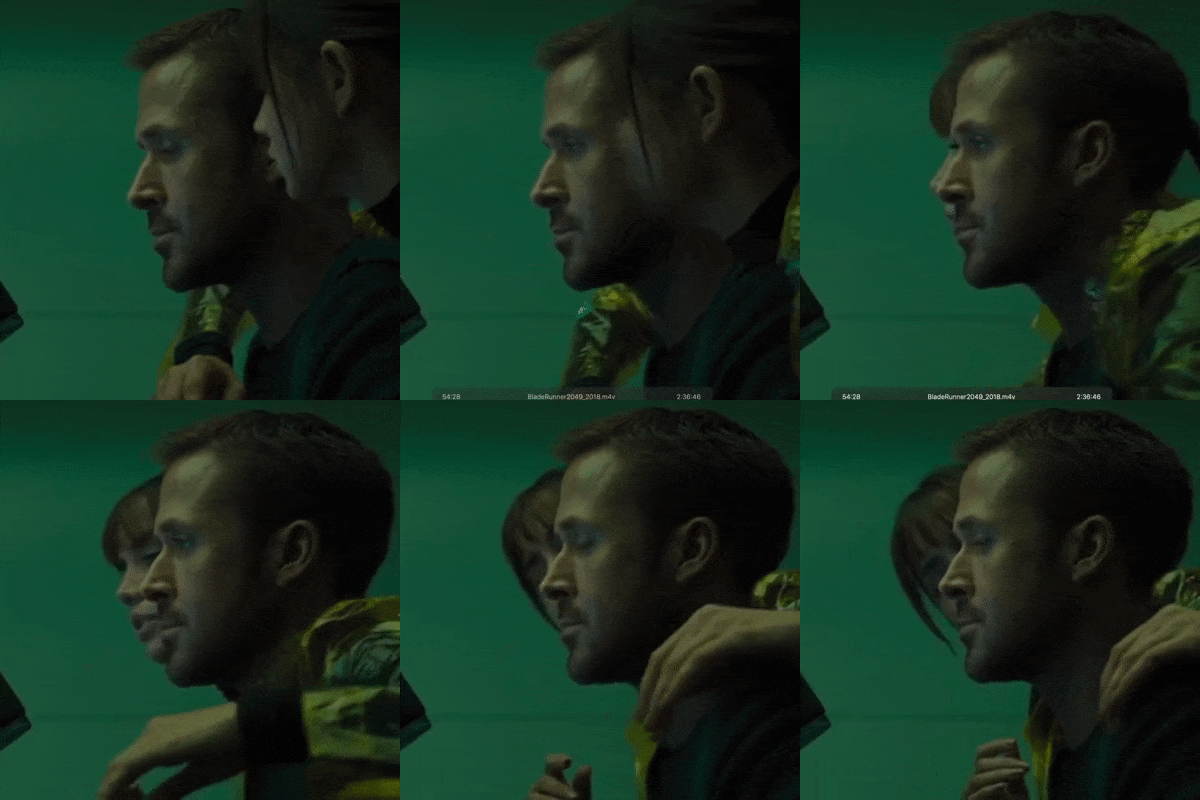
Joi has access to a huge data base archive, as she recalls the holographic wooden horse logged from K’s memories. The hologram to be further ‘grounded’ has sound, as Joi flips the wooden horse it slaps into her hand, as Joi puts her arms around K her plastic jacket crackles as it creases. Joi passes back and forth though K but there is a constant realistic sound to her impossible movements.

60mins

In this scene K has been shot down on his way to the orphanage in ruined San Diego. K is outnumbered and being attacked. Luv has been watching him, tracking him via a drone, she sees that he needs help. She brings the drone within range to help K. Luv is still at the Wallace Corporation, she is sitting cross legged in a 66 white Pierre Pauline Ribbon Chair having her nails laser tattooed. Luv controls the drone via voice control and via her glasses where she can focus on a target and a blink initiates the drone to fire. The scene puts emphasis upon the detachment between the remote control and the event. The remote is a fashion item, beautiful glasses. Luv is being pampered, sitting in her designer chair within composed surroundings fighting a war against an army in a scrapyard in a contaminated radioactive zone. Luv is presented as exquisite and feminine, she is fighting a marauding, heavily armed gang without stress or emotive expression. It requires as much concentration as she simultaneously uses to get her nails laser tattooed. The dissociation, remote to event is given emphasis in every way. It should be remembered that Luv is a semi-autonomous replicant programmed to serve Niander Wallace and as such we have a semi-autonomous remote controlling a remote.

1-22mins

Joi, the A.I. hologram is aware that she cannot fulfil K’s physical needs as she lacks a tactile dimension. Joi pays Mariette, a replicant female to become a surrogate lover for K. K had met Mariette previously and Joi knew that he liked her. Joi syncs her holographic body over Mariette’s, the result is an ambiguous combination of the pair. K can now touch Joi via the surrogate’s body. To help visualise what is happening the sync of Joi and Mariette is allowed to lapse revealing the surrogate within the holographic shroud. Joi would need to create and map,’ a NURBS or polygon surface model of Mariette, mapped in real time with any delay being too slight for the human eye to register. 

1-55mins

Joi and the emanator are both products of the Wallace Corporation. When Luv fights and defeats K the emanator falls to the ground and Luv knows the consequences of its destruction. Joi appears and begs Luv not to destroy it as her very existence as compiled data from her relationship with K exists solely within it. Joi is an accumulation of memory that has a three-dimensional interactive presence via the hologram. If Luv destroys the emanator the accumulated data that is Joi is also destroyed. The essence of the person is destroyed. In this short scene Luv is very aware that she is killing Joi in the same event as killing a real person. Although Joi can be repurchased as the hologram as she is a bought product, the essence of Joi and her relationship with K has been built up over years of companionship. In the film her entire being exists within the emanator, without a backed-up memory. In this scene Joi was not cloud linked as that link could be traced by her makers, the Wallace Corporation. In the usual circumstance Joi would need to be cloud linked (or some future equivalent) to be able to interact in real-time with her mapped surroundings. If Joi was cloud linked, as would normally be the case, she would be constantly backed-up in the same way that iTunes or other apps are constantly backed up, accumulating each new alteration or modification.

If the essence of a person is the accumulated memory of one’s experiences, then one would need to question the value of real over unreal experience as in memory they are all equal. One should also note that memory is selective and that the process of selective editing composes a fiction. However, if memory could be digitised and stored it can equally be modified or altered. This will be the dilemma of both cloning and cryogenics. All those presently frozen in liquid nitrogen waiting a new body will have to accept whoever’s memories they are given on trust when the technology to deliver their new body eventually arrives.

Joi and K exist in an augmented reality where the real and virtual overlap. The emanator is the remote purchased and possessed by K and the third-person tool is Joi. The tool’s task here is to be a companion of which intimacy is integral to the role. Usually the benefit of a third-person tool in which the remote controls the tool is that of distance, scale, barrier and multiples as described above. Here, all of those vanish to accentuate the reality of the experience with a companion. The collected augmented experience becomes K’s reality and it exists and is authenticated in the real world in real time. Fiction and fact are inseparable. As at 1-47mins as K asks “Is that real” (dog)? Deckard (Harrison Ford) replies “I don’t know ask him”. The point being does it matter?

In the film The Matrix (1999) when at lunch, aboard the Nebuchadnezzar, the teams ‘digital pimp’ Mouse (Matt Doran) offers Neo (Keanu Reeves) time with ‘the girl in the red dress’, Mouse’s digital creation. In this event all reality is stripped from the interface of the remote as it simply becomes a transition, a means by which the real is replaced by a digital reality. The interface is not a seamless transition from the real to the virtual, but instead the experience would be an either or, real or digital. However, the memory would be real and it would be collected and assembled with other memories to become the essence of one’s being. 

Fictive worlds have been part of man’s creative conscious though-out time, they are often used as a means of escape, as a means of control, or as a means of explaining what one does not comprehend. Fictive worlds exist within and feedback to real world events, from the Greek adventures with the Gods, religions and their associated parables, myths of nymphs, pixies, fairies, zombies, orks, chimera and super heroes. Since the Sumerian gods Enlil, Enki and Ninhursanga (3000BC) to Astro Boy, Witchblade and Dokkoida (21st Century Manga) the fictive world continues to influence us as they feed back into our real world. Watch a child at play, embrace their imagined fictive world whilst running around the play-ground of real space time. These fictive worlds should never be considered to be dissociated from our real world as we have fought wars, built temples, organised cities, mapped skies, created calendars and other measurements of time, mass and distance around their fictive existence. Man organises and assembles his real world in the shape of his fictive world. The human construct sits on nature and is rarely part of it. It is ordered and organised in a way that is completely abstract to nature. The directed myth controls the real. We do not need to physically touch something to influence, to have causal affect? Joi is an intimate associate, a confident, a sounding board, a guiding hand, a conscience. An AI collection of personal data that is corporately owned. At present we have influencers, they guide the masses to the markets and have great power and persuasion. The idea that we each, at some point in the future, may have a holographic friend, a corporately owned, personally targeted holographic conscience, is frightening. As a future controller of people, it would be almost god like, beyond objective criticism as it would be a collection of self-monitoring personal data. However, it would be under corporate control and act as a collective global conscience, guiding each individual with AI driven personally targeted directives. Here the fictive myth, personified by one’s holographic friend, would have causal and directive effect. Controlling the myth controls and directs the real-world consequence, as it has done through-out time.

Man’s interface with the world via the semi-autonomous third-person tool will allow him to become so distanced from reality and the consequences of reality, that both the real and fictive will become a seamless whole. Our hands already perform a bizarre choreographed ballet on our phone screens as we communicate with distant others, each of us at our gateway to the net and this digital world. Wii game and augmented reality have already made that dance a figurative abstract. The dissociation of movement from anything within its immediate environment will be one of the strangest ballets yet… or is it. The mime artist, the shaman, an emotive performance in classical ballet all connect the real with an imagined world. The real-world movement of the performer is dissociated from their virtual imagined worlds that they describe. This abstract dance, the interface of the future, will operate machinery in underwater mines, build structures on distant planets and walk the inside of our arteries, cleaning and repairing their surface from toxic impurities. Not unlike the performance of the Houngans or Mambos that connect to the afterlife of the Voodoo world, a possessed medium at a séance, or a partygoer on hallucinogens.

Finally, the filming of the holographic scenes in Blade Runner 2049 were not as straight forward as they initially seem. At first it is tempting to believe that they are a simple 2D overlay onto a 3D film sequence, the overlay having transparency and carried out post production. A 2D overlay would not work as it holds no volume and cannot accommodate rotation. As an actor rotates through 360 degrees a 2D overlay cannot correct perspective. To achieve the 3D hologram of Joi, Ana de Armas’s body was mapped and a digital model made of it. This is a 3D surface model, a shell. This was then cut in half vertically, from head to foot so that there were two half shells, a back shell and a front shell. The two half shells could be given different levels of transparency as required to achieve effect. Ana de Amas would act her role and be point mapped in space (usually neck and hips). The 3D model of Joi could then be overlaid onto Ana de Amas as she walked through 3D space. This process to overlay Joi would be the same for Mariette in the surrogate lover scene. Transparency and sync were manipulated to give the scenes visual comprehension.

The relevance of the mapped 3D surface model is important with regard to the future of tool interface. In the film, the 3D holographic shell is the conclusion, it is the objective of the exercise, a visual thing. Holograms are usually used for visual observation. In Blade Runner 2049 at 1-12mins we meet Deckard’s daughter at work in her lab creating artificial memories. She carries a tool that controls her holographic world. We first see her in a holographic forest studying an insect, she later uses the same tool to create a birthday party. The hologram is a 3D rendering of her ideas, of her design, it is a visualisation. But this technology can be reverse engineered. By mapping the body in real-time we could interact with distant spaces and operate distance machines. The software used to create the effect of the holograms and digital modelling in films such as these will soon filter into the augmented reality apps that we will all be using in the near future. These in turn will develop the technologies required for real-time distance interaction using figurative choreography with real world causal machines. The dilemma is that the more distant we are from the consequences of our actions the more fictive those consequences become.

Images

1. Joi’s entrance (15mins)

2. K’s food, Visual Spice (17mins)

3. K’s cigarette (18mins)

4. Data base merge (54mins)

5. Surrogate lover (1-22mins)

6. Single hand sync (1-23mins)

7. Billboard Joi (2-11mins)

Posted on

071017 – Space Port Venice – London

​071017 – Space Port Venice – London > words

Venice is a surreal island, a level plateau built on mud enshrouded by its lagoon. The Grand Canal, a truncated ‘river’ that starts and finishes as if cut from the mid section of another river from a distant land. The lagoon shelters the island. Venice is an island protected by spits and shallow mudflats and throughout its history these have foiled many a sea-based invasion, leaving antagonistic armies stranded in the shallows. Venice was originally little more than a swamp, a site chosen by the dispossessed and victimised, a marshland where its residents could reside in safety and start anew.

Early Venetian dwellings were little more than wooden huts on stilts clinging to the highest silt banks, an environment with poor natural resources, no farmland, few trees just marshes, reeds and bogs. Locally the residents could fish for crab, shrimp and silt dwelling fish. With stifling hot summers and brutally cold winters the original occupants were survivors, there to avoid persecution but also there to search out a better life, to start afresh without landlord or feudal lord. Soon they would learn to navigate their lagoon and become fishermen trading the surplus for what they needed. As their confidence grew they would venture further out into the Adriatic Sea trading along the coast of what is now Italy, Slovenia and Croatia. A natural progression to trading fish for goods or money was then to trade on the goods bought, so up and down the coasts they would travel buying and selling. With this the Venetians found wealth, their wooden huts soon replaced by large wooden buildings. Larger ships were built to carry more goods and to travel greater distances. As their success grew new inhabitants were attracted to their island home and soon it was full on its way to becoming a city. 

The larger ships carried the Venetians south down the Adriatic hugging the Albanian coast to Greece, here they would turn east eventually to reach Constantinople to trade with the Turkish traders at one end of the Silk Road. When Marco Polo returned to Venice after 24 years of travels to the East, his stories told of the huge wealth of the orient merchants who were keen for this new trade. The Silk Road travelled from China to Constantinople and the Venetians controlled all water born trade from Constantinople to the West via Venice. The areas around the Rialto developed into a market where all types of exotic goods could be bought and sold. Ships from Constantinople would harbour in the mouth of the Grand Canal and unload here at sea. Narrow boats took the goods from the ships along the network of canals and into the merchant’s houses. Venice was a port, a distribution and logistics centre but a centre like no others. The Venetian merchants houses developed into a unique type of wholesalers. Water gates at the base of the buildings open onto the canals allowing boats to access, unload and sell their wares. Floors immediately above this were storage and sales spaces. Floors above the sales spaces were domestic living accommodation. These were family businesses and the families grew very wealthy expressing their wealth in forever finer buildings. Early banking and insurance began here to aid the merchants and the infrastructure of trade developed. The Venetians were wise enough to appreciate that although their interests were personal their strength was as a collective so their ‘port’ was soon adorned with large pubic squares, churches, bridges, sculptures and monuments.

The trade routes along the Silk Road picked up ‘travellers, adventurers, explorers, rogues and vagabonds’. Service industries sprung up along route, food stalls, bars, theatres, gambling dens, dancers, faith healers, barbers, costumers, mercenaries, body guards, assassins, prostitutes, and at its terminus Venice soaked up this huge influx of cross cultural immigration that supplied these services. Intercontinental trade needs liberal conditions, in Venice, Christians, Moors, Asians and Jews all added to the mix. Their streets and their buildings an endless collage of cross pollination, an exquisite assemblage of adoption and adaption. 

When travelling considerable distances and when trade is exposed to substantial risk the best goods to ply have high value, low baulk. So trades in spices, gold, precious jewels, silks, perfumes and porcelain dominate. These suit the caravans of the land route, the rowed and square sailed ships of the sea route, the souks, bazaars and markets and the merchants houses of Venice.

The first privateers to venture into space will be looking for goods to trade. Asteroid mining will probably be one of the early businesses to be established. Small towns, space shanties, will settle on the asteroids they are mining and with time these settlements will grow attracting the many subsidiary industries that feed upon a primary industry. Not unlike the growth of Venice the asteroid towns will soon attract ‘travellers, adventurers, explorers, rogues and vagabonds’ all looking to get rich quick, to escape the established regime, to seek out a new life. 

Billions of years ago asteroids and planets were accreted from the same starting materials. The stronger gravitational force generated by a planet pulled all siderophilic (iron-loving) elements into their cores during the stages of their molten youths, leaving the surface crusts depleted of such materials. On earth asteroid impacts have re-infused the surface crust with these valuable elements. Typically these include metals such as gold, cobalt, iron, manganese, molybdenum, nickel, osmium, palladium, platinum, rhenium, rhodium, ruthenium and tungsten all with considerable economic and technological value. On asteroids due to their lack of sufficient mass and gravitational pull these elements may often be found lying on or near the surface, easing their discovery and recovery. Of these asteroids there are several Easily Recoverable Objects (ERO’s) and Near Earth Objects (NEO’s) that could feasibly be reached and mined. 

Asteroids are categorized by their spectra into Types. C-Type asteroids have a high abundance in ice and therefore these asteroids would have a significant infrastructure role in space. C-Type asteroids would be logical bases on which to set up space depots to provide, water, fuels (splitting water into hydrogen and oxygen) and ingredients for fertilizers (organic carbon and phosphorus). In time Ceres would be a logical C-Type asteroid (now classified as a dwarf planet) for such an infrastructure base. Space fuels, water and food from the C-type asteroids would support the mining outposts on the S and M-Type asteroids.

S-Type and M-Type asteroids contain numerous metals including rare metals. As soon as trade between asteroids and between asteroids and earth commences subsidiary industries would grow along and around the new trade routes opening a new frontier. At present economic rather than technological conditions have prevented space initiatives, development and progress. However, as of September 2016, there were 711 known asteroids with a market value exceeding US$100 trillion and it is only a matter of time before the equation tips towards the economically feasible. The vastness of space contains an economic vastness of resources, although the total mass of the asteroid belt is only 4% that of the moon, asteroids are resource rich.

Early asteroid mining may well resemble the Privateers of the Fifteenth Century. Pirates on the high seas backed by National Governments. In a world that had yet to be claimed and with all eligible parties fighting for their share, this was a very grey area for any form of legislation. Earth has drafted The Outer Space Treaty and The Moon Agreement that outline laws and procedures with regard to space and space mining but only a few countries have signed these and as the prospects become more feasible the rules will change. It will be corporations backed by investors and not governments that will fund early space exploration. The East India Company immediately comes to mind, controlling key ports and Trade Routes, the gateways, will be the desired path of most corporations, to encourage anyone with a bucket, a spade and spaceship to ride out, stake a claim and strike gold.

The early days of space mining may well be Gung Ho but just as Venice was the initiator of this essay, by establishing trade and controlling the gateway to the Silk Road, out of the swamp grew an amazing rich and diverse city. There will be space cities equally magical, their stories told by Marco Polo astronauts. But just as Venice had its day, its day also passed. Wars with Turkey lost the Venetians control over Constantinople and with it control of the Silk Road land route to the East. Soon Columbus would discover the New World and Vasco Da Gama would round the Cape of Good Hope establishing a sea route to India. Venice’s monopoly on Eastern trade would be broken and its oared galleys were now outdated and of little use on the open seas. I see no reason why the rise and fall of future space cities should be any different. According to CNEOS, “It has been estimated that the mineral wealth resident in the belt of asteroids between the orbits of Mars and Jupiter would be equivalent to about 100 billion dollars for every person on Earth today.” It is difficult to imagine the asteroids belt being left untouched forever, dwindling terrestrial resources may well force our hand. To fully explore space we would need resources beyond those that could be supplied by Earth. 

An important test bed for mankind’s ambitions for space would be with our own moon. The moon’s surface is believed to be rich in cobalt, iron, gold, palladium, platinum, titanium, tungsten, uranium and the gas helium3. Water has been discovered at the poles which would be used either to sustain life or split and be used as a fuel. The moon could also function as the earth’s lifeboat housing data stores of information including genetic, technical and historic should an asteroid ever fatally hit the earth. How many more years will we wait for the first moon base?

The Surrogate Twin

Posted on

170817 – Space Drifter – London

​170817 – Space Drifter – London > words

When it is time to leave our planet to explore the unknowns of the Solar systems what form of craft will enable such exploration. To cross the huge distances of space humans require either some form of stasis in which we sleep throughout the journey or a multi generational ship. The idea of the tin can spaceship loaded with sufficient supplies to cross these vast expanses would seem naïve. In space there are no drive thru’s or convenience stores (as yet) from which to resupply. (Ref. Diary 271216 – Distance) To put Space distance into perspective the recent discoveries of the Kepler potentially habitable planets, 2011-2015, range from 500-2700 light years away. A light year is almost 6 trillion (6,000,000,000,000) miles. The space shuttle orbits the earth at 18,000mph at this speed it would need 37,200 years to travel one light year. The scale and breadth of space is still, to the human mind, incomprehensible. Spaceship Earth, a phrase coined by Buckminster Fuller, is the spaceship we need to replicate to traverse the above distances. Huge sail boats, drifting farms, acres on a wing.

In the Arizona Desert in the early 1990’s The Biosphere 2 experiment in which eight people were kept within a sealed enclosure for a period of two years. This experiment tried to create a fully self sustaining closed environment, producing its own air, water, food whilst recycling all of its waste. The Biosphere 2 was a three-acre by nine-story volume maintained as an independent controlled circular system in which all that was required by the eight inhabitants was provided from within its own ecosystem. This supposedly balanced system was supposed to completely support its eight inhabitants, a tall order and one that was doomed to fail. Ecosystems are multi complex elaborate symbiotic systems; they do not travel well in part. Biosphere 2 consisted of five biomes that replicated terrestrial biomes each working as an interconnected vivarium. The biomes were a rainforest, a grassland savannah, a mangrove wetland and an ocean and coral reef all enclosed via space frames and glass. The name Biosphere 2 was chosen as it was to be the second self-sufficient biosphere after that of Earth. There has been no valid follow up to the Biosphere 2 project and any hope of traversing the endless expanse of space requires a self-sustaining system. The Biosphere projects need to be reinstated and be of international concern and collaboration. The knowledge required to maintain a self regulatory sustainable Biosphere would not only be useful for space travel but of obvious use to the management of planet earth. 

So space travellers are faced with immense distances and slow speeds. To cross the vast stretches of space, ships would need to be vast self-contained multi generational enclosed ecosystems. Flying farms designed by horticulturalists as well as by engineers. Sail boats that drift, as early plant life first propagated earth, randomly drifting, following the solar winds, clinging to outcrops of inhabitable surface wherever found. These would be delicate fragile structures that maximise surface areas to catch energy and produce food. The nearest prototype to a future Space Drifting craft would be the plankton clouds of the oceans. Plankton are simple intelligent life forms that work collectively as producers, consumers and recyclers, a collaborative team of ocean farmers. There is much to be learnt from plankton’s photosynthetic creators, they have the ability to use the energy of light and to soak up carbon dioxide whilst producing sugar and releasing oxygen. Around half of the world’s oxygen is produced via phytoplankton photosynthesis. The need to fully understand and be able to replicate photosynthesis will be a key component is long distance space travel and future space colonisation. To be able to build and maintain algae farms and understand and control cyanobacteria films may be an early prerequisite to both earth’s maintenance and space terraforming. It will be impossible to terraform any future planet without some form of panspermia. Controlling this seeding, monitoring and modifying its outcomes over millennia, will be an essential component of space conquest. 

Mankind is a long way from being able to cross the distances required to reach any potential habitable extra terrestrial world. In the first instance there is a need to create fully autonomous circular systems/environs on earth. Then these would need to be tested by creating orbital habitats that can capture and store the suns energy. The most obvious orbital habitat would be the moon and it is here that the early experiments in space habitation should commence but only after we have achieved a fully self-contained biosphere on earth. At the same time autonomous robotic drifters could be sent out to initiate colonisation of planets and asteroids by seeding cyanobacteria. Simultaneously these autonomous robots could set up staging posts throughout space that would enable and assist future colonists on their long crossings through time. Autonomous robotic drifters could collect and assemble space debris, small asteroids and meteorites, using these as the building blocks of perhaps future habitable stations. This in turn would be a test bed for building planets or moving planets to within our own habitable zone (Goldilocks Zone) as this may also be key to maximising the few future habitable zones that exist throughout the many solar systems. 

One can only speculate on what these space ships of the distant future may look like but they will probably look more like farms than space ships. So images below.

The Surrogate Twin

Images. 1-7 Space Drifters for the Infinite Abyss.

Posted on

270117 – Iris Van Herpen – London

270117 – Iris Van Herpen – London > words

The Iris Van Herpen clothes not only continue to be at the forefront of invention and innovation but also are becoming more and more wearable with each collection. The AW16 collection Seijaku is an exploration into Cymatics. Sound waves are visualised using evolving geometric patterns, where the higher frequency sound waves produce a more complex pattern. The ethereal moiré effect of the dresses appears to be created by waves of light captured on sheer organza and tulle. As the models move a mesmerising optical mirage flows over the silhouette of their bodies. Like all Van Herpen shows nothing is left to chance. The Zen bowl sound installation of Kauya Nagaya, laid like ripples, flow from the footsteps of the models The sound fills the L’Oratoire du Louvre with a haunting resonance reverberating from the marble floor to the cross vault stone domes above. Dark oak panelling forms the backdrop at ground level. These earthy natural colours in a hall of haunting sound has a religious intensity used here to showcase and counterpoint scientific and technological pieces. The models are delicate, fragile, almost see through, each one a sculpture in motion ending their walk on a small granite plinth. The models here, as if intoxicated by the moment, display a doll like process of self-discovery. Every part of this show is perfect installation art, scripted polished and professional.

The SS17 collection ‘Between The Lines’ explores more optical illusionistic effects and distortions with rhythmic black on white 3D printed patterns sewn onto Mylar. The bodies form is lost within a camouflaged optic of complex geometries that create strange over body forms. Many of the pieces are not worn but instead walked within, the penumbra and the silhouette being recurring themes within the work. Iris Van Herpen and her very talented team are fast becoming the rising stars of the fashion world with work that continues to grow in strength and maturity. Her shows have become art works in their own right following on from the pioneering shows of Alexander McQueen in the early 2000s. This is brilliantly inspirational work.

Images left to right. 1 Cymatic volume Ben Lloyd Goldstein. Iris Van Herpen AW16 2-5, SS17 6-7.

Posted on

150117 – Kinetic Fresco – London

​​​150117 – Kinetic Fresco – London > words

The forgotten techniques of Mannerism and Baroque.

Di sotto in sú 

Quadratura

Anamorphosis

Trompe-l’oeil 

Fresco and Fresco-secco

Perspective theories developed in the 17th century to a point where enclosed space could be opened up using illusionistic painting techniques. Walls and ceilings became surfaces that could be expanded into other fictional worlds. The techniques were adopted from the theatre and were often used to open up a space to the outside world typically with garden vistas or soaring skies. These fictional painted spaces contained other worlds that were often mythical or biblical. They were spaces in which to escape or to be reminded of ones humble place on earth, a space to explore but also an over looking space who’s inhabitants watch and judge. ‘As the gods look down’ the physical space is monitored by the fictional space. Story telling, myths and fables complete the interaction between the two spaces and the physical space becomes a transitional space to another world, a gateway. Religious spaces have often been rendered as such.

Trompe-l’oeil – Fresco is painted into plaster that is still wet (fresh) whilst fresco-secco is painted onto dry plaster. The technique for transferring the images to the plaster is dependent upon the type of fresco used. On fresco an outline drawing would be sketched on the under layer in a red pigment that then bled into the fresh top layer prior to pigmentation. In fresco-secco the drawings were transferred from paper sketches or cartoons in the same way as all large paintings were created. Outlines on the cartoon are pricked with a series of fine holes through which soot or chalk powder is rubbed to mark out the areas to paint. Fresco painting is a slow process with large ceilings and walls often taking years to complete. Once complete it is a static image, a static illusion.

The technique of Quadratura created single point spatial perspectives. This false architecture of perspective when painted onto a flat or shallow vaulted ceiling would continue the real architectural space. The perspective had one focal point and used foreshortening of figures, architectures and landscapes to create the illusion of a deeper space often opening to an infinite sky. Fresco painting is the technique ideally suited to the Grand Manner of the Baroque. The ambition of scale and subject complement the vast canvas of the walls and ceilings of the palaces of the nobility. Whole spaces were transformed as each enclosing surface was expanded with an illusionistic space. A dialogue would begin between each expanded space that conversed across the room and in so doing dragged the real world into the fictional and vice versa.

Baroque Quadratura was only convincing when standing at one point. Augmented and animated ceilings could shift this perspective as the viewer walked around the room. The shopping mall is already an augmented space, a real space overlaid with wireless fed information about products, information or events, a rich and dynamic multi-media experience. It will be interesting to see whether these augmented spaces develop into a new medium of spatial experience or whether they will remain merely as information overlay options to be turned on or off as desired. As virtual reality (VR) becomes mainstream, at first adopted for home and public entertainment, the overspill of this spatial type onto the city will create another layer to be explored by artists, architects and designers. Layering the fictional onto a real space, exploring time, place, sound and activity dislocation, the consequences of such experimentation are yet to be known. What is certain is that the augmented real space will be a hyper-real alternative to the space we experience today. The layering of the augmented onto the real will be read as one single spatial experience in the same way as the fictional ceiling frescos and real time volumes read as one space. What is new is that the augmented space will be dynamic and interactive and that we experience it in two ways, one as a space and two via a device. If there is a further layer of augmentation via a device, a cell phone, pad or wearable, a hybrid interpretation of space materialises. The space has a public domain and numerous subjective, simultaneous personal domains. The urban spaces of Tokyo, Hong Kong and Seoul, where walls of electronic media enclose public spaces, are a precursor of this spatial type. The information the media walls support is pragmatic and informative as opposed to purely cultural or experimental.

The 1990’s offered VR parallel worlds and the internet created cyberspace. Whilst VR is still waiting for technology to catch up and commercialise, cyber space has been domesticated, taken over by the big brands and normalised and is now little more than an ‘electronic suburb’ (Norman Klein). However within cyberspace new obsessions have emerged that create a constant and continuous dialogue between the data of cyberspace and occupied real space. Selfies, the use of GoPro or dog cams are all forms of video surveillance that turn real space into cyberspace. Cyberspace when recalled upon a device informs real space. Every real time object with embedded information becomes a cornerstone to cyberspace, simultaneously a three dimensional reality and a two dimensional on screen character. Once in cyberspace it can be edited, altered, layered with text of further information such as music or sound. It becomes something else, neither a copy nor an original, neither fact nor fiction. Space has never been experienced with this type of dynamic duality before.

When every object in a physical space has been embedded with some level of technological tangible interface the centralised computer becomes obsolete and a reader is all that is required. All of the surrounding physical space becomes part of the human computer interface. When tracking a users interface to provide localised information the users data is collected. Augmented space is both an experiential and monitored space (‘as the gods look down’ text from above). Augmented space is a 4D physical space (when 4D is 3D plus time) with an additional fifth dimension of information, a 5D space. Augmented space is never permanent and exists within a feedback loop. As information is collected and uploaded from interactions with the physical space the augmented space is modified to accommodate new incoming information that is in turn fed back to the physical space. Augmented space is therefore a space of collective learning and experiencing. At present the user needs an interface device to access and then interpret the augmented space. When the interface device is no longer electronic but biological it is feasible that collective learning or collective experiences could add a further perceptual dimension. The collective experience would have multiple experiential responses; these may be polar or assimilated into a generic.

With the augmented electronic space, the dynamic or kinetic fresco, choreography is added to the skills required of the electronic fresco painter. Unlike previous frescos, in the kinetic fresco every constant has been replaced by a variable and every variable is a fiction. In this world the image has a greater inherent value than the original, as the image is hyper-real, super-intense, edited and associative. The image is the myth that the object aspires to and possession of the object is the means of acquiring that myth. Through this image and its associative context the original object is loaded with additional values and aspirations and as such the real becomes more fictional. When the object is a space we inhabit and that space is further continuously augmented, updated and refined. The two spatial types, real and fictional are blended, their differences become indistinguishable, and we inhabit this new spatial type with blind religious fever.

The Blue Journey dance performance (gif image four) is a work that consists of two elements that happen at different times and are then re-sequenced in the present. The backdrop is a pre-recorded animation that draws upon a limited pallet of black on blue (the work of choreographer David Middendorp). It is two-dimensional and flat, an animated picture plane presented as a vertical surface, as a border enclosing a real space, a boundary. The events on this flat animated space are fantastical, they defy gravity, have no fixed scale, they are able to morph in form, disappear and reappear, they can float, fly and become ephemeral. This fiction is a dream space edited and rehearsed, it tells a story, it is an animated locale, a fresco, a Trompe l Oeil. The fictional space is a space from the past, a historical space that has already happened elsewhere, perhaps only happened in the digital space of the computer screen. A transplanted fiction from another time and place. A space that never existed is presented as a spatial extension of the real.

The Blue Journey performance happens in real time in a physical space, the stage in front of the animated space and consists of a dance, a dialogue between two characters, over viewed by a third party, the animation. To cement the relationship between the performers and the backdrop, two events happening at separate times, the backdrop first takes the role of shadow to the performer. This is introduced simply, as the male dancer walks across the stage followed by his shadow. This simple act of walking with ones shadow apparently falling onto a wall sets the premise for the full extent of the credibility of the following journey. By locking these two dislocated movement pieces into one time frame, the fantastical and the real merge and a mythological landscape materialises. The boundary that contained the real world has been breached and space is extended into an animated augmented world. The transition is seamless; the audience are given no instruction other than this simple introduction that the shadow follows the walking male. This is all that was needed to link an imaginary world to the real world, to link two distinct time zones. When the female dancer begins to move she is beautiful, graceful and poetic, her shadow follows and the audience is dragged further into the illusion of synchronised time. Then the shadow stops, it no longer follows the dancer, but the idea of synchronised time is not lost as the audience is convinced that the shadow is that of another dancer working back stage. Not losing the illusion of synchronised time is essential to maintaining the extension of the real space into the fictional. 

The fact that this space is animated and choreographed gives it a power that traditional fresco was unable to achieve. The extended space becomes a walk into an occupied fictional space as opposed to the previously Mannerist viewed only space. It is important to note that this spatial extension has been achieved simply by silhouette, in a flattened two-tone, two-dimensional space. This is a space that never imitates the real and has none of the full richness of a Baroque Quadratura. In the Baroque, sculpture was often used as the transition from the real to the fantastical, a peripheral border linking the two worlds, sculpture as foreground, imaginary space as background. Sculpture was a static transition; its dynamic comes from gesture and association. Further movement of the viewer and the changing fall of shadow and light would animate the Baroque sculptural transition.

As the Blue Journey performance continues, the space of the fantastical begins to take over and separate from the real. The audience are drawn into the fictional animated space, as this (background) has greater dynamic than the real time performance (foreground). This shift in dynamic from real to fictional is essential for taking the eye from the real to the fantastical and this will be a key component of future augmented space. The Blue Journey animated space continues to increase the credible limits of fantasy as figures dissolve in mist, float without gravity, multiply instantaneously and eventually the silhouette dancers fall as if rain from the sky. The bonds between the real and imaginary are choreographed through sequencing, gesture and touch, keeping the two spaces locked in one time zone simultaneously happening in the present. This interaction is best exemplified when the dancer leaves the real world to join the animated world only to reappear back in the real. This seamless link of the real and fictional connects the two separate time and location zones in which each space was made into the one space of the present.

Future augmented space will explore the possibilities outlined above and as a consequence the delineation between what is real and imaginary will continue to evaporate. At the same time in a crowded world of physically finite space extended virtual space is infinite.

Images left to right. 1 Chiesa di San Pantaleone Venice – Gian Antonio Fumiani 1645-1710. 2 Chiesa di Sant’Ignazio, Rome – Andrea Pozzo 1642-1709, 3 Palace of Liechtenstein – Andrea Pozzo 1642-1709. 4 Blue Journey Dance.

The Surrogate Twin 

Posted on

271216 – Distance – London WC2

​​​271216 – Distance – London WC2 > words

We are off to visit the Caravaggio exhibition for a second time. As we turn the corner to approach Trafalgar Square from the west the low winter sun hits the National Gallery hard on its face; the lights beauty stops us in our tracks. The low sun brought relief to the moldings and cornices, adding definition, warming the yellow Portland stone whilst articulating all of the details of William Wilkins façade. It was a rare opportunity to fully appreciate a London building so often hidden by English overcast skies. Ruskin’s Seven Lamps promptly came to mind, Venice at sunrise or sunlit cobbles in a sleepy Italian hill town….but then there was a pause as I said that light had travelled 149 million miles to hit that façade. We Googled the travel time, light travelling at 186 thousand miles a second took eight minutes to travel from the sun to the National Gallery.

It is difficult to comprehend space speed and distance, 149 million miles in eight minutes, 18.6 million miles a minute. We understand space-time only from speeds that we regularly experience, long distances are most frequently experienced through car travel and this forms our all-encompassing concept of scale. At 60 mph, a mile a minute, quite fast and a legal speed, London to Bristol, 120 miles is 2 hours, London to Manchester, 210 miles is 3.5 hours. If we had lived in the 18th Century our all-encompassing concept of scale would be the horse and carriage with a speed of approximately 6 mph, London to Bristol 20 hours, London to Manchester 35 hours. Our experiential conditioning of space-time prevents us from fully comprehending our insignificance within the universe.

A light year, the distance light travels in a year, is six trillion miles, again a meaningless number, even more incomprehensible when written 6,000,000,000,000 miles. Our VW Golf is happy at 60 mph. one light year at VW Golf speed is 100,000,000,000 hours or 47,915,668 years. So in our VW Golf, assuming we would need a couple of sandwich breaks it would take 48 million years to travel one light year. The nearest star to the sun is Alpha Centauri 4.4 light years from earth, the Golf’s not up to it.

There are approximately 300 billion stars in the Milky Way, if, assuming 10% of them have planets, there are 30 billion planets in our galaxy alone and there are over 100 billion known galaxies in the observable universe. Our concept of space-time is so wonderfully inadequate and our present ability to cross such distances is so far out of our reach that it will be some time before we can ”boldly go”.

If Einstein’s Theory of Special Relativity is correct and that energy and mass are interchangeable, speed of light travel is impossible for material objects that weigh more than photons. The energy needed to move a material object at the speed of a massless photon moves to an infinite requirement as it approaches the speed of light. Warping space to move an object instead of increasing its kinetic energy is a purely theoretical solution to the problem although one adopted by many science fiction writers. Star Treks warp drive is a scalable measure using the formula v=w3c where v is velocity, c the speed of light, and w the warp factor. Therefore warp factor 1 is the speed of light, warp factor 2 is eight times the speed of light (23) and warp factor 3 is twenty-seven times the speed of light (33). Warp factor 10 theoretically reverses time.

Discovering the means by which to cross such colossal distances will be the equivalent to the wake up that followed the Hellenistic astrologers proof that the world is spherical and not flat. (The world as a sphere was conceived by the Greeks in the 6th century BC and proven in the 3rd century BC). Until we are able to cross such immense space-time distance our only interplanetary explorers will be Hollywood movie stars, the occasional Vulcan and of course the suns photons.

Images 1-7. The National Gallery at Sunrise. 7 Robert Venturi’s Post Modernist Trace.

The Surrogate Twin

Posted on

211216 – Electronic Gallery – London c06/1992

​​​211216 – Electronic Gallery – London c06/1992 > words

Flock Project June 1992.

Invented in 1904 the air curtain is a pragmatic form of invisible non-material boundary. A sheet of energy separates two temperature zones with a fast moving airflow screen preventing the internal and external air pressure from equalising. The air curtain is a primitive form of invisible architecture, a type of force field protecting an interior enclosure.

In the late 1960’s the work of Super Studio montaged an architecture that had been reduced to pure energy, there are no buildings or monuments, no borders or boundaries but instead environs that facilitate and enable life. These were politically conceptual projects conceived for an idealised continuous space, the space of John Lennon’s 1971 Imagine.

Architecture is organised simplistically, usually with serve and servile zones punctuated by service cores that provide for and support programmes. It is possible to organise a more liberal architecture directly from the programme by deconstructing, re-writing and overlapping programmes. Destructed programmes form compositions that are multi-layered like a musical score, the resulting spaces more liquid and transitory. Flock swarming or fish schooling describe types of organised collective motion of numerous individual members that move as a combined whole. This is usually used as a means of defence by magnifying the spatial consequence of the colony. The flock or school move together with equal speed and direction, instantly and collectively responding to events, actions and dangers. The swarm or school is a kinetic spatial organisational system producing a fluctuating architecture appropriate for software driven spatial typologies.

The Light Flute was an initial experimental maquette, it was deliberately shaped like a flute, one end was held and from the other streamed ‘notes’. The ‘notes’ were interchangeable transparencies on stems. Hold the Light Flute to the sun and light through the transparencies modulates the physical space upon which the light falls. The purpose of the Light Flute was not to throw image onto surface, although that was part of its function, but instead to represent the dualism within the concept. When the Light Flute was offered to someone, they would hold it, study it, enquire about its purpose but almost always eventually hold the Light Flute to their mouths and mimic playing. Here without any causal or rational reason an object had directed the behaviour of the user. The Light Flute is an instrument that both modulated space and behaviour. The Electronic Gallery is a larger instrument of the same type.

Film space is an instantaneous scale less space, it can compress and extend time, slow it down and speed it up, it can advance or recede the picture plane expanding and collapsing our perceived physical enclosure. In film space the subject may be viewed simultaneously from several directions, close up or from afar and as such it portrays space as a group activity or a collective Borg experience. The space may also be described by the experience of the subject, the dog running through the woods, the bullet cartridge being discovered. Film space plays forwards and backwards, it loops and replays, it zooms in and out, becomes focussed an unfocussed, it can be colour intense or de-saturated. Film space is a constantly narrated and orchestrated space, well edited and cropped, perfect, hyper-real as it makes public the most intimate whilst normalising the most brutal. Film space is a ride, the viewer is carried through a sequence of pre-determined events, shown what to see, when to laugh, when to walk away. The space is shared, emotions shared, fear as a group activity, we are dragged into the fight; we stand alongside the assailants, within the circle of aggression. The viewer experiences the car chase, the motorbike ride, the crash and the inevitable recurring death. The death can be experienced from inside the subject, as all focus is lost, eyes slowly close and the skies turn black. Through constant saturation we have become immune to film space we accept it as a normal interpretation of physical space, yet it is nothing like the real space we inhabit.

The Electronic Gallery set out to explore the impasse between our understandings of film space and physical space, between conceptual synthetic space and real space. It set out to explore the synchronistic potentials within the simultaneous experience of both spatial types. The Electronic Gallery reinterprets a real time walk by wrapping it in a swarm of choreographed spatial sequencing. The brief questioned both the cinema and the traditional gallery as an appropriate typology, it made a pragmatic shortcut into an abstract meander with a spliced array of alternative spatial experiences en route. The architecture was to be reduced to the liquid medium of film. There are no service cores, no secondary programmes, there is no enclosure and the structure is removed from the immediate spatial experience. Each picture plane, a two-dimensional surface, becomes a tesseract of evolving spatial types working in isolation or together as a hive mind collective. The synthetic space of the picture plane modifies the physical space through its discourse. A building consists of hardware and software, form and event, the Electronic Gallery moves towards the presentation of pure software, the space as energy, liquid, volatile, a womb or an abyss. 

The space of fire is a space created by pure energy, it has its own dynamic, is self-forming, it is not a space of enclosure, skin or structure. The Electronic Gallery is a self-morphing space fuelled by the energy of information, sequenced interactive software. It can be fire, water or woods, it can be macro or micro, inter planetary travel or journeys through nano landscapes. The space can be subjective and personal, augmented solely for private consumption. As architecture becomes more kinetic, responsive, space modulating, the system that organises it will need to be more fluid. The Electronic Gallery would be an ongoing experiment, an instrument, a spatial research tool for assessing space-time juxtapositions.

Synthetic space is a timeless medium, it can represent a space that is happening elsewhere simultaneously, represent a space that happened several years previously or be a space that has never existed at all. In it one can listen to spaces from other times, smell fields and factories, interact with it, push through the synthetic forest to discover past or future worlds. In synthetic space the real world has been decontextualized, manipulated, edited, tempered. This hyper-real intensity makes the synthetic space more real, more violent, more exotic. There is a constant dialogue and discourse between real and synthetic space, as synthetic space intensifies to become more real, real space emulates it to catch up. The fictional and the real interact, one directs the other. As real space tries to imitate its super-intense fictional counter part, the fictional space increases its intensity to further distance the real. The fictional synthetic space has been edited and recomposed to deliver hyper-real intensity. One subjectively and subconsciously edits real space-time to align with the concepts and expectations of constructed synthetic space-time. Real and synthetic are mutually interactive, influential and directive this is a self-propelling cultural relay loop.

The early maquettes of the Electronic Gallery explored the spatial ideas of swarm organisation and were left clear. Other early maquettes employed the use of a previously created synthetic space, Peter Paul Rubens (1577-1640) paintings of Marie de Medici, Queen of France. These were painted as a series of twenty-four four meter high frames that depict events throughout the Queen’s life; by default they incorporate time and could easily have been a storyboard for a film and of course they were pure fiction. Marie de Medici was an unremarkable person with an unexceptional life. Rubens paints her as a divinity taught by the Gods, a French heroine of extraordinary adventures, noble deeds and fearless undertakings. Thus immortalised this is the image that history adopts and with the adoption of the myth her real world powers increase.

In a world that is a copy of a copy of a copy, that is simulated and re-assimilated there is little attachment to anything natural. i.e. strawberries not tasting like strawberry drinks, that in turn make suppliers genetically modify strawberries to taste more like strawberry drinks. This is our world, the world in which we live and architecture and film should explore this space.

See also Fruit Pastels 161216

Images Left to Right. 1 Herrings School, 2-6 Electronic Gallery, 7 Starlings flock.

The Surrogate Twin

Posted on

061216 – Lessons – London

​​​061216 – Lessons – London > words

Natures R&D

Mankind’s ability to produce and assimilate knowledge is increasing exponentially along with the products and technologies associated to this newfound knowledge. This has left many of the world’s population socially and intellectually displaced and has been a catalyst for the political unrest across the globe as people pursue popular political doctrines. This new knowledge is mainly used to create fiscal products and efficiencies that in turn increase pressure on global problems such as population and capital consolidation. Progress moves forward at ever increasing speed whilst not tackling the issues of priority urgency. The world’s ability to be able to support the human population is running close to maximum capacity, there is a requirement to slow down to buy time to better manage and direct future development. With access to plentiful resources and energy mankind has achieved via brute force, he now needs to achieve with balance a fully sustainable agenda that has scope for equilibrium and longevity. This will include a managed global fiscal/population, terraform earth projects that allow us to inhabit ever more extreme regions, a move to a fully solar economy and the beginning of space colonisation. Ever increasing computer power is slowly decoding the complexities of molecular and genetic biology. As our understanding of bioengineering increases our control over its uses and applications will increase. Initially this knowledge will be used to repair and prevent medical issues, gene strengthening will lead to gene splicing which in turn will lead to complete remodelling and genetic design for specific requirements.

Man still has much to learn from natures millions of years of R&D. To inhabit ever more extreme environs, including space, man would do well to maximise on nature’s millenniums of development. Perhaps at some point in the future man will take control of his own evolutionary path as he continues to adapt and evolve in relation to the ever more extreme environments in which he will inhabit. This short accumulative essay on the marvels of the natural world lists nature’s considerable achievements in living within extreme environments. The list has no particular order and will be added to as time permits. The purpose of the essay is based on the premise that humans living in extra-terrestrial environments will evolve independently from earth-based humans. The human species will split and diversify to accommodate the new imposed conditions of their chosen future environ. Science will enable and enhance the speed at which humans evolve through bioengineering, fine-tuning each human strain to its new or predicted environ. All life on earth is genetically similar as we have evolved and diversified over time from common ancestors. During the evolution process a multitude of natures wonders have developed unique and very specific skills many of which would be beneficial to increase the pallet of the human bioengineer. The list below begins to sample possible source traits.

Flamingos

Thermoregulation – The Flamingo thermoregulates keeping its body at a constant temperature regardless of the surrounding ambient temperature. This allows the flamingo to inhabit regions of severe diurnal range where day night temperature may vary from -30 to a day temperature of +40 °C. Using a system of counter current blood flow heat is efficiently recycled and not lost, extremities such as the long legs and large feet are highly vascularized and these can be used for either cooling or conserving heat. The body works as a heat pump so heat loss is minimized when the ambient temperature is cold and heat gain minimized when the ambient temperature is hot. A flamingo’s legs are primary heat conductors. It will stand on two legs when the ambient temperature is hot so as to aid heat loss and on one leg when wishing to minimize heat loss. The efficiencies gained through thermoregulation allow better use of energy during other activities such as flight where flamingoes have been known to travel up to 600km between habitats. Flamingos are also able to use evaporative heat loss methods such as, cutaneous evaporative heat loss and respiratory evaporative heat loss. Cutaneous evaporative heat loss lacks efficiency in hot dry climates due to moisture loss during the evaporative process. Respiratory heat loss, panting like a dog, is a more efficient method of cooling. The flamingo’s respiratory system, its long neck, trachea and membranes within the neck are all part of a sophisticated cooling system. 

Osmoregulation – Flamingos inhabit hyper-saline lakes with high alkalinity, often called soda lakes. They ingest food with high salt content and mostly drink salt water, whilst also being able to drink fresh water at near boiling point from geysers and volcanic springs. The flamingo desalinates this water with the use of its kidneys, the lower gastrointestinal tract and its salt glands, these work together to maintain the homeostasis between ions and fluids. Although salts from food and water pass through the kidney first it is dissipated via the salt glands in the flamingos beak. As such the flamingo is an organic water conservation and desalination plant.

Brown Bears

Many mammals hibernate, some much more efficiently than bears but the principles are the same for each. When food and resources are limited and environmental conditions harsh lowering ones metabolic rate conserves energy over prolonged periods. When the bodies metabolic rate is lowered the body temperature drops and the heart rate and breathing are slower. The hibernating body exists on reserves of stored fat built up before hibernation. Whilst hibernating bears are able to recycle their urine and proteins, this stops muscle atrophy and the need to urinate for many months. Bears also have cubs during hibernation and the cubs also hibernate until warmer weather arrives. If humans fully understood how hibernation works and how to induce it in humans this would have many uses including medical and space travel.

The Artic Wood Frog

Many insects, reptiles and fish posses a level of freeze tolerance but the Artic Wood Frog is the master and can be frozen alive. Up to two thirds of the frogs body water can be frozen and it will still live. When frozen, the Artic Wood Frog stops breathing, its heart stops beating and it can endure this state for many weeks with temperatures as low as -16°C. Upon thawing the frog returns to a healthy life. The Artic Wood Frog uses cryroprotectants that lower the freezing temperature of the animal’s tissue to protect its cells. Cryoprotectants include urea (usually excreted in urine) and glucose (blood sugar). Being able to freeze living human tissue without damaging cells would have immediate medical implications including its use for organ transplants. If humans could survive an induced frozen state this may be useful for space travel and space survival.

Microbats

Many mammals, birds and fish use bio sonar or echo-location. It is used for navigation and hunting.

Microbats such as Townsend’s big-eared bats are masters of echo-location. Man-made sonar is multi beam. Bio sonar has one point to transmit sound, the mouth, and two points to receive sound the ears. Bio sonar is extremely efficient at analyzing size, speed, distance and surrounding environments these can all be sensed using bio sonar with incredible accuracy, microbats hunting moths being one example. Microbats use sound waves above the range that humans can hear, ultrasound. For humans bio sonar would be useful for mapping, modeling and navigation.

Hydractinia

Starfish, sea urchins, the Mexican axoloti, newts, some lizards and frogs can all regrow body parts. Every species is capable of aspects of regeneration but this regeneration can be complete (total replacement) or incomplete partial replacement or repair where full or total regeneration is prevented by fibrosis. The salamander can regrow its tail but not its limbs whilst closely related frogs can also regrow their limbs. Sharks regrow teeth throughout their lives, something humans are unable to do, and deer annually regrow antlers. The planarian worm has impressive regenerative abilities, chop them into tiny pieces and each piece will regrow a body but a small marine creature the hydractinia can better all this and regrow its head. The key to regeneration is the retention of embryonic stem cells for life and it is possible that humans may have this form of tissue regeneration but it is genetically dormant. The embryo has the genetic structure to fabricate a body and its associated parts to maintain complete regeneration throughout ones life one would need to retain this ability at a cellular level. The bodies ability to fully self-repair would have immediate use wherever our future explorations may lead, however distant we are from the nearest hospital or donor bank.

Limpet teeth

Abalone shell, spiders silk and tooth enamel are all tough. Tooth Enamel is the hardest substance in the human body and is 96% mineral. Abalone shell an extremely hard ceramic composite (see entry 071116 Composites) made from platelets derived from chalk and glued together with an elastic protein. This combination of rigidity and flexibility gives the shell its unique characteristic and its strength. Spider’s silk is also a composite that combines the properties of two spun proteins. Spiders produce three types of silk each with a different purpose. Dragline silk forms the diagonal spokes of the spiders web, bridgeline silk the point of connection to the webs support and a third more elastic silk that is used to create the continuous spiral of the web itself. Dragline silk is the strongest of the spider’s silks and has a tensile strength of 1.3 GPa (gigapascals). Steel by comparison is 1.65 GPa but spiders silk is less dense and therefor much lighter than steel, so weight for weight spiders silk is 5x stronger than steel. 

Limpets are molluscs that spend most of the day scraping their food from the surface of rock with their teeth. Limpet teeth have replaced spider’s silk as the strongest organic material known to date. Limpet teeth have a tensile strength well beyond most alloys at 3.0 to 6.5 GPa. The teeth consist of a protein base interwoven with a tightly packed webbing of nanofibers made of an iron-based mineral called goethite. Like all of nature’s materials it is fabricated at ambient temperature from readily available materials. If we understood, at a molecular level, how limpet teeth are made (grown) we could make (grow) body armour stronger than Kevlar and perhaps eventually use that knowledge to build spaceships and space stations.

Barnacle Glue

Barnacles, a crustacean, have two natural larval stages, the first nauplius is common to most crustacean, it swims freely once it hatches out of the egg feeding on the plankton. The second cyprid larvae stage is unique to barnacles. The cyprid larvae searches for a surface that is exposed to water flow, either a moving surface such as a boats hull or whale torso or a surface within strong tidal flow. The cyprid larvae attaches itself to its chosen surface for the rest of its life and from here feeds on passing plankton.

Barnacles are fixed with an excreted cement. Most bio-adhesives consist mainly of proteins such as gelatin and carbohydrates such as starch. Barnacles adhere by first excreting an oily substance that clears the water from the rock or surface to which it wants to attach, it then excretes a phosphoprotein adhesive (a protein containing phosphorus). Proteolytic activation of structural proteins help bond the protein with other proteins and the chosen surface whilst transglutaminase cross-linking reinforces cement integrity. It is believed that this is similar to blood clotting so the barnacles cement bond is a form of wound healing.

If we understood exactly how the barnacle bonds we could adhere in moving wet conditions with an environmentally benign glue. If the bonding process was fully understood the reverse would be easily achievable creating surfaces to which the barnacle was unable to attach. This would have priority for ships where friction efficiency equates to more speed with less fuel consumption.

Gecko Feet

The Gecko is renowned for being able to climb vertical smooth surfaces such as glass, it can even hang inverted from such surfaces, and yet its feet are neither sticky or use suction to adhere. The gecko’s feet are a type of dry adhesive using millions of fine hairs as contact at a micro scale.

The gecko’s foot spreads wide for maximum contact with the underside of each toe having a series of ridges that are covered with uniform ranks of setae (fine hair). Each setae subdivides into hundreds of split ends with flat triangular tips called spatulas. A geckos’ satae is approximately 110 micrometers long and 4.2 micrometers wide. The spatula end is about 0.2 micrometers long and 0.2 micrometers wide. There are about 14,400 setae per square millimeter on the foot of a tokay gecko, over 3.2 million on its front feet. The geckos feet work by attraction and repulsions between atoms, molecules and surfaces. A molecule is a group of atoms bonded together, the smallest fundamental component of a chemical compound. Atoms consist of protons and electrons. Positive atoms are attracted to negative atoms and this is the basic principle of molecular bonding. The geckos’ feet do not bond as in the chemical description to a surface but use this attraction to grip. 

Human design application of this knowledge would include gloves, suits or any interlocking surface that needs an immediate on/off.

I will continue to add to this text when time and relevance permits.

The Surrogate Twin