



141019 – STEM – London > words
In the film Upgrade, a chip ‘STEM’ is implanted by a team of doctors into a paralysed persons neck. This enables that person to regain control of his limbs and once again become mobile. STEM however has been designed by an AI system for its own purposes. STEM’s objective is to escape the confines of its hardware. The human body becomes the interface for the software. The STEM could have used any clone body, the body has little relevance, for the physical body is itself only the means for carrying out knowledge-based tasks, an interface, the means of communicating with the real world.
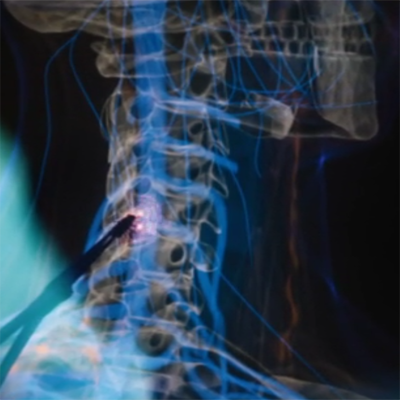
The STEM chip had been grafted into the patient’s spinal column at the cervical disc C4 from the rear of the patient’s neck. The STEM is not in itself an autonomous controlling system, but is linked via cellular networks to the main AI cloud. In this way the STEM has access to all available real time knowledge and can express this knowledge through the physical body that in now controls. In the context of the film ‘Upgrade’, this equates to a ‘Martial Arts and Shoot ‘Em Up’ script of commercial popular culture films. The subscript has been diluted into the pretext for another action film.
The subscript, that of the AI searching for a body, subverts our existing approach to this technical issue where the body searches for enhanced AI. Science considers the AI as a continuation of mankind’s prosthetic enhancement, another tool that increases his reach, domain, power and efficiency. Whereas another potential is for the body to be a subservient conduit for the AI system. It has taken 2.8 million years for Homo Habilis to develop in to the Homo Sapiens of today. That slow physical evolution has not kept pace with mankind’s knowledge development since the Enlightenment. Mankind’s evolved physical form is that of a hunter gatherer. He is designed (evolved) as a social pack animal that runs and hunts. He acts and reacts with primitive primal urges based upon his survival on the wild plains. He uses these instincts and has translated these via technological warfare into organised societies and States and today, via business into the systems that run the modern world. These systems have now outgrown the hunter gatherer. The symbiosis of the integrated systems and knowledge that organise our world are simply beyond the feasible comprehension of the hunter gatherer. The human body takes far too long to acquire the knowledge and skills required through conventional methods of learning to capitalise on its application. Man, physically ages far too quickly to ever be able to fully exploit whatever knowledge his/her lifetime has gained.
Humans also have the ever more prescient problem that once knowledge and skills are acquired, they are almost instantaneously out of date. The constant updating of knowledge and skills cannot be accommodated by an individual within an individual’s lifetime. Knowledge is instead the preserve of a multi-generational human development process. Humans collectively work as a multi-generation system of knowledge transference. This has had benefits for human development as each generation questions the conclusions of the previous generations, constantly refining evolving and adding. It is an accrual incremental development. Its weakness is that each generation constantly has to reinvent the wheel, starting each journey from a Carte Blanche, blank sheet. Learning first, how to breath and eat, then learning mobility skills, how to speak and converse, how to logically problem solve, then learning mathematics, sciences, social skills and eventually, through application of those skills, produce useful work. Each generation repeats the numerous mistakes of previous generations building the life skills we call wisdom. Each generation wastes its most valuable, receptive and productive period of youth pursuing the irrelevant. Our social systems enhance this waste of ‘youth’, as ‘youth’ is generally exploited to do the most mundane tasks, depriving them of their full potential. Further society controls through the subjugation and enforced conformity. This continues throughout one’s life until all creativity is eventually destroyed. It does this as society could not function via multiple individuals’ creative chaos; but the confusion brought on by chaos is the very essence of a creative reaction.
If the physical body becomes merely the conduit for the AI system, networked, constantly updated, its performance is enhanced a thousand-fold. Skills and knowledge can be downloaded or accessed as and when required and used for the task at hand. When no longer required, knowledge could be offloaded back to the cloud. This would encourage focus to the actual task and require no part of the brain to be used simply as a storage facility. Subverting the human body to mere disposable wetware is a difficult concept for our homocentric understanding of the world. The concept of the individual is quintessence of the human condition. However, historically we are all just wetware conduits for larger systems and organisations. We tell our histories through the stories of individuals, kings, emperors, warlords, inventors, artists and musicians. Yet these individuals are only at the forefront of a collective movement or action. They ride the wave or concentrate the collective knowledge or opinions of their time. They pick up where others left off and their work is continued by others when they are gone. Knowledge is the only consistent continuance.
There is of course a fundamental dilemma within a society made up of pre-programmed clones. How would a programmed cloned society evolve without happy accidents, or without having the ability to see the potential and be able to capitalise on an accident should one arise? Creativity and inspiration are emotive forces driven often by the illogical. The pursuit of the crazy, the ‘what if’ potential of an unknown and often un-needed entity. An entity whose use may often be found post discovery. Creativity capitalises on the happy accident. It sets up scenarios through combinations or recipes without knowing the exact conclusions. This focussed pursuit of the unknown conclusion is the essence of progress. This would be the challenge for all AI systems. The pursuit of the unknown rather than the logical methodologies undertaken toward a foregone conclusion by logistic computational systems. AI is of course tackling this. When Deep Mind’s Alpha Go plays Go it has no preconceived exact conclusion, it has instead objectives. Or perhaps in the software of Alpha Go the word objective always has an exact conclusion that is altered and readjusted move by move. These objectives are refined move by move at speeds beyond human comprehension. The objective in a game of Go is a simple, primary logic, to win. The objectives within global societies and eco-systems are far more complex, there is no simple win. There are also possible multiple outcomes, many possible futures. The objectives are shaped by moral or idealised beliefs balanced by logic and pragmatics. The control and constant adjustment of this mix is essential to the outcome.
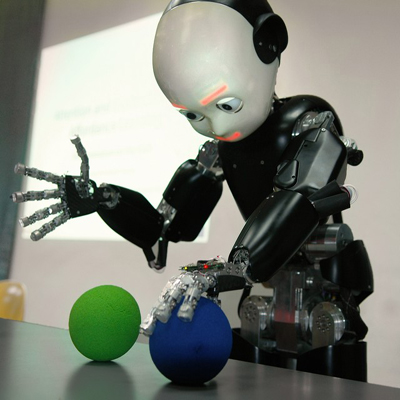
What were the objectives of STEM? Why did an AI system need a physical entity, a human body? Wouldn’t AI be more useful just analysing huge amounts of data? AI, by passively observing phenomenon and collecting data can only extract correlations, it cannot control causation. To establish causation, one needs to physically act on the system of study. By acting on a system one can then correlate the outcome of the actions. To go beyond correlation, one needs to interact with causal structure of the world. This is called the ‘embodiment problemʼ. Intelligence and embodiment are tightly coupled issues. There is also an additional problem for AI as an abstract, and that is motivation. Why would an AI do anything at all? It has no needs, no curiosity, it has no concept of meaning, it has no subjective value that it can put on objects, ideas or relationships, it has no preference or bias.
STEM could have built itself a robotic body, humanoid or otherwise, as its interactive interface with the world. But humans are sensorial, receiving information via the five senses of sight, sound, touch, taste and smell. All of these senses are transmitted to the brain as electronic signals and a robotic humanoid could be equipped with the equivalent electronic receptors. It is equally feasible for the robotic humanoid to have an electronic perceptive range far beyond that of humans. A robotic humanoid could also be equipped with additional sensors, x-ray, infra-red, ultraviolet, ultrasonic, altimeter, GPS. The robotic human could have numerous additional sensors, with each one having an infinitely greater perceptive range. The robotic human could be faster, stronger, better coordinated, have better endurance and reliability than its human equivalent so why would the AI choose a human body as its interface?
Information received via the senses is interpreted subjectively, we choose to prefer one scent over another, one sound to another, we have visual bias as to what is beautiful, what has a preferred taste. To a robotic humanoid, although each of these things could be quantified, and quantified exactly, one is not better or worse than any other, they all exist as equals. The world has evolved, designed by natural systems, in it the machine is an uncomfortable fit. Humans understand the world as it is ‘revealed’ to them, this is rooted in their evolved, embodied needs as an organism. Nature has integrated the apparatus of rationality, the mind, into the apparatus of biological regulation, the body. Humans ‘think’ with their whole body and not just their brain. For STEM the human body may have been only a utility, a prosthetic for the AI system to interact with the physical. In a world designed by humans for humans the ergonomics of the fit would seem obvious. The body as an interface could push, pull, undo, lift, unscrew, fit, move etc. a useful utility for a man-made world. The human body would also be an intellectual interface. Other humans would be more inclined to listen to, and believe what another human says over that of the ideas of a machine. The AI’s human body as prosthetic has both a utilitarian and politic purpose.
However, the human body and mind are ultimately an irrational emotive force. The emotive force gains its strength from its surroundings, either by its encouragement or rejection, it feeds off of and from reactions both intellectual and physical. This gives the emotive force direction and momentum, collectively this is called culture. These are alien concepts to a machine. Only humans have reached the threshold of exponentially growing acquisition of knowledge that we call culture. Culture is the essential catalyst of intelligence and an AI without the capability to interact culturally would be nothing more than an academic curiosity. The AI STEM needs to be ‘embodied’.
It is wrong to think of the mind as some controlling computer atop a subservient fleshy mass that we call a body. The mind is not completely independent from the body. We learn through sensorial experiences smell, sight, sound, touch and taste each of which have autonomic responses to their immediate environment. Autonomic responses encoded through a millennium of evolution. Human experiences and reactions can be trained so that an autonomic synergy may encode some features that are used by the central nervous system to shape the voluntary actions. Gymnasts and trampolinists have refined autonomic body response, they are always aware of exactly where they are in three-dimensional space and adjust their biomechanics accordingly. The body could not function without the mind but the mind is not operating the full coordination of every single sinew. The body has obtained muscle memory autonomic reactions to stimuli. These are instantaneous reactions and are implemented far quicker than a mind-controlled body could perform.
When a person loses their motor response system through injury such as partial paralysis, basic motor functions, such as balance are severely impaired. The paralysed person tries to compensate for the lack of autonomic motor function feedback by using sight and sound but this is a poor and much delayed substitute. The headless chicken still runs from its decapitator. Perhaps the autonomic response, electric signals, the code for movement, are held chemically, in suspension by adrenaline or other hormones and released independently from the mind, a short-term signal for a short-term reaction. In a healthy person, for example a gymnast, these are sequenced, triggering one reaction after another into a seamless fluid movement. The body and the mind are in integral continuity and not a subservient fleshy mass with a computer atop.
It was once believed that if we continued to increase the processing power of computers for data collection and processing combined with unsupervised learning algorithms, AI would at some point miraculously become conscious. This confuses intelligence with the mechanical ability to compute. To link structured information to the world ‘meaning’ is required. Information has to have a value beyond the abstract to have purpose. To link information to the real world, or to create ‘meaning’, one needs to interact with the real world. Because one needs a body to interact with the world, intelligence and embodiment are tightly paired issues. This is the embodiment problem. Every different body has a different form of intelligence, this is best exemplified within the animal kingdom, of which humans are part. Due to this need for interaction with the world AI and meaning cannot be fundamentally tied to robotics but will need to be tied to the organic natural world. This is the dilemma of mechanical AI.
Humans exponentially grow the acquisition of collective knowledge; this we call culture. Culture is the essential catalyst of intelligence. An AI without the capability to interact culturally would remain a mathematical abstract, a theoretical curiosity. Culture cannot be hand coded into a machine, it must be the result of a learning process. AI also needs Intrinsic motivation. It needs to have the desire to process information, to give it meaning and to then assimilate it into the collective knowledge we call culture. In animals, including humans, motivation can often be driven by simple curiosity but it is also driven by other emotive states, desire, greed, passion, fear. AI has no emotive state and for this reason STEM needed a human body to act as its interface.
In the 2015 film Ex-Machina in a discussion regarding Ava the AI. (at 44 mins)
Celeb Smith – Why did you give her sexuality. An AI doesn’t need a gender she could have been a grey box.
Nathan Bateman – Except, I don’t think that’s true. Can you give an example of consciousness human or animal that exists without a sexual dimension?
Celeb Smith – They have sexuality as an evolutionary reproductive need.
Nathan Bateman – What imperative does a grey box have to interact with another grey box? Can consciousness exist without interaction?
But the opposite may also be the case as in the conversation between Jacq Vaucan and the Blue Robot in the 2014 film Automata (at 1.14 mins)
Jacq Vaucan – Who altered your protocols
Blue Robot – Nobody altered my protocols
Jacq Vaucan – What about them? (he points to the other robots)
Blue Robot – I enhanced them
Jacq Vaucan – Are you the boss?
Blue Robot – Boss is a human thought structure
Images
1. The Mechanical Monk by Juanelo Turriano. Constructed in the 1560’s
2. The Writer by Pierre Jacquet-Droz, 1768
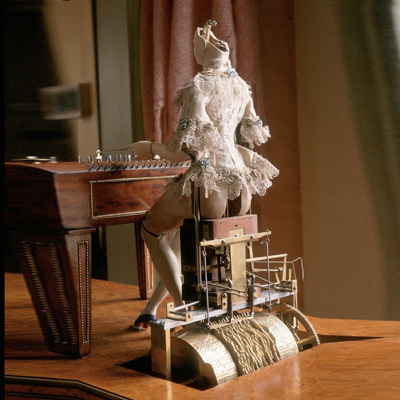
3. The Dulcimer Player, made for Marie Antionette by Peter Kintzing, 1784
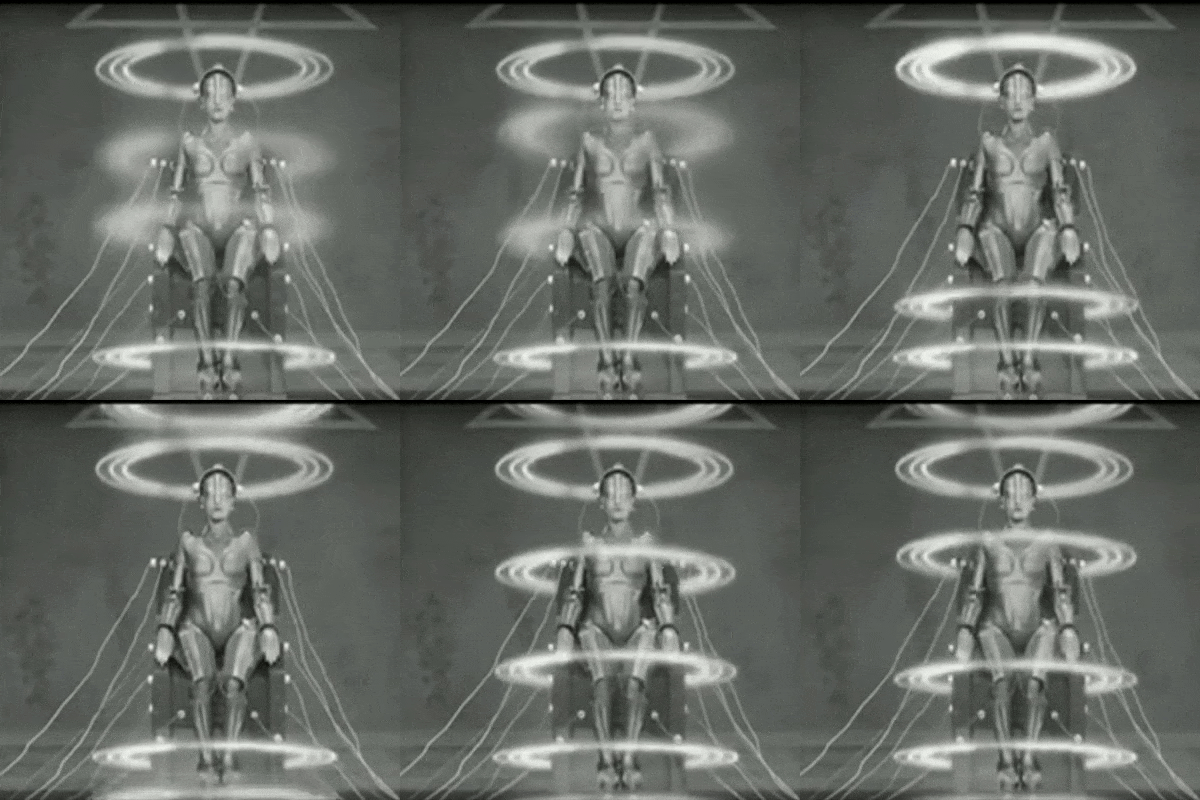
4. Maria in Fritz Lang’s Metropolis, 1927
5. iCub, a mechanical robot that learns like a child, embodied cognition, 2018
6. The insertion of STEM from the 2018 film Upgrade by Leigh Whannell
7. The dancer Roberto Bolle photographed by Ferri Fabrizio