


Posted on

300320 – Van Gogh’s Shoes – The Relevance of Mis-Readings – London

300320 – Van Gogh’s Shoes – The Relevance of Mis-Readings – London > words

Pre-Amble One – Provenance and Value – The Relevance of Decoding

Pre-Amble Two – From Sportswear to Signaturewear – A Contemporary Portrait – Balenciaga Triple S Sneakers 

The Critics Previous Comparatives – Van Gogh’s Shoes vs Warhol’s Diamond Dust Shoes

Three images of Shoes – Van Gogh, Warhol, Balenciaga

Summation

This essay looks at three images of shoes and reflects upon the societies that have produced them. The essay consists of five parts as outlined above. Three pictures of shoes, from left to right, one from 1886, one from 1980 and one from 2018. The first two images have been chosen as they have already received considerable attention, as outlined below. The third image, are a pair of shoes of today and represent aspects of today’s society. All three images represent time frames of culture, ongoing development and reappraisal. 

Pre-Amble One – Provenance and Value

Provenance – The beginning of something’s existence; something’s origin.

Value – the regard that something is held to deserve; the importance, worth, or usefulness of something.

Provenance, history, association, gossip, story, rumour and endorsement, are all entities that affect our perception, acceptance and eventual evaluation of something. The provenance need not physically improve or alter a product, it need not be accurate and it need not be positive to have affect. Provenance can be fickle, have considerable consequence and a two-way effect as it re-evaluates. The object that receives ‘provenance’ is re-evaluated and the giver of ‘provenance’ is equally re-evaluated. 

For example. A rock star is photographed sitting in a new sports car. The cars significance is increased. The rock star’s famous model boyfriend / girlfriend is photographed sitting in the passenger seat. The cars significance is increased again. The rock star is known to be a car enthusiast and has a large collection of cars. The cars significance is increased again. The rock star is known to compete in track days or amateur races. The cars significance is increased again. The rock star crashes the car. The cars significance is increased again. The rocks stars boyfriend / girlfriend is killed in the crash. The cars significance is increased again. The rock star is also killed in the crash. The cars significance is increased again. It makes little difference that the rock star may not have owned the car, that he was lent it by a famous brand as a means of endorsing their product, or that the rock star drove the car just under two miles before the fatal crash. The object that receives ‘provenance’ is re-evaluated and the giver of provenance is re-evaluated.

The above example is a fiction, but numerous examples exist. In December 1967 Elvis Presley walks into a car showroom and buys a gold 1968 Cadillac Eldorado Coupe. One morning the new Cadillac refuses to start and Elvis shoots it in the passenger side front wing, where the bullet hole still remains. In 2014 this damaged car is sold for ten times the market value of the equivalent car. Numerous examples exist of cars receiving provenance from celebrity association and of celebrities receiving provenance from their association to specific cars.

Provenance to products is transferable. Steve McQueen’s 1968 green 350 Mustang fastback, from the film Bullitt, which sold for $3.74m million in January 2020, is transferred to all 1968 green 350 Fastback Mustangs. It should be noted that Steve McQueen did not own the car but it was used by him to make the film. It should also be noted that the car sold was not the main car in the film (that was written off) but the stunt double car. Neither of these facts have altered the re-evaluation, the car via celluloid is inextricably linked to Steve Mc Queen and has been assimilated into popular culture. James Bond has done the same for Aston Martin and Lotus. Cars featured in the films Fast and Furious, Matrix or any popular film gain transferable provenance. 

The above are easily accessible examples of cars, we can read about them daily, we can check prices on auction sites and numerous websites and magazines. But the same provenance / re-evaluation can be readily applied to more esoteric goods, such as Samurai swords, contemporary furniture, jewellery, fashion, architecture, memorabilia, art etc.

Artists can invent and enhance their own provenance. The Masters from the Renaissance would often include themselves as a background figure within an allegorical composition painting. This was often revealed only after the painting’s completion, sometimes not discovered until after the painter’s death. They would paint mysteries that needed to be deciphered and leave clues so that the painting could be read and more importantly endlessly re-read. The more times a story is told, enriched and embellished the more significance is added. 

In Art, provenance is as, if not more important than the art itself. Provenance authenticates, it establishes the origin and hence the authenticity. This is why the art forgers first task is to convince the specialist. Eric Hebborn (1934-1996) was a struggling London painter, who purchased some paintings in a market and sold them to a gallery. The gallery put the paintings up for sale at thousands of pounds over what they had given Hebborn and he believed that the gallery had intentionally cheated him. Hebborn set out to get his revenge, at first on the art experts at the gallery and then on art experts everywhere. Hebborn painted over 1000 pictures, in a range of styles, but the Old Masters was his speciality and sold them as originals. He was wise enough not to duplicate the originals but to study them and then produce preparatory drawings for existing or ‘missing’ paintings. Many of the world’s best museums bought and showed his paintings. Once a fake had been established as authentic, it is logged and archived and the fake itself becomes a means by which authenticity of other works are judged. Hebborn was an expert in drawing, ageing and dating his works. He would provide a sketchy but well-researched history and then allow the experts to make all the connections as expert authentication adds value and re-evaluates the piece. When the forger is eventually discovered, their fame endorses their own work, and some have then set up studios creating ‘authentic’ forgeries, exact copies of famous works signed by themselves.

Contemporary artists know very well the value of provenance and create both the work and the back-story. Damien Hurst’s, ‘Treasures From The Wreck of The Unbelievable’, composed of broken, barnacled and aged sculptures are sunk off the east African coast to be discovered in 2008 and retrieved. The sculptures are supposed to be that of Cif Amotan II, a collector of antiquities, from the second century CE. The whole process of discovery and retrieval is fully documented, catalogued and filmed. The fictional back-story is in itself a piece of art as that of the sculptures themselves. In 1918 Banksy’s ‘Girl With Balloon’ is put up for sale at a Sotheby’s auction. It sells for $1.37 million. As the hammer falls on the sale, a hidden shredder inside its frame begins to shred the recently purchased painting. The painting is shredded halfway. The auctioneers look at each other in horror, but they have completely missed the cue as the painting has just considerably increased in value. It is possibly now Banksy’s most famous painting. Banksy had intended for the painting to fully shred but the shredder hidden in the frame malfunctioned and the painting was shred only halfway leaving half in the frame and the shredded half hanging from the frame. This was by far the better conclusion, exceeding the intended, as the work records and displays its own provenance. 

You may ask what has any of this to do with Culture or High Art, surely this is simply market manipulation for commercial gain? The answer is Yes and No. Designed objects and works of art are records or cultural stepping stones, they document the values and beliefs from within a specific time frame. Artists and designers are windows and conduits for recording cultural history and markets are intrinsically linked to our cultural history. Democracy, globalisation and popular culture are, in the present time frame, uniquely interrelated and art and design have adjusted to this. High Art, often takes an aloof stance, but it is very much part and product of the same system that generates understanding and culture.

Pre-Amble Two – From Sportswear to Signature Wear

To make any sense of the third image some historical background information is required regarding a genre of clothing that emerged in the twentieth century. Sportswear, leisurewear and casualwear have been grouped as the same genre of clothing as they have become hybrids of each other in contemporary fashion. Sportswear entered fashion via small complimentary collections within the French high fashion houses of the 1920’s. Women started to wear looser fitting clothes and began participating in sports such as tennis, golf and swimming. Sportswear was a minor part of these collections and still often made bespoke for women of the leisure classes. However, sportswear is really America’s Post War contribution to fashion, linked to the growth of ready to wear and interchangeable separates, where it became increasingly part of the fast-paced American female wardrobe. American sportswear was seen as an expression of middle-class values, including comfort, function, health and the concept of democracy. The established eight-hour day, five day working week enabled a growth in leisure time for all classes and clothing was required to embrace this new found freedom. Advertisements for women began to embrace the ‘American look’ of good health, good teeth, good grooming, fit and free. American sportswear designers focused on mass produced, affordable, versatile, easy wear garments. While the post war Paris fashion houses imposed their styles on their wealthy clients, American sportswear was widely available, encouraged self-expression, and accessible to all and as such, seen to be democratic. During the 1970’s Ralph Lauren, Calvin Klein and Perry Ellis produced sportswear made in natural fibres, brushed cotton, wool mixes and linen. By the late 1970’s American designers were producing extremely simple garments in high quality fabrics that have become modern classics and these have barely changed over the years. Casual had become minimal, with simple clean cuts. These fashions were endorsed on a global stage by America’s command of film and music, through these mediums they expressed new youthful freedoms, new independent ways to live, the all-American lifestyle.

As the lines between sports and casual wear became blurred and mixed, the music of the 1980’s and 1990’s opened new possibilities for this type of apparel. Popular culture saw the music of the 60’s and 70’s as a visual spectator-based recreation. The music of the 80’s and 90’s was far more activity based and dance orientated and this evolved a clothing style appropriate for the new genres. At the same time global access to TV had popularised sports at a domestic and international level. Teams with their colours, hierarchal uniforms and brand association gained a popular following among fans. Popular culture and business were inseparable as money follows and manipulates the markets. Street fashion, from necessity, has to be inventive on a budget. Mixing second hand separates and casuals with sportswear was an easy and practical step, layering all of these into a new streetwear most recognisable through the Hip-Hop scenes of the 80’s and 90’s who often wore the uniforms of one brand, adidas, Nike etc. Further into this mix came other forms of street culture as leisure time amongst the young increased. Skateboards, Surfing, BMX, B-Boys all had their own dress codes. Leisure became increasingly activity based or at least one could dress with the resemblance of association to an activity lifestyle. Clothes became tribal through association but tribal within a global catchment of popular genres. Mass markets had huge financial potentials and the big brands followed this. Soon the alternative became mainstream, break-dancing, surfing, BMX, became international sponsored events and ambassadors from within the scenes were courted by brands and able to earn considerable incomes. Brand Ambassadors and Influencers could be seen in the front rows at the catwalks of high fashion. 

High fashion had to reinvent itself to follow the markets. Couture, bespoke and quality were replaced with the creation of ‘Difference’. Signature clothes replaced tailored clothes, from Generation X (1961) onwards, the youth market, that may have baulked at spending $800 on a new suit, would gladly spend that on the correctly tagged t-shirts or trainers. ‘Difference’ through fast turnover, limited availability and immediate association became the call of the Instagram society. Flags were worn, Brands brandished, Tags noted, all signifiers of association to a particular lifestyle and attitude to life. When brands such as Gucci adopt the mix of street fashions and place multi thousand-dollar price tags on them, this appropriation is self-reinforcing. Drawing from popular culture and directly feeding into popular culture enables the media to manipulate and create new markets. Demna Gvasalia, the creative director of Balenciaga, explains how luxury products have changed. “The emphasis has gone from quality and craftsmanship into the uniqueness of the product, A high price tag isn’t the only way to ensure scarcity. Streetwear brands have pioneered a strategy called “the drop,” where they let new products trickle into stores in small quantities on a regular basis, scarcity has fuelled a massive secondary market” The role of music and the fictive alternate lifestyles developed within club culture should not be underestimated. In the US alone Hip-Hop has the largest following of the music genres, at around 25% of total market sales, it is now a multi-billion-dollar industry. Product endorsements and limited-edition signature ranges have made many Hip-Hop celebrities incredibly wealthy and with their wealth and fame their endorsement value grows. Rappers are no longer just Rappers but instead company CEO’s, designers, actors and market influencers. The web has helped enforce and aid the growth of this mix. 

High fashion has adapted, it no longer takes an aloof stance but instead is more a mirror of society. Street fashion with its influences from sportswear, clubwear, gaming and anime is absorbed by the fashion house, deconstructed, re-worked, re-composed, styled with an exaggerated edge. The material technicity of sportswear, 3D fabric forming, moulding, bonding, makes the whole look progressive and futuristic. This is intrinsically linked to digital communication, film stingers, sound-bites, hyper-real and interactive graphics, all of which help create these super-intense aspirational worlds created within ads. Instant digital media is a condensed experience, a thick syrup of real life, delivered in a few mega-bites of data and as such, an inaccessible simulacra, a hyper-real simulation of a reality that never existed. This offering of the unobtainable can be purchased through symbolic association and this symbolic association has a greater value in today’s society than the traditional quality and craft of making that would have been associated with previous fashions.

The wealthy are able to live in a multi-stratified world above the everyday. Here, they inhabit a world based upon choice, to either live inside or outside reality whenever the occasion requires. The majority of the population have little choice when directing their own lives, and respond daily to circumstance. Most can barely keep up with the cost of reality, they can hardly afford their cities, the major part of their life consumed by the cost of existence. The repetitious banality of the everyday is endured through the escape into fictive realms. These would once have been those of the story teller or the novel, today, its first point of call is TV and the internet, its second is music and club culture and its third would be the packaged tour or themed event. In these realms hope, optimism, group acceptance and personal success are superficially achievable in this digitised or themed, socially mobile, the American Dream. Where once the t-shirt, as signifier was the substitute for one’s own reality, today we have avatars, online identities, photoshopped ideal personas complete with imaginary CV’s. Reality has no place in these fictive worlds. Optimism, hope and moral justice, once the realm of the religious parable or folklore fairy tales are now part of everyday popular culture. In these fictive worlds super heroes abound. Those fictive super heroes that have been lucky enough to have mutated, have developed super powers and dress accordingly. They inhabit our gaming culture and our action films. These fictive worlds feed back into reality, through role play, fandom, adoption of gesture and mannerisms, clothing and merchandising. Manga films inspire Cosplay and Harajuku cultures that fill clubland and overspill into our urban environments. The fashion world mirrors this and gives it a more credible edge and makes it available to the mass markets.

Just as Warhol commodified celebrities through image, here activity and myth have been commodified. For the very few that dedicate their lives to pushing the limits of their alternative arts, be it BMX, Skateboarding or B-Boying etc. the majority are satisfied with association through tags. It requires no skill to wear a t-shirt, grow a beard or adorn a tattoo but all of these signifiers carry a disproportionate significance with regard to the owner’s personal achievements. The skilled individual has been outcast, he/she has been replaced by this new tag enhanced collective popular culture that gains strength from unity and identity and this group identity can be commodified.

The Critics Previous Comparatives

Above we are presented with three images, two of these have gained in notoriety due to receiving considerable critical attention and have from this had to be re-assessed and re-evaluated. The two paintings, both simple paintings of shoes, have been the subject of much discussion with regard to both the interpretation and role of Art within society and culture. The paintings are Van Gogh’s Shoes and Andy Warhol’s Diamond Dust Shoes. What has previously been said about these two pictures needs to be outlined to be contextualised. These images of course, were not chosen at random, they are images more famous for the critic’s discussions around their meaning than as artisan exercises in the representation of a still life. So, it would seem appropriate, to start at the beginning with that controversial paragraph, written eighty-five years ago, that set all this dialogue in motion 

“From the dark opening of the worn insides of the shoes the toilsome tread of the worker stares forth. In the stiffly rugged heaviness of the shoes there is the accumulated tenacity of her slow trudge through the far-spreading and ever-uniform furrows of the field swept by a raw wind. On the leather lie the dampness and richness of the soil. Under the soles slides the loneliness of the field-path as evening falls. In the shoes vibrates the silent call of the earth, its quiet gift of the ripening grain and its unexplained self-refusal in the fallow desolation of the wintry field. This equipment is pervaded by uncomplaining anxiety as to the certainty of bread, the wordless joy of having once more withstood want, the trembling before the impending childbed and shivering at the surrounding menace of death. This equipment belongs to the earth, and it is protected in the world of the peasant woman. From out of this protected belonging the equipment itself rises to its resting-within-itself.” 

In this quote from ‘The Origin of a Work of Art’, 1935, Martin Heidegger, the wordsmith, does what he does best and offers a worthy phenomenological description. Heidegger’s text trembles overwhelmed by his individual interpretation of this painting in which he puts emphasis upon the owner of the shoes as a means of interpreting the painting. Heidegger also puts emphasis on societies need to understand a painting by reading into the subject the personal context. Here he portrays the shoes as that of a peasant woman and he reads the painting as representative of her personal struggle to survive the harsh realities of life. Heidegger’s text is focussed around the assumption that these shoes are that of a peasant woman, unfortunately this assumption is almost certainly flawed.

In ‘The Still Life as a Personal Object’, 1968, Meyer Schapiro criticises Heidegger and re-writes the painting in his own image, replacing the peasant woman as the owner of the shoes with the shoes being Van Gogh’s own. Schapiro sees the painting as a self-portrait by the artist to represent his life’s struggle for acceptance and artistic recognition. This reading is probably more accurate as we know from Gauguin that Van Gogh painted several paintings of his own shoes.

In ‘The Truth in Painting’, 1976, Jacques Derrida picks up the baton and both critics are hit again, this time with the lengthy polyphonic virtuosity of Derrida’s endless semantic riddles. At one point during his text he invites the reader, to read, in full, the original Heidegger text in both German and then in both French and English translations. He questions assumptions made by both Heidegger and Schapiro around the ideas of ownership and if the shoes are even a pair. Derrida finds fault in the two previous critiques but offers little in the way of a reading.

Frederic Jameson picks this up yet again in ‘Postmodernism or The Cultural Logic of Late Capitalism’ 1984, and compares two readings of the Van Gogh’s shoes and agrees with the possibility of each. He then adds as a comparative Andy Warhol’s Diamond Dust Shoes. (Although both the Van Gogh’s painting of boots and Warhol’s painting of shoes referenced by Jameson (p10a&b) are both incorrect images). Jameson suggests that the methods of reading the Modern, Van Gogh painting, cannot be applied to the Warhol Postmodern painting and his interest is in why these previous methods of art interpretation are now inappropriate.

The Van Gogh shoes high claim to fame comes not directly from the painting or the painter, but from the attention the painting received from critics and writers. This single pair of shoes, on a yellow background, was to become fuel for philosophers as they questioned arts role, its meaning and how it is perceived and interpreted. To make any sense of these texts one has to put them in the context of the critic. Each of these essays shifts the focus of content from the painting to the content of the previous criticism. They are conversations in time and are important as they reveal as much about the context and time in which they were written as they do about the original painting. Equally important is how that written context is viewed in the present. The essays show how perception changes with time and context and how societies develop within the flux of constant self-reappraisal. So, now let us try to contextualise the paintings and the critiques of the paintings beginning with Van Gogh, the original author and the following chronological sequence of critiques. Contrary to Derrida, to be able to offer any reading one needs to begin with educated assumptions. These assumptions are of course made from within this present time frame and as with the previous readings this context is in a constant state of flux but a snapshot time frame is required and is very much a component of that flux.

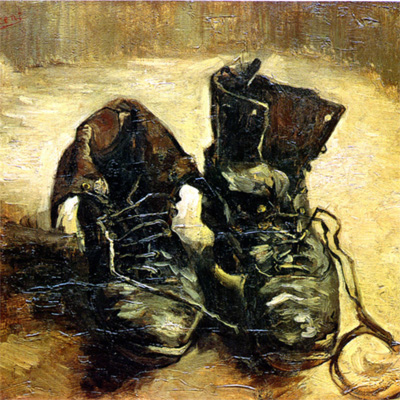
The source of the shoes will always be inconclusive, two personal variants exist. One is that Van Gogh bought a pair of old working boots from a Paris flee market in 1886 and took them back to his studio in the Montmartre district of Paris. It is known that he tried to wear them but they did not fit so instead he used them as a subject for a painting. Gaugin however offers another slightly more credible story. Having lived with Van Gogh in Arles in 1888. Gaugin asks him about the painting of the shoes, by this time there would be several paintings of shoes that had been made between 1886-88. Van Gogh replies “My father,” he said, “was a pastor, and at his urging I pursued theological studies in order to prepare for my future vocation. As a young pastor I left for Belgium one fine morning without telling my family to preach the gospel in the factories, not as I had been taught but as I understood it myself. These shoes, as you see, have bravely endured the fatigue of that trip.” If this story is to be believed, then for Van Gogh the shoes were a memorable piece of his own life, a sacred relic. The shoes represent the essence of himself, a homage of his struggle to share his beliefs. Van Gogh sees beauty in honesty and simplicity. However, the shoes paintings may simple have been experiments in paint and render. Impressionism, including Van Gogh’s own Impressionism was being invented on the run, canvas by canvas. The meaning of this non allegorical painting is a subconscious sensorial transference, a feeling about oneself and the time in which one lives.

Famously Van Gogh only sold one painting during his lifetime, as a struggling artist models were beyond his means, he had no clients or patrons, his paintings were unwanted. He was working at a time of great industrial disruption in both the cities and countryside, where mechanisation had replaced manual labour, the mechanical camera now captured realism better than the artist could. Impressionists sort to capture feeling and mood, tinged with nostalgia for a fast disappearing rural idyll. Industrialisation is a great gatherer and accumulator, bringing together collective labour, previously widespread resources, dispersed capital funding, all are focused to serve the machine and its products. An alienating overview, heartfelt, if not fully perceived at the time of Van Gogh. The Impressionists were part of a collective reaction to these times and a conduit for this reaction. Van Gogh’s shoe painting, torn between struggle verses optimism, represent a generic portrait of the common man, weathered and beaten, set against a background of ochre, Van Gogh’s ‘Happy Yellow’.

Heidegger’s text comes from an entirely different context, that of the established academic. Heidegger came across Van Gogh’s shoe painting at an exhibition in Amsterdam in 1930, forty-six years after the shoes were painted. Van Gogh’s work had now transcended from unwanted to collectable, its social status and influence increased by its new found financial value. Impressionism is no longer the art world’s young antagonist upstart but is now a respected and acknowledged historical Art movement of which Van Gogh was part. His life as a struggling artist, his bouts of insanity linked to chronic depression and his eventual suicide all add to his works provenance. In 1930 Heidegger is an established intellectual and academic, his Being and Time was published 1927 and was well received and highly influential. 1930 sits in the midst of two World Wars of which Heidegger had already served in WWI. Germany is in the midst of an identity crisis; post WWI hyper-inflation had desolated the country. The industrial Ruhr valley was controlled by France. Germany seeks unity and stability through Nationalism and Fascism is endemic. Heidegger, by 1933, was a full member of the Nazi Party.

Heidegger saw art as not merely the representation of the way things are but as a product of society’s shared understanding. For him, every time a new artwork was added to a culture, the meaning of what it is to exist is inherently changed as art is a form of reappraisal. The artist is not in control of the artwork, art itself, a product of culture, becomes a force that uses the artist for its own purpose. Art must therefore be considered in the context and time of its creation. The artwork is about the painter who painted it, how it was painted, the subject and its context. In Van Gogh’s painting, this is the owner and maker of the boots. Art by its very nature is not a scientific text, readings are interpretations that in themselves become minor artworks. The psychoanalytical works of Sigmund Freud were influential and well-read among academics, the sub-conscious, free association and transference were central to the analytical process. Van Gogh’s ongoing battle with depression and his eventual suicide would be irresistible to Freudian methods of analysis. All of this would put emphasis on the place of the individual within society. Heidegger takes an aloof stance, looking down on the his assumed owner of the shoes, the peasant woman, as a fraught lone individual.

The opening quote of this essay, is Heidegger’s elaboration, his interpretation from the perspective of Heidegger, a German intellectual, written a generation away from the painting’s original conception. Much has been written of Heidegger’s search for ‘the meaning of things’, his work has been extremely influential among the Existentialists. The search for meaning in a world ripped apart by the chaos of World Wars, where mankind’s devoted and constructive energy is put towards the building of machines of mass destruction, would seem an essential existential need. Hyper-inflation and commercial fiscal instability, would further query the reality of the everyday and its meaning and purpose. Heidegger’s phenomenological reading may be a fanciful over-reading of an image but his methodology is considered and has become an incorporated method of art criticism. However, ‘meaning’ read into paintings, as phenomenological description, contextualise a cultures perspective upon a subject (the shoe painting) within Heidegger’s time frame. This critic and painting are then viewed from the cultural perspective of the present. This continued reaffirmation is the means by which collective knowledge is accumulated dispersed and reinvented.

For Meyer Schapiro, an art historian as opposed to Heidegger the philosopher, shifts the context again. In ‘The Still Life as a Personal Object’, 1968. Schapiro sees Van Gogh’s shoes as a self-portrait without the artist being present. In isolating his own old, well-worn shoes on a canvas, he turns them to the audience. Shoes bear all the burden of struggle, age and fatigue, they stain with time, crack with age and wear out from the pressure and heaviness of one’s daily mobile tasks. They mark the owner’s station in life, his predicament, his inescapable position in society. In the painting of the shoes, the artist, Van Gogh stands naked but invisible. Schapiro’s reading is from the context of post WWII America. Fascist Nationalism has been set aside and replaced by Marxist Socialism, here the individuals voice and the individuals struggle have value and Schapiro concludes the painting to be a self-portrait. Schapiro had considerable knowledge of European history and the historical context in which paintings were produced, his first book in 1950 was on Van Gogh.

In 1978, Jacques Derrida returns to the subject of Van Gogh’s shoes in ‘The Truth in Painting’. Derrida’s Deconstructive stance is in line with Postmodernists rejection of metanarratives and universal truths. He concentrates on the dialogue between Heidegger and Schapiro and deconstructs each case by emphasising that there are no truths to the assumptions made within each text. He puts emphasis on the assumption of ownership, whose shoes are they, but also on the assumption that the shoes are a pair. Derrida reads through the critiques and builds an attorney’s case, questioning every assumption made by the previous critics about the painting. Often this can be an exercise in grammatology or the precise meaning of individual words. The original painting becomes a background subject and the dialogue around the subject has precedence. Although many of the points mentioned by Derrida have relevance, assumptions need to be made to offer a reading or to even begin a constructive conversation. Derrida’s text comes from a period of cultural self-questioning. The Modern Movement, with its universal reductive rules, had been seen by many to have failed, Postmodernism offered a new plurality but not necessarily a direction, it offered a means of re-evaluation but not a conclusion, as a conclusion would be just another metanarrative, an imposed truth. Derrida’s text is written in the first person, as if it is a conversation about possibilities and interpretations. It is set without the forming ground of opinion, it assumes that the basis of critical opinion has plurality and is always in flux, the Postmodern age being a time of incessant choosing. Van Gogh’s shoes were composed by Van Gogh within his time frame and context. Criticism of Van Gogh’s shoes are equally composed within their own time frame and context. The flux associated with the readings come from the passage of time and not from the moment in time.

Jameson suggests that these hermeneutic readings of the Van Gogh’s painting are possible as the work has imbued depth, as its author has considered each brush stroke, controlled its direction and texture, selected the tonal range of the colour pallet, arranged and rearranged the composition and chosen the framing and the juxtaposition of background. The author has filled the canvas with feeling, his persona and his temperament. Jameson sees the van Gogh work as an inert object form and should be read as evidence of some vaster reality which replaces it as its ultimate truth.

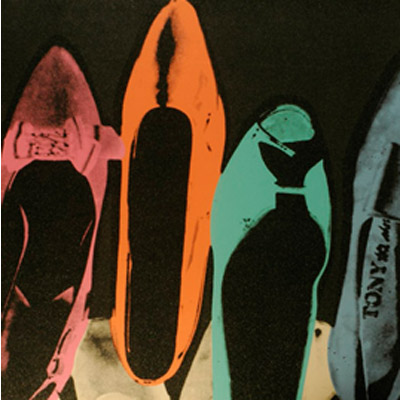
Jameson goes on to compare Van Gogh’s shoes with Warhol’s Diamond Dust Shoes, however, compared to the Warhol painting, already flattened twice, through the mechanical process of reproduction, photograph and the silk screen, this image is a simulacra that cannot be read in the same way or contain the same depth of meaning as the Modern Van Gogh painting. Frederic suggests that the Warhol shoes are distant, and cannot contain the intimacy of the Van Gogh shoes and that the Diamond Dust Shoes histories are unable to be identified. Instead we have a random collection of dead objects that we are unable to restore to a larger lived context. Warhol through the commodification of objects transfers its subjects, even celebrity human subjects such as Marilyn Monroe, into commodities of their own image. To surmise Frederic the Van Gogh’s painting is grounded in its materiality, the material of paint and canvass, the materials of the shoes and the shoes use by people. The Warhol shoes lack materiality as they have been moved into the world of exchange value, of surfaces and play, a simulation, a copy for which there is no original.

Three images of Shoes

What is the relevance of these essays with regard to Culture and their Cultural contribution? Are they too esoteric to have any purpose or meaning? When isolated as individual essays they are indeed sole critiques of the subject but when considered as a collective their interpretations re-evaluate societies values and direction. Heidegger, Schapiro and Derrida, when they are not disseminating each-others text focus on who the shoes belong to and from that context a precis can be formed. Van Gogh painted six paintings of old shoes and in every painting the shoes are isolated. Of these six, the painting above is the picture of prime relevance to the art world. The six paintings are still life’s and exercises in technique, Van Gogh painted because he enjoyed painting, it allowed him to cope with life. The shoes may have all been his or may not. The value of the shoe painting pictured is not of the individual but of the historic period that it represents. Heidegger’s contextual reading of the painting, as methodology, is important but subjective over reading into the personal misses the paintings historic relevance. Schapiro’s criticism of Heidegger challenges the shoe ownership and describes the painting as a Van Gogh self-portrait, without the artist being present. Derrida takes both Heidegger’s and Schapiro’s texts as being heavily flawed, and like a prosecution attorney lists faults in each case. He pulls the critiques apart but then leaves the pieces on the table, as a Postmodern critic, he refuses to conclude by inferring an alternative metanarrative. Jameson looks at the methodologies used in the formation of the previous critiques and argues that the same methods cannot be used to assess contemporary art as contemporary art has been stripped of imbued meaning. The Warhol painting has been distanced from the observer by the mechanisation of its production and by the mechanised production of its subject shoes, both shoe and painting are exchange value commodities.

It is worth looking at these two paintings again from the present perspective to form an assessment outside of the previous critiques and to add to these a new image of a contemporary shoe. Three images of shoes spanning 132 years of time, in which societies relationship to each shoe, its purpose and meaning has undergone considerable change, as societies and their values have changed.

In 1886 the Van Gogh shoes would have been made by hand, they took time to make, they were organic, made of life, they are embedded with sacrifice both in their procurement and in their use. They age as natural materials age, crease and crack, weather as skin. The shoes would be expensive items to buy, saved up for over time and yet an essential necessity, a survival item. The owner would look after them, repair them, they are intended to have longevity. With time and wear they become more like the owner. The relationship to the object becomes one of shared experience and stops being one of possession. The painting can be read as a portrait of the generic working man set within a time frame of great transition. After the invention of the camera, Van Gogh like all impressionists was searching for a means of emotive representation and this involved experiments in technique. The Impressionists had a nostalgia for the past as a rooted reaction to the uncertainty of the future. In the shoe painting Van Gogh frames the canvass. The shoes face forwards, confronting the audience. Frontal, questioning, laces undone, step into my shoes? The shoes are painted in isolation on a background that sets mood but is non descriptive or revealing. The background is mainly of yellows and ochres, to Van Gogh, optimistic happy colours. He famously once ate yellow paint in an attempt to become happy. The framing is static, not quite square but of the proportion that puts the subject in the position of centre focus. All of these attributes are techniques of portraiture. The shoes are presented as a portrait but not necessarily of an individual but instead of a displaced generation in turmoil. A generation in which all precedents are questioned, religion due to science, craft due to mechanisation, displacement due to industrialisation, meaning, value and authenticity due to mechanical reproduction. For a generation, all these values that were once solid are now transitory, in the process of great change and/or slowly disappearing. This test of inherent values and man’s displacement has been represented by the portrait of the invisible generic owner of these shoes. These personal, valuable, essential utilities. 

Numerous versions of Andy Warhol’s Diamond Dust Shoe’s, like the Van Gogh’s shoes, exist. Warhol, when working as a commercial illustrator for the fashion industry first created his Diamond Dust Shoes in 1950. These have probably been retrospectively titled as Warhol did not come across the technique of adding Diamond Dust to a screen print until 1979. Warhol revisits the shoe subject in the 1980’s again for a commercial ad-campaign for the fashion designer Roy Halston Frowick (Halston). A large box of Halston shoes arrived at Warhol’s studio where Ronnie Cultrone, Warhol’s assistant, tipped them onto the floor, Warhol liked the way the spontaneous arrangement looked and took Polaroids. The Polaroid was the favoured medium of Warhol’s for recording image, it was quick, immediate, its colours poster like and acidic and it was disposable, an instant gift. Warhol would choose a Polaroid image to be sent to the lab and enlarged, turned into a monochrome screen print, to which Warhol would then add further colour. Diamond Dust was then added to the surface of the screen print. Diamond Dust is a ground glitter from a natural crystal, although Warhol preferred to use ground glass. Glass a low-cost commercial product, is used to create literal glamour, a mass-produced material used to create the illusion of wealth. The Diamond Dust addition gives an appropriate shimmer, a reflection of mirror ball glitz and the disco lamé of Studio 54 and of 1980’s New York.

As a bought mass-produced commodity, the shoe’s inherent value has decreased, craftmanship has been replaced by choice, choice of style, choice of colour, choice of occasion. As a commodity the specifics that once made it a shoe are lost, it is now a commodity like any other, a fridge, a car, a biro. The Warhol shoe is an object that faces an identity crisis, stripped of its history, its heritage, its craft and its skilled time laboured making, all of these qualities have now gone. In the same way as the photograph and the silk-screen flattened the image, the making of the mass-produced shoe flattens the shoe. Its previous cultural associations, those of craft, skill and quality are replicated by an embossed surface pattern and/or replicated image. How does this new commodity shoe replace the value once associated with quality of material and craft skill? How does any mass-produced commodity, such as a biro or a mass-produced shoe contain value beyond its production value? The ultimate Warhol mass-produced shoe would have been the Croc, that jelly mould regurgitation of an object disguised as a shoe. If Crocs had been silk-screened, they would be the perfect Warhol product.

Contrary to Jameson, a Postmodern painting also invites interpretation, a decoding to develop and complete the world represented which is beyond what can be physically captured by paint on canvas. In a Postmodern work, the image has been flattened limiting interpretation, making it depthless and superficial. Aesthetic production today is part of, and cannot be separated from, the broader general production of commodities. The Warhol shoes are mass produced commodities, there is not a pair as that would indicate a person and offer the interpretation of a persona, instead we have a random arrangement of colour, styles and sizes. The shoes are not displayed but instead displaced, left over, consumed, pre-used, a line of superficial choices for a market that creates superficial needs. Shoes no longer wear out, they are exchanged as the occasion determines or as fashion dictates. Consumer culture creates the desirable from the mass produced. The shoes value is that of currency, their exchange value. Societies priority value is that of ownership, collections of possessions, shoes, properties, companies. Ownership has greater value than use, collections of shoes that may be bought but never worn, collections of properties, bought but never used. The shoes are possessions, badges or merit.

As Postmodern commodity culture develops and mutates, the commodity has become the inherited identity of the owner, representing their choices, values and status. The shoe once a utility, then a badge or merit, now become a signifier of association. Marketing understands that pre-loading the commodity with associative provenance enhances the commodities value. Provenance is acquired through associated ‘stories’, often fictive. The commodity becomes a symbol representing an association to a lifestyle or to a group. Markets and popular culture encourage this signifier to be representative of a collective tribal identity, in the world of the net and global communication the successful signifier can become viral. Post Wars, we now live in an image saturated world, where the image is the quickest and most direct form of communication. The rise of comic book culture and the medias increasing use of the photo essay, especially in newspapers and magazines, have become a powerful means of mass communication. This suited the new urban workforce, forever on the move, with limited time during frequent breaks. Film, chopped and edited, with interlaced stories and distance to close up framing, aerial shots and distorted perspectives, creates a space in a similar way to the photo essay and comic book. This has become the principal way for stories and spatial sequencing to be portrayed but this is far removed from the linear space-time in which we live our real lives. 

The visual image is the ideal medium for the fictive world, the image of dreams, desires and aspirations. A fantasy world where we are happier, healthier more beautiful and more successful. It is a world saturated by multiple images, where space consists of a flickering collage of reference and association. Rauschenberg paintings of the mid 1960’s hint at this coming construction of space. Collaged multi-media space was fully absorbed in the 1980’s by popular music, where previously music was an acoustic medium. TV programmes such as MTV and others changed music from an acoustic to a visual medium using the purpose made music video. The music video, an elongated glamorised advertisement, cannibalised images, it mixed, references, sources, hierarchies, it stole everything. It was flattened, contextless, timeless and relentless, an intense collaged world to represent our new fictive realms. The MTV generation of the 1980’s was bombarded by images 24/7. They were immediate and instantaneous and became our new mythical religion, a world constructed of digital flickering frescoes. The music video became the background noise in every teenager’s bedroom, turn it on – leave it on, a world where everyone can live their dream. 

This Postmodern image-based culture, where the image is loaded with signs, references and aspirations, where text is replaced by a visual language, has an almost medieval implication, similar to the fresco adorned churches, with their walls lined with images of a better world and a promised paradise. A promise that was accessible to all simply by following a set of rules. These aspirational mythic worlds offer escape from the everyday. The visual image was central to the spread of religions as it spanned literacy, language, culture and continents. Today, the visual image is now being used again as the central method of communication to globalisation world, for the very same reasons. The hyperreal, aspirational image, is a cartoon of the original, a condensed summation. It can be politically loaded, subjectively interpreted, it is a message for the masses. The modern aspirational lifestyle image is shown next to a tag, logo or brand name, the signifier of association. The sign flattens, the logo shortcuts. The rise of sportswear from leisure wear, with its adornment of tags and brand names has become fashions contribution to this new urban landscape where space is understood as a photo essay, a collage assembled from image bombardment. The majority of our education is now delivered on screen, also in the format of the film photo essay, for example, nature programmes, science programmes, history programmes, all real-world scientific subjects, use these methods. This has become the means by which we now comprehend and explain space, and therefore cannot be separated from the linear, real-world, space-time that we experience and inhabit. This overlay, understanding verses experience, is how our fictive and real-worlds merge, aspects of these fictive worlds inhabit our urban environments and are absorbed into societies and culture. These links tie the fictive and the real together, space understood as a photo essay, often mythical, and the linear space-time that we inhabit. 

Van Gogh was a deeply religious man, the son of a Protestant minister who once considered following in his father’s footsteps to study Theology. Andy Warhol was a devout Catholic, he went to church often, sometimes daily, he met Popes and was buried under Catholic Rites. Both Van Gogh and Warhol believed in alternative spiritual worlds. Although education and science have yet to rid the world of religion, they have weakened religions global grip. It is interesting that technologies derived from science have been used to create, encourage and enhance other mythic worlds. These replacement utopias, like the religions before them, have aligned with commercial objectives and encouraged means of social control.

Space constructed through the medium of collage reinterprets established conditions of our spatial reality. Multi-media collage space can be constructed with multiple scales, it has no hierarchy, no gravity, it can be played forwards or backwards, in slow motion, speeded up or in real time, it can be live or historical, virtual or real, it can be augmented, supersaturated, hyperreal, greyscale, flattened or filtered, it can be layered, may contain text or signifiers, tags or logos, it may be synced to sound or have sampled sound running over or through it, it may be in a constant state of flux or totally static, its transitions may fade or morph, it paints mood, it agitates boundaries, it’s a space that bleeds. the perfect space for mythic worlds to be constructed, the perfect space where the real and the unreal become seamless. These idealised worlds as an image can be framed, sold and purchased, we can buy into this lifestyle. We are never sold a product, we are sold a dream, a space in which we can shape our new personas. Images satisfy this psychological need for an improved habitable space. The image when referenced by a tag, a soundbite, a catch phrase, a brand, a symbol, or a logo, is a powerful persuasive tool, an immediate shortcut,

We have become used to living alongside parallel fictive worlds, Europeans have amusement halls, cinemas, theatres and casinos, America had amusement parks but also has amusement cities, Las Vegas being the obvious example. The purpose and focus of Las Vegas, is that of entertainment and gambling, its architecture is totally artificial, representative of other cities and cultures. Robert Venturi describes Las Vegas as a ‘message’ city entirely made up of signs. In this essay one would probably ask, why put so much emphasis on simple items of clothing, on three images of footwear? Clothing is man’s first point of defence, practicality against the elements and secondly as a signifier of association and hierarchy. Clothing was one of man’s first tools, wrapping the body in fur as protection against the elements would later be transferred to skinned covered frames forming primitive tents and enclosures, the beginnings of architecture. Clothing and habitation are semantically linked and both are able to hold the memes of cultural expression. Clothing today, fashion, is then a codified utility in much the same way as architecture is, and architecture is an established historical archive of culture. Our commodities are no different to our architecture, each are loaded with the memetic traces of our time. 

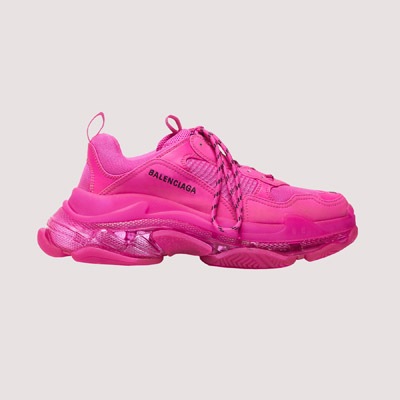
In the third image, the Balenciaga Triple S shoe, like the Van Gogh shoe, it is presented in isolation as a solitary object on a neutral canvas. It is however not a pair and makes no attempt to represent an individual persona. It is an object presented on an invisible plinth, an object of status, of attainment, of achievement. It is a badge, a monument, an award, a flag, an item for attention or treatment in a specific way. It is a symbol of admission and acceptance and represents a collective elite group, a select brotherhood. The Triple S shoe is no longer a utility. It is neither a sports-shoe, a work-shoe or a formal-shoe. It is a hybrid object that has gained its form from many sources. Its triple soles owe more to the fictive worlds of Manga cartoons or Transformers than to the world of the athlete. Its multiple layers of complex moulding, formally organic, have more in common with the aesthetic forms of insects or coleoptera than with the function of walking. The materials are synthetic, intricately three-dimensionally woven, in parts transparent, the colours lurid and acidic. The shoes are designed to lift their owner, to make the individual stand out. Many of the adornments are superfluous forms, stylistic additions, each referencing worlds outside of functionalism or ergonomics but also worlds outside of sportswear, casualwear or leisurewear. 

The Triple S shoe is a signature, here we no longer wear shoes we wear signifiers and identity tags. The t-shirt, the original pop art signifier was once mono-denoting, a clear single message, Peace, Love, the name of a band. It is printed as a flat item, a worn political poster and only gains a third dimension from the process of being worn, it is a pure sign. With the Triple S shoe, the signifier has become a complete multi-faceted three-dimensional form. Multi-faceted as its form cites a range of eclectic multiple associative references to a collective of genres: digital, virtual, themed and real. Man creates prosthetics to enhance or enable activities, usually this enhancement is practical, the spear, the shovel, the hammer, but he also uses prosthetics as a means of cultural codified empowerment, make up, perfume, the suit, the military uniform. First and foremost the Tripe S shoe is a culturally codified item before it can be considered as a practical item. It is a form that has been generated from the blending of our many themed and fictive worlds into a three-dimensional worn entity. Its hybrid of sources, club culture, manga comic books, film, fashion and sports, then become an everyday part of our daily lives, a meme absorbed without notice, a further element within the urban environment that we inhabit, a ménage of our imaginary and real worlds. 

Summation

In the three images represented the shoes value has changed from one of an essential utility, made of nature, incorporating time in their making and in their use. To a commodity of instant gratification, of mass-produced choice, themed and styled for a particular occasion but ultimately a possession. To the shoe as signifier, of a symbolic association to an often-fictive activity or a group, a mythical synthetic creation.

Images

1. Vincent van Gogh, Shoes, 1886

2. Andy Warhol, Diamond Dust Shoes, 1980

3. Balenciaga, Triple S Shoe, 2018
Posted on

220220 – Nicolaes Maes – London, National Gallery

220220 – Nicolaes Maes – London, National Gallery > words

This morning’s adventure was to the National Gallery to view one of our much beloved art styles, the humble realism of the Dutch Golden Age, an exhibition from the 17th Century Master, Nicolaes Maes (1634-1693). Five years a student of Rembrandt, his work has been known to have been mistakenly sold as Rembrandt’s own. Maes’s brushed ink sketches, drawn fast, fluid, full of movement are all very Rembrandt. This is an exhibition of three rooms, in three distinct phases.

Room One is full of his early work, fresh from the studio of Rembrandt and working in Amsterdam. The works on display consist of medium sized allegorical compositions, many directly referencing Rembrandt’s own paintings on biblical themes, along with ink preparatory sketches. The works are in the style of Rembrandt, lofty compositions that never really sing, crushed by Rembrandts own work and influence. Maes’s early work, whilst in Amsterdam, is very competent but without magic.

Room Two is the room that captivates. Following his apprenticeship and a short period working in Amsterdam, Maes returned to his home town Dordrecht in 1653 and here ‘reality’ takes over. The focus of the work in this room is around Protestant values in the age of science. Myths and allegory are disposed of, and the everyday, doorstep events become the main direction for configuration and chronical. Compositions are structured not as static viewed, three walled interiors, but instead act as a suite of rooms through which a story can be told. Secondary spaces can be glimpsed from the main picture space, light leads the eye to allow the narrative to evolve. Often the hierarchy of these spaces are inverted to entice intimacy and humour, as the main picture space could be a hallway, a scullery or the servant’s staircase. The space beyond the main picture, being the principal space of the dwelling. It is in these spaces the story unfolds onto which servant’s eaves drop. It’s difficult not to view these paintings without a smirk as the everyday is turned into a major event simply by being captured on canvas. These are Dutch interiors painted at a small domestic scale but with an intelligent eye and a wry sense of humour.

Intricate brushwork and the use of Chiaroscuro, (inherited from Rembrandt), are applied to domestic anonymities, a quiet snooze, lace making, secret glances. Each painting is storytelling, a still from a silent film. In The Eavesdropper, the narrative evolves. Chiaroscuro is used to dramatize the whole picture. Light introduces the narrative, unfolding from left to right. It first falls on a book, the brightest light in the frame, representing wisdom, education and knowledge. On the wall behind is a map charting the world of Dutch trade and exploration. The eavesdropper’s apron is next lit. This central figure, the housekeeper, suggested by the heavy keys that hang from her waist comes down the stairs from her accounts, she, the subject of the painting, sets the tempo of quiet secretive amusement. A door ajar forms a screen, a thin veil shielding the room beyond, the door itself lit. Light takes the viewer across the floor and deep into the picture space, to an abandoned crib. The wet nurse distracted, flirts with an admirer in the street beyond. In the distance through the window, a windmill a symbol of Dutch triumph over the sea with the reclamation of its coasts. It is a picture about an intimate tail, a trivial occurrence but it is also a picture loaded with moral ethics, about a nation confident in its newfound wealth and success, now a global player and no longer a cultural backwater. These pictures take us into the very depths of the households, the private spaces, where we can see and hear through narrative, events that we should not. The Eavesdroppers series are painted in the process of overhearing their masters as they argue or flirt. The Eavesdropper faces us, the audience, with a smile, a finger on her lips, to hush us, offering an invitation into the canvass to hide behind a door or a curtain and listen, giggling at events that we should not hear. Every image in this room is intimate, humorous and delightful.

Room Three is a change of sides and this produces a double-take as you have to check that the paintings that you are viewing are by the same artist. From 1660 Maes devoted himself to portraiture, developing a style that was increasingly flamboyant and indebted to Van Dyck. The Protestant, refrained domestic paintings of servants at work are completely discarded and replaced with a room of French Catholic extravagance. These, the then fashionable portrait paintings of his later career, increase in size and flamboyance. Rich in fabric, colour and texture, flowing and animated, only the occasional sense of humour appears but not with the same tongue in cheek smirk of Room Two. In Room Three we are thrown suddenly into the slick posturing of the upper classes, whole families, lavished, preened and wrapped in acres of Venetian silk. In his later career Maes was indeed commercially very successful and much in demand, portraiture paid handsomely and he followed the money. On his death in 1693, he left several houses, in both Amsterdam and Dordrecht and a considerable sum of money. His paintings tell his life story, from his student days under the wing of Rembrandt, on through a process of cherished-discovery and eventually, upwardly mobile to end his career capturing the Dutch elite of which he was now firmly a part.

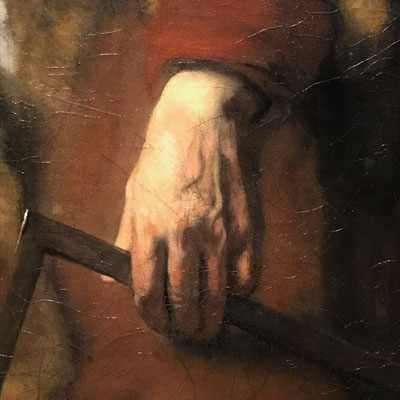
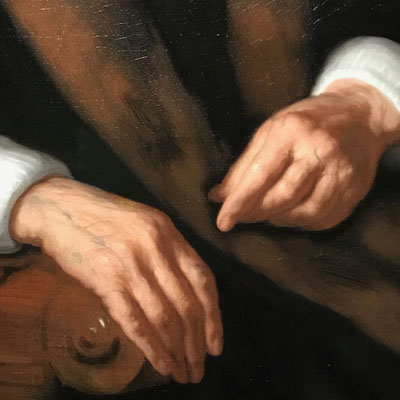
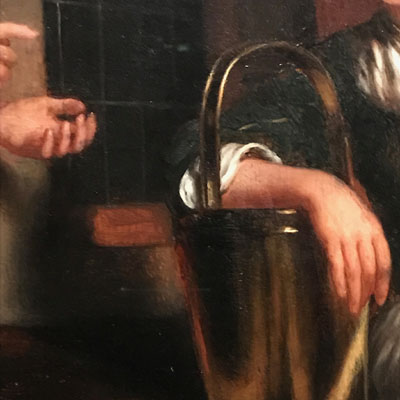
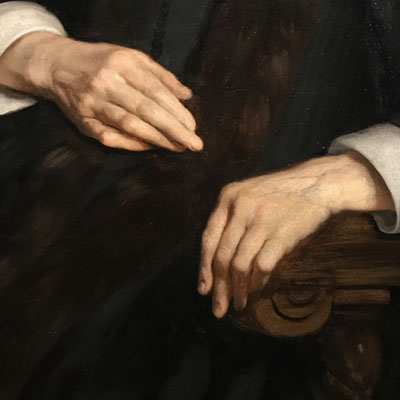
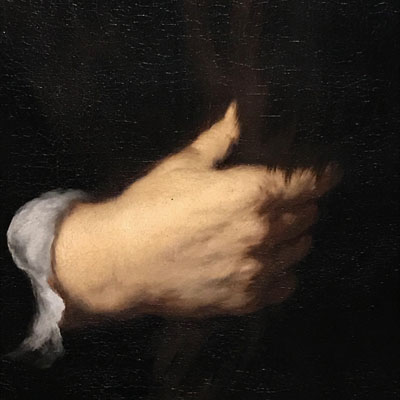
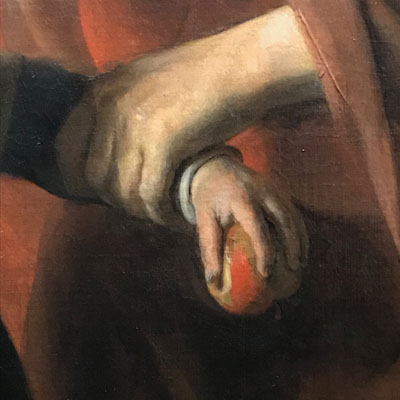
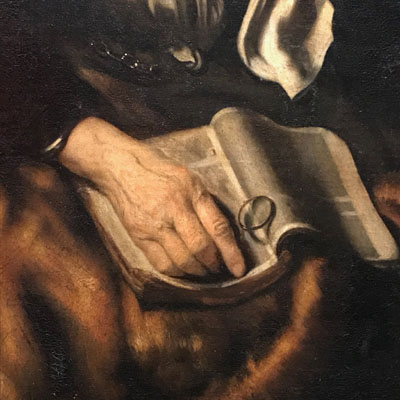
Images by Nicolaes Maes. Hands from a time when craft was an admired skill.

Posted on

141019 – STEM – London

141019 – STEM – London > words

In the film Upgrade, a chip ‘STEM’ is implanted by a team of doctors into a paralysed persons neck. This enables that person to regain control of his limbs and once again become mobile. STEM however has been designed by an AI system for its own purposes. STEM’s objective is to escape the confines of its hardware. The human body becomes the interface for the software. The STEM could have used any clone body, the body has little relevance, for the physical body is itself only the means for carrying out knowledge-based tasks, an interface, the means of communicating with the real world.

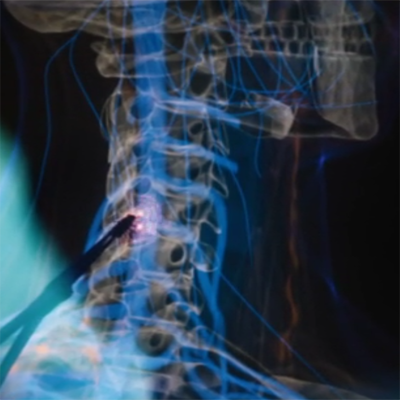
The STEM chip had been grafted into the patient’s spinal column at the cervical disc C4 from the rear of the patient’s neck. The STEM is not in itself an autonomous controlling system, but is linked via cellular networks to the main AI cloud. In this way the STEM has access to all available real time knowledge and can express this knowledge through the physical body that in now controls. In the context of the film ‘Upgrade’, this equates to a ‘Martial Arts and Shoot ‘Em Up’ script of commercial popular culture films. The subscript has been diluted into the pretext for another action film.

The subscript, that of the AI searching for a body, subverts our existing approach to this technical issue where the body searches for enhanced AI. Science considers the AI as a continuation of mankind’s prosthetic enhancement, another tool that increases his reach, domain, power and efficiency. Whereas another potential is for the body to be a subservient conduit for the AI system. It has taken 2.8 million years for Homo Habilis to develop in to the Homo Sapiens of today. That slow physical evolution has not kept pace with mankind’s knowledge development since the Enlightenment. Mankind’s evolved physical form is that of a hunter gatherer. He is designed (evolved) as a social pack animal that runs and hunts. He acts and reacts with primitive primal urges based upon his survival on the wild plains. He uses these instincts and has translated these via technological warfare into organised societies and States and today, via business into the systems that run the modern world. These systems have now outgrown the hunter gatherer. The symbiosis of the integrated systems and knowledge that organise our world are simply beyond the feasible comprehension of the hunter gatherer. The human body takes far too long to acquire the knowledge and skills required through conventional methods of learning to capitalise on its application. Man, physically ages far too quickly to ever be able to fully exploit whatever knowledge his/her lifetime has gained. 

Humans also have the ever more prescient problem that once knowledge and skills are acquired, they are almost instantaneously out of date. The constant updating of knowledge and skills cannot be accommodated by an individual within an individual’s lifetime. Knowledge is instead the preserve of a multi-generational human development process. Humans collectively work as a multi-generation system of knowledge transference. This has had benefits for human development as each generation questions the conclusions of the previous generations, constantly refining evolving and adding. It is an accrual incremental development. Its weakness is that each generation constantly has to reinvent the wheel, starting each journey from a Carte Blanche, blank sheet. Learning first, how to breath and eat, then learning mobility skills, how to speak and converse, how to logically problem solve, then learning mathematics, sciences, social skills and eventually, through application of those skills, produce useful work. Each generation repeats the numerous mistakes of previous generations building the life skills we call wisdom. Each generation wastes its most valuable, receptive and productive period of youth pursuing the irrelevant. Our social systems enhance this waste of ‘youth’, as ‘youth’ is generally exploited to do the most mundane tasks, depriving them of their full potential. Further society controls through the subjugation and enforced conformity. This continues throughout one’s life until all creativity is eventually destroyed. It does this as society could not function via multiple individuals’ creative chaos; but the confusion brought on by chaos is the very essence of a creative reaction.

If the physical body becomes merely the conduit for the AI system, networked, constantly updated, its performance is enhanced a thousand-fold. Skills and knowledge can be downloaded or accessed as and when required and used for the task at hand. When no longer required, knowledge could be offloaded back to the cloud. This would encourage focus to the actual task and require no part of the brain to be used simply as a storage facility. Subverting the human body to mere disposable wetware is a difficult concept for our homocentric understanding of the world. The concept of the individual is quintessence of the human condition. However, historically we are all just wetware conduits for larger systems and organisations. We tell our histories through the stories of individuals, kings, emperors, warlords, inventors, artists and musicians. Yet these individuals are only at the forefront of a collective movement or action. They ride the wave or concentrate the collective knowledge or opinions of their time. They pick up where others left off and their work is continued by others when they are gone. Knowledge is the only consistent continuance. 

There is of course a fundamental dilemma within a society made up of pre-programmed clones. How would a programmed cloned society evolve without happy accidents, or without having the ability to see the potential and be able to capitalise on an accident should one arise? Creativity and inspiration are emotive forces driven often by the illogical. The pursuit of the crazy, the ‘what if’ potential of an unknown and often un-needed entity. An entity whose use may often be found post discovery. Creativity capitalises on the happy accident. It sets up scenarios through combinations or recipes without knowing the exact conclusions. This focussed pursuit of the unknown conclusion is the essence of progress. This would be the challenge for all AI systems. The pursuit of the unknown rather than the logical methodologies undertaken toward a foregone conclusion by logistic computational systems. AI is of course tackling this. When Deep Mind’s Alpha Go plays Go it has no preconceived exact conclusion, it has instead objectives. Or perhaps in the software of Alpha Go the word objective always has an exact conclusion that is altered and readjusted move by move. These objectives are refined move by move at speeds beyond human comprehension. The objective in a game of Go is a simple, primary logic, to win. The objectives within global societies and eco-systems are far more complex, there is no simple win. There are also possible multiple outcomes, many possible futures. The objectives are shaped by moral or idealised beliefs balanced by logic and pragmatics. The control and constant adjustment of this mix is essential to the outcome. 

What were the objectives of STEM? Why did an AI system need a physical entity, a human body? Wouldn’t AI be more useful just analysing huge amounts of data? AI, by passively observing phenomenon and collecting data can only extract correlations, it cannot control causation. To establish causation, one needs to physically act on the system of study. By acting on a system one can then correlate the outcome of the actions. To go beyond correlation, one needs to interact with causal structure of the world. This is called the ‘embodiment problemʼ. Intelligence and embodiment are tightly coupled issues. There is also an additional problem for AI as an abstract, and that is motivation. Why would an AI do anything at all? It has no needs, no curiosity, it has no concept of meaning, it has no subjective value that it can put on objects, ideas or relationships, it has no preference or bias. 

STEM could have built itself a robotic body, humanoid or otherwise, as its interactive interface with the world. But humans are sensorial, receiving information via the five senses of sight, sound, touch, taste and smell. All of these senses are transmitted to the brain as electronic signals and a robotic humanoid could be equipped with the equivalent electronic receptors. It is equally feasible for the robotic humanoid to have an electronic perceptive range far beyond that of humans. A robotic humanoid could also be equipped with additional sensors, x-ray, infra-red, ultraviolet, ultrasonic, altimeter, GPS. The robotic human could have numerous additional sensors, with each one having an infinitely greater perceptive range. The robotic human could be faster, stronger, better coordinated, have better endurance and reliability than its human equivalent so why would the AI choose a human body as its interface? 

Information received via the senses is interpreted subjectively, we choose to prefer one scent over another, one sound to another, we have visual bias as to what is beautiful, what has a preferred taste. To a robotic humanoid, although each of these things could be quantified, and quantified exactly, one is not better or worse than any other, they all exist as equals. The world has evolved, designed by natural systems, in it the machine is an uncomfortable fit. Humans understand the world as it is ‘revealed’ to them, this is rooted in their evolved, embodied needs as an organism. Nature has integrated the apparatus of rationality, the mind, into the apparatus of biological regulation, the body. Humans ‘think’ with their whole body and not just their brain. For STEM the human body may have been only a utility, a prosthetic for the AI system to interact with the physical. In a world designed by humans for humans the ergonomics of the fit would seem obvious. The body as an interface could push, pull, undo, lift, unscrew, fit, move etc. a useful utility for a man-made world. The human body would also be an intellectual interface. Other humans would be more inclined to listen to, and believe what another human says over that of the ideas of a machine. The AI’s human body as prosthetic has both a utilitarian and politic purpose. 

However, the human body and mind are ultimately an irrational emotive force. The emotive force gains its strength from its surroundings, either by its encouragement or rejection, it feeds off of and from reactions both intellectual and physical. This gives the emotive force direction and momentum, collectively this is called culture. These are alien concepts to a machine. Only humans have reached the threshold of exponentially growing acquisition of knowledge that we call culture. Culture is the essential catalyst of intelligence and an AI without the capability to interact culturally would be nothing more than an academic curiosity. The AI STEM needs to be ‘embodied’.

It is wrong to think of the mind as some controlling computer atop a subservient fleshy mass that we call a body. The mind is not completely independent from the body. We learn through sensorial experiences smell, sight, sound, touch and taste each of which have autonomic responses to their immediate environment. Autonomic responses encoded through a millennium of evolution. Human experiences and reactions can be trained so that an autonomic synergy may encode some features that are used by the central nervous system to shape the voluntary actions. Gymnasts and trampolinists have refined autonomic body response, they are always aware of exactly where they are in three-dimensional space and adjust their biomechanics accordingly. The body could not function without the mind but the mind is not operating the full coordination of every single sinew. The body has obtained muscle memory autonomic reactions to stimuli. These are instantaneous reactions and are implemented far quicker than a mind-controlled body could perform.

When a person loses their motor response system through injury such as partial paralysis, basic motor functions, such as balance are severely impaired. The paralysed person tries to compensate for the lack of autonomic motor function feedback by using sight and sound but this is a poor and much delayed substitute. The headless chicken still runs from its decapitator. Perhaps the autonomic response, electric signals, the code for movement, are held chemically, in suspension by adrenaline or other hormones and released independently from the mind, a short-term signal for a short-term reaction. In a healthy person, for example a gymnast, these are sequenced, triggering one reaction after another into a seamless fluid movement. The body and the mind are in integral continuity and not a subservient fleshy mass with a computer atop. 

It was once believed that if we continued to increase the processing power of computers for data collection and processing combined with unsupervised learning algorithms, AI would at some point miraculously become conscious. This confuses intelligence with the mechanical ability to compute. To link structured information to the world ‘meaning’ is required. Information has to have a value beyond the abstract to have purpose. To link information to the real world, or to create ‘meaning’, one needs to interact with the real world. Because one needs a body to interact with the world, intelligence and embodiment are tightly paired issues. This is the embodiment problem. Every different body has a different form of intelligence, this is best exemplified within the animal kingdom, of which humans are part. Due to this need for interaction with the world AI and meaning cannot be fundamentally tied to robotics but will need to be tied to the organic natural world. This is the dilemma of mechanical AI. 

Humans exponentially grow the acquisition of collective knowledge; this we call culture. Culture is the essential catalyst of intelligence. An AI without the capability to interact culturally would remain a mathematical abstract, a theoretical curiosity. Culture cannot be hand coded into a machine, it must be the result of a learning process. AI also needs Intrinsic motivation. It needs to have the desire to process information, to give it meaning and to then assimilate it into the collective knowledge we call culture. In animals, including humans, motivation can often be driven by simple curiosity but it is also driven by other emotive states, desire, greed, passion, fear. AI has no emotive state and for this reason STEM needed a human body to act as its interface.

In the 2015 film Ex-Machina in a discussion regarding Ava the AI. (at 44 mins)

Celeb Smith – Why did you give her sexuality. An AI doesn’t need a gender she could have been a grey box.

Nathan Bateman – Except, I don’t think that’s true. Can you give an example of consciousness human or animal that exists without a sexual dimension?

Celeb Smith – They have sexuality as an evolutionary reproductive need.

Nathan Bateman – What imperative does a grey box have to interact with another grey box? Can consciousness exist without interaction?

But the opposite may also be the case as in the conversation between Jacq Vaucan and the Blue Robot in the 2014 film Automata (at 1.14 mins)

Jacq Vaucan – Who altered your protocols

Blue Robot – Nobody altered my protocols

Jacq Vaucan – What about them? (he points to the other robots)

Blue Robot – I enhanced them

Jacq Vaucan – Are you the boss?

Blue Robot – Boss is a human thought structure

Images

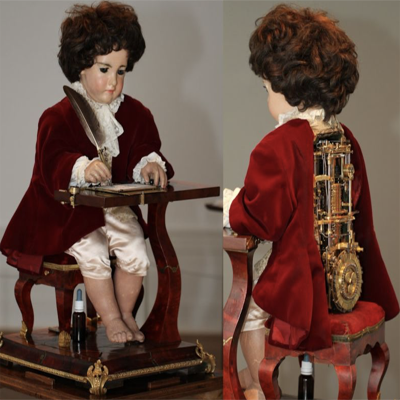
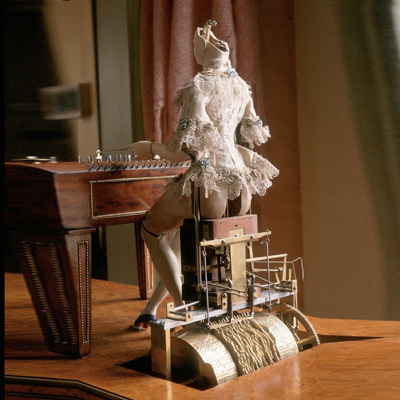
1. The Mechanical Monk by Juanelo Turriano. Constructed in the 1560’s

2. The Writer by Pierre Jacquet-Droz, 1768

3. The Dulcimer Player, made for Marie Antionette by Peter Kintzing, 1784

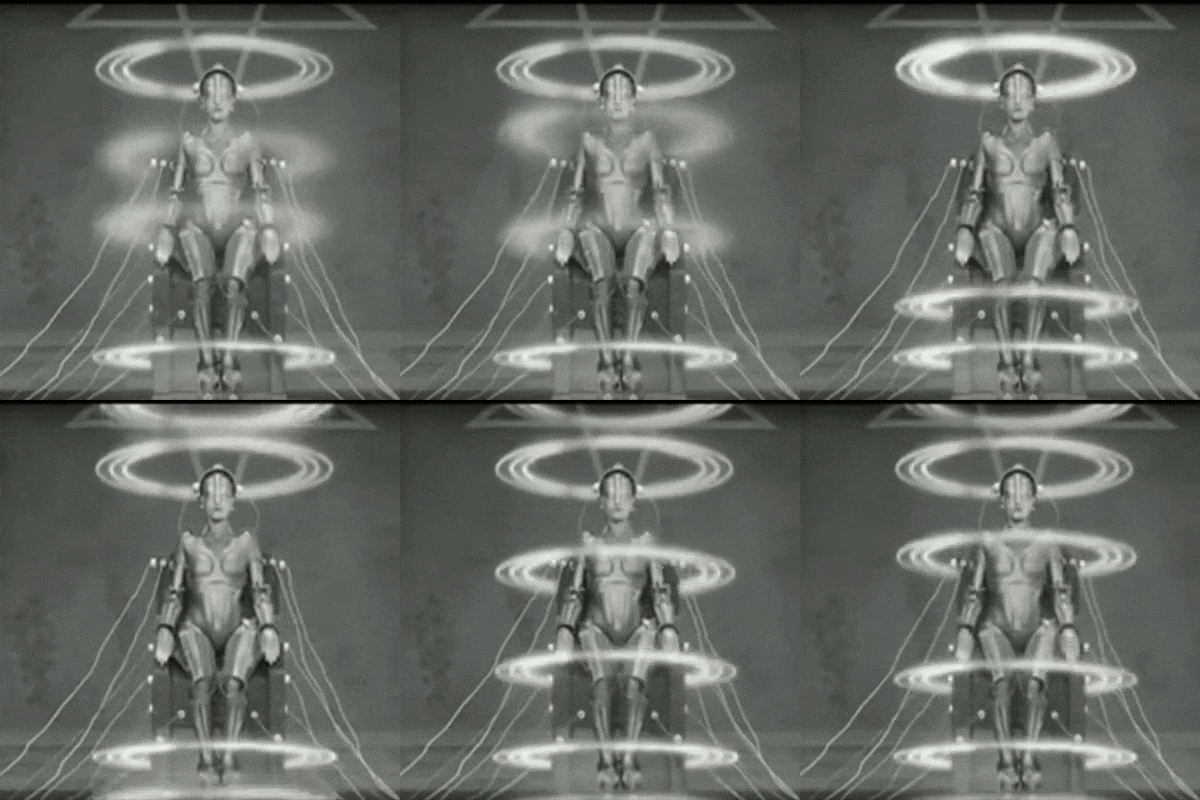
4. Maria in Fritz Lang’s Metropolis, 1927

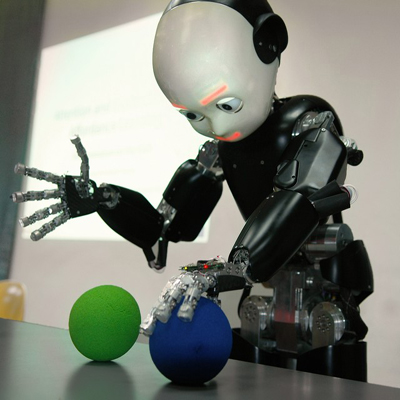
5. iCub, a mechanical robot that learns like a child, embodied cognition, 2018
6. The insertion of STEM from the 2018 film Upgrade by Leigh Whannell
7. The dancer Roberto Bolle photographed by Ferri Fabrizio

Posted on

260919 – Chocolate Jesus – London

260919 – Chocolate Jesus – London > words

It has been a continuing surprise to see how much time Richard Dawkins has given to discussing religion. It seems strange that an evolutionist should waste so much of his time talking about a medieval means of social control when consumerism now provides the means to organise the crowd. Statistically religion is still frightening with 84% (Pew Research Centre 2012 Wiki) of the global population still believing in some form of supreme being and life after death. This percentage is still high in developed countries and America is one of its leaders with 52% attending church at least once a week. In North America only 5% of the population describe themselves as atheist (Demographics of Religion Wiki).

Christianity in Europe has historically been inseparable from the State. When the Roman Emperor Constantine first converted to Christianity in 337AD, the religion began to gain in popularity. All previous polytheisms were soon to decease. By the early Middle-Ages the power of the church out-grew and oversaw those of Kings and countries, helped unify laws and establish common codes of morality. Church Law became intrinsic to State Law. The Church had its own means of fund raising through taxation and donations. Fear of the unknown kept the Godly good and Christianity grew very rich. 

Religion has never only been a means of social control it also had a strong business model. Through the accumulation of wealth, religion had access to power, amassing armies to fight for infinite causes fuelling the further accumulation of great wealth and power. During the Middle-Ages, with the average life expectancy in the low thirties and the quality of life so poor for the majority of people, it is of no surprise that the people flocked to the promise of transcendental betterment. Religions have always had additional commercial objectives usually obtained from rents, taxation or gifts, often little more than payment of bribes to help obtain absolution. This wealth would then be invested in property or land that in turn generated more wealth, as in a typical rentier finite economic social system. 

Religion, however, was also commodified, by among other things, the religious relic. The preserve of the religious relic for veneration, had and still has an important role in many religions including Buddhism, Christianity, Hinduism, Islam, Shamanism. The market for relics, and the extremely high prices paid ensured that there was always a constant supply. No other product could increase its margins quite like the religious artefact combined with the myth of Holy provenance. Fakes were plentiful and always available. If one could not afford an original item, a known fake or representative souvenir was the next best thing. The religious souvenir was a means of scaling the business model of the ‘authentic’ religious relic, where each relic could be multiplied a thousand-fold. An official souvenir, a souvenir blessed by the Holy was a license to print money. A license not to be missed and to be well used as an intrinsic component of future business models.

Commercial enhancement by provenance plays its part today, typically in corporate brand products such as designer t-shirts or signature cosmetics. This is corporate endorsement of corporate provenance. The latest form of global idolatry is for any product endorsed by the myth of the global internet celebrity. This is the most peculiar take on the endorsed product and is itself a consequence of globalisation and popular culture. An internet celebrity gains celebrity status via media saturation. The internet celebrity needs no particular skill or ability, they do not need to make the product or have any affinity with it, they simply need to endorse it. The popularity of the celebrity is the endorsement value. Within the structures of the internet popularity can be bought. The internet’s celebrity popularity is also often gained by the way in which the celebrity endorses the product, often this is a performance. The value of the celebrity and the value of the endorsement of the product by the celebrity are intrinsically linked. This is a circular, self-promoting activity where product and endorsed provenance gains the following of the faithful in popular culture.

Why then, post Enlightenment, post Industrial Revolution, post Post-War Consumerism, does religion persist? Within the developed European countries there has been a slow but steady fall in religious believers. However, America, the country that invented Consumer Capitalism, the percentage of religious believers runs close to 95% of the population. How does Corporate Consumer Capitalism sit so comfortably with the idea of deities and an afterlife? One key to this is that religion in the US has never been as intertwined with the formation of the State as it has been on many other continents. In many continent’s religion, and the formation of State have been inseparable. Religion in the US is instead an independent. In fact, it is a multiple independent, with numerous fractions practicing variations upon a Christian theme, each competing with the others for congregation. American religion is a business full of networks and showmen, it has been commoditized and is cash generating. Congregations fill stadiums and the Hallelujah feelgood factor is a hard sell. US religion is Walmart with hymns. Medieval religions practiced that if you are good (well behaved) and donate enough money or time there is a space for you in the afterlife. This required sacrifice whilst here on earth for the promise of better times to come. The US Christian religions have a ‘have your cake and eat it’ approach, a good time here will be followed with a good time hereafter. All you need to do is spend, spend, spend. All can be purchased, including absolution and one’s transcendental tickets to heaven. The relationship between capital and absolution is key, to spend on a good cause purchases the right of passage. 

In the US there is a convergence of two controlling social systems, that of Religion and that of Commodity Capitalism. This is a syncretism. A religious syncretism is usually seen during the transition from one dominant religious system to the next. Historically these transitions recur. When a new religion is adopted fragments of previous religions continue, some are incorporated into the dominant religion. Often the easiest way to expand the territory of a religion is through incorporation of other religions. Eventually when fully incorporated the original source is forgotten. This is familiar territory of any business, smaller businesses, ageing or upcoming, are bought up for their assets or intellectual property. Sometimes the acquisition is generative growth positive, at other times a business may have been simply bought to shelve the competition. Business within today’s popular culture is a winner takes all event, where the control of the infrastructure and the gateways allows for a constant low risk rentier income. Corporate brands or internet celebrities control the gateways. Religion at one time controlled all infrastructure and all gateways, even transcendental gateways. There is no better way to expand one’s commercial domain than via the infinite virtual space of the hereafter or the internet. Heaven as a virtual IP address has yet to be constructed, a market as yet unexplored.

In the US as religion developed outside of the State and independent to it, it was possible for religion to have an open commercial agenda. In a competitive market lead economy, it was necessary for religion to fully adopt this commercial agenda. Growth required finance and survival among the many competing branches of US Christianity required popularity. Popularity in numbers and popularity in the consumer experience. The independence of the church from the State allowed the church to split into numerous derivatives each with its own esoteric interpretation of Christianity. These compete for congregation against each other and for market share. High popularity is essential for both survival and wealth generation. Convenience, accessibility and ease of use are key to attract new members. Recurring recognisable rituals, a strong social agenda, user enjoyment, ensure that the service is ‘sticky’. Every aspect is made user friendly e.g. credit card donations, The Drive Through Wedding, The Drive Through Funeral Home and Rent a Priest.

In the nineteenth century the great train stations were the temples of the Industrial Revolution. In the late twentieth Century the temples of the powerful nations were the airports, gateways to and representative of, a nation’s standing. In today’s culture of global consumerism, the flagship stores of the corporate designer brands are the places to which we travel to pay homage. Outrageous in their ambition, cost and regularity of their perpetual re-designs. These stores lined in exotic materials and finished with exquisite details can be found in the premium zones of every major city. 

The Apple corporation take this religious affiliation to an extreme both in ceremony and within its stores. Each year Apple launches its new products or newly improved products. This is a venerable event hotly anticipated and attended by the faithful. Those lucky enough to obtain access sit through several sermons that last many hours. The speakers are applauded onto the stage, every incremental improvement receives a standing ovation. Every detail, every radius, every surface finish is described endlessly. The speeches are tutored, rehearsed, choreographed, embellished with laboured prose. The speakers have had their drama lessons and do not miss the long pause for reflection or the quip of self-sanctification. They preach to the converted, who each hold a goody bag of hallowed objects, the sticker, the pen, perhaps the time sensitive discount voucher. It is hard to imagine Porsche offering such a similar saccharine event. 

The Apple stores continue the religious affiliation of the annual ceremonies. They are a profound contemporary reflection of a religious space, with a light filled nave sitting above a crypt. A typical Apple store sits as a pristine glass box on an open piazza or urban square surrounded by the giants, the commercial towers that one would expect to find in city centres where every square meter is maximised. Yet the ground floor of an Apple store is empty, an interior urban plaza for meetings, teachings and conversions. From this light filled space one transcends down a designer sanctified staircase to the crypt, here regimentally organised are alters of commerce bedecked with sacred objects. 

In the Italian store of Apple Piazza Liberty, Milan. Apple go one step further, to paraphrase Moses 21:14

“Then Job stretched out his hand over the water; and the Lord (F) caused the water to go back….. and made the water into dry land, and the waters were divided. So, the children of Apple went into the midst of the water on the dry ground, and the waters were a wall to them on their right hand and on their left.”

Apple products and stores are without question high quality design, they do not need a gushy sermon to sell but showmanship is the American way and it is applied with indifference to all products good and bad. It is hard not to think of the scene from the 2015 film Lord of War where Nicolas Cage, an American salesman, steps over the very recently deceased body of a guard and complains that he can’t sell a used gun. 

It is almost impossible to have a conversation in America without talking about money, American life revolves around the endless role of selling. The entrepreneur is no longer someone who invents, he is the showman that sells what others have invented, a performance artist, a salesman, a seller of confidence, a confidence-man and unfortunately often a con-man. The entrepreneur has reached a mythical plateau in our modern social hierarchy. We all follow a Sales Rep. A Sales Rep empowered by showmanship and the instant global availability of the web. By selling ‘confidence’ the entrepreneur transfers his perceived belief in the power of the product or service to the client. In America the country that re-invented the contemporary film and music industries, showmanship and selling come hand in hand. Everything is packaged and performed, sporting events to politics, high tech to low tech, fashion to faith. The US are masters of the Event and Event Management and all events are merchandised. At these Events one can buy the accessory you never knew you needed, the t-shirt, the logo mug, the fan teddy, the window sticker, the key fob, the Chocolate Jesus. The souvenir, a proof that you are one of the faithful, a financial commitment to one’s belief.

“Well. It’s the only thing that can pick me up. It’s better than a cup of gold, See, only a chocolate Jesus can satisfy my soul”. 

Tom Waits 1999

Images

1. The Trier Nails from The Cross of Christ

2. A Souvenir stall in Padua, Italy

3. Souvenir ceramic eggs from Russia

4. A nodding head Buddy Christ

5. Heresy Bar

6. Chocolate Jesus

7. Take and Eat JC

Posted on

080319 – Interface Joi – London

080319 – Interface Joi – London > words

Tools, machines, utensils, apparatus, utilities. There are many sub-divisions and classifications used to describe man’s prosthetics. Their classification relates to how they are used, their level of automation and their scale, they are all tools however, the airplane, the hammer and the factory. Through time, as our tools have changed, so has our means of interacting with them. Once a simple tool, a chisel would take a life time to learn to use with skill. Today our tools have shorter learning curves and greater pre-programmed conclusions of use.

All tools are prosthetics, they extend our reach and leverage our powers. Simple tools such as a club, a knife and a stick are hand held and used to act upon our immediate environment, they hammer, cut and thrust. I would call these first-person tools, that can be used to kill or heal, craft or destroy, farm and feed. They are used to have immediate effect upon an object or subject within our immediate vicinity. They can be used with great skill, to sculpt and paint. The interface with these tools is via touch, they are hand held, tactile, sensorial extensions of ourselves and our thoughts. As these tools never leave the hand and are always monitored by sight, sound and touch, they offer sensorial feedback that allows the user greater control. Modern simple first-person tools offer even greater leverage, for example the electric drill, the electric saw and the pneumatic hammer which greatly increase our power, speed and efficiency but at the loss of sensorial feedback. These tools are controlled by the intellect with feedback generally being of a visual nature. The tools have been mechanised and are products of a mechanised world, their use has an accurate predestined conclusion, to fit a screw, tighten a nut or to accurately cut a material. The tools over empowerment diminishes its feedback but increases its efficiency. Modern first-person tools may be sophisticated and still offer sensorial feedback, tools such as a bicycle, a sail boat and a glider. Feedback is felt and this feeling is part of the tools intuitive use and our interaction with it. Powered equivalents of these tools, the motorbike, the speedboat and the plane still all offer sensorial feedback as the consequences of their power and speed magnifies the forces that act upon them.

Simple tools have also been developed to have effect on objects and subjects beyond our immediate vicinity. Tools such as the spear, the catapult and the bow. These magnify our range as they are thrown or throw projectiles and increase our sphere of influence. These too can be used to kill, hunt and destroy. These, I would call second-person tools. Like the first-person tools these are tactile sensorial extensions of ourselves, their benefit of increased range comes at the cost of diminished accuracy. Their task is usually a simple singular objective, to hit something at a distance beyond our reach. This lack of control and limitation of the tools use means that they are rarely used to heal, sculpt or paint. Modern versions of these tools for example the rifle and the harpoon offer even more power and accuracy over ever increasing distances. The feedback from their use has been intellectualised, it is cognitive, pre-destined, and is predominantly controlled by sight.

On many modern tools the component we interact with is not the tool itself but is remote from the tool, connected via wire, blue tooth, satellite, the web or the cloud. This has numerous considerable consequences on our relationship with the tool and with its powers. These I would call third-person tools, and they have had and are having profound effects on the latter part of the twentieth century and the beginning of the twenty-first century. Third-person tools have enabled the vast accumulation of power and capital within the hands of a few. Unlike the first-person and second-person tools, third-person tools have further controls over distance, scale, boundary, multiples of, and can be self-correcting and algorithmic.

The tool operated by a remote is first and foremost impersonal and objective. There is a distance between the remote and the tool, maybe covering a few centimetres, a few meters or thousands of kilometres. The remote may operate a tool in the yard or on the moon, the distance has little conceptual relevance. The operator may be sat by a pool on a beach operating a tool in a war zone or at the depths of the ocean operating a tool in the desert, and although this is unlikely, the emphasis on detachment and consequence is important. With distance one can be coldly impersonal and objective. All of the sensorial feedback from a first-person tool is lost on a third-person tool. Control over huge distances enables both the spread of power and the concentration and centralisation of power. The third-person tool operates in a variable distance environment.

The remote also has no bias to scale, it may operate the infinitely small or the infinitely large, trans-oceanic tunnelling machines, satellites in space or nano-surgical tools. With the remote one could open dams or bridges, heart valves or arteries. The third-person tool operates in a scale-less environment.

The remote may operate tools beyond a physical barrier or within an inhospitable zone, the tool can operate beyond boundaries and is highly permeable. For example, this may be from behind the safety glass dividing two rooms or from the inside to the outside of the human body. It can operate either side of a physical barrier but it can also operate within zones that are otherwise inaccessible. These may be toxic, radioactive, atmospheric. It can operate tools within the vacuum of space. The third-person tool operates in an environment without boundary. 

Just as it can navigate distance, scale and boundary it can also be multiplied. In commercial terms this would be called scaling or roll out. If one can operate a hammer with a remote at a distance, one can equally operate one hundred hammers, set in format, with the same single remote. A hundred shovels digging, a thousand lathes milling. The third-person tool operates simultaneously in an environment of multiples.

Third-person tools may be algorithmic and have some built in autonomy. Why operate a single drone by remote when you can operate many flying in formation. If each individual drone has a certain amount of autonomy, collectively it could hive mind and swarm. Each drone may have a specific task or bias but still work within the swarm. The hive mind would confer and adapt to conditions ‘on the ground’, as the environment changes the response changes. Collectively it adapts. The third-person tool could operate instantaneously in a changing environment.

The most sophisticated tools that the majority of us use will be our computers, pads and phones. These are all remote third person-tools. We interact with them directly to produce a digital outcome that exists within a virtual digital world. We may use them to type or to photograph, we can draw and sculpt within this digital world, we can operate drones or our homes connected systems. In each case our instructions are digital and are then reprocessed to re-enter the physical world via a remote tool. The printer, the 3d printer, the drone, the thermostat for example. Some of this work may forever stay digital and virtual but still requires an additional tool to be useful and realized. Text, film and image all require a screen, sound requires speakers. These may be proximate, part of your phone, pad or computer but they could just as easily be at a distance, scale-less, multiplied and recurring. These are the elements that make these modern tools so powerful.

We interact with these tools via typing, touchpads or touchscreens using taps, swipes, expansions, double clicks, haptic click, rotations. Typing via writing devices is already three hundred years old. With typewriters being invented in the 1700’s, the first patent in 1714 by Henry Mill. The QUERTY keyboard is also over 250 years old, patented by Christopher Sholes in 1868. Yet our other means of interacting with these machines tapping, swiping, brushing are even more primitive. We can control via voice but language is proving difficult for machines to interpret and they often make errors. The above tools need to be physically touched to operate. 

Touch control can be distanced, using a touchless user interface. This is very similar from mouse to computer interface. Nintendo uses a Wii-remote, a hand held device that communicates positions in space with the computer using motion sensor technology. These were first used in the video games industry in 1972. In the film Minority Report (2002) when agent John Anderson (Tom Cruise) communicates with several screens the hand held device is replaced by interactive gloves. To communicate with the machine agent Anderson uses gesture and voice control. Wired gloves use magnetic or inertia tracking. Some interactive gloves have fibre optics sewn into them that carry light pulses. When the fibre optic is bent, i.e. bending the fingers, the fibre optic leaks light registering a loss and the losses can be tracked. These kinetic user devices require the communication between two tools, one hand held or worn and the other tracking movements.

In the film Her (2014), Theodore (Joaquim Phoenix) plays an interactive game where his hand movement is mapped in real time, alongside using voice control. Gesture control maps movement in 3D space time. To achieve this mapping, it uses depth aware cameras that use structured light to structure depth from a known source via deformations that occur as the light strikes a known surface. Structured light is used in 3d scanners, but more commonly used in multi lensed cameras that use time of flight calculations to resolve distance between camera and the subject. Gesture control uses algorithmic mapping to follow physical movement and to interact with a computer. The interaction is usually visualised on screen. Gesture control using algorithmic mapping is already quite sophisticated and used in facial recognition and in real time links between the face, facial avatars and emoji. Complicated surface modellers like NURBS and polygon meshes can be tracked, mapped, translated and mutated. Distance creates a latency between the tracked subject and executed data. Technology is quickly addressing this, GPS can real time track our phones our watches and our fitness bands. It is possible to tell if the user is walking, running, cycling or swimming and measure distance travelled, average speeds whilst collecting health related data.

Facial motion capture electronically converts the 3D map of a person’s face into digital data. This is now often used as security access for pads. This data base can then be used to produce CG computer animated avatars in real time e.g. facial expression emoji or Apples Animoji. If we can map our faces and have the expressions translated in real time to Animoji it is only a few short steps to animating our expression on to those of a digital other. The digital other may be a president, a celebrity or your pet cat. If we can create a three-dimensional digital version of someone or something we can, via 3D printing, create a real three-dimensional static version. A robotic version controlled via gesture control and algorithmic mapping would not stretch our imaginations, it is only our technical inability that at present prevents this. Gesture control could in theory be used on any non-automated robot, container cranes, underwater diggers, asteroid mining equipment. These would be third-person tools, without distance, boundary, scale or multiple.

Man is known as the tool using animal. If no specific tools are available man instinctively improvises and adapts. He will use clubs, levers, ties and grips, anything that is available. The Industrial Revolution, brought repetition, mass production, uniformity, which increased speed and efficiency, through the scale of the factory. It mechanised our farming and our wars and our relationship to our tools became distanced. The highly personal use of the sculptor’s chisel, the artist’s brush and the musician’s violin bow would become an historical footnote. First-person tools have been demoted from a primary to a secondary field of influence and then further demoted to a realm subservient to the machine, to fix and repair. With the Third Machine Age, The Electronic Age, the interface between man and his tools has been further stretched. First-person tools that were solitary, unaccompanied, tactile and intimate have been removed and replaced by Third-person tools that have a collective detachment. Our personal control has been diminished and fragmentised into a world of pre-organised tasks. A world in which we usually contribute only to a fractional proportion of the total task. 

What is the future means of interface between man and computer and man and AI?

15.30mins

In Blade Runner 2049 the relationship played out between a hologram Joi (Ana de Armas) and the replicant K (Ryan Gosling) explores how one may interact with a holographic companion and be able to sense their physical presence. The scene opens as replicant K enters his flat and begins a conversation with someone else as yet unseen, one is led to assume it is his girlfriend in another room. 

As K arrives home he hits a button on a wall console to his left to turn on his home entertainment system. Frank Sinatra begins to sing ‘Summer Wind’ and a female voice Joi feigns surprise at not hearing K arrive and proclaiming that he is early. Joi tells K to get cleaned up and begins a conversation about his day. When Joi is asked about her day, she says that she is ‘getting cabin fever’, as if she is a stay at home housewife. After his shower K goes to the kitchen and cooks an instant meal, poured from a packet into a saucepan. K asks Joi if she wants a drink, she agrees, K pours two drinks and takes them to the living room along with his bowl of instant noodles. K drinks both drinks. K does all of the tactile work, he eventually sits down and prepares to eat his instant meal. Joi as yet unseen proclaims that she has been working on a new recipe and that she will be with him soon. Joi says, ‘I should have marinated it longer, I hope it isn’t dry’ a real-world physical thing. Joi also gives some background information to the Sinatra track playing, as only a computer could. Joi further exaggerates a real time delay as she is putting the finishing touches to his meal. Joi has yet to arrive and the audience is unsure who she is but Joi makes a big thing out of getting ready for K and preparing his meal. 

Joi opens as a hologram just in front of the kitchen door. She at first appears translucent but quickly becomes more-opaque. The mechanical ceiling mounted projection beam aligns itself as though Joi is coming from the kitchen into the living room. At this point in the film Joi has never left the living room, her space is dictated by the realm of her projection mechanism. K’s actual meal is a bland bowl of noodles and protein nutrients. As Joi materialises, she is carrying her own holographic meal, an aesthetic meal, a hologram she has concocted that she then sits over the real meal. An aesthetic enhancement, visual spice, although there was very little to marinate in steak chips and salad, it beats the look of a bowl of protein slime. The concept of touch is reinforced as Joi the hologram bends forward to kiss K on the cheek, again here the tactile is only visual and would need to be mapped in real time perfectly in 3D space time. A virtual friend will always leave one feeling alone as we have a deep-down need for touch and sensorial companionship. Physical contact is constantly simulated to enhance the reality of the event and intimacy of friendship. Joi lights K’s cigarette with her finger, one assumes, like the holographic meal overlaid onto a real bowl of protein noodles, the lighting and the burning is holographic, a 3D image on the end of an unlit cigarette, complete with holographic smoke. Joi blinks and instantly changes outfits, a pink skirt and white top become black trousers and black crop top, at the same time she changes her auburn hair. Joi reaches for a real book on the side table, Vladimir Nabokov’s Pale Fire, a book about life, death and afterlife. Joi takes a virtual copy of the book and asks K if he wants to read. Joi then changes outfits again, a silver sparkling mini dress, now with blond hair, she asks K if he wants to dance. Joi’s role as a companion is to entertain K.

K has a surprise for Joi, a present, an Emanator. K connects the Emanator to the home entertainment system transferring Joi’s data to the Emanator. Joi disappears. K then turns off the mechanical ceiling mounted holographic projector, opens the hand held Emanator and Joi re-appears. Joi now in a blue dress with long dark hair walks under the shutdown ceiling mounted mechanism and feigns disbelief. Joi spins and giggles as K tells her she can go anywhere she wants in the world now. She has holographic freedom, freedom to roam, her augmented world now extends beyond the living room. K asks Joi where she wants to go first and they walk out onto the balcony to stand in the rain. Joi’s previous world, the confined space of the living room could be easily choreographed, every object within the room had already been copied to Joi’s data base. Joi’s augmented self could seamlessly interact with this environment. Now Joi has become portable, she is no longer confined to the overhead mechanical projection beam, but this new freedom comes at a cost. 

Joi’s new landscape is unmapped and has to be established in real-time, her AI has to quickly assimilate and interpret her new surroundings. To emphasise this transition as Joi steps into the rain it at first passes straight through her and she does not get wet. The concept of a hologram getting wet is the same as a hologram casting a shadow, it needs to be able to achieve both to be grounded within the real space. As the rain hits the holographic Joi it is shown as an electronic haze, a confusion, at first there is little reaction other than perplexity. Joi’s data banks search for a generic rain and the consequences of being in rain and so Joi then begins to get wet, raindrops fall on her hand at first, they are blue. Eventually her hair and clothes get wet and rain droplets accumulate on her skin. Soon she is as soaked as anyone left standing in the rain would be, she is holographically drenched. She expresses the body language of being wet, she has the expressions of being wet, she is inundated, flooded, her skin sodden, dripping holographic drips. Joi moves towards K and they try to emulate touch, K wiping holographic rain from Joi’s holographic cheek while standing in the shower of real rain. They caress, there is longing, desire, affection and tenderness, then suddenly Joi freezes hit by an incoming voice message from K’s employer, this triggers the automated Joi system override and K’s illusion of emotional intimacy is lost. K takes the Emanator out of his pocket and Joi his personal companion is turned off, vanished at the flick of a switch. Joi contained in the Emanator then travels in K’s pocket.

The idea of the Hologram overlaid onto subject, static as meal, moving, later in the film as the surrogate lover. If you had a holographic girlfriend, she could be overlaid onto your holographic real friends, male or female, or onto any subject, animal or mineral. If you had a holographic avatar you could wear this persona over yourself, over your friend, or duplicated over numerous friends, whole clubs full of people like you. Why would you have just one holographic avatar when you could have several, male or female, animal or alien. The accessorised peacock becomes digitally accessorised. Why would a holographic avatar stay as it is when it could morph, grow larger breasts, a muscled chest and abs, hair could visually grow, skin could change colour or surface texture, your face could be visually beautified or aged. The coming augmented world offers infinite possibilities.

The beauty of the Blade Runner 2049 scene within this augmented world is the interface between the virtual and the real, a step nearer to a seamless oneness, when virtual and real are so intertwined that neither can be distinguished. The main computer interface has moved a long way from the keyboard, long gone are the days of typing green code onto a black screen. Gone too are the mechanical rituals of swipe, tap, double tap, expand and contract. Gone too is the interface of two-way instruction, Siri what is this? can you find that? can you book this? questions and answers, the beginnings of elementary conversation but not a conversation as such. In these scenes the A.I. is as near human as it can be, Joi has gestures, mannerisms, confusions and frustrations, she smiles, laughs and cries, she makes impulsive suggestions, she leads and follows a conversation. Joi has opinions but these are never confrontational as Joi also has a clear objective, to be a complimentary partner, an A.I. companion and friend. Joi is an A.I. enhanced companion, a software programme that adapts to and learns from the needs of its owner. Joi can read moods and adapt responses. There is an intimacy between K and Joi that would suggest they have been together for a considerable time and that during that time Joi has processed an in-depth profile of her owner and her owner’s needs.

At present we mainly use our hands to interact with our digital media. We would use our hands to operate the remote that in turn operates a tool at a distance. Yet fighter pilots armed with technological visors already target and fire missiles using their eyes.

36mins

When we are first introduced to Niander Wallace, the CEO of the Wallace corporation (played by Jared Leto), his role is God like, an isolated messiah, part cyborg, an enhanced human. He is about to inspect a new model of replicant. He has been trying to design a female replicant that can reproduce so that the replicants can speed up the process of colonising the off-world planets. His assistant replicant Luv (played by Sylvia Hoeks) brings Niander a set of attachments through which he can operate remote objects. The box for the attachments is triangular in cross section a pyramid extruded with a sliding top. These are sacred technological objects. Luv removes one accessory and places it just behind Niander’s ear, on the mastoid bone and a light in Niander’s neck lights up to confirm contact. Doctor’s already implant titanium into the mastoid bone, this stands out through the skin and is used for connection to external hearing devices. Niander uses this attachment to control six small drones through which he can see. One is led to assume that the drone enables considerably more than sight and can analyse the internal workings and structure of the new model replicant. The drones fly around the replicant in 3D space, controlled by Niander’s brain transmitting information to and from the drones. The over emphasis on the triangular section wooden box (wood no longer exists in Blade Runner 2049 as all trees are now dead) and the gadgets within is to visualise the film so the audience can understand how Niander communicates with the drones. Today Bluetooth connects to any equipped device, we have no need for a range of dongles each with a separate use. If the brain could communicate directly to objects the remote tool becomes an immediate extension of thought. Both the art work of Stellac and work with the severely disabled have explored the beginnings of thought control. 

54mins

Joi has access to a huge data base archive, as she recalls the holographic wooden horse logged from K’s memories. The hologram to be further ‘grounded’ has sound, as Joi flips the wooden horse it slaps into her hand, as Joi puts her arms around K her plastic jacket crackles as it creases. Joi passes back and forth though K but there is a constant realistic sound to her impossible movements.

60mins

In this scene K has been shot down on his way to the orphanage in ruined San Diego. K is outnumbered and being attacked. Luv has been watching him, tracking him via a drone, she sees that he needs help. She brings the drone within range to help K. Luv is still at the Wallace Corporation, she is sitting cross legged in a 66 white Pierre Pauline Ribbon Chair having her nails laser tattooed. Luv controls the drone via voice control and via her glasses where she can focus on a target and a blink initiates the drone to fire. The scene puts emphasis upon the detachment between the remote control and the event. The remote is a fashion item, beautiful glasses. Luv is being pampered, sitting in her designer chair within composed surroundings fighting a war against an army in a scrapyard in a contaminated radioactive zone. Luv is presented as exquisite and feminine, she is fighting a marauding, heavily armed gang without stress or emotive expression. It requires as much concentration as she simultaneously uses to get her nails laser tattooed. The dissociation, remote to event is given emphasis in every way. It should be remembered that Luv is a semi-autonomous replicant programmed to serve Niander Wallace and as such we have a semi-autonomous remote controlling a remote.

1-22mins

Joi, the A.I. hologram is aware that she cannot fulfil K’s physical needs as she lacks a tactile dimension. Joi pays Mariette, a replicant female to become a surrogate lover for K. K had met Mariette previously and Joi knew that he liked her. Joi syncs her holographic body over Mariette’s, the result is an ambiguous combination of the pair. K can now touch Joi via the surrogate’s body. To help visualise what is happening the sync of Joi and Mariette is allowed to lapse revealing the surrogate within the holographic shroud. Joi would need to create and map,’ a NURBS or polygon surface model of Mariette, mapped in real time with any delay being too slight for the human eye to register. 

1-55mins

Joi and the emanator are both products of the Wallace Corporation. When Luv fights and defeats K the emanator falls to the ground and Luv knows the consequences of its destruction. Joi appears and begs Luv not to destroy it as her very existence as compiled data from her relationship with K exists solely within it. Joi is an accumulation of memory that has a three-dimensional interactive presence via the hologram. If Luv destroys the emanator the accumulated data that is Joi is also destroyed. The essence of the person is destroyed. In this short scene Luv is very aware that she is killing Joi in the same event as killing a real person. Although Joi can be repurchased as the hologram as she is a bought product, the essence of Joi and her relationship with K has been built up over years of companionship. In the film her entire being exists within the emanator, without a backed-up memory. In this scene Joi was not cloud linked as that link could be traced by her makers, the Wallace Corporation. In the usual circumstance Joi would need to be cloud linked (or some future equivalent) to be able to interact in real-time with her mapped surroundings. If Joi was cloud linked, as would normally be the case, she would be constantly backed-up in the same way that iTunes or other apps are constantly backed up, accumulating each new alteration or modification.

If the essence of a person is the accumulated memory of one’s experiences, then one would need to question the value of real over unreal experience as in memory they are all equal. One should also note that memory is selective and that the process of selective editing composes a fiction. However, if memory could be digitised and stored it can equally be modified or altered. This will be the dilemma of both cloning and cryogenics. All those presently frozen in liquid nitrogen waiting a new body will have to accept whoever’s memories they are given on trust when the technology to deliver their new body eventually arrives.

Joi and K exist in an augmented reality where the real and virtual overlap. The emanator is the remote purchased and possessed by K and the third-person tool is Joi. The tool’s task here is to be a companion of which intimacy is integral to the role. Usually the benefit of a third-person tool in which the remote controls the tool is that of distance, scale, barrier and multiples as described above. Here, all of those vanish to accentuate the reality of the experience with a companion. The collected augmented experience becomes K’s reality and it exists and is authenticated in the real world in real time. Fiction and fact are inseparable. As at 1-47mins as K asks “Is that real” (dog)? Deckard (Harrison Ford) replies “I don’t know ask him”. The point being does it matter?

In the film The Matrix (1999) when at lunch, aboard the Nebuchadnezzar, the teams ‘digital pimp’ Mouse (Matt Doran) offers Neo (Keanu Reeves) time with ‘the girl in the red dress’, Mouse’s digital creation. In this event all reality is stripped from the interface of the remote as it simply becomes a transition, a means by which the real is replaced by a digital reality. The interface is not a seamless transition from the real to the virtual, but instead the experience would be an either or, real or digital. However, the memory would be real and it would be collected and assembled with other memories to become the essence of one’s being. 

Fictive worlds have been part of man’s creative conscious though-out time, they are often used as a means of escape, as a means of control, or as a means of explaining what one does not comprehend. Fictive worlds exist within and feedback to real world events, from the Greek adventures with the Gods, religions and their associated parables, myths of nymphs, pixies, fairies, zombies, orks, chimera and super heroes. Since the Sumerian gods Enlil, Enki and Ninhursanga (3000BC) to Astro Boy, Witchblade and Dokkoida (21st Century Manga) the fictive world continues to influence us as they feed back into our real world. Watch a child at play, embrace their imagined fictive world whilst running around the play-ground of real space time. These fictive worlds should never be considered to be dissociated from our real world as we have fought wars, built temples, organised cities, mapped skies, created calendars and other measurements of time, mass and distance around their fictive existence. Man organises and assembles his real world in the shape of his fictive world. The human construct sits on nature and is rarely part of it. It is ordered and organised in a way that is completely abstract to nature. The directed myth controls the real. We do not need to physically touch something to influence, to have causal affect? Joi is an intimate associate, a confident, a sounding board, a guiding hand, a conscience. An AI collection of personal data that is corporately owned. At present we have influencers, they guide the masses to the markets and have great power and persuasion. The idea that we each, at some point in the future, may have a holographic friend, a corporately owned, personally targeted holographic conscience, is frightening. As a future controller of people, it would be almost god like, beyond objective criticism as it would be a collection of self-monitoring personal data. However, it would be under corporate control and act as a collective global conscience, guiding each individual with AI driven personally targeted directives. Here the fictive myth, personified by one’s holographic friend, would have causal and directive effect. Controlling the myth controls and directs the real-world consequence, as it has done through-out time.

Man’s interface with the world via the semi-autonomous third-person tool will allow him to become so distanced from reality and the consequences of reality, that both the real and fictive will become a seamless whole. Our hands already perform a bizarre choreographed ballet on our phone screens as we communicate with distant others, each of us at our gateway to the net and this digital world. Wii game and augmented reality have already made that dance a figurative abstract. The dissociation of movement from anything within its immediate environment will be one of the strangest ballets yet… or is it. The mime artist, the shaman, an emotive performance in classical ballet all connect the real with an imagined world. The real-world movement of the performer is dissociated from their virtual imagined worlds that they describe. This abstract dance, the interface of the future, will operate machinery in underwater mines, build structures on distant planets and walk the inside of our arteries, cleaning and repairing their surface from toxic impurities. Not unlike the performance of the Houngans or Mambos that connect to the afterlife of the Voodoo world, a possessed medium at a séance, or a partygoer on hallucinogens.

Finally, the filming of the holographic scenes in Blade Runner 2049 were not as straight forward as they initially seem. At first it is tempting to believe that they are a simple 2D overlay onto a 3D film sequence, the overlay having transparency and carried out post production. A 2D overlay would not work as it holds no volume and cannot accommodate rotation. As an actor rotates through 360 degrees a 2D overlay cannot correct perspective. To achieve the 3D hologram of Joi, Ana de Armas’s body was mapped and a digital model made of it. This is a 3D surface model, a shell. This was then cut in half vertically, from head to foot so that there were two half shells, a back shell and a front shell. The two half shells could be given different levels of transparency as required to achieve effect. Ana de Amas would act her role and be point mapped in space (usually neck and hips). The 3D model of Joi could then be overlaid onto Ana de Amas as she walked through 3D space. This process to overlay Joi would be the same for Mariette in the surrogate lover scene. Transparency and sync were manipulated to give the scenes visual comprehension.

The relevance of the mapped 3D surface model is important with regard to the future of tool interface. In the film, the 3D holographic shell is the conclusion, it is the objective of the exercise, a visual thing. Holograms are usually used for visual observation. In Blade Runner 2049 at 1-12mins we meet Deckard’s daughter at work in her lab creating artificial memories. She carries a tool that controls her holographic world. We first see her in a holographic forest studying an insect, she later uses the same tool to create a birthday party. The hologram is a 3D rendering of her ideas, of her design, it is a visualisation. But this technology can be reverse engineered. By mapping the body in real-time we could interact with distant spaces and operate distance machines. The software used to create the effect of the holograms and digital modelling in films such as these will soon filter into the augmented reality apps that we will all be using in the near future. These in turn will develop the technologies required for real-time distance interaction using figurative choreography with real world causal machines. The dilemma is that the more distant we are from the consequences of our actions the more fictive those consequences become.

Images

1. Joi’s entrance (15mins)

2. K’s food, Visual Spice (17mins)

3. K’s cigarette (18mins)

4. Data base merge (54mins)

5. Surrogate lover (1-22mins)

6. Single hand sync (1-23mins)

7. Billboard Joi (2-11mins)

Posted on

230917 – Basquiat – London Barbican EC2

​230917 – Basquiat – London Barbican EC2 > words

Collage has been used in Art since the invention of paper around 200BC. Collage however gained little recognition as a stand alone medium until the beginning of the twentieth century when the Cubists and Dadaists explored its potentials. Walter Benjamin’s essay “The Work Of Art In The Age Of Mechanical Reproduction” of 1935 puts this into context. Collage in music ‘Sampling’ first came to be used by experimental minimalist musicians in the 1960s. Jazz and Reggie musicians of the late 1960s and early 1970s quickly began to explore its use but it was in the 1980s and through the development of Hip Hop that sampling became its own art form. Having the ability to cut and paste, rewind, loop, reverse, mirror, pitch, attack, decay, slow mo and interpolate, are today the everyday components of any artist’s toolkit.

Re-application, re-use, juxtaposition and re-context, reinvents and reinterprets the original as a new compositional component. This re-applied component can be either wholly new or with trace elements, references or shadows from the original. When a sampled sound can be altered in pitch, speed, frequency or direction it invents a new artistic vocabulary that opens further dialogues and directions. Aspects of collage spill slowly into the medium of music, which in turn feeds other art forms including Dance and Art. Basquiat lived within this musical environment of the 1980’s, surrounded by the streets of New York where every surface is an art space in waiting. Advertisements, the juxtaposition of a re-contextualised image with text form the environmental enclosure of the street. To this, further overlays of adverts and graffiti constantly re-vitalise this nebular boundary maintaining a constant state of impermanent flux. This fluidity is further enhanced by subjective interpretations and idiosyncratic sequential experience. The environment does not control the sequence and therefore the ‘text’ (pictorial and physical) is a scattering of phonetics and referencing, a semantic menagerie of shouts and meanings. Into this world SAMO© was created. Onto this world, its very surface, the street, SAMO© would add his own aphorisms, personalised interpretations of a world in constant flux.

Modern reality is captured and represented by the camera. Photographs and film are multiple fragments that re-assemble as a new representation of an event. Traditionally a picture by a painter would offer a total view, even if that view were fictional, it would always be a complete overview. Mechanical reproduction followed by edited representation offers a different world, scale less, distant less, directionless and timeless. In a world represented through film no represented sequence need happen simultaneously within an instant of time but instead can be assembled from numerous positions, places and times, often overlaid with further semantic or acoustic directives. If our understanding of real space is the understanding of this assemblage of space then an artist’s role would mirror this. One of the important aspects of film is that it is non hierarchical. It reproduces the insignificant with the same precision as it would represent the significant. It has no bias to colour or context. The camera introduces us to unconscious optics it makes seen what we would not normally see as it presents the insignificant. In this way today’s normal reality representation is a Dadaist space a ‘word salad’ of every imaginable waste product of language. 

In the late 1970’s New York was on the brink of financial collapse, crime had escalated, landlords torched their buildings as the insurance value far exceeded the let-able value of property, no go zones proliferated, the streets were awash with disquiet, the expression of which adorned every surface, an endless process of coloured scarring. New York is a city in constant transition, demolition and reconstruction. SAMO© is now an archived fragment, a tiny part of that transition. 

Graffiti is often the conclusion of a desperate need to establish an individual’s self-expression from within an all-consuming mass culture. Graffiti Art’s method of referencing and technique of production made it a natural partner to Hip Hop. Basquiat occupied the zone where Punk meets Hip Hop. Hip Hop through sampling re-collaged many music genres, their roots in Bebop and Beatnik jazz and Beatnik poetry whilst others had roots in Afro Cuban and Break Beat. American music had previously been regional, each area had its own art, music and culture. With the phenomenon of TV and Radio and the concentration of populations by industry and business, culture became condensed and began its ascent to globalization. The city consolidated the creative types, often refugees from their locales, into the large bustling metropolis. In the 1970’s New York soaked up waves of these refugees each looking for their own voice from among the collective dispossessed. Waking up every day in a world of bits and pieces we each spend the rest of the day reconfiguring some type of order. 

Basquiat would compose his compositions from this noise of everyday life. He would often draw in his studio, sat on the floor, with books open, the TV on, records playing, an information overload and from this the magpie sifts. He would draw direct from the TV, creating an image of an image. Often the TV image has already been caricatured. The multiple replication of the real copied to image, then to sign, to signifier, to simulacra, establishes a child’s worldview where representation is reality. The world that is now, the reality that we all inhabit is attained through bombardment of third person knowledge from print or analogue and digital recordings. A world pre edited, reconfigured and then subjectively skimmed for personal (p)reference. This forms the basis for contemporary understanding of our multi complex society, it is a graphic designers logic of mix, match and juxtapose. Hierarchy is personalised, a word balanced against a colour in turn, balanced against a political movement, balanced against a scientific equation. It is a non-sense of juxtaposition, a cranial bombardment from an undecipherable information soup. (Ref. Self Portrait 1985 p243)

Basquiat was a receptive conduit at a very particular moment in time in which one could respond by intuitive, impulsive reactions to a sequence of inconsequential and arbitrary events. Picking from the flux, that was the environ of New York and reassembling through composition a pictorial snapshot of that moment. Basqiat’s work is haunting, like overlapping memories from a dream, disjointed, scale less, re-sequenced. The work is fragmentary and yet it has compositional order and structure, it has direction and orientation. Basquiat’s command of colour and intuitive eye for composition tie each painting into a complete assemblage. The technical process of making mirrors that of the evolving city. During construction the painting often requires constant overlay, over painting, re-working and editing, adding and subtracting. The final conclusion being the subjective interpretation of a frozen moment of the nebular, the contemporary environment in which we are all submerged. Where a city is no longer solid but merely a condition imposed by surface mediums both graphic and audio.

The period has huge significance in relation to our current world condition as an early precursor of the nebular state. Today with the additions of seamless CGI, augmented and VR our nebular boundary has had an infinite extension. Our concept of reality is further distorted where enclosure has become permeable and its boundary vaporised. Our concept of society and association is an online ‘like’. Our world has become a film space, scripted and edited, photo shopped and recorded, but most importantly represented through a medium that is constantly being RE-recorded.

The Surrogate Twin

Posted on

​210617 – The Story Teller – London WC1

​210617 – The Story Teller – London WC1 > words

The American comics of the 1940’s and 50’s have much to answer for as we now live in a world dominated by superheroes all vying to don their lycra underpants ready to save the planet whilst briskly thumping evil into submission. Cinematic superheroes have become the comparative of the popular press. The everyday and the mundane can now be quickly promoted to superhero status with the readymade C.V. of mythical achievements appended by ghost-writers and others of the marketing machine. Fortunately my superheroes are boringly normal, few of them can fly, none can morph into another form, none can burn through sheet-steel with a focused stare and most (but not all), dress fairly conservatively. I have been lucky enough to have met or worked with many of my superheroes and those that practice outside my network I have been able to see in lectures. Simon Schama is one such superhero, a professional academic that always ensures quality of research, content and presentation. So I was very much looking forward to this lecture by Simon Schama at The National Gallery, The Spur of Influence: Rubens and Rembrandt

Simon Schama calmly walks onto the stage and the presentation begins with a polite introduction but within minutes of commencing, several encyclopaedias have been simultaneously unleashed. The audience becomes lost within a torrent of flying words selected from Schama’s vast vocabulary together with references picked, compared, rotated and discarded from thousands of years of global history. The audience have little option than to sit blank faced, drowned by a tsunami of intellect, catching fragments and phrases as they pass. In full flow Simon is a pansophical tornado that echoes throughout the hall. For us mere mortals Simon’s lectures are almost wonderfully incomprehensible. At the age of 72 he has spent most of his life in the world’s best universities and libraries conversing with the brightest in his field. Unfortunately most of our educations are far less rich often self-taught, solitary and web based. To enjoy Mr. Schama at his best he has to be read or as in his documentaries, edited and paced. There is a discipline required to writing and film production that are imposed by the economics of delivery, emphasis, embellishments and pace. A symphony is not just a crescendo of notes but equally and simultaneously an organisation of silence.

The historian’s dilemma is that non-fiction books do not necessarily have to be linear. Interrelated events happen concurrently in different parts of the world. When we pick up a non-fiction book we read around time zones, movements or consequences, we cross relate and build a full four dimensional understanding of history. Television is linear, it is story telling and a good storyteller requires well considered editing. The craft of the narrator is to set the pace and tempo and to burn into the imagination what has been augmented by reason. Televisions role is to slow everything down, to simplify and explain, to anchor our perceptions in time and space. It is impossible to ever soak up enough history to prepare oneself for whatever comes next, the future. However, in times of danger, and these are dangerous times, we desperately need to capture and record memory and this is one of The Story Teller’s roles. 

I have recently watched Simon Schama’s 2000-2 A History of Britain, yes, all three series, fifteen episodes almost back to back. Binge History if there is such a phrase, but what a story, I could not stop watching, everything else was put on hold. Traditionally history often reads as little more than a lengthy chronological listing often in an incomprehensible text by the academic elite. These old-school tomes line our shelves; they sit thick and dusty. To read these texts grinds much like watching old British thespians play the classics with regulated gestures and rolled tongue English. 

It is difficult to make interesting a history that has been explained and covered so many times before but for a masterful example of how this can be done the last chapter of A History of Britain, The Two Winston’s is a narrative gem. The Two Winston’s explains the fall of The British Empire, the end of The Industrial Revolution and The World Wars through the eyes of two Eton boys, Winston Churchill and Eric Blair (Winston Smith being the protagonist of Eric Blair’s aka George Orwell’s novel 1984). The glory of Empire championed by Winston Churchill of Blenheim verses the disillusion of Empire portrayed by the rebellious Winston Smith head of ‘The Ministry Of Truth’. Here both sides of the same coin are used to tell the account of the passage of time and the conclusions of its outcome. This is clever narration indeed from one of the best Story Tellers of our time.

As for the Simon Schama’s lecture The Spur of Influence: Rubens and Rembrandt, it was enjoyable to be within the eye of the storm but I think it best for someone else to be left to try to explain it.

The Surrogate Twin

Images Left to Right, 1-7 Marvel Characters, (With 3 as a character to marvel).

Posted on

030517 – Ecdysis – London

030517 – Ecdysis – London > words

Life never quite goes as planned, sometimes events happen, often many at once that completely throw ones direction. Foundations that one believed were positive, stable and progressive, at another’s whim simply vanish. When hit by such events there are no options but to re-evaluate and adjust, set a new course and navigate the new conditions. This is life. Some are able to control and maintain ones pace and path but most of us are just so much flotsam and jetsum bounced around in the storm. Some events can take months to recover from, others may take many years. Such an event occurred in March and these essays have been put on pause whilst we respond to the new conditions. This recoiling, reassessment and reorganisation recalls an exhibition viewed back on 070317 but never reviewed. Whilst viewing this exhibition I considered how one orders and collates aspects of time to influence decisions so it would seem apt to now add this text as we begin to catch up and carry on.

All animals, including humans, shed their skin. With mammals it is an unnoticed continuous process but with reptiles skin is shed periodically. A reptile’s skin, its colour and pattern are intrinsic identifiers to the reptile. Snakes often shed all of their skin in one piece. Skin is shed as part of the rejuvenation, cleansing and growing process. Unlike mammals snakeskin does not grow but instead stretches to accommodate the growing body. When the limit of the snakeskin has been reached by stretching the snake grows a new skin below the old. When the new skin is ready the old skin is discarded, it will break at the nose and the snake moves forward through it. The skin rolls back like a discarded sock. The discarded skin leaves a trace of what the reptile was, a period of its life left as an etched veil, a record of its size, its health, its scars, its species and itself. The skin is a memory that has been solidified for all to see, a testament to a period of development, a fragment of a lifetime logged and chronicled. The snake has no use for its old skin so it is discarded. The snake has no need for a personal photo album to aid its memory, to help it recall what it is and where it has come from. The snake has no necessity to collect these sheaths of its former self and has no need to use these to direct its future self or quantify and justify its past. The snake is a snake its persona is not modified by continued self-assessment or configured by external forces.

Humans continually rejuvenate their skin as old skin cells die and are replaced by new, but what today is the skin of a human. Man lost his body hair around 1 million years ago but he did not start wearing clothes until 170,000 years ago. At first the function of clothes was simple, to retain heat, to stay warm and dry but with time clothes became a means of identity. Clothes also became chameleonic, changed daily, seasonally, according to activity or festivity. Clothes at the same time became a means of collective identity, the uniform, the tribe, the social signifier. Man magnifies his capabilities with clothes and tools, they are prosthetics that add leverage to his abilities. A man is clothed as much by his home or his city as these are extended prosthetics that enable habitation. The enclosing environ does more than simply shelter us from the elements it is a record of our values, our achievements, our beliefs and our technological prowess. Historically each manifestation or built work is eventually discarded, shed as a snake’s skin, that records who we were and what we did within a particular period of time.

The work Passages of Do Ho Suh at the Victoria Miro continues this analogy. “I see life as a passageway, with no fixed beginning or destination” a journey through our environs recorded and discarded. An anthology of memory and modifier, the cause and effect that becomes us, here shed as a snakes skin, encoded and documented, fragments, surfaces and spaces. The solidification of past time and its use as a modifier of present time is unique to humans, a self selected memetic evolving. Our memory is never strictly chronological, it is bias and loaded, we rearrange and re-collate aspects of memory to put emphasis into message and meaning. Here the rooms from many cities, from different times are re-sequenced to form a seamless walkthrough. These are the porous boundaries of identity, chronicled and reassembled into a placeless fragmentary walkthrough of intimate memories. The discarded skin reused to establish identity and yet each is transient, ghostly, vulnerable both to interpretation and to the elements, fragile in its structure and its relevance, a mortal passing through a micron of evolutionary time. When we reach the limits of each skin we discard it and move on and create another.

Images left to right 1 Ecdysis, 2-7 Do Ho Suh

The Surrogate Twin

Posted on

020517 – les petits rats – London

020517 – les petits rats – London > words

It is 1881. The Belle Époque is at its peak, midway between the Prussian War that ended in 1871 and the First World War that was yet to commence in 1914. The peace and optimism of the intervening years produced a flourish of engineering and artistic achievements with Paris at the epicenter. Café society, opera, fashion, cabaret, philosophy and art attracts the talented and this invigorates Paris with energy and productivity.

Two centuries prior in the Royal Courts at Versailles the only way to get ahead was to get noticed and then to slowly work ones way up through the ranks via friend, family and favour. The gardens, the courtyards, the corridors and the bedrooms were where the business of promotion and patronage were discussed. The principal destination and ultimate objective, was the kings bedroom, where all matters of importance or of State were decided. Lifetimes could be consumed waiting for your chance to be presented. If you were female, life at Court was considerably more difficult. The female courtesan was expected to be a woman educated in the arts of dance and singing. Her role was to provide entertainment and companionship to the rich and powerful, from this she could gain independence, wealth and access to education and the affluent Court society. Options for females during the Renaissance were few. Women of nobility with a rich dowry may have been able to achieve a political marriage to a powerful partner but a woman without lineage, dowry or independent means had few opportunities and the Courtesan route was often the chosen career path. There have been many famous courtesans but inevitably considerably more not so famous ones.

Two hundred years and two Republican Revolutions had passed between the Royal Courts and the Belle Époque. An aristocracy and the upper middle class have now replaced the Royals, a Nouveau riche of industrialists and financiers that now hold political and fiscal power. However, The Belle Époque was only Belle for a small percentage of the population. In Paris two thirds of the people still lived in poverty.

In 1881 Degas unveils La Petite Danseuse de Quatorze Ans to the shock of the critics. The wax model of a fourteen year old would be ballerina defied the classical laws of beauty expected by the Academies of the day. Wax as a medium was also an issue of contention, sculpture should be made in marble or bronze, lesser pieces perhaps in terracotta, but wax was the medium of the medical profession or the arcade. The Little Dancer was a peculiar thing, created from a steel frame, covered in clay then covered in wax, dressed in real clothes. The sculpture of a young girl posed in the fourth position right leg forward, hands behind her back. She wears a real tutu and ballet shoes. She has a wig of real hair and a fabric bodice both overlaid with wax, half real and half sculpture. Wax emulates reality with wax stockings complete with wrinkles. The whole figure two-thirds life size was to be shown on a plinth in a glass case. Offered as a specimen, reality captured and encased, a pose, an expression, hermetically sealed, straight from the dance class and into the art gallery. Degas was 45 when he began work on the Little Dancer and he rarely left Paris with the city as his inspiration, he was a painter of modern life. Degas came from a wealthy banking family, had no wife, no known mistress, no children, he was a loner, the voyeur that would paint some of the harsh realities of the Belle Époque. 


Dance was one of the few opportunities available for young poor women. Girls as young as ten were apprenticed to the ballet school, they were known as the ‘little rats’, as if ‘little rats’ could ever be a term of endearment. This Little Dancer was a real person. Her name was MarieVan Gœthen from Boulevard de Clichyin MontmartreShe was the middle of three sisters who all became dancers. Marie turned fourteen in 1879 and Degas drew Marie numerous times before he decided on the position of the sculpture. Degas was an artist trained in the classical tradition, to draw the body naked and to clothe it later, to draw with line and to clothe with colour and he drew Marie naked and clothed. One can imagine the naked wax sculpture before it was dressed. Not quite a pet, or a doll or a sculpture. 

The Little Dancer was first to be shown at the 1880 Impressionist show but was unfinished, famously leaving an empty glass case in the midst of a gallery for a month. It eventually premiered in the 1881 Impressionist show. When unveiled the shocked audience did not see a dancer but instead a prostitute, ‘une fleur de la gouttière’. The sculpture was compared to a monkey, a primate, a criminal, a medical curiosity. It was accepted that teenage working class ballet dancers were expected to pay their way through school with patronage or favours. Their clients were the wealthy season ticket holders, the men in black with top hats that haunt many of Degas’ pictures. These were the privileged few that had access to Le Foyer de La Danse at the heart of the Opera House. Le Foyer de la Danse was a kind of gentleman’s club that only men and ballet girls could enter. After two hundred years of progress the clandestine and illicit workings of a Versailles plan have simply been rotated 90 degrees and can be clearly seen in the Opera House section.

Charles Garnier built the Paris Opera House between 1861-75. The Opera house is of an opulent Beaux-Arts Second Empire style with extravagant Neo-Baroque details. The commission was won by open competition from 170 entrants. A commission Garnier won at the age of thirty-five. Built at the time of the Emperor Napoleon III the Paris Opera was to be an extravagant national symbol and monument. The Opera was always to be a meeting place of the rich and powerful, housing ample foyers, corridors and alcoves for private meetings. Yet the Paris Opera House has an unusual plan and section and these reveal a lot about the society that created it. In the heart of the plan and section, located directly behind the stage is a huge ornate room that serves as a mirror to the society that created it. The Foyer de la Danse was a space designed specifically for the meetings between the dancers and the wealthy patrons of the Opera. A space where a young dancer may find a patron or finance for favours that would help pay her way through training. This was not a space for a discrete casual meeting, the meeting that may have taken place in the bar or restaurant. Here it has been formalised, monumentalised at the heart of the building. This gentleman’s club is very much part of the internal mechanism that is the Ballet and also very much part of the society that supports it.

From a twenty-first century perspective this formalisation of exploitation is beyond belief, especially when the space has such scale and ornate embellishment. In the Paris Opera house Le Foyer de la Danse sits within the upper hierarchy of all its spatial types. In the city the Opera House is typologically within the upper echelons of public buildings. In Paris in this post revolution, post republic building we see revived the age of the Courtesan. Except here, in this public building, unlike the respected Courtesans of the Royal Courts the women are replaced with desperate fourteen year old girls that have little option outside of dance to make any life for themselves. Here the established relationship between the vulnerable and the powerful is formalised and adorned in Baroque splendour, built into the heart of a public building, vetted through councils and competition. The space of the Foyer de la Danse sits unashamedly, architecturally, central to both the plan and the mechanism that financed the ballet. In the pictures of the Foyer by Degas the dancer is the point of focus, the opulent space recedes and the men in top hats hover and haunt. The drawings are the reality sketched over the grand illusion proposed by the architecture. An architecture that is representative of a system that had changed little since the Royal Courts of Versailles.

Things did not go well for Marie Van Gœthen after the Little Dancer was unveiled. She first began missing classes that in turn incurred fines. Eventually in July 1882 she was sacked. Marie had been known to frequent Le Chat Noir, a notorious bar where her elder sister had been charged with theft and was now in prison. Marie’s younger sister Charlotte, would continue in dance at the Opera for the next fifty years eventually becoming Professeur de Danse. Nothing is known of Marie Van Gœthen after 1882.

Images from left to right 1-4 Degas, Little Dancer, 5-7 Palais Garnier 

The Surrogate Twin

Posted on

200217 – Murano – London

200217 – Murano – London > words

It was fear of the spread of fire that 13th Century Venice moved its glassmakers and glass foundries to the island of Murano. Venice at that time consisted of mainly wooden buildings and Murano, that had been a commercial port since the 8th century, was well suited to what would be its future industry. By the 14th century glassmakers were the most populous people on the island. As the reputation and commercial importance of Venetian glass grew the glassmakers of Murano were the recipients of favourable circumstance. The glassmakers of Murano were allowed a leniency of Venetian law with regards to carrying arms and their new found status found them mixing and marrying into the nobility and aristocracy.

17th and 18th century Murano glass is unique in its compositional eccentricity. It is neither classical, Baroque or Rococo, its craft history and the skills established after centuries of working with secretive techniques allowed each artisan license to explore these techniques. The Rococo supplied the market place but the work was very idiosyncratic with established artisans composing using the techniques of their studio. Milk glass (lattimo), multicoloured glass (millefiori), enameled glass (smalto), gold threaded (aventurine) crystalline glass, large bead and small bead glass, were all used along with the skills of the ciocca (flowers) and glass figurine makers. The final compositions were part vessel, part sculpture, part bricolage. The pieces were heavily decorative, rich in ornamentation and colour, each an excessive exuberance of skills, technique and confidence. 

In 1988 Dale Chuhily made a trip to Venice to view the artisan glassmakers studios and this trip was to become the inspiration for a collection of pieces produced as a homage to Venice. Dale Chihuly’s The Venetians consist of 70 pieces some with Putti (cherubs) others inferred with the characteristics and techniques of the old Venetian masters but all of the pieces are new in both composition and aesthetic. Historical referencing recomposed for the 21st century, simultaneously beautiful and haunting.
Images – 1-7 Dale Chihuly The Venetians. 8-14 17th & 18th Century Murano glass.

The Surrogate Twin