
230917 – Basquiat – London Barbican EC2 > words
Collage has been used in Art since the invention of paper around 200BC. Collage however gained little recognition as a stand alone medium until the beginning of the twentieth century when the Cubists and Dadaists explored its potentials. Walter Benjamin’s essay “The Work Of Art In The Age Of Mechanical Reproduction” of 1935 puts this into context. Collage in music ‘Sampling’ first came to be used by experimental minimalist musicians in the 1960s. Jazz and Reggie musicians of the late 1960s and early 1970s quickly began to explore its use but it was in the 1980s and through the development of Hip Hop that sampling became its own art form. Having the ability to cut and paste, rewind, loop, reverse, mirror, pitch, attack, decay, slow mo and interpolate, are today the everyday components of any artist’s toolkit.
Re-application, re-use, juxtaposition and re-context, reinvents and reinterprets the original as a new compositional component. This re-applied component can be either wholly new or with trace elements, references or shadows from the original. When a sampled sound can be altered in pitch, speed, frequency or direction it invents a new artistic vocabulary that opens further dialogues and directions. Aspects of collage spill slowly into the medium of music, which in turn feeds other art forms including Dance and Art. Basquiat lived within this musical environment of the 1980’s, surrounded by the streets of New York where every surface is an art space in waiting. Advertisements, the juxtaposition of a re-contextualised image with text form the environmental enclosure of the street. To this, further overlays of adverts and graffiti constantly re-vitalise this nebular boundary maintaining a constant state of impermanent flux. This fluidity is further enhanced by subjective interpretations and idiosyncratic sequential experience. The environment does not control the sequence and therefore the ‘text’ (pictorial and physical) is a scattering of phonetics and referencing, a semantic menagerie of shouts and meanings. Into this world SAMO© was created. Onto this world, its very surface, the street, SAMO© would add his own aphorisms, personalised interpretations of a world in constant flux.
Modern reality is captured and represented by the camera. Photographs and film are multiple fragments that re-assemble as a new representation of an event. Traditionally a picture by a painter would offer a total view, even if that view were fictional, it would always be a complete overview. Mechanical reproduction followed by edited representation offers a different world, scale less, distant less, directionless and timeless. In a world represented through film no represented sequence need happen simultaneously within an instant of time but instead can be assembled from numerous positions, places and times, often overlaid with further semantic or acoustic directives. If our understanding of real space is the understanding of this assemblage of space then an artist’s role would mirror this. One of the important aspects of film is that it is non hierarchical. It reproduces the insignificant with the same precision as it would represent the significant. It has no bias to colour or context. The camera introduces us to unconscious optics it makes seen what we would not normally see as it presents the insignificant. In this way today’s normal reality representation is a Dadaist space a ‘word salad’ of every imaginable waste product of language.
In the late 1970’s New York was on the brink of financial collapse, crime had escalated, landlords torched their buildings as the insurance value far exceeded the let-able value of property, no go zones proliferated, the streets were awash with disquiet, the expression of which adorned every surface, an endless process of coloured scarring. New York is a city in constant transition, demolition and reconstruction. SAMO© is now an archived fragment, a tiny part of that transition.
Graffiti is often the conclusion of a desperate need to establish an individual’s self-expression from within an all-consuming mass culture. Graffiti Art’s method of referencing and technique of production made it a natural partner to Hip Hop. Basquiat occupied the zone where Punk meets Hip Hop. Hip Hop through sampling re-collaged many music genres, their roots in Bebop and Beatnik jazz and Beatnik poetry whilst others had roots in Afro Cuban and Break Beat. American music had previously been regional, each area had its own art, music and culture. With the phenomenon of TV and Radio and the concentration of populations by industry and business, culture became condensed and began its ascent to globalization. The city consolidated the creative types, often refugees from their locales, into the large bustling metropolis. In the 1970’s New York soaked up waves of these refugees each looking for their own voice from among the collective dispossessed. Waking up every day in a world of bits and pieces we each spend the rest of the day reconfiguring some type of order.
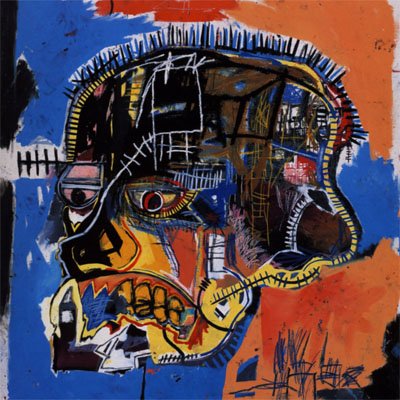
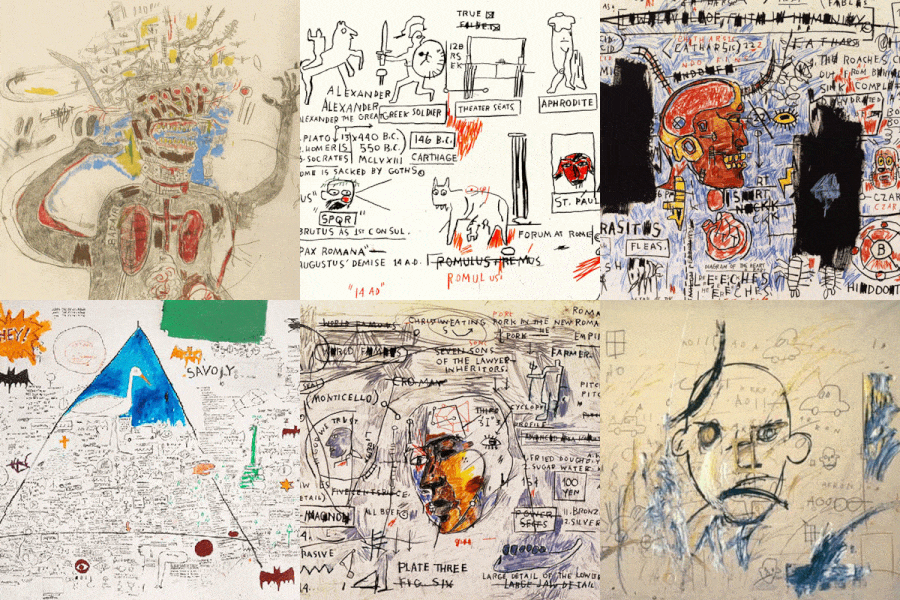
Basquiat would compose his compositions from this noise of everyday life. He would often draw in his studio, sat on the floor, with books open, the TV on, records playing, an information overload and from this the magpie sifts. He would draw direct from the TV, creating an image of an image. Often the TV image has already been caricatured. The multiple replication of the real copied to image, then to sign, to signifier, to simulacra, establishes a child’s worldview where representation is reality. The world that is now, the reality that we all inhabit is attained through bombardment of third person knowledge from print or analogue and digital recordings. A world pre edited, reconfigured and then subjectively skimmed for personal (p)reference. This forms the basis for contemporary understanding of our multi complex society, it is a graphic designers logic of mix, match and juxtapose. Hierarchy is personalised, a word balanced against a colour in turn, balanced against a political movement, balanced against a scientific equation. It is a non-sense of juxtaposition, a cranial bombardment from an undecipherable information soup. (Ref. Self Portrait 1985 p243)
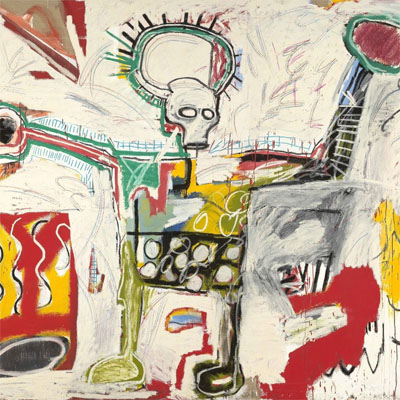
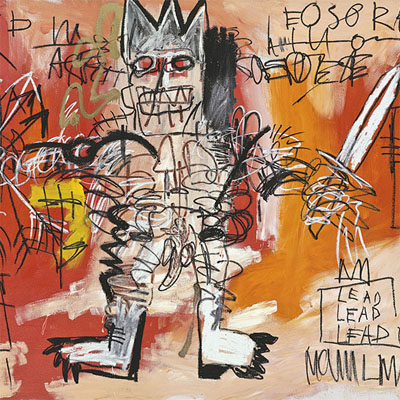
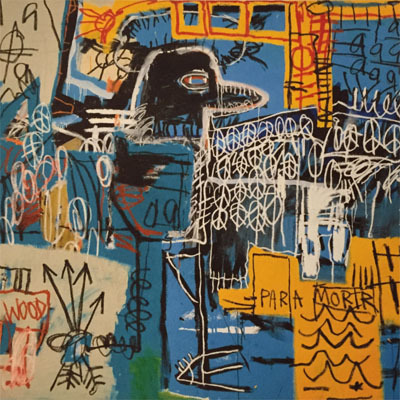
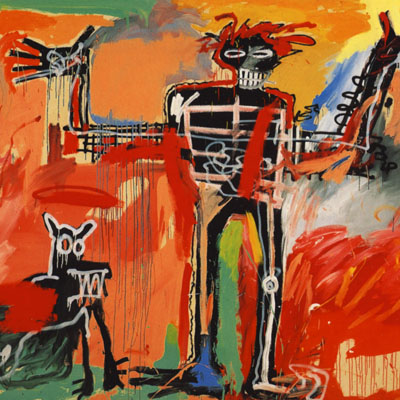
Basquiat was a receptive conduit at a very particular moment in time in which one could respond by intuitive, impulsive reactions to a sequence of inconsequential and arbitrary events. Picking from the flux, that was the environ of New York and reassembling through composition a pictorial snapshot of that moment. Basqiat’s work is haunting, like overlapping memories from a dream, disjointed, scale less, re-sequenced. The work is fragmentary and yet it has compositional order and structure, it has direction and orientation. Basquiat’s command of colour and intuitive eye for composition tie each painting into a complete assemblage. The technical process of making mirrors that of the evolving city. During construction the painting often requires constant overlay, over painting, re-working and editing, adding and subtracting. The final conclusion being the subjective interpretation of a frozen moment of the nebular, the contemporary environment in which we are all submerged. Where a city is no longer solid but merely a condition imposed by surface mediums both graphic and audio.
The period has huge significance in relation to our current world condition as an early precursor of the nebular state. Today with the additions of seamless CGI, augmented and VR our nebular boundary has had an infinite extension. Our concept of reality is further distorted where enclosure has become permeable and its boundary vaporised. Our concept of society and association is an online ‘like’. Our world has become a film space, scripted and edited, photo shopped and recorded, but most importantly represented through a medium that is constantly being RE-recorded.
The Surrogate Twin