

071017 – Space Port Venice – London > words
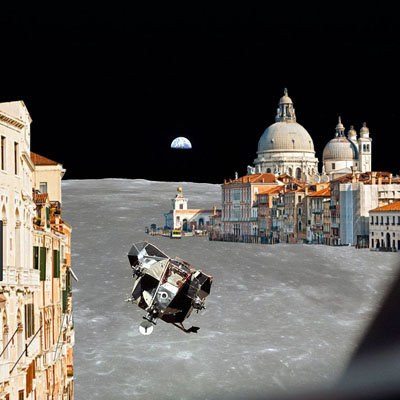
Venice is a surreal island, a level plateau built on mud enshrouded by its lagoon. The Grand Canal, a truncated ‘river’ that starts and finishes as if cut from the mid section of another river from a distant land. The lagoon shelters the island. Venice is an island protected by spits and shallow mudflats and throughout its history these have foiled many a sea-based invasion, leaving antagonistic armies stranded in the shallows. Venice was originally little more than a swamp, a site chosen by the dispossessed and victimised, a marshland where its residents could reside in safety and start anew.
Early Venetian dwellings were little more than wooden huts on stilts clinging to the highest silt banks, an environment with poor natural resources, no farmland, few trees just marshes, reeds and bogs. Locally the residents could fish for crab, shrimp and silt dwelling fish. With stifling hot summers and brutally cold winters the original occupants were survivors, there to avoid persecution but also there to search out a better life, to start afresh without landlord or feudal lord. Soon they would learn to navigate their lagoon and become fishermen trading the surplus for what they needed. As their confidence grew they would venture further out into the Adriatic Sea trading along the coast of what is now Italy, Slovenia and Croatia. A natural progression to trading fish for goods or money was then to trade on the goods bought, so up and down the coasts they would travel buying and selling. With this the Venetians found wealth, their wooden huts soon replaced by large wooden buildings. Larger ships were built to carry more goods and to travel greater distances. As their success grew new inhabitants were attracted to their island home and soon it was full on its way to becoming a city.
The larger ships carried the Venetians south down the Adriatic hugging the Albanian coast to Greece, here they would turn east eventually to reach Constantinople to trade with the Turkish traders at one end of the Silk Road. When Marco Polo returned to Venice after 24 years of travels to the East, his stories told of the huge wealth of the orient merchants who were keen for this new trade. The Silk Road travelled from China to Constantinople and the Venetians controlled all water born trade from Constantinople to the West via Venice. The areas around the Rialto developed into a market where all types of exotic goods could be bought and sold. Ships from Constantinople would harbour in the mouth of the Grand Canal and unload here at sea. Narrow boats took the goods from the ships along the network of canals and into the merchant’s houses. Venice was a port, a distribution and logistics centre but a centre like no others. The Venetian merchants houses developed into a unique type of wholesalers. Water gates at the base of the buildings open onto the canals allowing boats to access, unload and sell their wares. Floors immediately above this were storage and sales spaces. Floors above the sales spaces were domestic living accommodation. These were family businesses and the families grew very wealthy expressing their wealth in forever finer buildings. Early banking and insurance began here to aid the merchants and the infrastructure of trade developed. The Venetians were wise enough to appreciate that although their interests were personal their strength was as a collective so their ‘port’ was soon adorned with large pubic squares, churches, bridges, sculptures and monuments.
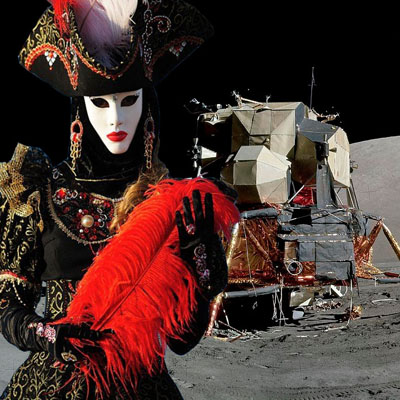
The trade routes along the Silk Road picked up ‘travellers, adventurers, explorers, rogues and vagabonds’. Service industries sprung up along route, food stalls, bars, theatres, gambling dens, dancers, faith healers, barbers, costumers, mercenaries, body guards, assassins, prostitutes, and at its terminus Venice soaked up this huge influx of cross cultural immigration that supplied these services. Intercontinental trade needs liberal conditions, in Venice, Christians, Moors, Asians and Jews all added to the mix. Their streets and their buildings an endless collage of cross pollination, an exquisite assemblage of adoption and adaption.
When travelling considerable distances and when trade is exposed to substantial risk the best goods to ply have high value, low baulk. So trades in spices, gold, precious jewels, silks, perfumes and porcelain dominate. These suit the caravans of the land route, the rowed and square sailed ships of the sea route, the souks, bazaars and markets and the merchants houses of Venice.
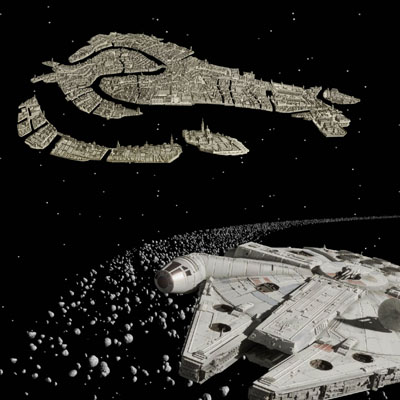
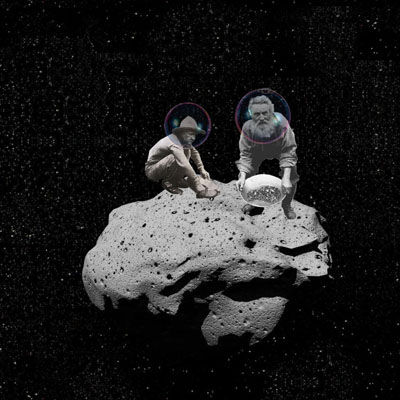
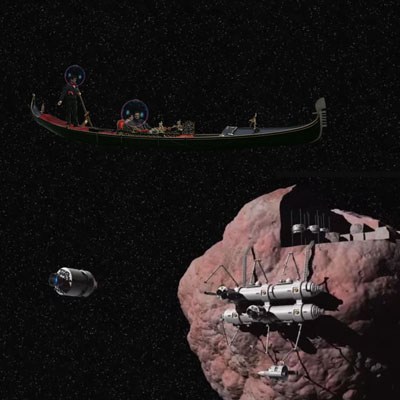
The first privateers to venture into space will be looking for goods to trade. Asteroid mining will probably be one of the early businesses to be established. Small towns, space shanties, will settle on the asteroids they are mining and with time these settlements will grow attracting the many subsidiary industries that feed upon a primary industry. Not unlike the growth of Venice the asteroid towns will soon attract ‘travellers, adventurers, explorers, rogues and vagabonds’ all looking to get rich quick, to escape the established regime, to seek out a new life.
Billions of years ago asteroids and planets were accreted from the same starting materials. The stronger gravitational force generated by a planet pulled all siderophilic (iron-loving) elements into their cores during the stages of their molten youths, leaving the surface crusts depleted of such materials. On earth asteroid impacts have re-infused the surface crust with these valuable elements. Typically these include metals such as gold, cobalt, iron, manganese, molybdenum, nickel, osmium, palladium, platinum, rhenium, rhodium, ruthenium and tungsten all with considerable economic and technological value. On asteroids due to their lack of sufficient mass and gravitational pull these elements may often be found lying on or near the surface, easing their discovery and recovery. Of these asteroids there are several Easily Recoverable Objects (ERO’s) and Near Earth Objects (NEO’s) that could feasibly be reached and mined.
Asteroids are categorized by their spectra into Types. C-Type asteroids have a high abundance in ice and therefore these asteroids would have a significant infrastructure role in space. C-Type asteroids would be logical bases on which to set up space depots to provide, water, fuels (splitting water into hydrogen and oxygen) and ingredients for fertilizers (organic carbon and phosphorus). In time Ceres would be a logical C-Type asteroid (now classified as a dwarf planet) for such an infrastructure base. Space fuels, water and food from the C-type asteroids would support the mining outposts on the S and M-Type asteroids.
S-Type and M-Type asteroids contain numerous metals including rare metals. As soon as trade between asteroids and between asteroids and earth commences subsidiary industries would grow along and around the new trade routes opening a new frontier. At present economic rather than technological conditions have prevented space initiatives, development and progress. However, as of September 2016, there were 711 known asteroids with a market value exceeding US$100 trillion and it is only a matter of time before the equation tips towards the economically feasible. The vastness of space contains an economic vastness of resources, although the total mass of the asteroid belt is only 4% that of the moon, asteroids are resource rich.
Early asteroid mining may well resemble the Privateers of the Fifteenth Century. Pirates on the high seas backed by National Governments. In a world that had yet to be claimed and with all eligible parties fighting for their share, this was a very grey area for any form of legislation. Earth has drafted The Outer Space Treaty and The Moon Agreement that outline laws and procedures with regard to space and space mining but only a few countries have signed these and as the prospects become more feasible the rules will change. It will be corporations backed by investors and not governments that will fund early space exploration. The East India Company immediately comes to mind, controlling key ports and Trade Routes, the gateways, will be the desired path of most corporations, to encourage anyone with a bucket, a spade and spaceship to ride out, stake a claim and strike gold.
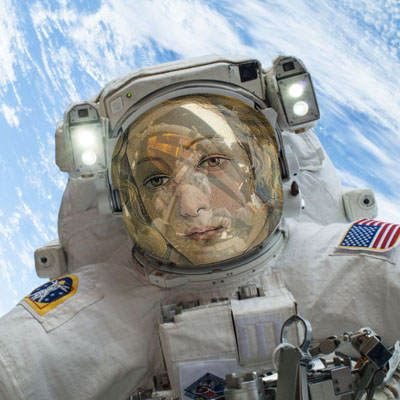
The early days of space mining may well be Gung Ho but just as Venice was the initiator of this essay, by establishing trade and controlling the gateway to the Silk Road, out of the swamp grew an amazing rich and diverse city. There will be space cities equally magical, their stories told by Marco Polo astronauts. But just as Venice had its day, its day also passed. Wars with Turkey lost the Venetians control over Constantinople and with it control of the Silk Road land route to the East. Soon Columbus would discover the New World and Vasco Da Gama would round the Cape of Good Hope establishing a sea route to India. Venice’s monopoly on Eastern trade would be broken and its oared galleys were now outdated and of little use on the open seas. I see no reason why the rise and fall of future space cities should be any different. According to CNEOS, “It has been estimated that the mineral wealth resident in the belt of asteroids between the orbits of Mars and Jupiter would be equivalent to about 100 billion dollars for every person on Earth today.” It is difficult to imagine the asteroids belt being left untouched forever, dwindling terrestrial resources may well force our hand. To fully explore space we would need resources beyond those that could be supplied by Earth.
An important test bed for mankind’s ambitions for space would be with our own moon. The moon’s surface is believed to be rich in cobalt, iron, gold, palladium, platinum, titanium, tungsten, uranium and the gas helium3. Water has been discovered at the poles which would be used either to sustain life or split and be used as a fuel. The moon could also function as the earth’s lifeboat housing data stores of information including genetic, technical and historic should an asteroid ever fatally hit the earth. How many more years will we wait for the first moon base?
The Surrogate Twin