


300320 – Van Gogh’s Shoes – The Relevance of Mis-Readings – London > words
Pre-Amble One – Provenance and Value – The Relevance of Decoding
Pre-Amble Two – From Sportswear to Signaturewear – A Contemporary Portrait – Balenciaga Triple S Sneakers
The Critics Previous Comparatives – Van Gogh’s Shoes vs Warhol’s Diamond Dust Shoes
Three images of Shoes – Van Gogh, Warhol, Balenciaga
Summation
This essay looks at three images of shoes and reflects upon the societies that have produced them. The essay consists of five parts as outlined above. Three pictures of shoes, from left to right, one from 1886, one from 1980 and one from 2018. The first two images have been chosen as they have already received considerable attention, as outlined below. The third image, are a pair of shoes of today and represent aspects of today’s society. All three images represent time frames of culture, ongoing development and reappraisal.
Pre-Amble One – Provenance and Value
Provenance – The beginning of something’s existence; something’s origin.
Value – the regard that something is held to deserve; the importance, worth, or usefulness of something.
Provenance, history, association, gossip, story, rumour and endorsement, are all entities that affect our perception, acceptance and eventual evaluation of something. The provenance need not physically improve or alter a product, it need not be accurate and it need not be positive to have affect. Provenance can be fickle, have considerable consequence and a two-way effect as it re-evaluates. The object that receives ‘provenance’ is re-evaluated and the giver of ‘provenance’ is equally re-evaluated.
For example. A rock star is photographed sitting in a new sports car. The cars significance is increased. The rock star’s famous model boyfriend / girlfriend is photographed sitting in the passenger seat. The cars significance is increased again. The rock star is known to be a car enthusiast and has a large collection of cars. The cars significance is increased again. The rock star is known to compete in track days or amateur races. The cars significance is increased again. The rock star crashes the car. The cars significance is increased again. The rocks stars boyfriend / girlfriend is killed in the crash. The cars significance is increased again. The rock star is also killed in the crash. The cars significance is increased again. It makes little difference that the rock star may not have owned the car, that he was lent it by a famous brand as a means of endorsing their product, or that the rock star drove the car just under two miles before the fatal crash. The object that receives ‘provenance’ is re-evaluated and the giver of provenance is re-evaluated.
The above example is a fiction, but numerous examples exist. In December 1967 Elvis Presley walks into a car showroom and buys a gold 1968 Cadillac Eldorado Coupe. One morning the new Cadillac refuses to start and Elvis shoots it in the passenger side front wing, where the bullet hole still remains. In 2014 this damaged car is sold for ten times the market value of the equivalent car. Numerous examples exist of cars receiving provenance from celebrity association and of celebrities receiving provenance from their association to specific cars.
Provenance to products is transferable. Steve McQueen’s 1968 green 350 Mustang fastback, from the film Bullitt, which sold for $3.74m million in January 2020, is transferred to all 1968 green 350 Fastback Mustangs. It should be noted that Steve McQueen did not own the car but it was used by him to make the film. It should also be noted that the car sold was not the main car in the film (that was written off) but the stunt double car. Neither of these facts have altered the re-evaluation, the car via celluloid is inextricably linked to Steve Mc Queen and has been assimilated into popular culture. James Bond has done the same for Aston Martin and Lotus. Cars featured in the films Fast and Furious, Matrix or any popular film gain transferable provenance.
The above are easily accessible examples of cars, we can read about them daily, we can check prices on auction sites and numerous websites and magazines. But the same provenance / re-evaluation can be readily applied to more esoteric goods, such as Samurai swords, contemporary furniture, jewellery, fashion, architecture, memorabilia, art etc.
Artists can invent and enhance their own provenance. The Masters from the Renaissance would often include themselves as a background figure within an allegorical composition painting. This was often revealed only after the painting’s completion, sometimes not discovered until after the painter’s death. They would paint mysteries that needed to be deciphered and leave clues so that the painting could be read and more importantly endlessly re-read. The more times a story is told, enriched and embellished the more significance is added.
In Art, provenance is as, if not more important than the art itself. Provenance authenticates, it establishes the origin and hence the authenticity. This is why the art forgers first task is to convince the specialist. Eric Hebborn (1934-1996) was a struggling London painter, who purchased some paintings in a market and sold them to a gallery. The gallery put the paintings up for sale at thousands of pounds over what they had given Hebborn and he believed that the gallery had intentionally cheated him. Hebborn set out to get his revenge, at first on the art experts at the gallery and then on art experts everywhere. Hebborn painted over 1000 pictures, in a range of styles, but the Old Masters was his speciality and sold them as originals. He was wise enough not to duplicate the originals but to study them and then produce preparatory drawings for existing or ‘missing’ paintings. Many of the world’s best museums bought and showed his paintings. Once a fake had been established as authentic, it is logged and archived and the fake itself becomes a means by which authenticity of other works are judged. Hebborn was an expert in drawing, ageing and dating his works. He would provide a sketchy but well-researched history and then allow the experts to make all the connections as expert authentication adds value and re-evaluates the piece. When the forger is eventually discovered, their fame endorses their own work, and some have then set up studios creating ‘authentic’ forgeries, exact copies of famous works signed by themselves.
Contemporary artists know very well the value of provenance and create both the work and the back-story. Damien Hurst’s, ‘Treasures From The Wreck of The Unbelievable’, composed of broken, barnacled and aged sculptures are sunk off the east African coast to be discovered in 2008 and retrieved. The sculptures are supposed to be that of Cif Amotan II, a collector of antiquities, from the second century CE. The whole process of discovery and retrieval is fully documented, catalogued and filmed. The fictional back-story is in itself a piece of art as that of the sculptures themselves. In 1918 Banksy’s ‘Girl With Balloon’ is put up for sale at a Sotheby’s auction. It sells for $1.37 million. As the hammer falls on the sale, a hidden shredder inside its frame begins to shred the recently purchased painting. The painting is shredded halfway. The auctioneers look at each other in horror, but they have completely missed the cue as the painting has just considerably increased in value. It is possibly now Banksy’s most famous painting. Banksy had intended for the painting to fully shred but the shredder hidden in the frame malfunctioned and the painting was shred only halfway leaving half in the frame and the shredded half hanging from the frame. This was by far the better conclusion, exceeding the intended, as the work records and displays its own provenance.
You may ask what has any of this to do with Culture or High Art, surely this is simply market manipulation for commercial gain? The answer is Yes and No. Designed objects and works of art are records or cultural stepping stones, they document the values and beliefs from within a specific time frame. Artists and designers are windows and conduits for recording cultural history and markets are intrinsically linked to our cultural history. Democracy, globalisation and popular culture are, in the present time frame, uniquely interrelated and art and design have adjusted to this. High Art, often takes an aloof stance, but it is very much part and product of the same system that generates understanding and culture.
Pre-Amble Two – From Sportswear to Signature Wear
To make any sense of the third image some historical background information is required regarding a genre of clothing that emerged in the twentieth century. Sportswear, leisurewear and casualwear have been grouped as the same genre of clothing as they have become hybrids of each other in contemporary fashion. Sportswear entered fashion via small complimentary collections within the French high fashion houses of the 1920’s. Women started to wear looser fitting clothes and began participating in sports such as tennis, golf and swimming. Sportswear was a minor part of these collections and still often made bespoke for women of the leisure classes. However, sportswear is really America’s Post War contribution to fashion, linked to the growth of ready to wear and interchangeable separates, where it became increasingly part of the fast-paced American female wardrobe. American sportswear was seen as an expression of middle-class values, including comfort, function, health and the concept of democracy. The established eight-hour day, five day working week enabled a growth in leisure time for all classes and clothing was required to embrace this new found freedom. Advertisements for women began to embrace the ‘American look’ of good health, good teeth, good grooming, fit and free. American sportswear designers focused on mass produced, affordable, versatile, easy wear garments. While the post war Paris fashion houses imposed their styles on their wealthy clients, American sportswear was widely available, encouraged self-expression, and accessible to all and as such, seen to be democratic. During the 1970’s Ralph Lauren, Calvin Klein and Perry Ellis produced sportswear made in natural fibres, brushed cotton, wool mixes and linen. By the late 1970’s American designers were producing extremely simple garments in high quality fabrics that have become modern classics and these have barely changed over the years. Casual had become minimal, with simple clean cuts. These fashions were endorsed on a global stage by America’s command of film and music, through these mediums they expressed new youthful freedoms, new independent ways to live, the all-American lifestyle.
As the lines between sports and casual wear became blurred and mixed, the music of the 1980’s and 1990’s opened new possibilities for this type of apparel. Popular culture saw the music of the 60’s and 70’s as a visual spectator-based recreation. The music of the 80’s and 90’s was far more activity based and dance orientated and this evolved a clothing style appropriate for the new genres. At the same time global access to TV had popularised sports at a domestic and international level. Teams with their colours, hierarchal uniforms and brand association gained a popular following among fans. Popular culture and business were inseparable as money follows and manipulates the markets. Street fashion, from necessity, has to be inventive on a budget. Mixing second hand separates and casuals with sportswear was an easy and practical step, layering all of these into a new streetwear most recognisable through the Hip-Hop scenes of the 80’s and 90’s who often wore the uniforms of one brand, adidas, Nike etc. Further into this mix came other forms of street culture as leisure time amongst the young increased. Skateboards, Surfing, BMX, B-Boys all had their own dress codes. Leisure became increasingly activity based or at least one could dress with the resemblance of association to an activity lifestyle. Clothes became tribal through association but tribal within a global catchment of popular genres. Mass markets had huge financial potentials and the big brands followed this. Soon the alternative became mainstream, break-dancing, surfing, BMX, became international sponsored events and ambassadors from within the scenes were courted by brands and able to earn considerable incomes. Brand Ambassadors and Influencers could be seen in the front rows at the catwalks of high fashion.
High fashion had to reinvent itself to follow the markets. Couture, bespoke and quality were replaced with the creation of ‘Difference’. Signature clothes replaced tailored clothes, from Generation X (1961) onwards, the youth market, that may have baulked at spending $800 on a new suit, would gladly spend that on the correctly tagged t-shirts or trainers. ‘Difference’ through fast turnover, limited availability and immediate association became the call of the Instagram society. Flags were worn, Brands brandished, Tags noted, all signifiers of association to a particular lifestyle and attitude to life. When brands such as Gucci adopt the mix of street fashions and place multi thousand-dollar price tags on them, this appropriation is self-reinforcing. Drawing from popular culture and directly feeding into popular culture enables the media to manipulate and create new markets. Demna Gvasalia, the creative director of Balenciaga, explains how luxury products have changed. “The emphasis has gone from quality and craftsmanship into the uniqueness of the product, A high price tag isn’t the only way to ensure scarcity. Streetwear brands have pioneered a strategy called “the drop,” where they let new products trickle into stores in small quantities on a regular basis, scarcity has fuelled a massive secondary market” The role of music and the fictive alternate lifestyles developed within club culture should not be underestimated. In the US alone Hip-Hop has the largest following of the music genres, at around 25% of total market sales, it is now a multi-billion-dollar industry. Product endorsements and limited-edition signature ranges have made many Hip-Hop celebrities incredibly wealthy and with their wealth and fame their endorsement value grows. Rappers are no longer just Rappers but instead company CEO’s, designers, actors and market influencers. The web has helped enforce and aid the growth of this mix.
High fashion has adapted, it no longer takes an aloof stance but instead is more a mirror of society. Street fashion with its influences from sportswear, clubwear, gaming and anime is absorbed by the fashion house, deconstructed, re-worked, re-composed, styled with an exaggerated edge. The material technicity of sportswear, 3D fabric forming, moulding, bonding, makes the whole look progressive and futuristic. This is intrinsically linked to digital communication, film stingers, sound-bites, hyper-real and interactive graphics, all of which help create these super-intense aspirational worlds created within ads. Instant digital media is a condensed experience, a thick syrup of real life, delivered in a few mega-bites of data and as such, an inaccessible simulacra, a hyper-real simulation of a reality that never existed. This offering of the unobtainable can be purchased through symbolic association and this symbolic association has a greater value in today’s society than the traditional quality and craft of making that would have been associated with previous fashions.
The wealthy are able to live in a multi-stratified world above the everyday. Here, they inhabit a world based upon choice, to either live inside or outside reality whenever the occasion requires. The majority of the population have little choice when directing their own lives, and respond daily to circumstance. Most can barely keep up with the cost of reality, they can hardly afford their cities, the major part of their life consumed by the cost of existence. The repetitious banality of the everyday is endured through the escape into fictive realms. These would once have been those of the story teller or the novel, today, its first point of call is TV and the internet, its second is music and club culture and its third would be the packaged tour or themed event. In these realms hope, optimism, group acceptance and personal success are superficially achievable in this digitised or themed, socially mobile, the American Dream. Where once the t-shirt, as signifier was the substitute for one’s own reality, today we have avatars, online identities, photoshopped ideal personas complete with imaginary CV’s. Reality has no place in these fictive worlds. Optimism, hope and moral justice, once the realm of the religious parable or folklore fairy tales are now part of everyday popular culture. In these fictive worlds super heroes abound. Those fictive super heroes that have been lucky enough to have mutated, have developed super powers and dress accordingly. They inhabit our gaming culture and our action films. These fictive worlds feed back into reality, through role play, fandom, adoption of gesture and mannerisms, clothing and merchandising. Manga films inspire Cosplay and Harajuku cultures that fill clubland and overspill into our urban environments. The fashion world mirrors this and gives it a more credible edge and makes it available to the mass markets.
Just as Warhol commodified celebrities through image, here activity and myth have been commodified. For the very few that dedicate their lives to pushing the limits of their alternative arts, be it BMX, Skateboarding or B-Boying etc. the majority are satisfied with association through tags. It requires no skill to wear a t-shirt, grow a beard or adorn a tattoo but all of these signifiers carry a disproportionate significance with regard to the owner’s personal achievements. The skilled individual has been outcast, he/she has been replaced by this new tag enhanced collective popular culture that gains strength from unity and identity and this group identity can be commodified.
The Critics Previous Comparatives
Above we are presented with three images, two of these have gained in notoriety due to receiving considerable critical attention and have from this had to be re-assessed and re-evaluated. The two paintings, both simple paintings of shoes, have been the subject of much discussion with regard to both the interpretation and role of Art within society and culture. The paintings are Van Gogh’s Shoes and Andy Warhol’s Diamond Dust Shoes. What has previously been said about these two pictures needs to be outlined to be contextualised. These images of course, were not chosen at random, they are images more famous for the critic’s discussions around their meaning than as artisan exercises in the representation of a still life. So, it would seem appropriate, to start at the beginning with that controversial paragraph, written eighty-five years ago, that set all this dialogue in motion
“From the dark opening of the worn insides of the shoes the toilsome tread of the worker stares forth. In the stiffly rugged heaviness of the shoes there is the accumulated tenacity of her slow trudge through the far-spreading and ever-uniform furrows of the field swept by a raw wind. On the leather lie the dampness and richness of the soil. Under the soles slides the loneliness of the field-path as evening falls. In the shoes vibrates the silent call of the earth, its quiet gift of the ripening grain and its unexplained self-refusal in the fallow desolation of the wintry field. This equipment is pervaded by uncomplaining anxiety as to the certainty of bread, the wordless joy of having once more withstood want, the trembling before the impending childbed and shivering at the surrounding menace of death. This equipment belongs to the earth, and it is protected in the world of the peasant woman. From out of this protected belonging the equipment itself rises to its resting-within-itself.”
In this quote from ‘The Origin of a Work of Art’, 1935, Martin Heidegger, the wordsmith, does what he does best and offers a worthy phenomenological description. Heidegger’s text trembles overwhelmed by his individual interpretation of this painting in which he puts emphasis upon the owner of the shoes as a means of interpreting the painting. Heidegger also puts emphasis on societies need to understand a painting by reading into the subject the personal context. Here he portrays the shoes as that of a peasant woman and he reads the painting as representative of her personal struggle to survive the harsh realities of life. Heidegger’s text is focussed around the assumption that these shoes are that of a peasant woman, unfortunately this assumption is almost certainly flawed.
In ‘The Still Life as a Personal Object’, 1968, Meyer Schapiro criticises Heidegger and re-writes the painting in his own image, replacing the peasant woman as the owner of the shoes with the shoes being Van Gogh’s own. Schapiro sees the painting as a self-portrait by the artist to represent his life’s struggle for acceptance and artistic recognition. This reading is probably more accurate as we know from Gauguin that Van Gogh painted several paintings of his own shoes.
In ‘The Truth in Painting’, 1976, Jacques Derrida picks up the baton and both critics are hit again, this time with the lengthy polyphonic virtuosity of Derrida’s endless semantic riddles. At one point during his text he invites the reader, to read, in full, the original Heidegger text in both German and then in both French and English translations. He questions assumptions made by both Heidegger and Schapiro around the ideas of ownership and if the shoes are even a pair. Derrida finds fault in the two previous critiques but offers little in the way of a reading.
Frederic Jameson picks this up yet again in ‘Postmodernism or The Cultural Logic of Late Capitalism’ 1984, and compares two readings of the Van Gogh’s shoes and agrees with the possibility of each. He then adds as a comparative Andy Warhol’s Diamond Dust Shoes. (Although both the Van Gogh’s painting of boots and Warhol’s painting of shoes referenced by Jameson (p10a&b) are both incorrect images). Jameson suggests that the methods of reading the Modern, Van Gogh painting, cannot be applied to the Warhol Postmodern painting and his interest is in why these previous methods of art interpretation are now inappropriate.
The Van Gogh shoes high claim to fame comes not directly from the painting or the painter, but from the attention the painting received from critics and writers. This single pair of shoes, on a yellow background, was to become fuel for philosophers as they questioned arts role, its meaning and how it is perceived and interpreted. To make any sense of these texts one has to put them in the context of the critic. Each of these essays shifts the focus of content from the painting to the content of the previous criticism. They are conversations in time and are important as they reveal as much about the context and time in which they were written as they do about the original painting. Equally important is how that written context is viewed in the present. The essays show how perception changes with time and context and how societies develop within the flux of constant self-reappraisal. So, now let us try to contextualise the paintings and the critiques of the paintings beginning with Van Gogh, the original author and the following chronological sequence of critiques. Contrary to Derrida, to be able to offer any reading one needs to begin with educated assumptions. These assumptions are of course made from within this present time frame and as with the previous readings this context is in a constant state of flux but a snapshot time frame is required and is very much a component of that flux.
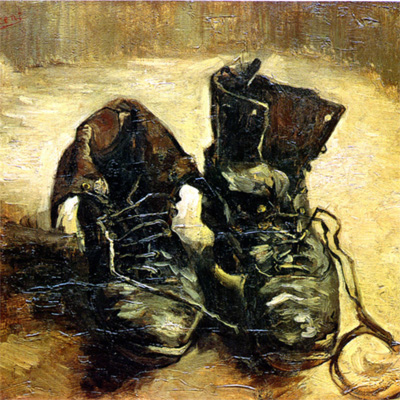
The source of the shoes will always be inconclusive, two personal variants exist. One is that Van Gogh bought a pair of old working boots from a Paris flee market in 1886 and took them back to his studio in the Montmartre district of Paris. It is known that he tried to wear them but they did not fit so instead he used them as a subject for a painting. Gaugin however offers another slightly more credible story. Having lived with Van Gogh in Arles in 1888. Gaugin asks him about the painting of the shoes, by this time there would be several paintings of shoes that had been made between 1886-88. Van Gogh replies “My father,” he said, “was a pastor, and at his urging I pursued theological studies in order to prepare for my future vocation. As a young pastor I left for Belgium one fine morning without telling my family to preach the gospel in the factories, not as I had been taught but as I understood it myself. These shoes, as you see, have bravely endured the fatigue of that trip.” If this story is to be believed, then for Van Gogh the shoes were a memorable piece of his own life, a sacred relic. The shoes represent the essence of himself, a homage of his struggle to share his beliefs. Van Gogh sees beauty in honesty and simplicity. However, the shoes paintings may simple have been experiments in paint and render. Impressionism, including Van Gogh’s own Impressionism was being invented on the run, canvas by canvas. The meaning of this non allegorical painting is a subconscious sensorial transference, a feeling about oneself and the time in which one lives.
Famously Van Gogh only sold one painting during his lifetime, as a struggling artist models were beyond his means, he had no clients or patrons, his paintings were unwanted. He was working at a time of great industrial disruption in both the cities and countryside, where mechanisation had replaced manual labour, the mechanical camera now captured realism better than the artist could. Impressionists sort to capture feeling and mood, tinged with nostalgia for a fast disappearing rural idyll. Industrialisation is a great gatherer and accumulator, bringing together collective labour, previously widespread resources, dispersed capital funding, all are focused to serve the machine and its products. An alienating overview, heartfelt, if not fully perceived at the time of Van Gogh. The Impressionists were part of a collective reaction to these times and a conduit for this reaction. Van Gogh’s shoe painting, torn between struggle verses optimism, represent a generic portrait of the common man, weathered and beaten, set against a background of ochre, Van Gogh’s ‘Happy Yellow’.
Heidegger’s text comes from an entirely different context, that of the established academic. Heidegger came across Van Gogh’s shoe painting at an exhibition in Amsterdam in 1930, forty-six years after the shoes were painted. Van Gogh’s work had now transcended from unwanted to collectable, its social status and influence increased by its new found financial value. Impressionism is no longer the art world’s young antagonist upstart but is now a respected and acknowledged historical Art movement of which Van Gogh was part. His life as a struggling artist, his bouts of insanity linked to chronic depression and his eventual suicide all add to his works provenance. In 1930 Heidegger is an established intellectual and academic, his Being and Time was published 1927 and was well received and highly influential. 1930 sits in the midst of two World Wars of which Heidegger had already served in WWI. Germany is in the midst of an identity crisis; post WWI hyper-inflation had desolated the country. The industrial Ruhr valley was controlled by France. Germany seeks unity and stability through Nationalism and Fascism is endemic. Heidegger, by 1933, was a full member of the Nazi Party.
Heidegger saw art as not merely the representation of the way things are but as a product of society’s shared understanding. For him, every time a new artwork was added to a culture, the meaning of what it is to exist is inherently changed as art is a form of reappraisal. The artist is not in control of the artwork, art itself, a product of culture, becomes a force that uses the artist for its own purpose. Art must therefore be considered in the context and time of its creation. The artwork is about the painter who painted it, how it was painted, the subject and its context. In Van Gogh’s painting, this is the owner and maker of the boots. Art by its very nature is not a scientific text, readings are interpretations that in themselves become minor artworks. The psychoanalytical works of Sigmund Freud were influential and well-read among academics, the sub-conscious, free association and transference were central to the analytical process. Van Gogh’s ongoing battle with depression and his eventual suicide would be irresistible to Freudian methods of analysis. All of this would put emphasis on the place of the individual within society. Heidegger takes an aloof stance, looking down on the his assumed owner of the shoes, the peasant woman, as a fraught lone individual.
The opening quote of this essay, is Heidegger’s elaboration, his interpretation from the perspective of Heidegger, a German intellectual, written a generation away from the painting’s original conception. Much has been written of Heidegger’s search for ‘the meaning of things’, his work has been extremely influential among the Existentialists. The search for meaning in a world ripped apart by the chaos of World Wars, where mankind’s devoted and constructive energy is put towards the building of machines of mass destruction, would seem an essential existential need. Hyper-inflation and commercial fiscal instability, would further query the reality of the everyday and its meaning and purpose. Heidegger’s phenomenological reading may be a fanciful over-reading of an image but his methodology is considered and has become an incorporated method of art criticism. However, ‘meaning’ read into paintings, as phenomenological description, contextualise a cultures perspective upon a subject (the shoe painting) within Heidegger’s time frame. This critic and painting are then viewed from the cultural perspective of the present. This continued reaffirmation is the means by which collective knowledge is accumulated dispersed and reinvented.
For Meyer Schapiro, an art historian as opposed to Heidegger the philosopher, shifts the context again. In ‘The Still Life as a Personal Object’, 1968. Schapiro sees Van Gogh’s shoes as a self-portrait without the artist being present. In isolating his own old, well-worn shoes on a canvas, he turns them to the audience. Shoes bear all the burden of struggle, age and fatigue, they stain with time, crack with age and wear out from the pressure and heaviness of one’s daily mobile tasks. They mark the owner’s station in life, his predicament, his inescapable position in society. In the painting of the shoes, the artist, Van Gogh stands naked but invisible. Schapiro’s reading is from the context of post WWII America. Fascist Nationalism has been set aside and replaced by Marxist Socialism, here the individuals voice and the individuals struggle have value and Schapiro concludes the painting to be a self-portrait. Schapiro had considerable knowledge of European history and the historical context in which paintings were produced, his first book in 1950 was on Van Gogh.
In 1978, Jacques Derrida returns to the subject of Van Gogh’s shoes in ‘The Truth in Painting’. Derrida’s Deconstructive stance is in line with Postmodernists rejection of metanarratives and universal truths. He concentrates on the dialogue between Heidegger and Schapiro and deconstructs each case by emphasising that there are no truths to the assumptions made within each text. He puts emphasis on the assumption of ownership, whose shoes are they, but also on the assumption that the shoes are a pair. Derrida reads through the critiques and builds an attorney’s case, questioning every assumption made by the previous critics about the painting. Often this can be an exercise in grammatology or the precise meaning of individual words. The original painting becomes a background subject and the dialogue around the subject has precedence. Although many of the points mentioned by Derrida have relevance, assumptions need to be made to offer a reading or to even begin a constructive conversation. Derrida’s text comes from a period of cultural self-questioning. The Modern Movement, with its universal reductive rules, had been seen by many to have failed, Postmodernism offered a new plurality but not necessarily a direction, it offered a means of re-evaluation but not a conclusion, as a conclusion would be just another metanarrative, an imposed truth. Derrida’s text is written in the first person, as if it is a conversation about possibilities and interpretations. It is set without the forming ground of opinion, it assumes that the basis of critical opinion has plurality and is always in flux, the Postmodern age being a time of incessant choosing. Van Gogh’s shoes were composed by Van Gogh within his time frame and context. Criticism of Van Gogh’s shoes are equally composed within their own time frame and context. The flux associated with the readings come from the passage of time and not from the moment in time.
Jameson suggests that these hermeneutic readings of the Van Gogh’s painting are possible as the work has imbued depth, as its author has considered each brush stroke, controlled its direction and texture, selected the tonal range of the colour pallet, arranged and rearranged the composition and chosen the framing and the juxtaposition of background. The author has filled the canvas with feeling, his persona and his temperament. Jameson sees the van Gogh work as an inert object form and should be read as evidence of some vaster reality which replaces it as its ultimate truth.
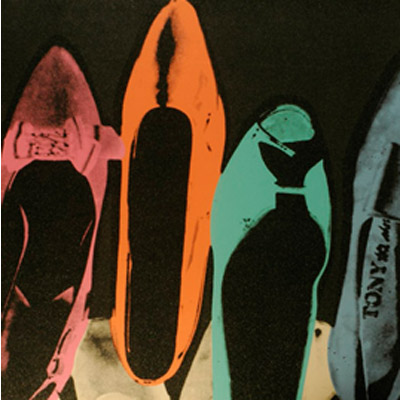
Jameson goes on to compare Van Gogh’s shoes with Warhol’s Diamond Dust Shoes, however, compared to the Warhol painting, already flattened twice, through the mechanical process of reproduction, photograph and the silk screen, this image is a simulacra that cannot be read in the same way or contain the same depth of meaning as the Modern Van Gogh painting. Frederic suggests that the Warhol shoes are distant, and cannot contain the intimacy of the Van Gogh shoes and that the Diamond Dust Shoes histories are unable to be identified. Instead we have a random collection of dead objects that we are unable to restore to a larger lived context. Warhol through the commodification of objects transfers its subjects, even celebrity human subjects such as Marilyn Monroe, into commodities of their own image. To surmise Frederic the Van Gogh’s painting is grounded in its materiality, the material of paint and canvass, the materials of the shoes and the shoes use by people. The Warhol shoes lack materiality as they have been moved into the world of exchange value, of surfaces and play, a simulation, a copy for which there is no original.
Three images of Shoes
What is the relevance of these essays with regard to Culture and their Cultural contribution? Are they too esoteric to have any purpose or meaning? When isolated as individual essays they are indeed sole critiques of the subject but when considered as a collective their interpretations re-evaluate societies values and direction. Heidegger, Schapiro and Derrida, when they are not disseminating each-others text focus on who the shoes belong to and from that context a precis can be formed. Van Gogh painted six paintings of old shoes and in every painting the shoes are isolated. Of these six, the painting above is the picture of prime relevance to the art world. The six paintings are still life’s and exercises in technique, Van Gogh painted because he enjoyed painting, it allowed him to cope with life. The shoes may have all been his or may not. The value of the shoe painting pictured is not of the individual but of the historic period that it represents. Heidegger’s contextual reading of the painting, as methodology, is important but subjective over reading into the personal misses the paintings historic relevance. Schapiro’s criticism of Heidegger challenges the shoe ownership and describes the painting as a Van Gogh self-portrait, without the artist being present. Derrida takes both Heidegger’s and Schapiro’s texts as being heavily flawed, and like a prosecution attorney lists faults in each case. He pulls the critiques apart but then leaves the pieces on the table, as a Postmodern critic, he refuses to conclude by inferring an alternative metanarrative. Jameson looks at the methodologies used in the formation of the previous critiques and argues that the same methods cannot be used to assess contemporary art as contemporary art has been stripped of imbued meaning. The Warhol painting has been distanced from the observer by the mechanisation of its production and by the mechanised production of its subject shoes, both shoe and painting are exchange value commodities.
It is worth looking at these two paintings again from the present perspective to form an assessment outside of the previous critiques and to add to these a new image of a contemporary shoe. Three images of shoes spanning 132 years of time, in which societies relationship to each shoe, its purpose and meaning has undergone considerable change, as societies and their values have changed.
In 1886 the Van Gogh shoes would have been made by hand, they took time to make, they were organic, made of life, they are embedded with sacrifice both in their procurement and in their use. They age as natural materials age, crease and crack, weather as skin. The shoes would be expensive items to buy, saved up for over time and yet an essential necessity, a survival item. The owner would look after them, repair them, they are intended to have longevity. With time and wear they become more like the owner. The relationship to the object becomes one of shared experience and stops being one of possession. The painting can be read as a portrait of the generic working man set within a time frame of great transition. After the invention of the camera, Van Gogh like all impressionists was searching for a means of emotive representation and this involved experiments in technique. The Impressionists had a nostalgia for the past as a rooted reaction to the uncertainty of the future. In the shoe painting Van Gogh frames the canvass. The shoes face forwards, confronting the audience. Frontal, questioning, laces undone, step into my shoes? The shoes are painted in isolation on a background that sets mood but is non descriptive or revealing. The background is mainly of yellows and ochres, to Van Gogh, optimistic happy colours. He famously once ate yellow paint in an attempt to become happy. The framing is static, not quite square but of the proportion that puts the subject in the position of centre focus. All of these attributes are techniques of portraiture. The shoes are presented as a portrait but not necessarily of an individual but instead of a displaced generation in turmoil. A generation in which all precedents are questioned, religion due to science, craft due to mechanisation, displacement due to industrialisation, meaning, value and authenticity due to mechanical reproduction. For a generation, all these values that were once solid are now transitory, in the process of great change and/or slowly disappearing. This test of inherent values and man’s displacement has been represented by the portrait of the invisible generic owner of these shoes. These personal, valuable, essential utilities.
Numerous versions of Andy Warhol’s Diamond Dust Shoe’s, like the Van Gogh’s shoes, exist. Warhol, when working as a commercial illustrator for the fashion industry first created his Diamond Dust Shoes in 1950. These have probably been retrospectively titled as Warhol did not come across the technique of adding Diamond Dust to a screen print until 1979. Warhol revisits the shoe subject in the 1980’s again for a commercial ad-campaign for the fashion designer Roy Halston Frowick (Halston). A large box of Halston shoes arrived at Warhol’s studio where Ronnie Cultrone, Warhol’s assistant, tipped them onto the floor, Warhol liked the way the spontaneous arrangement looked and took Polaroids. The Polaroid was the favoured medium of Warhol’s for recording image, it was quick, immediate, its colours poster like and acidic and it was disposable, an instant gift. Warhol would choose a Polaroid image to be sent to the lab and enlarged, turned into a monochrome screen print, to which Warhol would then add further colour. Diamond Dust was then added to the surface of the screen print. Diamond Dust is a ground glitter from a natural crystal, although Warhol preferred to use ground glass. Glass a low-cost commercial product, is used to create literal glamour, a mass-produced material used to create the illusion of wealth. The Diamond Dust addition gives an appropriate shimmer, a reflection of mirror ball glitz and the disco lamé of Studio 54 and of 1980’s New York.
As a bought mass-produced commodity, the shoe’s inherent value has decreased, craftmanship has been replaced by choice, choice of style, choice of colour, choice of occasion. As a commodity the specifics that once made it a shoe are lost, it is now a commodity like any other, a fridge, a car, a biro. The Warhol shoe is an object that faces an identity crisis, stripped of its history, its heritage, its craft and its skilled time laboured making, all of these qualities have now gone. In the same way as the photograph and the silk-screen flattened the image, the making of the mass-produced shoe flattens the shoe. Its previous cultural associations, those of craft, skill and quality are replicated by an embossed surface pattern and/or replicated image. How does this new commodity shoe replace the value once associated with quality of material and craft skill? How does any mass-produced commodity, such as a biro or a mass-produced shoe contain value beyond its production value? The ultimate Warhol mass-produced shoe would have been the Croc, that jelly mould regurgitation of an object disguised as a shoe. If Crocs had been silk-screened, they would be the perfect Warhol product.
Contrary to Jameson, a Postmodern painting also invites interpretation, a decoding to develop and complete the world represented which is beyond what can be physically captured by paint on canvas. In a Postmodern work, the image has been flattened limiting interpretation, making it depthless and superficial. Aesthetic production today is part of, and cannot be separated from, the broader general production of commodities. The Warhol shoes are mass produced commodities, there is not a pair as that would indicate a person and offer the interpretation of a persona, instead we have a random arrangement of colour, styles and sizes. The shoes are not displayed but instead displaced, left over, consumed, pre-used, a line of superficial choices for a market that creates superficial needs. Shoes no longer wear out, they are exchanged as the occasion determines or as fashion dictates. Consumer culture creates the desirable from the mass produced. The shoes value is that of currency, their exchange value. Societies priority value is that of ownership, collections of possessions, shoes, properties, companies. Ownership has greater value than use, collections of shoes that may be bought but never worn, collections of properties, bought but never used. The shoes are possessions, badges or merit.
As Postmodern commodity culture develops and mutates, the commodity has become the inherited identity of the owner, representing their choices, values and status. The shoe once a utility, then a badge or merit, now become a signifier of association. Marketing understands that pre-loading the commodity with associative provenance enhances the commodities value. Provenance is acquired through associated ‘stories’, often fictive. The commodity becomes a symbol representing an association to a lifestyle or to a group. Markets and popular culture encourage this signifier to be representative of a collective tribal identity, in the world of the net and global communication the successful signifier can become viral. Post Wars, we now live in an image saturated world, where the image is the quickest and most direct form of communication. The rise of comic book culture and the medias increasing use of the photo essay, especially in newspapers and magazines, have become a powerful means of mass communication. This suited the new urban workforce, forever on the move, with limited time during frequent breaks. Film, chopped and edited, with interlaced stories and distance to close up framing, aerial shots and distorted perspectives, creates a space in a similar way to the photo essay and comic book. This has become the principal way for stories and spatial sequencing to be portrayed but this is far removed from the linear space-time in which we live our real lives.
The visual image is the ideal medium for the fictive world, the image of dreams, desires and aspirations. A fantasy world where we are happier, healthier more beautiful and more successful. It is a world saturated by multiple images, where space consists of a flickering collage of reference and association. Rauschenberg paintings of the mid 1960’s hint at this coming construction of space. Collaged multi-media space was fully absorbed in the 1980’s by popular music, where previously music was an acoustic medium. TV programmes such as MTV and others changed music from an acoustic to a visual medium using the purpose made music video. The music video, an elongated glamorised advertisement, cannibalised images, it mixed, references, sources, hierarchies, it stole everything. It was flattened, contextless, timeless and relentless, an intense collaged world to represent our new fictive realms. The MTV generation of the 1980’s was bombarded by images 24/7. They were immediate and instantaneous and became our new mythical religion, a world constructed of digital flickering frescoes. The music video became the background noise in every teenager’s bedroom, turn it on – leave it on, a world where everyone can live their dream.
This Postmodern image-based culture, where the image is loaded with signs, references and aspirations, where text is replaced by a visual language, has an almost medieval implication, similar to the fresco adorned churches, with their walls lined with images of a better world and a promised paradise. A promise that was accessible to all simply by following a set of rules. These aspirational mythic worlds offer escape from the everyday. The visual image was central to the spread of religions as it spanned literacy, language, culture and continents. Today, the visual image is now being used again as the central method of communication to globalisation world, for the very same reasons. The hyperreal, aspirational image, is a cartoon of the original, a condensed summation. It can be politically loaded, subjectively interpreted, it is a message for the masses. The modern aspirational lifestyle image is shown next to a tag, logo or brand name, the signifier of association. The sign flattens, the logo shortcuts. The rise of sportswear from leisure wear, with its adornment of tags and brand names has become fashions contribution to this new urban landscape where space is understood as a photo essay, a collage assembled from image bombardment. The majority of our education is now delivered on screen, also in the format of the film photo essay, for example, nature programmes, science programmes, history programmes, all real-world scientific subjects, use these methods. This has become the means by which we now comprehend and explain space, and therefore cannot be separated from the linear, real-world, space-time that we experience and inhabit. This overlay, understanding verses experience, is how our fictive and real-worlds merge, aspects of these fictive worlds inhabit our urban environments and are absorbed into societies and culture. These links tie the fictive and the real together, space understood as a photo essay, often mythical, and the linear space-time that we inhabit.
Van Gogh was a deeply religious man, the son of a Protestant minister who once considered following in his father’s footsteps to study Theology. Andy Warhol was a devout Catholic, he went to church often, sometimes daily, he met Popes and was buried under Catholic Rites. Both Van Gogh and Warhol believed in alternative spiritual worlds. Although education and science have yet to rid the world of religion, they have weakened religions global grip. It is interesting that technologies derived from science have been used to create, encourage and enhance other mythic worlds. These replacement utopias, like the religions before them, have aligned with commercial objectives and encouraged means of social control.
Space constructed through the medium of collage reinterprets established conditions of our spatial reality. Multi-media collage space can be constructed with multiple scales, it has no hierarchy, no gravity, it can be played forwards or backwards, in slow motion, speeded up or in real time, it can be live or historical, virtual or real, it can be augmented, supersaturated, hyperreal, greyscale, flattened or filtered, it can be layered, may contain text or signifiers, tags or logos, it may be synced to sound or have sampled sound running over or through it, it may be in a constant state of flux or totally static, its transitions may fade or morph, it paints mood, it agitates boundaries, it’s a space that bleeds. the perfect space for mythic worlds to be constructed, the perfect space where the real and the unreal become seamless. These idealised worlds as an image can be framed, sold and purchased, we can buy into this lifestyle. We are never sold a product, we are sold a dream, a space in which we can shape our new personas. Images satisfy this psychological need for an improved habitable space. The image when referenced by a tag, a soundbite, a catch phrase, a brand, a symbol, or a logo, is a powerful persuasive tool, an immediate shortcut,
We have become used to living alongside parallel fictive worlds, Europeans have amusement halls, cinemas, theatres and casinos, America had amusement parks but also has amusement cities, Las Vegas being the obvious example. The purpose and focus of Las Vegas, is that of entertainment and gambling, its architecture is totally artificial, representative of other cities and cultures. Robert Venturi describes Las Vegas as a ‘message’ city entirely made up of signs. In this essay one would probably ask, why put so much emphasis on simple items of clothing, on three images of footwear? Clothing is man’s first point of defence, practicality against the elements and secondly as a signifier of association and hierarchy. Clothing was one of man’s first tools, wrapping the body in fur as protection against the elements would later be transferred to skinned covered frames forming primitive tents and enclosures, the beginnings of architecture. Clothing and habitation are semantically linked and both are able to hold the memes of cultural expression. Clothing today, fashion, is then a codified utility in much the same way as architecture is, and architecture is an established historical archive of culture. Our commodities are no different to our architecture, each are loaded with the memetic traces of our time.
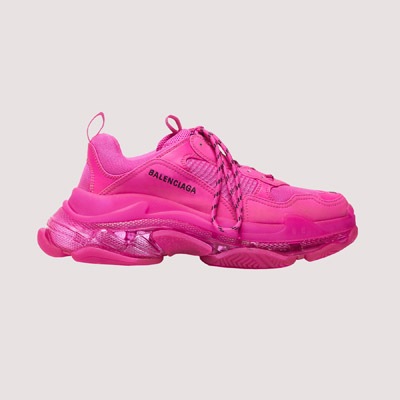
In the third image, the Balenciaga Triple S shoe, like the Van Gogh shoe, it is presented in isolation as a solitary object on a neutral canvas. It is however not a pair and makes no attempt to represent an individual persona. It is an object presented on an invisible plinth, an object of status, of attainment, of achievement. It is a badge, a monument, an award, a flag, an item for attention or treatment in a specific way. It is a symbol of admission and acceptance and represents a collective elite group, a select brotherhood. The Triple S shoe is no longer a utility. It is neither a sports-shoe, a work-shoe or a formal-shoe. It is a hybrid object that has gained its form from many sources. Its triple soles owe more to the fictive worlds of Manga cartoons or Transformers than to the world of the athlete. Its multiple layers of complex moulding, formally organic, have more in common with the aesthetic forms of insects or coleoptera than with the function of walking. The materials are synthetic, intricately three-dimensionally woven, in parts transparent, the colours lurid and acidic. The shoes are designed to lift their owner, to make the individual stand out. Many of the adornments are superfluous forms, stylistic additions, each referencing worlds outside of functionalism or ergonomics but also worlds outside of sportswear, casualwear or leisurewear.
The Triple S shoe is a signature, here we no longer wear shoes we wear signifiers and identity tags. The t-shirt, the original pop art signifier was once mono-denoting, a clear single message, Peace, Love, the name of a band. It is printed as a flat item, a worn political poster and only gains a third dimension from the process of being worn, it is a pure sign. With the Triple S shoe, the signifier has become a complete multi-faceted three-dimensional form. Multi-faceted as its form cites a range of eclectic multiple associative references to a collective of genres: digital, virtual, themed and real. Man creates prosthetics to enhance or enable activities, usually this enhancement is practical, the spear, the shovel, the hammer, but he also uses prosthetics as a means of cultural codified empowerment, make up, perfume, the suit, the military uniform. First and foremost the Tripe S shoe is a culturally codified item before it can be considered as a practical item. It is a form that has been generated from the blending of our many themed and fictive worlds into a three-dimensional worn entity. Its hybrid of sources, club culture, manga comic books, film, fashion and sports, then become an everyday part of our daily lives, a meme absorbed without notice, a further element within the urban environment that we inhabit, a ménage of our imaginary and real worlds.
Summation
In the three images represented the shoes value has changed from one of an essential utility, made of nature, incorporating time in their making and in their use. To a commodity of instant gratification, of mass-produced choice, themed and styled for a particular occasion but ultimately a possession. To the shoe as signifier, of a symbolic association to an often-fictive activity or a group, a mythical synthetic creation.
Images
1. Vincent van Gogh, Shoes, 1886
2. Andy Warhol, Diamond Dust Shoes, 1980
3. Balenciaga, Triple S Shoe, 2018