
021217 – Modigliani – Tate Modern, SE1 London > words
It is difficult to look at any work of art without understanding the context from which it is derived. This context is often a combination of personal, regional and global influences related to the period of their development. The bias to the mix of stimuli is determined by circumstance. Amedeo Modigliani (1884-1920) had a lucky / unlucky childhood but a tragic life. The lucky part was that his parents were both well-educated multi lingual relatively affluent Jewish Italian merchants. He had a highly intelligent and devoted mother who was also his early tutor. His unlucky childhood was that his birth was preceded by the financial ruin of the family business and that he suffered from persistent illness throughout his youth and the rest of his life. At the age of fourteen while sick with Typhoid fever he rambled through his delirium of his desire to see the paintings of the Italian Renaissance Masters and to visit Florence to view the great museums of the Uffizi and Palazzo Pitti. When Amedeo had recovered his mother not only took him to Florence to see the works in the museums she also enrolled him as an art student to Guglielmo Micheli. As a student he was introduced to the styles and themes of 19th Century Italian Art. With this his life as an artist begins, however his studies were cut short by illness, this time tuberculosis a recurring illness that would eventually take his life. Modigliani worked for a short time in Venice, between 1903-6 but he arrives in Paris in 1906 and is immediately surrounded by the contemporary artists of the day.
In Paris, in the early 1900’s, the bohemian avant-garde, the fauvists, the surrealists and the cubists were laying the foundations for Modern Art. Modigliani’s early work was influenced by the work of Toulouse-Lautrec and Cézanne but one can also see the influence of Gauguin and Matisse. When in Paris he would have known and mixed with his contemporaries Picasso, Braque, Severini, Gris, Epstein and Brancusi. Modigliani also embraced the hedonistic bohemian Paris lifestyle of hashish and absinthe, in part to combat, disguise and endure his recurring tuberculosis. Poverty and squalor was sadly very much part of that lifestyle to which he soon became a prince of vagabonds, the educated pauper.
In 1909 Modigliani was introduced to Brancusi. Encouraged by this introduction he briefly, during the years of 1911-12 Modigliani worked only in sculpture. This work is really quite sublime and is a clear turning point for Modigliani. The sculptural work has both the influence of the modern and the primitive. In it we can see both the hand of Brancusi and Modigliani’s own studies of African sculptures. The sculptural works helped Modigliani make the transition from figurative representation to effigy or figurine representation. The sculptural heads are no longer of people but the masks of people. When Modigliani returned to painting, this form of representation and the desire for primitive purity stays with him and the mask as a representative condition dominates.
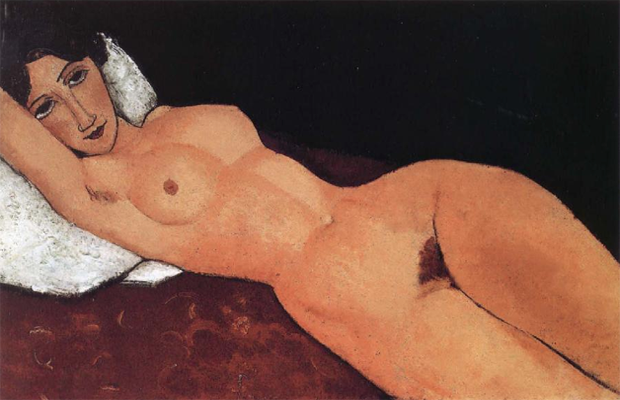
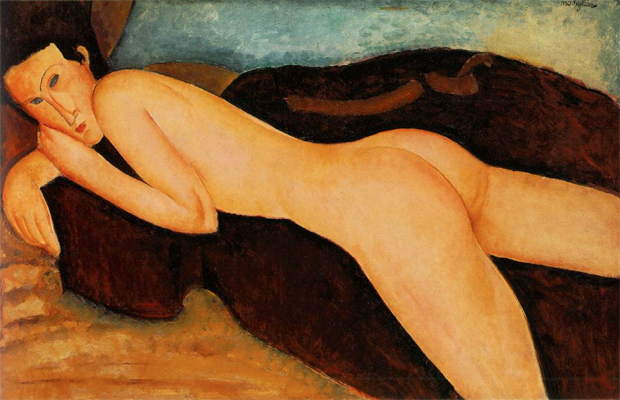
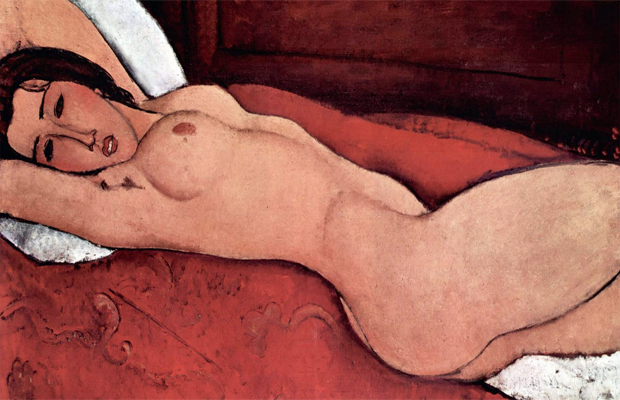
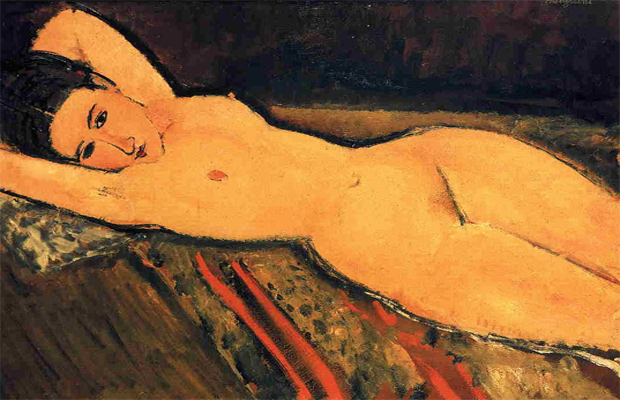
Modigliani’s female nudes both sculpted and painted are sensual pieces, with elongated torsos and voluptuous curves. These female nudes are equally objects of idolatry with the figures reduced to a stylised primitive representation, fertility figurines. They are Earth mothers offering protection, love security and safety, objects of worship and of longing. This depiction of beauty offered a strong directional counterpoint to the classical imagery that precedes it. In the painted works strong use of colour throughout creates a powerful emotive response especially within the backgrounds where it is almost violent. This is juxtaposed by the soft curves of the female figure and the delicacy created through elongation of the face, torso and neck. Eyes without pupils often darkened are as empty as a De Chirico piazza, void or either life or expectation.
There is a melancholy in the work of Modigliani that reflects both the time and his own personal circumstance, a melancholy that sets the canvas as if Gauguin’s Areois has stepped into the frame of De Chirico’s The Red Tower. It is a melancholy that could only be expected from an Italian Socialist Jew brought up in a growing Fascist Italy at a time just prior to the First World War. The melancholy would be further enhanced by personal circumstance both physical and financial. Artists, as artists should be, were reflective upon their times, often critical and reactionary. The art world of the early twentieth century had a passion for African primitivism, the search for the primal, that raw emotion of the intuitive that had been lost to the efficiencies of industry and industrialisation. The artists sought solace through the primal as an emotive reaction to a world fast being consumed through endless mechanisation, the mechanisation of life, of art and of war.
Modigliani’s nudes collectively form the strongest and most coherent block of work. Within the figure the simplification of line and form are lessons learnt from working in stone and the influence of Brancusi. Fauvist influences enrich the backgrounds and the juxtaposition of the idyllic form to the restless background creates the dissociation between existential ‘being’ and the irrational universe. This dissociation of ‘being’ versus universe generates the void in which melancholy permeates. The serene figures float calmly above this environmental noise on a higher plane from the day to day. The figures portray an idealist escape, a gateway to a better world; they offer the solace of an effigy in a world that is about to tear itself apart.
The Surrogate Twin