
150117 – Kinetic Fresco – London > words
The forgotten techniques of Mannerism and Baroque.
Di sotto in sú
Quadratura
Anamorphosis
Trompe-l’oeil
Fresco and Fresco-secco
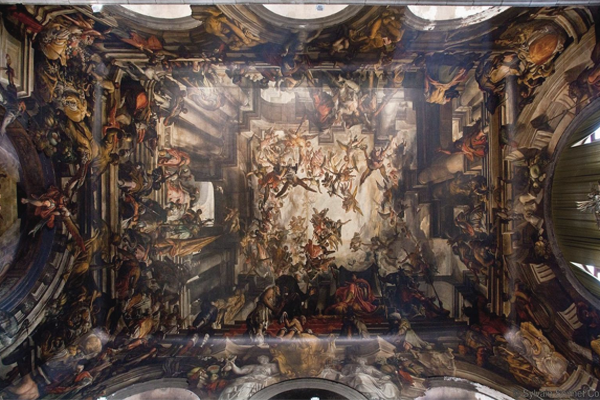
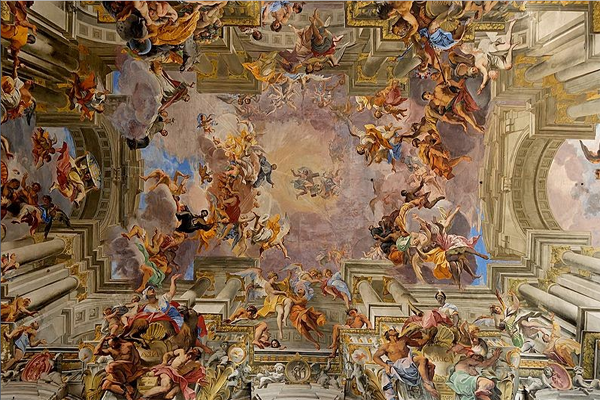
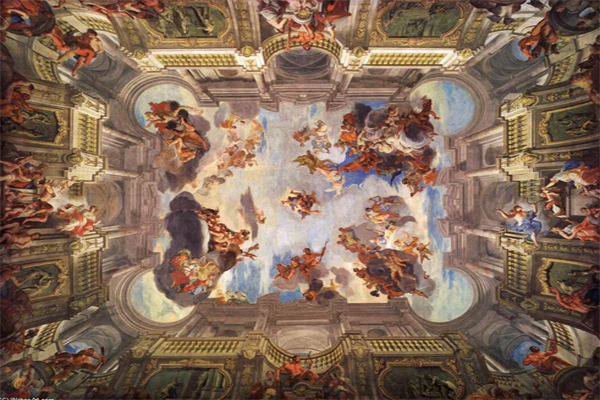
Perspective theories developed in the 17th century to a point where enclosed space could be opened up using illusionistic painting techniques. Walls and ceilings became surfaces that could be expanded into other fictional worlds. The techniques were adopted from the theatre and were often used to open up a space to the outside world typically with garden vistas or soaring skies. These fictional painted spaces contained other worlds that were often mythical or biblical. They were spaces in which to escape or to be reminded of ones humble place on earth, a space to explore but also an over looking space who’s inhabitants watch and judge. ‘As the gods look down’ the physical space is monitored by the fictional space. Story telling, myths and fables complete the interaction between the two spaces and the physical space becomes a transitional space to another world, a gateway. Religious spaces have often been rendered as such.
Trompe-l’oeil – Fresco is painted into plaster that is still wet (fresh) whilst fresco-secco is painted onto dry plaster. The technique for transferring the images to the plaster is dependent upon the type of fresco used. On fresco an outline drawing would be sketched on the under layer in a red pigment that then bled into the fresh top layer prior to pigmentation. In fresco-secco the drawings were transferred from paper sketches or cartoons in the same way as all large paintings were created. Outlines on the cartoon are pricked with a series of fine holes through which soot or chalk powder is rubbed to mark out the areas to paint. Fresco painting is a slow process with large ceilings and walls often taking years to complete. Once complete it is a static image, a static illusion.
The technique of Quadratura created single point spatial perspectives. This false architecture of perspective when painted onto a flat or shallow vaulted ceiling would continue the real architectural space. The perspective had one focal point and used foreshortening of figures, architectures and landscapes to create the illusion of a deeper space often opening to an infinite sky. Fresco painting is the technique ideally suited to the Grand Manner of the Baroque. The ambition of scale and subject complement the vast canvas of the walls and ceilings of the palaces of the nobility. Whole spaces were transformed as each enclosing surface was expanded with an illusionistic space. A dialogue would begin between each expanded space that conversed across the room and in so doing dragged the real world into the fictional and vice versa.
Baroque Quadratura was only convincing when standing at one point. Augmented and animated ceilings could shift this perspective as the viewer walked around the room. The shopping mall is already an augmented space, a real space overlaid with wireless fed information about products, information or events, a rich and dynamic multi-media experience. It will be interesting to see whether these augmented spaces develop into a new medium of spatial experience or whether they will remain merely as information overlay options to be turned on or off as desired. As virtual reality (VR) becomes mainstream, at first adopted for home and public entertainment, the overspill of this spatial type onto the city will create another layer to be explored by artists, architects and designers. Layering the fictional onto a real space, exploring time, place, sound and activity dislocation, the consequences of such experimentation are yet to be known. What is certain is that the augmented real space will be a hyper-real alternative to the space we experience today. The layering of the augmented onto the real will be read as one single spatial experience in the same way as the fictional ceiling frescos and real time volumes read as one space. What is new is that the augmented space will be dynamic and interactive and that we experience it in two ways, one as a space and two via a device. If there is a further layer of augmentation via a device, a cell phone, pad or wearable, a hybrid interpretation of space materialises. The space has a public domain and numerous subjective, simultaneous personal domains. The urban spaces of Tokyo, Hong Kong and Seoul, where walls of electronic media enclose public spaces, are a precursor of this spatial type. The information the media walls support is pragmatic and informative as opposed to purely cultural or experimental.
The 1990’s offered VR parallel worlds and the internet created cyberspace. Whilst VR is still waiting for technology to catch up and commercialise, cyber space has been domesticated, taken over by the big brands and normalised and is now little more than an ‘electronic suburb’ (Norman Klein). However within cyberspace new obsessions have emerged that create a constant and continuous dialogue between the data of cyberspace and occupied real space. Selfies, the use of GoPro or dog cams are all forms of video surveillance that turn real space into cyberspace. Cyberspace when recalled upon a device informs real space. Every real time object with embedded information becomes a cornerstone to cyberspace, simultaneously a three dimensional reality and a two dimensional on screen character. Once in cyberspace it can be edited, altered, layered with text of further information such as music or sound. It becomes something else, neither a copy nor an original, neither fact nor fiction. Space has never been experienced with this type of dynamic duality before.
When every object in a physical space has been embedded with some level of technological tangible interface the centralised computer becomes obsolete and a reader is all that is required. All of the surrounding physical space becomes part of the human computer interface. When tracking a users interface to provide localised information the users data is collected. Augmented space is both an experiential and monitored space (‘as the gods look down’ text from above). Augmented space is a 4D physical space (when 4D is 3D plus time) with an additional fifth dimension of information, a 5D space. Augmented space is never permanent and exists within a feedback loop. As information is collected and uploaded from interactions with the physical space the augmented space is modified to accommodate new incoming information that is in turn fed back to the physical space. Augmented space is therefore a space of collective learning and experiencing. At present the user needs an interface device to access and then interpret the augmented space. When the interface device is no longer electronic but biological it is feasible that collective learning or collective experiences could add a further perceptual dimension. The collective experience would have multiple experiential responses; these may be polar or assimilated into a generic.
With the augmented electronic space, the dynamic or kinetic fresco, choreography is added to the skills required of the electronic fresco painter. Unlike previous frescos, in the kinetic fresco every constant has been replaced by a variable and every variable is a fiction. In this world the image has a greater inherent value than the original, as the image is hyper-real, super-intense, edited and associative. The image is the myth that the object aspires to and possession of the object is the means of acquiring that myth. Through this image and its associative context the original object is loaded with additional values and aspirations and as such the real becomes more fictional. When the object is a space we inhabit and that space is further continuously augmented, updated and refined. The two spatial types, real and fictional are blended, their differences become indistinguishable, and we inhabit this new spatial type with blind religious fever.
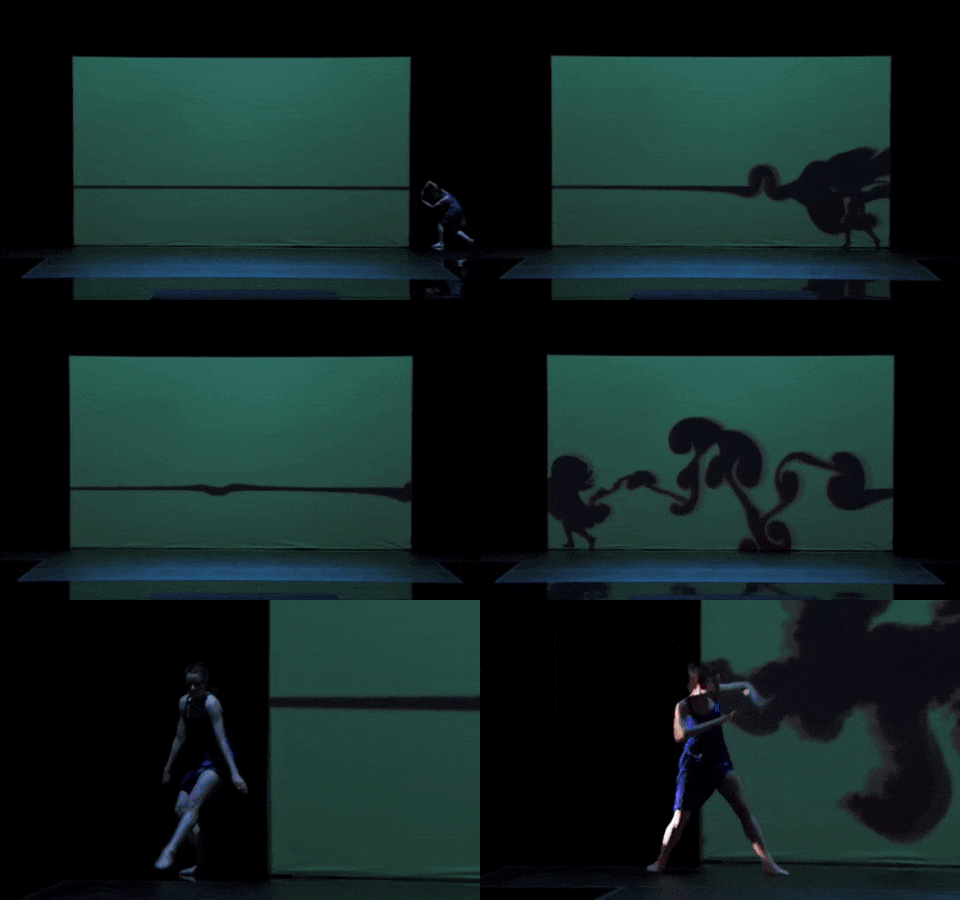
The Blue Journey dance performance (gif image four) is a work that consists of two elements that happen at different times and are then re-sequenced in the present. The backdrop is a pre-recorded animation that draws upon a limited pallet of black on blue (the work of choreographer David Middendorp). It is two-dimensional and flat, an animated picture plane presented as a vertical surface, as a border enclosing a real space, a boundary. The events on this flat animated space are fantastical, they defy gravity, have no fixed scale, they are able to morph in form, disappear and reappear, they can float, fly and become ephemeral. This fiction is a dream space edited and rehearsed, it tells a story, it is an animated locale, a fresco, a Trompe l Oeil. The fictional space is a space from the past, a historical space that has already happened elsewhere, perhaps only happened in the digital space of the computer screen. A transplanted fiction from another time and place. A space that never existed is presented as a spatial extension of the real.
The Blue Journey performance happens in real time in a physical space, the stage in front of the animated space and consists of a dance, a dialogue between two characters, over viewed by a third party, the animation. To cement the relationship between the performers and the backdrop, two events happening at separate times, the backdrop first takes the role of shadow to the performer. This is introduced simply, as the male dancer walks across the stage followed by his shadow. This simple act of walking with ones shadow apparently falling onto a wall sets the premise for the full extent of the credibility of the following journey. By locking these two dislocated movement pieces into one time frame, the fantastical and the real merge and a mythological landscape materialises. The boundary that contained the real world has been breached and space is extended into an animated augmented world. The transition is seamless; the audience are given no instruction other than this simple introduction that the shadow follows the walking male. This is all that was needed to link an imaginary world to the real world, to link two distinct time zones. When the female dancer begins to move she is beautiful, graceful and poetic, her shadow follows and the audience is dragged further into the illusion of synchronised time. Then the shadow stops, it no longer follows the dancer, but the idea of synchronised time is not lost as the audience is convinced that the shadow is that of another dancer working back stage. Not losing the illusion of synchronised time is essential to maintaining the extension of the real space into the fictional.
The fact that this space is animated and choreographed gives it a power that traditional fresco was unable to achieve. The extended space becomes a walk into an occupied fictional space as opposed to the previously Mannerist viewed only space. It is important to note that this spatial extension has been achieved simply by silhouette, in a flattened two-tone, two-dimensional space. This is a space that never imitates the real and has none of the full richness of a Baroque Quadratura. In the Baroque, sculpture was often used as the transition from the real to the fantastical, a peripheral border linking the two worlds, sculpture as foreground, imaginary space as background. Sculpture was a static transition; its dynamic comes from gesture and association. Further movement of the viewer and the changing fall of shadow and light would animate the Baroque sculptural transition.
As the Blue Journey performance continues, the space of the fantastical begins to take over and separate from the real. The audience are drawn into the fictional animated space, as this (background) has greater dynamic than the real time performance (foreground). This shift in dynamic from real to fictional is essential for taking the eye from the real to the fantastical and this will be a key component of future augmented space. The Blue Journey animated space continues to increase the credible limits of fantasy as figures dissolve in mist, float without gravity, multiply instantaneously and eventually the silhouette dancers fall as if rain from the sky. The bonds between the real and imaginary are choreographed through sequencing, gesture and touch, keeping the two spaces locked in one time zone simultaneously happening in the present. This interaction is best exemplified when the dancer leaves the real world to join the animated world only to reappear back in the real. This seamless link of the real and fictional connects the two separate time and location zones in which each space was made into the one space of the present.
Future augmented space will explore the possibilities outlined above and as a consequence the delineation between what is real and imaginary will continue to evaporate. At the same time in a crowded world of physically finite space extended virtual space is infinite.
Images left to right. 1 Chiesa di San Pantaleone Venice – Gian Antonio Fumiani 1645-1710. 2 Chiesa di Sant’Ignazio, Rome – Andrea Pozzo 1642-1709, 3 Palace of Liechtenstein – Andrea Pozzo 1642-1709. 4 Blue Journey Dance.
The Surrogate Twin