
090119 – Teatro Del Mondo – London > words
“The Modern Movement originated as a great pluralistic program attempting to rectify the spirit of the time, the Zeitgeist, catching in its initial stages in the different cultural realities of the European and American horizons. After thirty years of free experimentation, (Art Nouveau, Protorationalism, Expressionism, the modern classicism of Behrens, the creative eclecticism of Sullivan and Wright) the Modern Movement beginning in the twenties, tended to translate into a set of constraining rules, into a real orthodoxy, three fundamental dogmas: the functionalist analysis – as a starting point for architectural research; the annihilation of the traditional grammar of architecture – with all its differences corresponding to places and civilisations; the identification between architectural progress and the use of new technologies – understood as potential generators of language.
The above quote from Paolo Portoghesi’s “The Fear of Heresy”, best surmises the convergence of the Modern Movement from the many reactions to the consequences of the Industrial Revolution. The three fundamental dogmas outlined above in turn become the basis for Post Modern reactions at the beginning of the Electronic Revolution. These reactions have in themselves been pluralistic, evoking eclectic exercises in classicism, semiotics, structuralism, de-constructivism, formalism and sensorialism, manifesting in a resurgence of the figurative, the fable and the myth. The Post Modern as a generic all encapsulating term used across many disciplines from literature through art, fashion, music, film, dance, design and architecture has been a period of reappraisal. The poetic, the narrative, the tactile, the referential and the metaphysical have all been explored to escape the formulaic and the authoritarian. Many of these reactions have been explored by individuals practicing in artisan studios or have been tested in the Universities around the world. Much of the work is collagist with the Electronic Revolution aiding easy access to other disciplines and cross-pollination of influences where working methods have proved a very progressive experimental environment for all disciplines. Out of this petri dish come exercises in the unimaginable, breaking the shackles of science and production to venture into the minds where fictive possibilities blend seamlessly into the real.
Memory
It is impossible to be Italian without also being nostalgic. The memories of past great civilizations whisper along the streets and cobbles of every major Italian city. Typological icons invented by The Roman Empire, The Powers of the Papacy and The Renaissance adorn many Italian city center’s and are echoed across the world as copies of copies reiterated throughout time. From this the Italian architect sees the city as a great vessel, a carrier of history and memory. Nostalgia is metaphysical, a pathway to romantic interpretations of happier and simpler times, times of clarity and order, of truth and virtue, where the sublime and the theatrical are emphasized over the pragmatic or syntactic. The great typological icons, the temple, the coliseum, the galleria, the arcade, all back drop the piazza with its on-going theatre of life. Memory, the psychic vapor that oozes from every faded fresco, eroded stucco and crumbling frieze fills the streets with an invisible but perceived memory mist. The picturesque is the Italian city, it physically exists, it is no longer the painting, it is a physical living, working, reality. The Italian courtyard, the balcony house, washing lines hanging over narrow streets, the loggia curtain flapping in the wind, the silent figurines, all bear witness. The statues, histories spectators, have watched and recorded all that has walked before them, hundreds of years of monumental events, Iconic moments that shaped the narrative that in turn became the country and its people. The echo never stops, every street whispers to the next – I was this, I did this, I am this – a relentless schizophrenic, multi faceted ghost upon a ghost.
The Italian city can be seen as a receptacle, an accumulation of collective and individual memory. The city derived from the analysis of political, social and economic systems drawn upon by the ruling class at each relevant time, a perpetual re-concluding product. But the city can also be seen as a spatial construct, with individual responses that are an additive to an on going ‘histoire’. In each interpretation the narrative dominates, leaving its traces, its reveres, layer upon layer. The onward fight against the inevitable conclusion that all invariably returns to dust. The crumbling, the exfoliation, peeled and scrubbed, returned to its former glory only to slowly return back into the ground to be carried as dust in the wind. The empty piazza, this negative volume is a forum for reflection, a time traveller’s portal to previous worlds. This void, walled perhaps with a Fifteenth Century Town Hall, a Sixteenth Century Church, a Nineteenth Century Galleria, all punctuated with statues from every century and from many lands. At the piazza’s center a fountain what better way to represent ongoing life, here water cascades timeless and continuous through every century over dropped lover’s coins carrying their wishes and dreams of better things to come. This is the living tapestry of the Italian city.
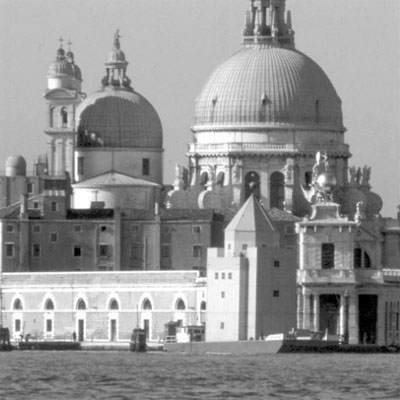
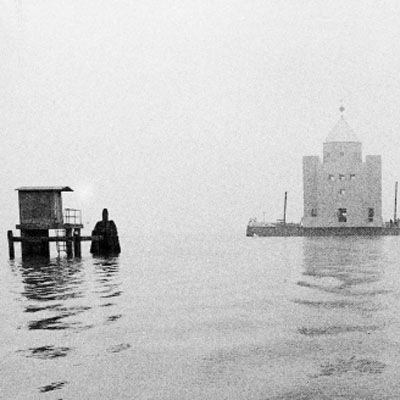
As Venice sinks slowly back into the sea where better to explore memory and nostalgia by emphasizing the ephemeral, that even the monumental is ephemeral. The Theatre, an iconic symbol of every city, a typological giant among a cities many monuments, the Theatre that confirms a cities success, its solidity, security and culture. Rossi takes the typologically monumental and to set it adrift on a barge to visit the sinking city. The theatre here is a player that plays its part with its exits, entrances and scenes. During its short life the “Last scene of all, that ends this strange eventful history, is second childishness and mere oblivion, sans teeth, sans eyes, sans taste, sans everything.” The passing of an event captured by photography in the same way that every empty coliseum and outdoor amphitheater echo with the silent sounds of gladiatorial battles, chariot races and the great crescendo of historic oratory.
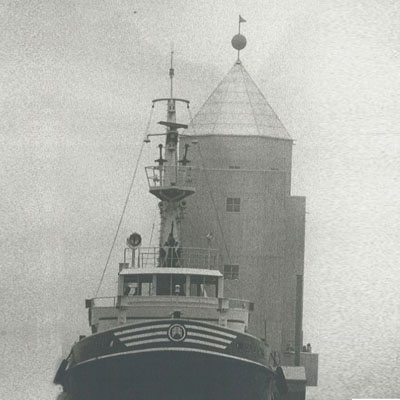
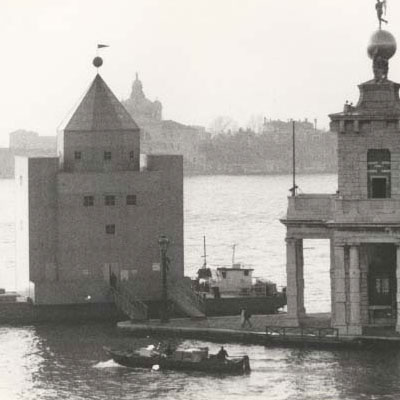
Aldo Rossi’s Teatro del Mondo of 1979, no small title for a small timber clad temporary building, offers the power of typological referencing, a form, the signifier, pregnant with the genetic heritage of its typological brothers and sisters, a reinforced collective, an authority. The Teatro here instead of solid and eternal is delicately floating and vulnerable, its height too tall to have stability, a wooden sail on a barge, timber the colour of sandstone. This is an exercise in how to take the monumental and to make it a shell of timber and paint, the inflammable, floating unstable over a murky sea, an ephemeral reminder of the transience and fragility of everything, including Venice.
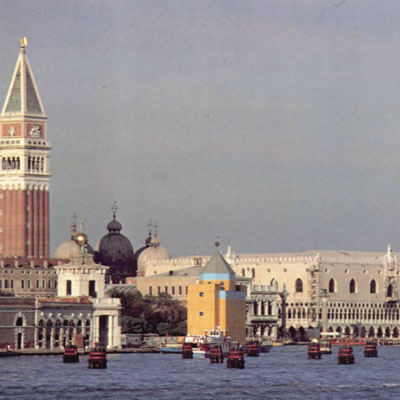
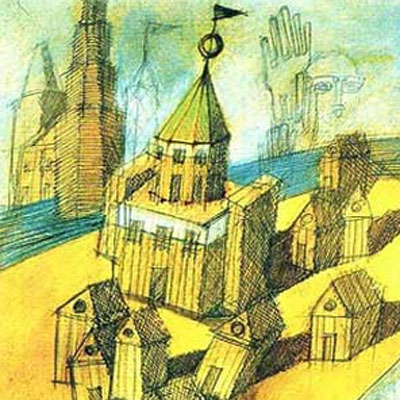
Rossi wanted to recall the tradition of the sixteenth century theatrical floats from the period when Venice was the playground of Europe. The dialogue for Rossi’s Teatro would not be prioritized for actor and audience but instead with the City of Venice itself. From the outset the Teatro was to be a tower, a voluminous space and not simply a floating stage. It would speak with the city, the domes and the cupolas, the piazzas and the arcades, an architectural conversation of form and typology, of history and fragility. A tower hunched between two shoulders that would conceal two staircases, the central volume terminated with an octagon and an octagonal roof, as often in Rossi’s work tinted blue that brings the sky into the form. Just below the roof a blue band representing the classical cornice, the beginnings of a grand architecture skinned in paint and wood over a structure of scaffold tubes. Rossi’s architecture is associative, its forms are read via intellect to references of the past. It is not sensorial and it is not to be experienced sequentially as a modernist building may be. It is in itself, meditative, reflective and nostalgic. There is a need in Rossi’s work for human absence, as there is in the work of De Chirico. Human absence leaves us, the viewer, alone with the work, solitude, isolation and silence and only within these conditions can we drift through time back to spaces as yet unoccupied by the seething masses, by the here and now.
To Rossi architectural design was an extension of theoretical analysis. The architecture moves between the real city and the imaginary city, the Teatro Del Mondo sits somewhere in between, it is a gateway, a metaphorical link. With its towers and cupola it references the traditional city in which everything is solid and stationary but in the Teatro de Mondo solidity floats from location to location, event to event, a stage set that creates the stage set. The Teatro draws upon Elizabethan theatres, lighthouse structures and the architecture of Venice. A floating fragment of the city, a place where architecture ends and the world of imagination begins. It creates an architecture through action, the insertion, the intervention, forces reinterpretations of the historical fabric, an interloper that temporarily alters the landscape of a city. It invades on-going centuries old discussions and intrudes upon the comfortable fellowship of existing volumetric connections. It interrupts Venice and its scenic space, politely gate-crashing the old boys club by wearing an old school tie.
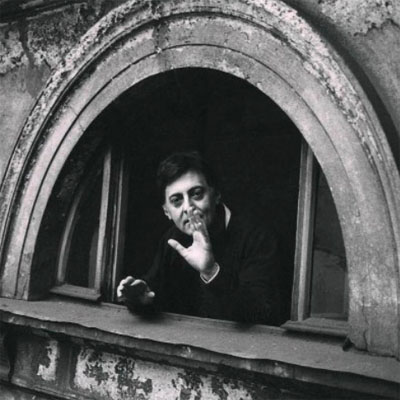
Aldo Rossi (1931-1997)
The Surrogate Twin