
230119 – The iconic 1967 Pontiac ‘Goat’ > words
The 1960’s were a time when the two super powers, the USA and the USSR, went globally head to head, with the Cold War battle grounds of the Middle East, Cuba, China and Vietnam. The Cold War had already begun post World Wars and as early as 1951-53 Iran became the pawn in a battle of power. Iran sat on huge reserves of oil and was unable to realise these without outside help. It was also strategically located in the heart of the Middle East, a gateway to Asia. Following the lessons learnt from the two World Wars, oil was the new black gold and no country could do without it. Britain, America and the Soviet Union all at first tried for control of this region, once known as Persia, but this soon became a two horse race as the Soviet and the US each saw Iran as a crucial stepping-stone on the road to world domination. The Soviets were wanting to expand south and move into the Middle East spreading the Communist word and the US wanted to contain Soviet power. A head to head developed, fought over a small and poor country, in the land of that country.
The Middle East had become the new frontier, a bulwark to stop Soviet expansion. This was both a battle of ideologies, Communist versus Democratic Capitalism, as well as a control of economic and energy infrastructure. The Baghdad Pact of 1955 was indirectly a means of US control over an area of strategic and economic importance. On a global stage the US had stepped in to adjudicate where historically the British Empire had once set the law. Military bases, spy stations and communications networks, both Soviet and American, sprung up across the Middle East and North Asia. The Cold War between the new two world Super Powers was well underway. But Superpower conflict was not only centred on the Middle East and Oil, global strategic positions also came to a head, with further Soviet and US conflicts erupting in Korea, Vietnam and Cuba. Every Super Power conflict quickly became a propaganda exercise of opposed world ideologies. When the Cold War reached a stale mate The Space Race became the arena for one-upmanship. By the early 1960’s, the two Super Power’s were each taking pot shots at the moon just to prove that they could hit it, sending their latest missiles at the ball in the sky to keep score of their so-called impact landings. Several of the rockets missed their lunar target and flew forever onwards into space; they are probably still travelling.
In 1900 the US was still a wild frontier and the British Empire still had considerable standing on the world stage but by the 1950’s, Europe, the Old World leaders, had been crippled by The Wars and the ensuing dept. The UK went from governing the world’s largest empire to begging the IMF for a loan in one generation, a mere fifty years. Britain had lost its global political seat and the US would now take its place as a new world superpower with its role in international politics. Oil was the new gold and control of energy was the basis of infrastructure for any new world power. As the US flexes it’s political muscles, it’s car industry introduces the muscle car. Sheer brute force, the fastest in a straight line across the shortest route, expedient, efficient, conclusive, a total political beast. Here the industrial lion that once represented The British Empire is devoured in one great petrol guzzling bite. In the US there is a new confidence, a new wealth and a growing middle class. For this market the US motor industry builds the Pontiac GTO, the first muscle car, a symbol of the US’s new place in the world, representative of it’s control and abuse over oil, a symbol of it’s newfound wealth. Size is everything, big houses, big fridges and big cars, a world of excess, what better way to express the dominance of the new world over the old.
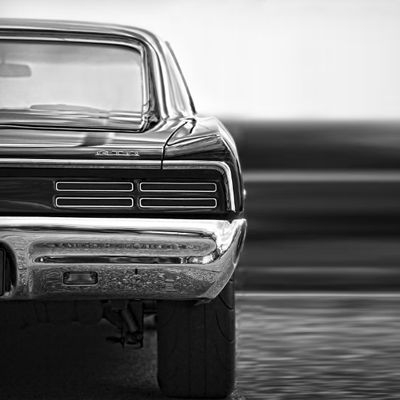
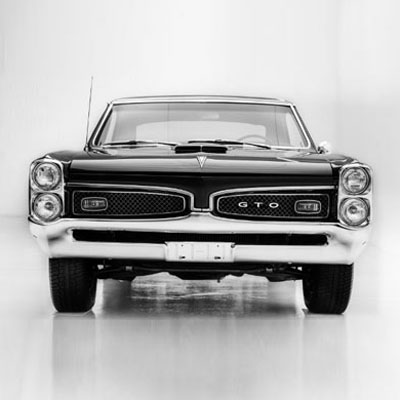
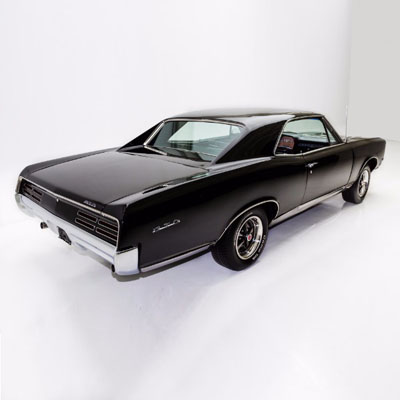
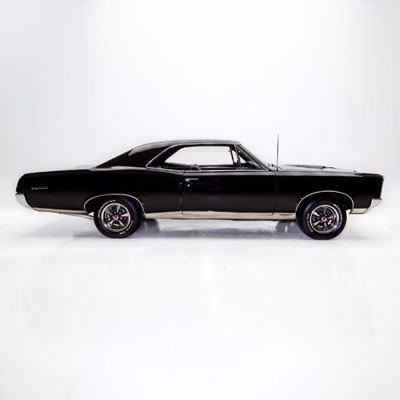
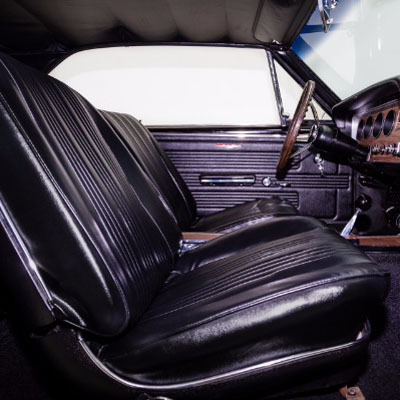
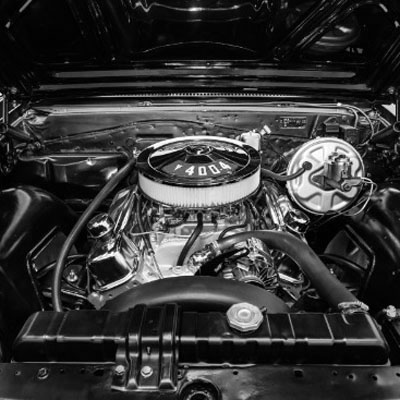
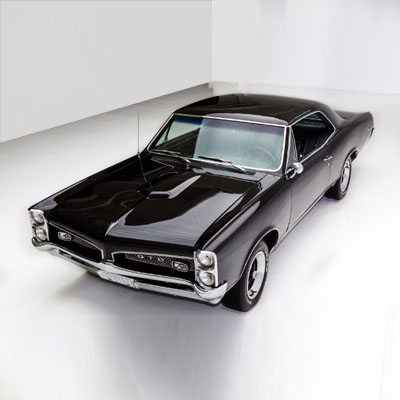
The 1967 Pontiac GTO has always been a favourite car. Not just because it’s a beautiful flat slab of 60’s American culture, but also as an icon of an era, symbolic of a rapidly changing world, the expression of the countries growing confidence. It’s a sports car that wants to be a saloon, that wants to grow up, at the same time it’s a saloon that wants to be a sports car. The Pontiac Motor Division made the first generation Pontiac GTO’s from 1964 to 1967. Personal preference may dictate the best first generation car but it is hard to beat the 1967 360 bhp 400 cubic inch V8. The car was optioned with a 3 speed Turbo Hydramatic TH-400 automatic transmission equipped with a Hurst performance dual gate shifter, called the ‘his and her’ shifter allowing either automatic or manual selection through the gears. Although it could be argued that the ’66 car was slightly better looking due to the front grill and rear lights, the ’67 was the car to have. There were three models, the Sport Coupe, the Hardtop and the Convertible. The Hardtop car without ‘b pillars’ was preferred. Rally 2 wheels allowed for the fitting of the recently introduced all round disc brakes and the ’67 cars had a whole load of other safety equipment fitted as standard, padded dash, energy absorbing steering wheel, shoulder seat belts and dual reservoir brakes as examples.
During 1963 a ban on auto racing advertising had shifted Pontiac Motors marketing focus onto the youth orientated street performance market. The name GTO was used in reference only to the 1960’s ‘Gran Tourismo Omologato’ cars that were officially certified for racing, but the Pontiac GTO was never built to race and it soon picked up the nickname as the ‘Goat’. The car was straight line fast with a 0-60 time of around 6 seconds and a standing quarter time just under 15 seconds with the car passing through the gates at 98mph.
Bigger and Better was not only to be seen throughout the propaganda of The Cold Wars between the US and the USSR it was also to be seen on the US highway between the rival US motor companies. Other US Muscle Car icons of this time should include:
1970 Dodge Charger RT 440 Magnum Six Pack.
1970 Dodge Challenger RT 440 Magnum Six Pack.
1970 Plymouth Barracuda 440 Six Pack
1968 Ford Mustang 428 ci, GT500 Shelby Cobra, Twin four Choke Holleys.
Muscle cars dominated youth culture from the mid 1960’s through to the early 1970’s. With the event of the 1973 oil crisis came speed restrictions and pollution controls, the reign of the US Muscle Car was over.
There were 65,176 1967 hardtop cars made so they are not rare but as an iconic reference of American motor memorabilia its hard to beat a 1967 Pontiac Goat Triple Black, 400 ci, Four Pack, Hurst Shifter, Mean.
The Surrogate Twin