
030219 – Christian Dior – V&A London > words
As one enters the Dior show at the V&A it is tempting to immediately begin comparisons between this and that of the V&A Alexander McQueen exhibition of 2015 but it is important first to establish the many differences between the two shows and the design houses that they represent. Alexander McQueen was very much a lone star that shone very brightly and briefly for two decades who had direct control over a tight and talented team that had grown their reputation from their student days into the beginnings of what was to become the fashion empire that we know today. McQueen’s fashion sits neatly within the Postmodern. Postmodern fashion as Postmodern Art was re-exploring the decorative, it was historically referential, thematic and heavily influenced by TV culture and the reproduced image. The Postmodern developed in a world saturated by visual media, where juxtaposition is an everyday event incurred simply by changing channels or turning a page. Art becomes culturally collagist, a mix of narratives, fictive or otherwise, directed into a persuasive thesis. The results are strong, dynamic, hyper-real and full of instant impact. The work of Alexander McQueen capitalised on all that is Postmodern and the work was slickly package and choreographed with Hollywood panache.
In contrast, the work from the Dior studio spans from the 1940’s through to the present day, almost eight decades. The exhibition includes the work of Dior and the subsequent six Creative Directors. The Dior atelier has its roots in the world of Beaux Arts, (La Belle Époque) Parisian Couture, it’s team is an army of highly skilled artisans accomplished in the esoteric crafts of appliqués, tulle, perlage, bolducs, moulage, plissés and many more exotic verbs. The work is subtle and sophisticated. Its impact is not always immediate but instead grows slowly as the piece reveals layer upon layer of work that has gone into crafting the final form. The McQueen and Dior shows both have a similar feel, the plan and procession, with compartmenting of collections into themed chapters to help explain an overview. Both shows had a very good pace with wonderful transitions between each spatial chapter but the Dior show is a slower walk.
There has been a move of late away from showing only final pieces, the famous profiles and the celebrity centred ensembles. The Dior show of course includes these but there is also an importance given to the making process, the development from initial sketch through to toile, the elaborate exercises in detail and applique through to the eventual marketing of the final piece. The white room with walls lined with samples, test pieces, calico toiles, exploring possible future conclusions is a delight. One can imagine how a sketch is translated through a toile via wrapping and working with the fabric on the mannequin, with heavy stitching and pinning holding each fold or pleat in place. Certain pieces still had chalk and pen lines marking areas for further alterations. This is work in progress and wonderfully raw, one can carefully observe the hand stitched structure that is the foundation of haute couture.
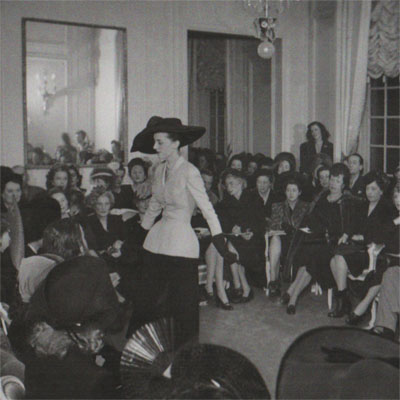
Dior’s ‘New Look’ caused much outrage upon its release, this was at first due to the amount of fabric used to create his full to the floor dresses (in many countries fabrics were still rationed post war). However the styles, with their full bust, pinched waist and voluminous hips were equally criticised as being too feminine, with concerns that women would be re-shackled as pre-war decorative and immobile ornaments. The Wars out of necessity had created a great independence and liberation for women and it is understandable that they were not keen to be ‘kept’ once more. The Wars had been brutal, leaving little of beauty or even the memory of beauty to remain; a counterpoint reaction was long overdue and well needed. The resultant Dior silhouette was to define fashion throughout the 50’s and in the process it would help establish France and Paris in particular as the fashion avant-garde. The French fashion industry grew and quickly diversified into accessories, perfumes and cosmetics helping to pull the nation out of the economic abyss left by the Wars.
The continuity of the Dior House is emphasised as an on going directive. The works under Dior’s six Creative Directors, Yves Saint Laurent 1957-60, Marc Bohan 1960-89, Gianfranco Ferré 1989-97, John Galliano 1997-2011, Raf Simons 2012-15 and Maria Grazia Chiuri 2016 – present, stand alongside those of Dior. The continued inspiration from such a vast archive of works, with many contemporary re-iterations or past pieces, ensures an echo of the Dior brand through the decades. This has been to the benefit of the house and to the organisation of the show.
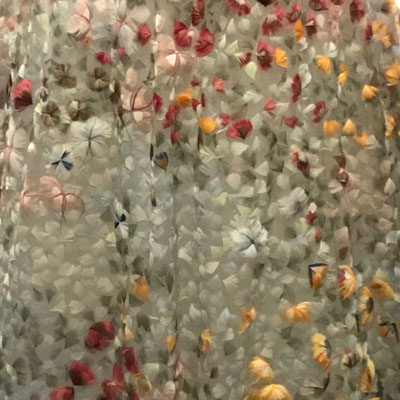
When one is presented with the concept sketch alongside the finished piece it is immediately apparent that there is a long journey of interpretation between the two. The sketches of any of the consecutive Creative Directors from Dior (1947) to Maria Grazia Chiuri (2019) are all very loose. The sketches capture the essence, feel or volume of a piece but little more. On examination, pockets, collars, folds, cuffs are all developed post sketch in the anonymous Ateliers of the Dior Couture house. This development from sketch to toile is not only where the bulk of the work of any garment is but also the most skilled work. Pattern cutter’s that turn an outline two-dimensional sketch into a three dimensional object are highly skilled and highly creative themselves, re-interpreting lines to actual forms that hold three-dimensional space. The people that do this work stay sadly, as unknowns in the shadows, and there are many further teams of these people each with their own speciality skill. In the workrooms the “Petites Mains” or seamstresses turn ideas into exquisite haute couture garments. The tradition of haute couture demands that the garments are almost entirely made by hand. Many complex pieces take hundreds of hours to complete. Within the “Arts et Métiers” of Paris there are artisans that work only on embroidery, pleating or bead work.
One also needs to contextualise the early work of Dior against contemporary culture of the time. Dior is presenting his collections at the same time as William de Kooning and Jackson Pollack are exploring abstract expressionism. Le Corbusier is designing Chandigarh and Ronchamp and Miles Davis and John Coltrane are beginning their experiments in improvised jazz. Dior’s “New Look” wasn’t really so new. Following the War, where women dressed more like men, the newness was really a return to an earlier time where women dressed as ‘women’. Dior said “ I design clothes for flower-like women”. The “New Look” revived Edwardian techniques and silhouettes but ultimately the craft of making was revived.
The early Dior collections were named after a cut with the focus on making, the A Line, the Y Line, the Natural Line, the Oblique Line’. St Laurent continues with this emphasis on the craft of making with his tailoring of the silhouette. Marc Bohan’s early collections follow suit but by the mid 60’s collections titles are cultural, the Mysterious Orient, Mexican Mood, African Style, but none of these collections really diverge from the main stream 60’s fashion, they are safe and conservative within the styles of the times. This continues through the 70’s and 80’s with works being refined mainstream. There are some more eclectic pieces like the 84 collection inspired by Klimt and Pollock, but these still fall within the large shouldered power dressing of the times. The Ferré collections of the early 90’s explore volume and asymmetrics, bold prints and juxtapositions, each collection is named but the name is not the driving inspirational force. It is corporate power dressing but there is a clear niche market being targeted. By the 90’s there are clearly collections with historic referencing such as the 93 Images In The Mirror Collection. The final collections of Ferré are mature, sophisticated and safe, all working well within the confines of Dior.
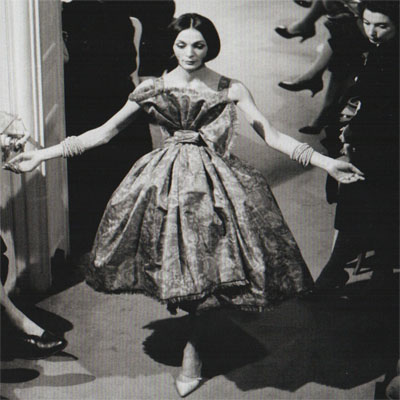
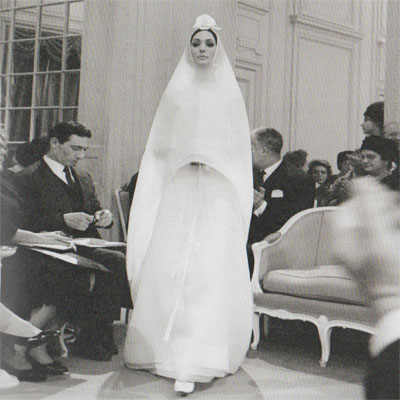
What is interesting when looking sequentially through all of the Dior collections under the six Creative Directors is as we move through the photographs chronologically from show to show, from Dior through St Laurent to Marc Bohan one notices how the background changes. The audience keeps getting younger and by the time we reach the mid 60’s there is truly a youth explosion. Markets have changed, youth is gaining independence and earning it’s own capital earlier and the fashion markets follow this lead. Job opportunities begin to favour those that are able over those that are connected. Old systems once ruled by inherited wealth and the established hierarchies are at last breaking down. We can also witness how markets then realised that there is a premium within a brand and that this should be protected and developed. The Dior House was still fairly conservative, Dior became a corporate force when Bernard Arnault took control and brought in Ferré. Arnault built his fortune in real estate, by buying companies he was able to position himself into the high margin world of fashion. The fashion world is now run as a multinational conglomerate, this in turn brings capital into the industry, R&D budgets increase along with the quality and quantity of output. The 1980’s begins this cultural shift of commodification and globalisation. The 80’s experienced the ‘Big Bang’ here we truly begin to become global, everything becomes corporate, processed and mass market. Processed fashion, art, music – culture commoditised. The Dior 80’s collections are international, culturally neutral although still with a western world bias due to world capital allocations.
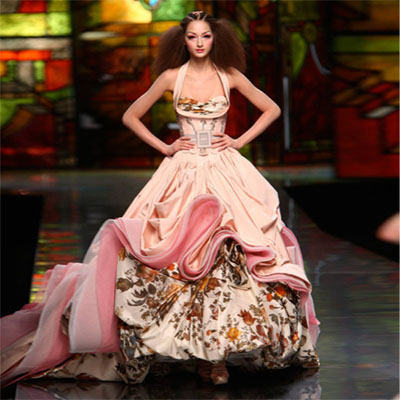
In the late 1990’s there is a massive cultural change under the directorship of Galliano. The work is revolutionary, inspirational, brave, it pushes the Dior House to expand its horizons. With Galliano Dior becomes an inventive fashion world leader. Galliano’s approach differs greatly from that of Dior, each live within their own times. By the 90’s his world has become thematic, a TV culture reference source. How does one reinforce the power of the Dior brand and avoid repetition. Galliano does this through the thematic. For his couture collections he would often (nearly always) take a team on a three-week cultural field trip, Mongolia, China, Peru, Russia, where they would immerse themselves in the culture visiting museums, theatres ballets and collecting material samples, beading, fans, photographs and cut-outs. This would then form the basis of the couture collection for each year. All of the Ready to Wear collections were then derivative of the annual couture collections. They took the essence and made it more wearable and commercially viable, the couture collections always working as the flagship for the brand. There is both design efficiency and marketing logic in this. This cultural scavenging, as one only ever gets the postcard version of a culture in a three-week trip, is totally of our media saturated times. From a trip to East Asia, Chinese, Japanese and Mongolian can all be freely intermixed they are merely reference material for the thematic. In this mix one creates the hyper-real Asian stereotype, the hi-tech, kung-fu calligraphic geisha. The stereotype we are used to seeing on TV, the representation of Asian culture that we now all understand, a copy, of a copy, of a copy. This is now a stereotype so powerful that even the Asian’s copy it. As the English now copy their Englishness, the French their Frenchness etc. It’s how we understand our world and fashion exploits what is current, making material the ephemeral. It could be suggested that it is fashions role to translate the ephemeral into the material, expressing the aspirations of the time and ignoring fashions of the recent past.
Our first visit to the Dior show was a push through the crowds, it is always difficult to fully appreciate a show when the exhibition spaces are crammed full of people. Luckily memberships and experience has allowed us the chance to visit these shows in blissful solitude. We managed to visit both the McQueen show and the Dior show when the galleries were completely empty, this has been such a luxury. But the answers I was looking for from our second visit to the Dior show failed to materialise. I was hoping to get a greater understanding of the making process. At the V&A 2017 Balenciaga show there were x-rays of the garments that exposed many of the hidden structures that helped hold a soft two-dimensional material into a complex three-dimensional form. The x-rays also revealed the many layers that build up the composite structures of layered fabrics. Stiffening webbing and felts, laid at cross grain with darts and cuts, sometimes with additional stiffeners, bone or wire, all of which make up the structure of these fashion composites. The techniques used offer transferable skills to many other fields of design. At the Dior show this level of understanding was still inaccessible. Perhaps the frustration came partly from my own lack of craft skill, I am not a tailor so I cannot pretend to think or understand like one but I understand materials and was still unable to gain full access to process.
In many ways fashion design is so different to many other design disciplines where the drawing is absolute and finite before the making process begins. In fashion a designer’s initial sketch can reveal so little, often only the essence of a piece. After there is a long creative process of further development left unrevealed, the process of wrapping, draping and falling; working hands-on with the mannequin, cutting, stitching, glueing, adding, subtracting and dressing. Although the media loves the idea of the maestro, the best design work is always a team effort with many skills working together towards a conclusion. The process is additive with each member of the team bringing their own specific skill. This difficult and lengthy procedure from sketch to conclusion is the very substance of design and the public need greater appreciation of this.
The most interesting conclusions gained from this show have been cultural, the transition from a director driven by the language of making to directors driven by the assemblage of image. The assemblage of image still feeds back into the language of making due to the established method of couture but there has been a slow drift, a detachment, between the creative process to the making process. Equally interesting has been the demographics of the target market that over the eight decades of the Dior House have become forever more youthful. This is partly due to youth empowerment and access to disposable income but is also very much a transition dictated through the incorporation of ready to wear collections. Large conglomerates require huge turnover and by definition these are popular culture markets.
Across the work of all of the Creative Directors presented at the Dior show, the delights are in the details and in the way detail compliments form, always part of the same sensitive dialogue, the same conversation, the same objective.
Seven images from seven directors. From left to right in choreographic order.
1. Dior – 1947
2. St Laurent – 1959
3. Marc Bohan – 1961
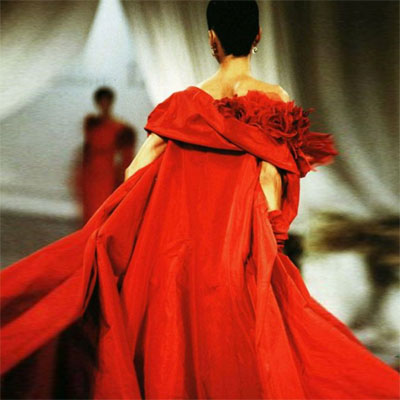
4. Gianfranco Ferré – 1989
5. Galliano – 2009
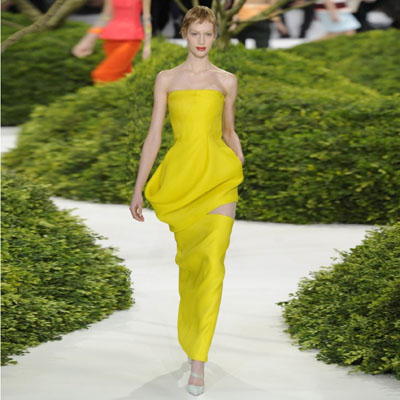
6. Raf Simonds – 2013
7. Grazia Churi – 2017