
Posted on

​071116 – Composites – London

​071116 – Composites – London > words

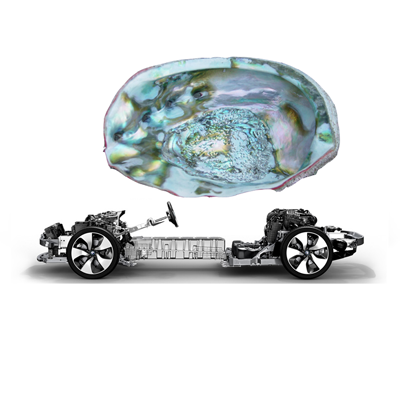
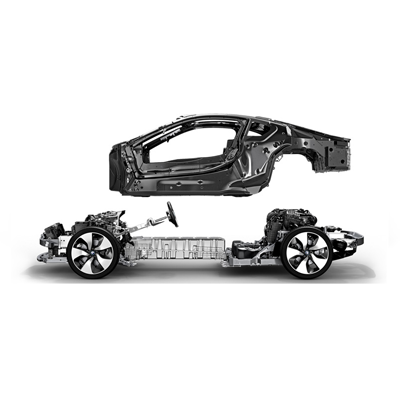
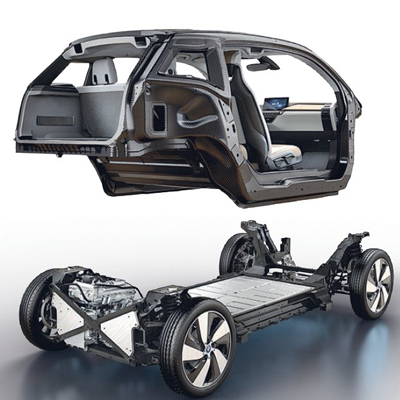
BMW i3 i8

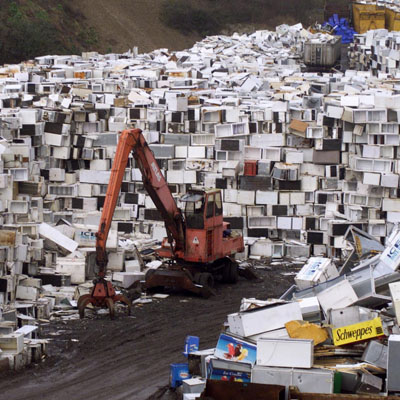
A recent article in the FT praised the uptake of composites, especially carbon fibre, as a material to be used for mass-produced cars. Both the author and reader’s comments were enthusiastic for the wide spread application of composites for mass production. The planet supports 8 billion people and is already carrying at least 3 billion, possibly 6 billion, too many. Each of these would like a car. Many in the west own more than one. It is estimated that the Chinese alone will buy 40 million cars by 2020. Cars are multiple reoccurring buys, car manufacturers benefit from maximising this reoccurring purchase. Vehicle obsolescence increases the number of reoccurring purchases. Obsolescence in the car industry can be as fickle as colour, style or the addition of some unnecessary new electronic gadget. Style generated obsolescence is key to mass-market consumerism. The landfill sites are full, the oceans adrift with acres of discarded plastic. When the carbon fibre car body replaces the plastic drink bottle where will we throw the waste? The FT article, the author and all of the readers comments were oblivious to the fact that man pollutes by the decisions he makes at the point of manufacture.

To cut car emissions manufacturers are keen to reduce a cars weight. Electric cars are heavy due to the batteries carried. Hybrid cars are heavier still as they carry two power sources, battery packs and fuel storage. This additional weight is partially offset by reduction in body shell weight and carbon fibre is a proposed alternative. The BMW i3 and i8 are beautiful and sophisticated pieces of engineering design. They have the wow factor that will provide a short-term lift in sales but they are simultaneously examples of irresponsible industrial design at a corporate level.

Carbon Fibre

Carbon fibre is a unique material. Its strength to weight ratio is many multiples higher than steel or aluminium. It can be moulded into many complex forms essential for efficiently distributing loads through highly stressed junctions and intersections. Carbon fibre’s place in Formula One or the aircraft industry is well earned but as a medium of mass production it is an inappropriate material.

Carbon fibre consumes 14 times the amount of energy required to make steel. More than 90% of the energy needed to manufacture carbon fibre composites is consumed in making the carbon fibre itself. 90% of carbon fibre manufacture is derived from polyacrylonitrile made from acrylonitrile, which is derived from the commodity chemicals propylene and ammonia. The process of making carbon fibre requires multiple ovens used in sequence. The first two ovens are at temperatures of 200-300 degrees C but carbonization is achieved by putting the fibres through another series of ovens ranging in temperatures from 700-800 degrees C, then 1200-1500 degrees C and finally 3450-4500 degrees C. Alongside the energy intensive heat sequence is the chemical washing, doping, catalyst forming, cleaning this with acids and ammonia. Some of the chemicals used throughout the process include dimethyl sulfoxide, dimethyl acetamide or dimethyl formamide, zinc chloride and rhodan salt, itaconic acid, sulfur dioxide acid, sulfuric acid or methylacrylic acid. These are all highly toxic pollutants that the FT article is promoting if carbon fibre is mass-produced.

At end of use carbon fibre is even more problematic as it does not biodegrade or photodegrade. – EVER – it will sit in landfill for millenniums. Carbon fibre cannot in anyway be usefully recycled. There are two ways to re-use carbon fibre one of which involves burning without oxygen (pyrolysis), but this is an intensive use of energy and produces a brittle material. The second is shredding and reusing the by-product as fill or aggregate. In both scenarios it is more expensive to recycle carbon fibre than produce it from virgin material and the recycled material is severely downgraded and has very little use, quality or properties of the original composite material.

Molluscs

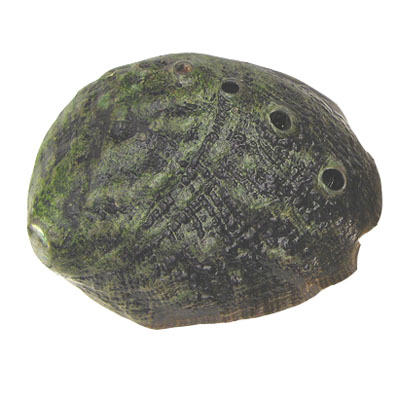
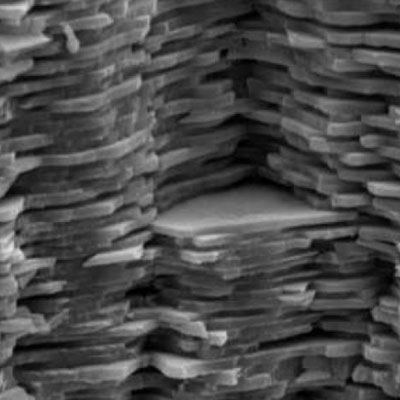
Abalone is the name of a group of large sea snails or molluscs. The shell is made of nacre a composite. Nacre is composed of hexagon platelets of aragonite, calcium carbonate (chalk) glued together with proteins and polysaccharides (sugars) to form elastic biopolymers. Abalone is twice as strong as any known ceramic. Its layered composite structure prevents shearing and provides compressive and tensile strength. This shell material deforms under stress and behaves like a metal. Abalone is an accumulative secreted medium a process similar to 3D printing and this technique is perfect for fabricating complex forms. 

Nacre like all of nature’s products is manufactured at ambient temperature using readily available non life threatening materials, here sugar and chalk. 

Nature has an ordered hierarchical structure, weaving from the atomic level to the macroscopic. This repetition is applied to all scales and provides the materials unique strength.

Structures built from a molecular level up have an inherent logic that dictates what bonds to what and how. This forms a pre-coded system of self-assembly.

This coding allows nature to work with templates that are site and condition specific. It builds exactly what it needs to the specification needed. There is no waste of either time or material.

At the end of its life the Abalone returns all it has used back to the sea. Its production cycle is fully cradle to cradle.

Material scientists are still unable to replicate the process of growing perfect crystalline structures and even further away from them being applied to mass production but the direction of future production is clear. The complex forms that can be constructed from secreted natural mediums will be far superior to processed sheet materials or toxic chemical moulds.

Aluminium

Aluminium is approximately 5 times more energy intensive than steel to produce although this only adds 15% to the cost of production over steel. Car manufacturing in aluminium requires additional tooling with increased complexity throughout the production process and this adds a total of 60%, including raw material production, over the cost of producing steel cars. However aluminium is 100% recyclable, it does not downgrade through the recycling process and uses 95% less energy to recycle than to produce from bauxite. Aluminium also weighs a third of steel. Complex shell moulding and bonding techniques can provide all of the protection and crumple zones required in a modern car. Aluminium can also be 3D printed to create complex crumple zones. There are many advantages in using aluminium for mass production including, availability, lightweight, corrosion resistance and the ability to recycle without downgrading. The additional cost of aluminium over steel is offset by efficient life cycle use and as aluminium an inherent high raw commodity value at the point of recycling.

Until we are able to understand how to build cars in a similar way that nature constructs the mollusc, from the molecular level up all at ambient temperature, aluminium is the transition medium of choice to be used for lighter mass produced cars just as gas is the transition medium as we move from coal to solar.

The Surrogate Twin. 
Posted on

191016 – AI.viation – London

191016 – AI.viation – London > words

Mans obsession with flight goes back millennium from the mythological Icarus who unfortunately flew too near to the sun, to the flying machines of Leonardo Da Vinci. The Montgolfier Brothers first took to the skies in a hot air balloon in 1785 and the first successful parachute jump was made by Jacques Garnerin in 1797. These were men who’s ideas were ahead of their times and ahead of the capabilities of available technology. At the turn of the twentieth century technology had caught up and the ascent to flight was tackled in earnest.

Many early flying machines were driven by little more than the belief in an idea. There were those that flapped, beat, whisked and scooped at the air hoping to gain lift. Many a full size craft were built too quickly following a sketch with almost no development testing and brave men died trying to prove their invention. Early on two approaches developed scientifically, one from box kites and the other from gliders. The box kite approach culminated in Alberto Santos Dumont’s tail first box kite of 1906. The glider approach rigorously researched by the Wright Brothers with first flight achieved in 1903. Some of the early flying machines have an exquisite beauty and fragility being as delicate as a dragonfly wing. 
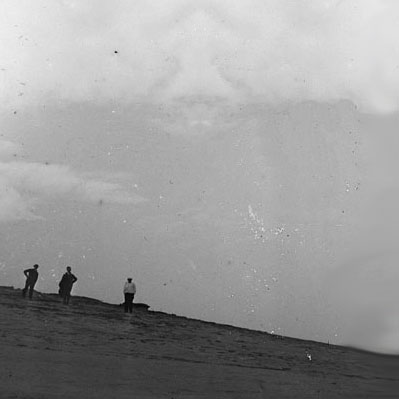
The work of the Wright Brothers shows the clarity of their problem solving technique and is a lesson in strategy for all designers. Aspects of flight are isolated and first resolved independently, slowly and methodically and over time each component is then assembled into a working whole, a total aircraft. There are four main aspects that are tackled scientifically. Lift, pitch, roll and yaw. Early work focussed on lift with flying glider wings over Kitty Hawk beach. The beach had constant winds and these would aid the experiments. A bi-wing tethered to the ground hangs motionless in the air as wind moves through it. Once the understanding of lift had been accomplished the control over each of the three axis of movement was undertaken. A front rudder was developed to control pitch, a rear tail to control yaw and wing warping to control roll. 

The design inspiration for control of roll famously comes to Wilbur Wright whilst selling a bike inner tube in the brother’s bike store. As the inner tube was taken from the box Wilber notice that by holding the end corners of the box on opposing diagonals he could squeeze and twist the length of the box. On a bi-plane a similar technique could be used to wing warp and create roll. To test the idea the Wright Brothers built a bi-winged model glider with a short stabilising tail. By attaching strings to the wing tips top and bottom they could warp the wings and roll the craft from left to right. The Wright Brothers understood the concepts of the centre of gravity and balance, moving the front rudder, responsible for pitch. If too near to the main wings this made the craft too responsive and when further away less responsive but more stable. This would have been very similar to their work on bicycles, for example when shortening or lengthening the front forks with regard to steering. The Wright Brothers built wind tunnels and studied the effects of moving small weights across a frame. They made small incremental changes to their designs and tested and recorded the consequences of each. The work was hands on intuitive and methodically logged and appraised. This approach formed the foundation for understanding controlled flight.

It is interesting to note the conceptual simplicity of the Wright Brothers approach to flight and of The Wright Flyer of 1903. This is that the plane is a glider with an engine and that flight is achieved with the engine pushing or pulling the glider through the air in one direction, forwards. The plane is not a humming bird, a bat, a falcon or a dragonfly and has none of the manoeuvrability of any of these. This conceptual simplicity of a glider with an engine is still very much relevant today and covers most aircraft. The skills of the humming bird, bat, falcon or a dragonfly are still beyond our technology but recent experiments with computer controlled drone flight should soon be transferable to responsive aircraft. With recent advances in robotics and AI, vertical take off and landing (VTOL) craft that are emissions free, autonomous, computer controlled and have a radically simplified interface, may soon be an option for the everyday commute. 

Of all of mans great technological achievements from the invention of the wheel onwards few had the impact of mans conquest of the sky. Flight shrunk the world by linking isolated cultures, opened up new trade routes and added another horrific dimension to warfare. The very first flying machines were only achieved one lifetime ago. In 1903 Wilbur and Orville Wright flew just over 36m in 12 seconds at a speed of 10.9 km per hour, whilst by 1976 the record aircraft speed had increased to 3530 km per hour and manned rocket speed to 8281 km per hour. 

The exponential curve of mans technological progress is well known but needs to be forever re-quantified to give context to the ever increasing speed of change. At ten million years ago man first uses tools, he learns to control fire 1-2 million years ago, he first wears clothes around 50000 years ago, begins agriculture 11000 years ago, first uses iron 6000 years ago, invents the wheel 5500 years ago, invents paper 2000 years ago, invents gunpowder 1100 years ago, eyeglasses 1000 years ago, printing 500 years ago, telescopes, mechanised farming, steam engines, all arrive 300 years ago, electricity, radio, food preservation, early medicine, 200 years ago. Mass produced cars, washing machines, TVs, refrigerators 90 years ago, nuclear power 70 years ago, satellites, lasers and computers 50 years ago, CD’s, mp3s and the world wide web 30 years ago, cell phones and touch screens 10 years ago. 

From the point where man first used tools it took a further 10 million years just to learn to get dressed. Technological development was graphically almost horizontal for a further 50000 years with most of mans technical innovation happening in the last 100 years. This is the Law of Accelerating Returns. The speed of change has left our social and political systems behind, our education systems are woefully inadequate and we are all ill prepared for what is about to happen next with the coming of AI (Artificial Intelligence). Every innovation that man has made to date has been a tool that he could control to carry out a specific task whether that has been a flint axe, an aircraft, a computer or new medicinal drugs. This is about to change.

Mans closest evolutionary cousin is the chimpanzee. On equal weight terms the chimpanzee is twice as strong as a human. The only reason that man dominates chimpanzees is due to his superior intellect. This intellect has allowed man to become the dominant species on the planet. With the invention of AI man will build a self-learning silicon based machine that will be his intellectual superior. This will be the first tool that man has built that will have the ability to supersede his own knowledge. It will also be the first time that mankind has not been the superior intellect on this planet. 

Technological innovation is driven by communication. The invention of the printing press in the fifteenth century had minimal effect on mankind as the distribution and understanding of knowledge was limited. It was not until the twentieth century with the inventions of flight, TV and telephone that the distribution of knowledge and the reciprocal progress in technological invention took off.

Sci-Fi’s depiction of the future provides interesting analogies. The character Iron Man, from the films based on the Marvel comics, designs his new inventions through polite conversation with J.A.R.V.I.S. his super AI computer. The superior intellect of Tony Stark (Iron Man) instructs the computer to perform certain tasks en route to designing some new innovation. It is a one sided dialogue between man and his servant the machine. In reality it is far more likely that Tony Stark would not be instructing J.A.R.V.I.S. but instead trying to keep up with J.A.R.V.I.S. Tony Stark would be asking what have you just done, can you explain that again, lets start from the beginning and please break it down into small steps so that my carbon based organic brain can comprehend. Pseudo science has often been inspired by the popular press, the sci-fi comics of yesteryear or the science fiction films of today. The difference is that the science fiction films today are so well academically researched and politically connected that many of their projections are very credible. J.A.R.V.I.S. as trusted ally will always be a subject of conjecture.

The popular conception of AI is of something in human form such as the Terminator, Ex-Machina or the robots of Jonathan Nolan’s Westworld. Mankind has spent much of the last 30 years developing and integrating the worldwide web. Over 40% of the planet can now wirelessly connect to the web with that figure rising to 75% in most of the developed world. We have spent the same amount of time creating a global and logistic world. The planet is run by systems and AI will be a system, a controlling network. As an innovation AI is no longer a prosthetic device, the tool as an extension of ourselves but instead due to the global net it is an extension of our relationships to all connected others. The cloud becomes a stream of shared consciousness.

There are three states of AI. 

ANI or Narrow AI. This has specific skills in one subject.

AGI or General AI. This has developed human equivalent skills across all subjects.

ASI or Super intelligent AI. This exceeds human intelligence.

Once AGI has been reached it will self learn and redesign itself at such speed that it would soon be way beyond the powers of human comprehension.

The world already runs numerous ANI systems, Google ‘Search’, Amazon ‘you also might like’, Facebook friends, Siri, numerous apps and chat bots, high frequency financial trading, logistics firms, management firms. ANI are used to increase efficiency, they generally lie dormant until asked to perform some specific task. ANI are already part of an intrinsic network within our world. AGI would quickly interconnect all of the existing ANI systems to make one whole controllable network, it would then use that data to self improve and develop. It is estimated that we will have full AGI by 2025 – 40, within nine to twenty four years. Reaching AGI is hard to forecast as development is exponential but once AGI is reached and all existing ANI system are absorbed they would then all be self learning and self improving systems. One estimate suggests that it will take a decade for a computer to reach the human equivalent of a four year old, another hour to be of Einstein’s equivalent and another hour and a half to be 200,000 times more intelligent than all humans. We still mistakenly think of the computer as a single object and of a smarter computer as a larger more powerful single object but that is not how an intelligent computer would allocate resources. ASI would split its learning tasks to numerous computers around the planet and collectively share that information as it grows creating a whole series of development and feedback loops. There is no finite limit known on the level of possible intelligence but what is certain is that this organisation will be an ecosystem and not a humanoid object. Mankind has never before confronted a superior intellect and no one can truly guess the outcome of that conversation. Conversations are based upon values and who can guess what values AI would hold? Even objectivity needs a starting premise.

At the beginning of this text the intent was to compare AI with our first explorations in flight but this now seems inappropriate. Anthropologically personal computers could be compared to flight, both came out of the garage workshop and yet had global life changing consequences; both open up new cultural exchanges whilst simultaneously shrinking the world; both evolved with incredible technological speed; both will be remembered as part of the list of key events that shaped mankind. AI moves way beyond this and is more comparable to the space exploration we have yet to undertake, a very large unknown indeed. What is similar to the days of early flight is that it is driven by lot of hope, belief, trust and blind faith and recalls the day man first stepped off of the cliff and into a head wind hoping to spend time with the birds. There is still a lot to learn from the slow incremental approach of the Wright Brothers where risk is minimised and each step recorded.

The commercialisation of the Internet over the last 20 years has seen a disproportional consolidation of wealth and power into the hands of an ever-decreasing minority. This same minority own the large R&D workshops developing AI. Whoever controls AI will also control all of the patents produced from AI including an increasing number of medical and biological patents. At the same time more and more jobs will be automated meaning wealth consolidation and wealth disparity will also move along an exponential trajectory adding further to existing social problems. 

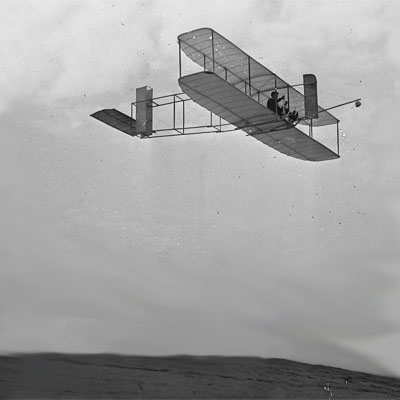
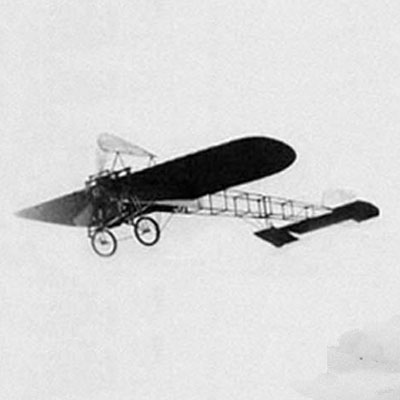
Images:The Wright Brothers test an early glider at Kitty Hawk beach, Louis Bieriot’s XI monoplane 1909.

The Surrogate Twin

Posted on

071016 – Lost Apple – London

​071016 – Lost Apple – London > words

On 220916 a rumour was leaked to the investment press that Apple had approached McLaren as a possible takeover target. The rumour was denied by all involved but the possibility has raised some interesting issues.

1. It never ceases to amaze the shear scale of Apple Inc. Company valuations when they move beyond the stratospheric multi billion become difficult to contextualise. At the time of writing Apples valuation is just below $1tn (trillion) with a cash pile of $216b. McLaren is valued at $1.5b and Apple has recently paid $3b for Beats so as an acquisition McLaren is small fry. With Sterling down 17% post Brexit and down 29% since 2014 McLaren is in bargain territory.

2. The design link to McLaren via Foster and Partners is easy to comprehend with Foster working on the Apple store roll out as well as the new Apple HQ. Foster has also completed the McLaren HQ and the McLaren Production Centre. The three design approaches of Foster, Apple, McLaren all sit firmly in the same camp. In these firms design is evolutionary, symbiotic and painfully labour intensive with constant reworking and refining. This design approach benefits from large offices with multi-disciplinary teams that have an inherent rich R&D cross pollination.

3. Strategically what is Apple doing and has Apple lost its way? This is a question asked by many since the death of Steve Jobs.

I have neither reason nor qualification to question the strategy of a proven company such as Apple yet intellectual curiosity continues to think these things through and in writing my thoughts perhaps some clarity will prevail. I have always been an Apple customer and have bought Apple products since the mid 1980’s. Apple in that time have done a few upgrades that have annoyed but most of their products I have used extensively until they are either obsolete or eventually fall apart. I have no complaints with Apple products and will buy Apple again and again but I see little clarity in Apple’s strategic direction.

Apple is one of the most secret companies with much of its R&D located in separate buildings scattered across LA. This will soon change as Apple relocates to the new HQ in Cupertino bringing all of the Apple design departments under one roof and no-one really knows what Apple has planned. Apple has large financial reserves and could use this to push the company in any or many directions. It has recently moved towards luxury items and cars neither of which sit comfortably within the established Apple ecosystem. Apple has also consistently argued that it is primarily a hardware company, something that I have always questioned, although Apple has recently changed tack on this.

Cars and Luxury offer design glamour and it is understandable that the design team would push in this direction but is this where Apple should be moving? It is said in product design that ‘eventually everything becomes a toaster’, a standardised product sold by many competing manufacturers. With any new product as the competition catch up and any progressive product development plateaus the only way to maintain market share is on cost and margins become squeezed. There is of course brand loyalty but a toaster is a toaster and the customer will only pay so much premium for brand loyalty when every other toaster does exactly the same job. Margins can be maintained through quality and the move toward luxury goods can add the further premium of status but is this of relevance when using an everyday utility that due to technological advancements has a relatively short lifespan.

Apple has never wanted to be an IBM or a Hewlett Packard. Under Steve Jobs, throughout 1976-1985 Apple avoided developing the related products to computers i.e. printers, scanners, hard drives etc. Only when Steve Jobs lost control of Apple in 1985 did Apple wrongly diversify into a whole range of computer related products. When Steve Jobs returned to the company in 1997 the first thing he did was to reduce the itinerary and concentrate on doing a few products very well, a wise move. Apple since the death of Steve Jobs under the leadership of Tim Cook have capitalised on the marketing, logistics and production of existing products or the existing product pipeline. Apple needs new products.

As an Apple user I equally value hardware and software, the two are inseparable. Apple software is intuitive, aesthetic, rarely crashes and has a high level of security. The software is integrated seamlessly across all of Apples products and it is this eco system that I am buying. If hardware design follows logical parameters, hardware will shrink moving slowly towards the point of invisibility. Commercially hardware is replaced every 6-8 years whereas software is constantly updated and can be regular income stream.

Apple has shown little interest in developing further computer related products and has stayed away from AI, VR, AR and also have avoided IOT products (Artificial Intelligence, Virtual Reality, Augmented Reality, Internet Of Things). All of this is in error and undervalues, the software and IOS established eco system, it undervalues customer loyalty and it misses out on the potential of VR, AR and IOT. As an Apple customer, if these products existed, I would buy a flat bed A3 Apple printer / scanner. I would expect it to be a cleaner design, smaller and more efficient than existing products on the market. For the home I would buy Apple thermostats and security cameras. I would buy Apple HDs and Apple home energy storage all of which would be integrated via the cloud. I would gladly pay Apple for the support and seamless integration of all of these devices into a controllable whole and therefor IOT would be my focus for Apple R&D.

The majority of home appliances are DC below 9V. Every appliance comes with its own transformer reducing the grid fed AC input current. All of the above IOT could wirelessly charge from a DC storage pack and be controlled via WiFi from the cloud. This would maximise the reach of Apples ecosystem and create revenue streams through upgrades, supports and running fees. At a later stage the car could be integrated with IOT as components from home to car could be swapped or have dual use. The products would all use the same power and run the same software. VR opens up huge entertainment, business and social networking potentials and this with time would integrate into the IOT described above.

Apple is renown for not always being first but for being best. Apple did not make the first smart phone or the first music playing flash drive but it took these products and set the standard for other manufacturers to follow. Perhaps in the Apple research labs sit all of the above just waiting on the market to be ready to accept them but there has been little news of this. Competition in the IOT market place will be fierce so perhaps letting the other majors slug out the initial rounds is the wise approach. Product interconnectivity, establishing cross product protocols etc. will leave many early entrants with obsolete equipment. Apple’s slow take up on IOT may be a deliberate strategy and the rumours of developing a car merely a diverting smoke screen. However if Apple grew first through IOT and then later added the car, the car would become an extension of the IOT environment. This reinterprets the car as a utility through which to access software and moves away from the historically established car interpretation of speed and status. The car would no longer be purely a mobility product but instead an extension of the home or rather an extension of the cloud and the resources of the cloud. It becomes a container of experience rather than the experience of movement. All hardware within the IOT facilitates the existential through access to the virtual and the cerebral.

IOT has been moving toward a point of convergence where embedded technologies in products are constantly pro-active monitoring and managing data. The net collects this data and uses it to be better tuned to the users needs. IOT builds the infrastructure for the information age with the smart home sitting in a smart grid together within a smart city. When technology is embedded the interface between the user and the product moves to the first person, third person remotes vanish. Control is more intuitive. Technology as a prosthetic extension, a tool, a car, a plane, becomes an atmospheric or environmental extension and this is totally new territory. Impose onto this AR and VR and the possible permutations are unfathomable.

The smart phone became the user interface for a range of traditional services and as such replaced those services. The smart phone took on the role of the camera, the book, the radio, the postman, the bank, the office, the games consul, the TV, the meeting room, the drawing board, the atlas, the sketch pad, the recording studio, the photo album, the library, the remote control, the newspaper, the medical monitor, the personal trainer, the language coach, the yoga instructor, the list keeps growing.

As the smart phone takes on these new roles the original appliance slowly disappears typically, the radio, the fax machine, the book, the TV and the camera. Group activities such as fitness or language become individual activities interacting with a virtual group. The virtual group may be thousands of miles away or disbursed across the globe or be augmented. This shrinks space time and condenses the experience whilst blurring cognition between virtual and real. Out dated objects become obsolete and yet the smart phone does not morph its form or increase in size to accommodate the acquisition of these obsolete products or activities and the rituals previously associated to products or activities are not carried over to the new medium of the smart phone. The generic language of interaction with the smart phone, swipe, expand, cut, paste, repeat etc. transcends all media. I play the violin on the smart phone using the same language as I would construct a painting or compose a document. This allows infinite access to cross disciplinary developments an expansion of the accessible territory of expression, a unique development in the history of man.

These are early days, presentations on IOT often consist of little more content than sales reps flogging thermostats and yet IOT as a self regulating, responsive and possibly augmented environment will have a impact beyond any technological development to date and Apple would want to be part of that ethnological experiment.

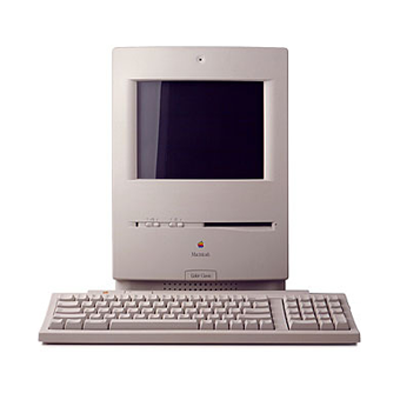
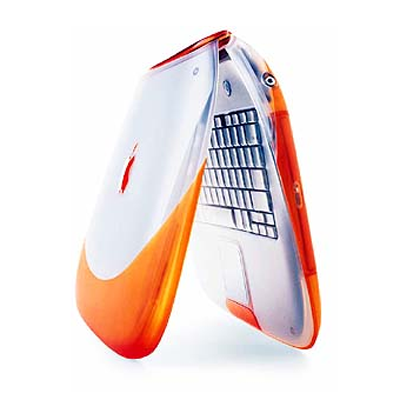
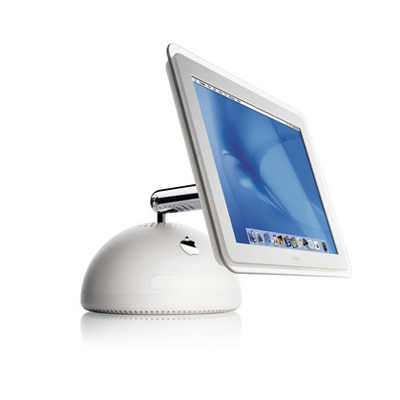
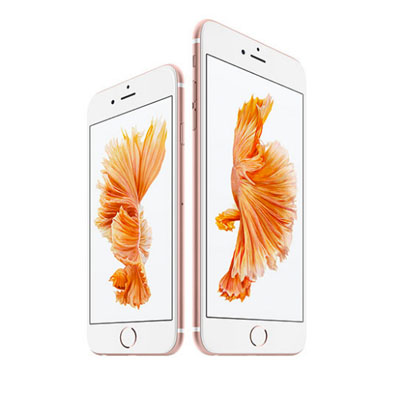
Images seven iconic Apple products:- The Macintosh Classic 1993, The iMac G3 1998, The iBook G3 1999, The G4 Cube 2000, The iPod 2 2002, The iMac G4 2002, The iPhone 7 2016,

The Surrogate Twin

Posted on

041016 – Collaboration – V&A London, SW7

​041016 – Collaboration – V&A London, SW7 > words

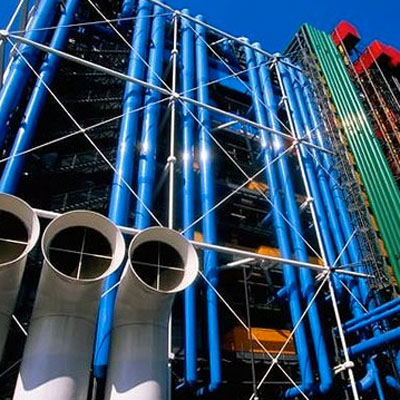
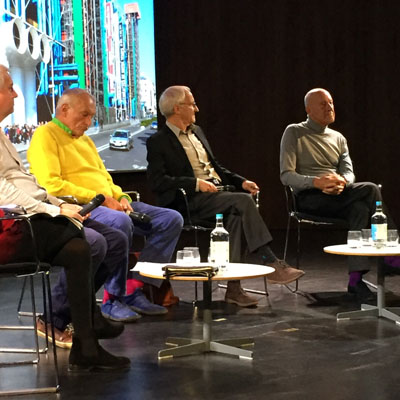
Engineering High Tech Architecture continues the V&A’s 1960’s revolution theme across many of its current exhibits. Foster, Rogers and the Arup engineers discuss the collaborative projects of the early days of High Tech Architecture. The talk was an informal discussion as opposed to a lecture explaining engineering issues and how they were resolved so in some ways disappointing. However, there was a powerful naïve optimism to the early 60s and 70’s architectural movements. Architects almost straight out of college landed huge competition wins and established themselves as the ‘Rock Stars’ of architecture. All architectural students, myself included, would have pawed endlessly over their projects so each project is very well known. The evening was without doubt nostalgic, like watching the Rolling Stones play a pub gig in 2012. Superstars all in one room, you could ask them questions, shake their hands, scream Beatles style (though no one did) or sing along. The stories of the early projects have been told so many times the responses, punch lines and musings could have been pre-quoted by most of the audience. I guess we were all fans saying thank you one last time. The evening was warm and heroic, the speakers had all lived such influential and fantastic lives and together had achieved so much.

We didn’t leave with improved knowledge but it was an evening we would never have missed. A salutation and a big thank you to Lord Foster, Lord Rogers and the Arup team.

The Surrogate Twin

Posted on

290716 – Electric 1 – London

​290716 – Electric 1 – London > words

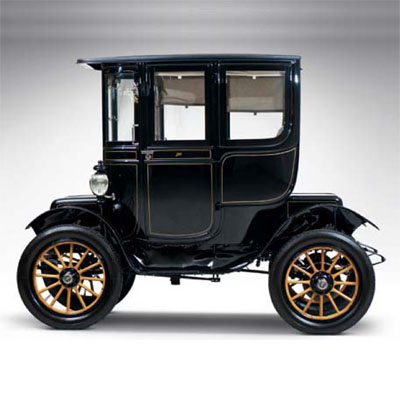
In the 1890’s the automobile industry was in its infancy, three fuel sources contested to dominate this new technological marketplace that of steam, electric and petrol and all were on equal footing. Today in a world dominated by and with a long history of petrol fuelled cars one forgets that steam and electric at the turn of the century took an early lead. Steam already had 100 years of railway R&D and the steam engine had been about for nearly 200 years. Adapting a steam locomotive to the roads should not have posed too many problems. Electricity had a 200 year history with electric trams having 100 years of R&D. A full three years before Bertha Benz borrowed her husbands latest invention, the three wheeled Benz Patent Motorwagen and in 1888 performed one of the best marketing drives of all time, English and French companies were already producing batteries, dynamos, motors and controllers ready to supply the infrastructure needed for the dominant vehicle of choice, the electric car. Electric cars were easy to drive with a few hours tuition required. The motors required no preparation, there were less moving parts, they were relatively silent and made no pollution. In the late 1890’s electric cars had already set land speed records travelling at over 65mph (100kph). So why by the early 1910’s had they all but been forgotten in a world of petrol fuelled dominance?

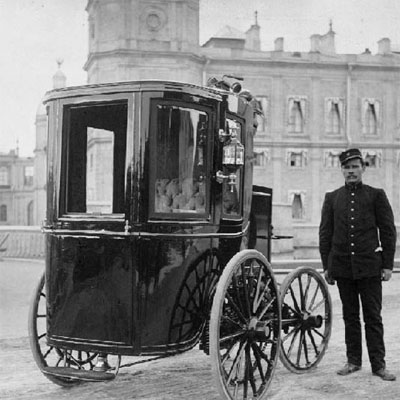
We have to also remember that the automobile at the end of the 1890’s was never considered to be a possession but instead a hired utility. Very few people owned a horse and carriage especially in cities where space was at a premium. Carriages were hired, they were the cab companies, being an owner driver was never a desired Edwardian consideration. As such the driver was the invisible servant, he sat atop the carriage exposed to the elements and the carriages themselves were social spaces, warm and protected, people sat Vis å Vis. The cities were polluted, coal fires for housing, poor sewers and the streets were covered in horse manure and urine. When the potential for an electric car became an affordable reality the cab companies were the first to adopt them to replace horse and carriage. The cab companies already had city infrastructure for its horse carriages. This infrastructure could quickly be converted in whole or in part as charging and battery replacement stations for the new electric vehicles.

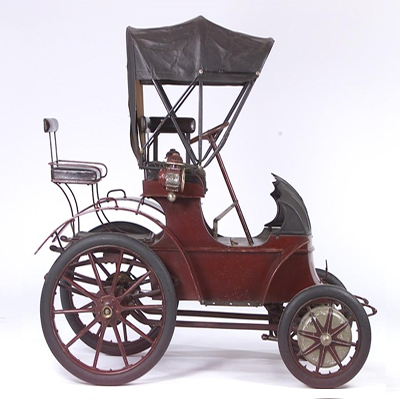
From 1900 to 1910 40% of all cars sold in the US were electric with only 22% being driven by the internal combustion engine. Most cars were only used in cities where range was not an issue and outside of cities roads were too poor to be used by any vehicles. Only later when smooth roads were built linking cities were longer journeys desirable. Early on electric vehicles were a superior technology. The 1899 Lohner-Porsche amongst others had numerous innovations including wheel hub motors, regenerative braking, an electronic / petrol hybrid variant, a slide out battery compartment for quick change instead of charging and although normally driven in full electric mode by two motors one on each front wheel a four wheel drive version was made. Unfortunately for electric vehicles the battery was always the weak link, it was heavy and had a low energy density and was further disadvantaged by extreme cold and poor charging infrastructure. The invention of an electronic start for the internal combustion engine and the production of Henry Ford’s first Model T, a car that sold at half the price of any electric vehicle, only hastened the demise of the electric car. As production increased on the Model T the purchase costs kept getting lower, speeding the downfall of the electric vehicles.

Commercial delivery electric vehicles ran on for a little longer. In Europe during the war years petrol was unobtainable so industries relied on electric power to shift heavy loads. In the UK electric delivery vehicles ran on through the 1960’s and 70’s, electric milk floats were a common site within the English townscape. By the 1960’s the problems caused by pollution produced by the internal combustion engine was a known entity especially in high-density countries like the UK. Town planning acts began to propose the expulsion of petrol vehicles from city centres and offered the idea of inner city traffic being all electric. Numerous electric micro cars were produced to support the planner’s ideas but many of these were poorly made and often looked more like large toys than real cars and they were never able to capture a commercial market. In the US in the early 1990’s General Motors produced the EV1, partly in response to the Middle Eastern oil crisis and partly as a solution to the LA smog. The EV1 was the first serious contender for a mass produced electric car but the oil and motor industries quickly realized that a car such as this would cut into their profit stream so they used their political might to terminate the project.

Historically there is a transitional period whenever a new technology is introduced. The transitional period is one of the most interesting as precedents are carried over from tangential industries and designers search for form through established typographies. For materials examples would be stone imitating timber in classical architecture, steel imitating timber and stone in Victorian architecture, plastics imitating numerous other materials. In design examples would be the computer or the radio, in architecture the Chicago skyscrapers desperate search for an aesthetic language to deal with the new multi-storey buildings, in transport the transition from horse and carriage to horseless carriage. All of these transition periods search for a visual aesthetic whilst further related material innovations push the medium. Eventually a winning combination materializes and with the acceptance of a new material or technology its individual merits can be exploited. Similarly as the aesthetic language for a new product becomes established and focused continued refinements ensure rapid innovative development; the radio, the TV, the computer, the train, the car, the plane, all being typical examples. In the free for all of the early days designers and inventors test their ideas with eclectic crude prototypes. Usually these prototypes have a strong bias towards one aspect of the design, often they can be very wide of the target e.g flapping machines for flight, but sometimes they are only off target as technology or society were not ready, sometimes good ideas get lost as bad ideas receive better marketing or funding. People are always looking for the shortest and easiest route to profit or problem solve and the shortest route is not always the best e.g. DDT, chlorofluorocarbons, pre-fabricated tower blocks. With regards to transport as the internal combustion engine gained dominance its embedded finance and technology make it ever harder to displace by alternatives.

With the recent resurgence of electric vehicles again, design moves through another transitional phase where precedent dictates form……electric vehicles look like cars, they have a bonnet and boot, they have a grill and radiator vent, they have a central transmission tunnel, they have dials, switches and knobs, they are obsessed with speed and the image of speed, none of which have anything to do with the future role of the electric vehicle. If autonomous driving becomes an everyday reality by the 2020 ETA expected the driver will once again sit metaphorically outside the carriage. If the electric vehicle becomes further integrated with the home and the Internet Of Things as would be logical, sharing components, battery packs, charging systems, information, interchangeable motors, servos and other parts, it may be worth considering the electric car of the very near future as a detachable room.

Assuming that we achieve autonomous electric vehicles the majority would probably be available to lease cab services, bus services and delivery services. One would imagine that the majority of inner city over ground transport to be first implemented would be small utility vehicles. Even large loads could be delivered via electric vehicles from distribution centres outside the inner city, again these would be shared and leased. The vehicles may be little more than electronic platforms onto which containers, cranes etc. could be loaded. If the electric vehicle is no longer a possession, the car designer’s obsession with speed and status become obsolete. Aerodynamic forms at sub 30mph inner city speeds become questionable. Shared cabs become social spaces, single person and double person transport would be little more than an enclosed chair, any distance travel may have a sleep pod.

Future design solutions to yet unknown requirements will invent new forms that will sit above a platform of batteries and sensors. The platform has no front or back as it will travel equally in either direction, with four wheel steering probably also sideways. We are again in an interesting transitional period not dissimilar to the beginning of the twentieth century and perhaps there are lessons to be learnt from the many ideas that were shelved during that exciting period of pioneering development however eccentric they may look now.

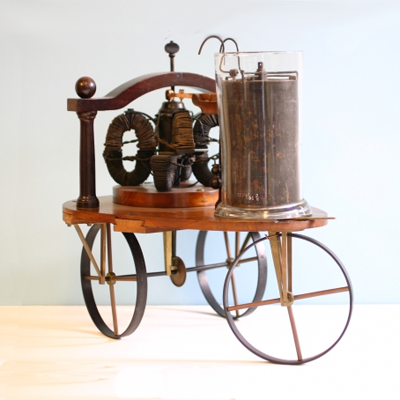
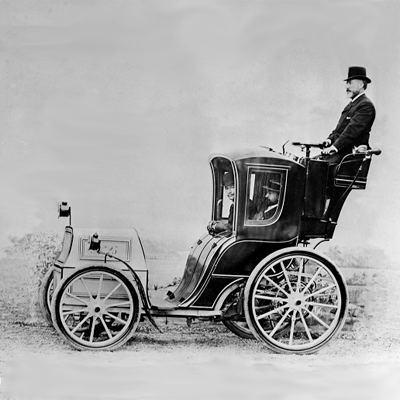
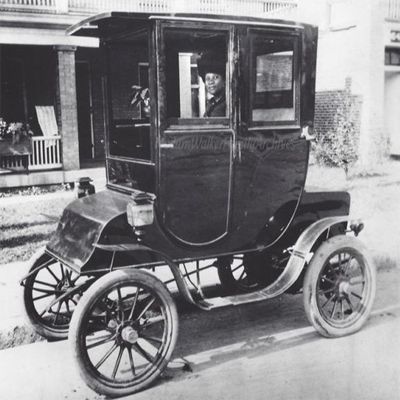
Images chronological order left to right

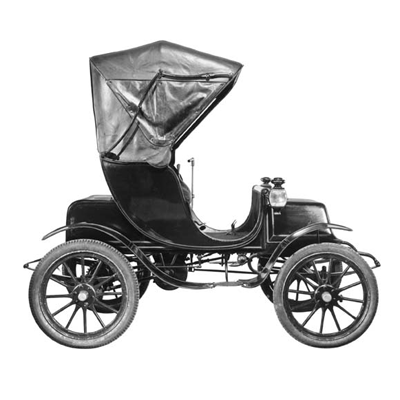
1835 Sibrandus Stratingh, c1898 Jeantaud electric cab, 1899 Lohner Porsche, 1899 Hippolyte Romanov,  1902 Studebaker,  c1914 Waverly Electric, 1912 Baker Electric,

The Surrogate Twin

Posted on

270616 – IVH Future Couture – London

270616 – IVH Future Couture – London > words

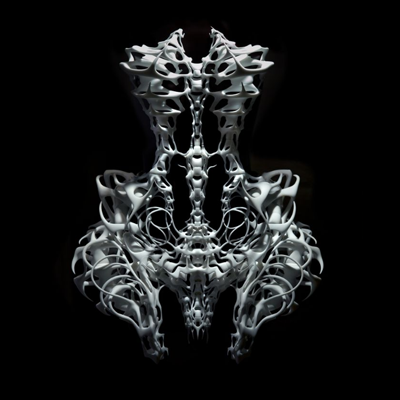
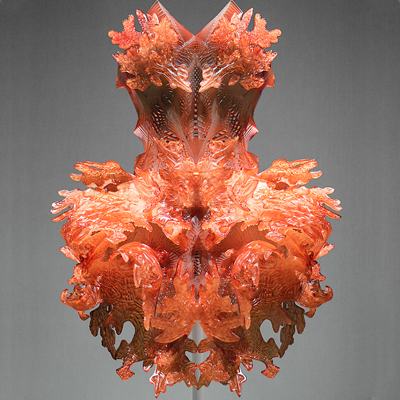
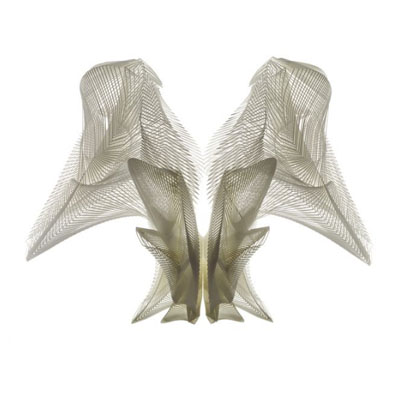
On the shelves in the studio is a book from 1992 Evolutionary Art and Computers by Stephen Todd and William Latham, a mathematician (Todd) and an artist combo. In this book now nearly a quarter of a century old lies an outline for the spatial form making of the art schools for the next few decades. The art is generated by simplistic rules typically scale change / rotate / move on xy or z axis – repeat. This basic algorithm generates spiraling patterns similar to fractal geometries. Minor alterations to the percentage of any of the three above radically alters the final form and the permutations are infinite. Add duplicate / mirror image and a 3d printer and you have the formula used to generate much of the work produced by architectural and industrial design courses over the last two decades. The formulas are perfect for work that is excreted. Over the past decade the work and research in this field has increased in refinement and sophistication. Algorithms sit on or inside algorithms so lacework can be integrated onto forms as part of the generative process. Colour and medium change can also be integrated into this seamless process. As the algorithmic input is infinitesimal so are the concluding forms. The artist/designers role is that of director/editor with the decision making process usually led by subjective aesthetic criteria. The next game change will come from AI’s contribution where performance criteria can be entered into the development process perhaps one day generating real time responsive form. As these ideas leave the research labs of the universities it has been adopted by industry and used in a range of unexpected ingenious and explorative ways.

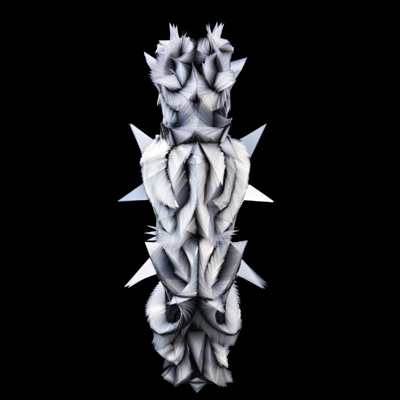
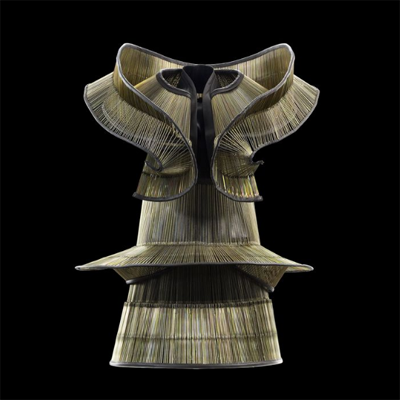
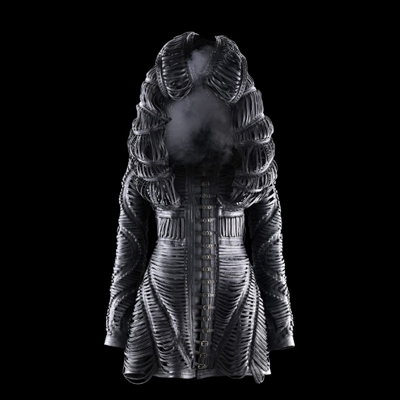
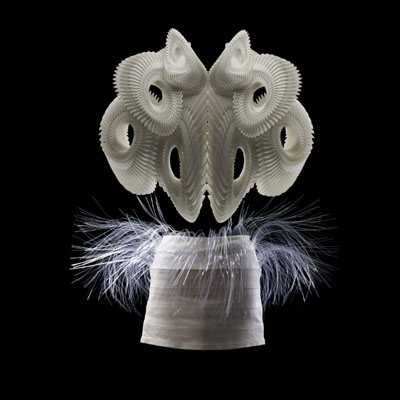
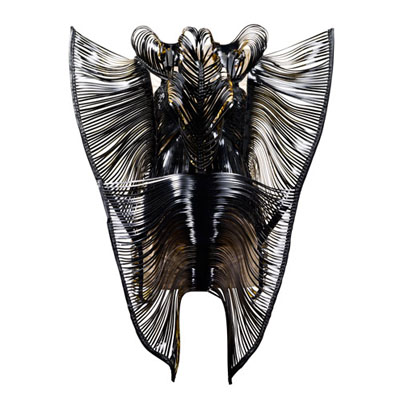
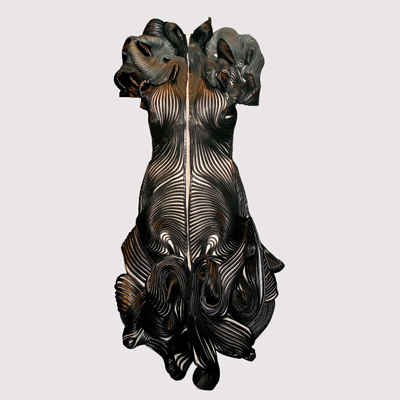
Iris van Herpen works with Couture that is both futuristic and sculptural, mixing traditional hands on Couture techniques with 3D printing and laser cutting. With collection concepts such as Hacking Infinity, Biopiracy, Hybrid Holism, Synesthesia it is clear that the intellect drives the work and the craft delivers the product. The clothes are structured to hold volume and form and movement is very much part of the sculptural choreography. The work is some of the most beautiful conclusions to the application of the above paragraph and as such is a logical progression to this area of exploration. Van Herpen’s studio has had a prolific decade and the exploration continues to gain pace and the coming show will be watched closely. Below are the beginnings of new concepts being formulated by this exploration and these are of intellectual interest beyond the aesthetic.

1  Scale. Algorithmic generated form is scaleless. Whether it be a Zaha Hadid building or a Van Herpen dress. One could shrink Zaha’s Al Wakrah stadium and wear it or increase a Van Herpen dress from the Lucid collection and inhabit it.

2  Surface. Many of the pieces in Van Herpen’s work occupy a space beyond the body and as such form a penumbra in which a silhouette is cocooned. I would predict that this outer penumbra will soon be the intelligent surface of most buildings, just as animals have fur and trees leaves.

3  Movement. Movement has always existed in fashion but here something different happens. Sometimes the piece is a kinetic dress that amplifies the movements of the wearer but when there is a dislocation between the silhouette and the penumbra there are two independent choreographies within each piece, one organic and sexual the other abstract and sculptural. 

4  Distortion. The use of Optical Light Screens within the garments distort both form and body.

5  Responsive. Sensory fabrics, fibre optic, sound emitting, have been woven into garments that encourage tactile and soon virtual interaction. Our technology, always a prosthetic extension of ourselves, gains a new intricacy and intimacy. Perhaps our garments will soon be knowledge intensive, self growing and self repairing.

Related exhibition Manus x Machina The Met Fifth Avenue New York through to 140816.

The Surrogate Twin

Posted on

240616 – 3D Printed Shoes – London

240616 – 3D Printed Shoes – London > words

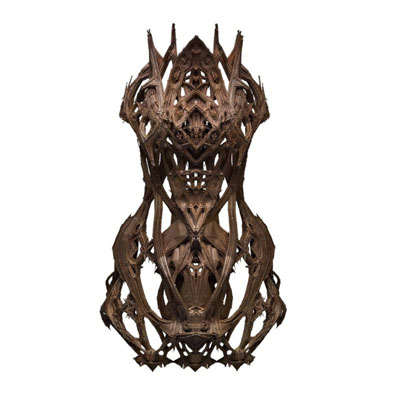
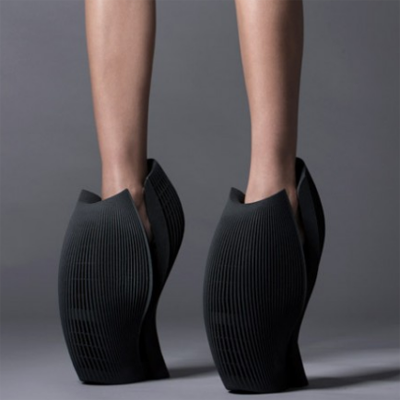
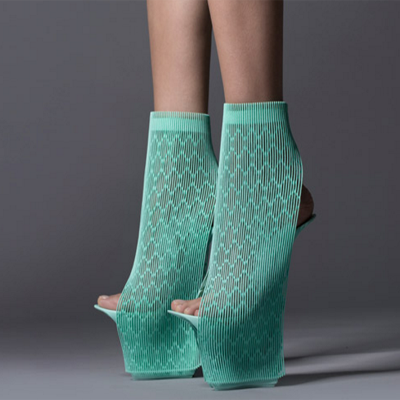
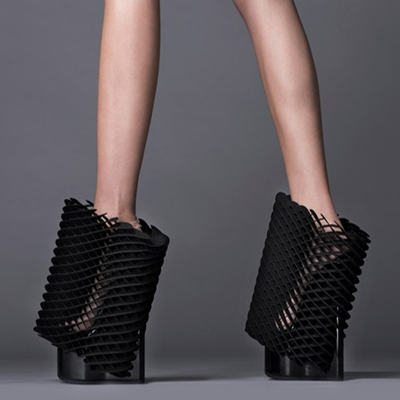
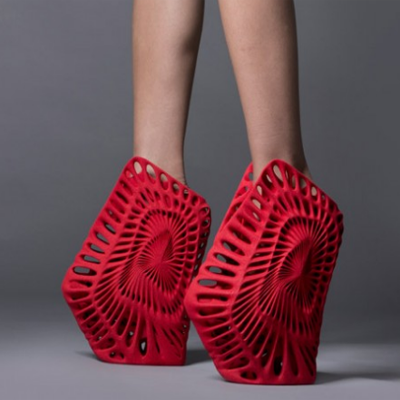
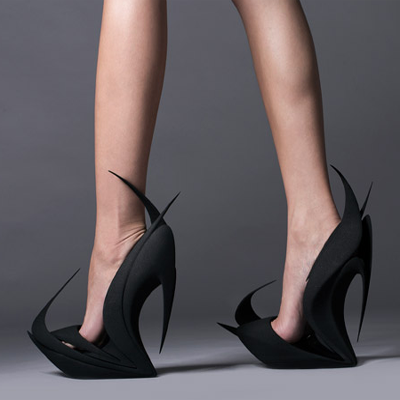
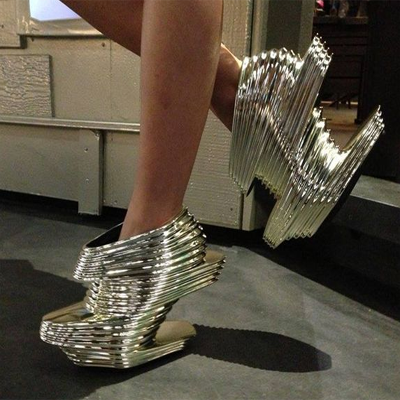
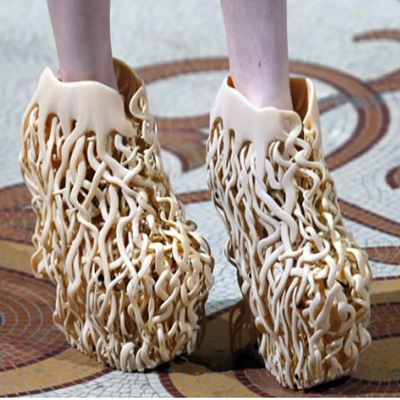
In the last decade computers working with 3D printers have become the front line of design and innovation in which fashion has been no exception. Computers create and visualise the previously unimaginable completing three-dimensional compositions of such complexity that they would have formally been impossible to either draw or craft. This new 3D medium is forcing exciting cross discipline collaborations as designers, architects and computer artists work together to explore the new spatial possibilities. The shoe and the bag are strange fashion accessories but the way they hold volume and space may be the architects attraction. As all architects must design a chair the shoe is becoming the fashion equivalent of the must do project or collaboration project. As can be seen by the work above the results have all been positive pushing limits in new aesthetic directions and forms. 

Images from left to right – Ben Van Berkel, Ross Lovegrove, Michael Young, Fernando Romero, Zaha Hadid x2, Iris Van Herpen.

The Surrogate Twin

Posted on

170616 – Biomimicry – V&A London, SW7

170616 – Biomimicry – V&A London, SW7 > words

Biomimicry the latest hyped trend does what many have previously tried to do utilise and learn from natures billions of years worth of R&D. So what is different this time around? The answer is thirty years worth of useable desktop computing. In the late eighties desktop computing became accessible, affordable and useable although they then had very limited CAD ability their power has increased exponentially over the last three decades. Information that was once the reserve of NASA or the military is available to all within a few clicks and new information is globally distributed from every bedroom or coffee bar laptop or ipad. Equally unprecedented is the intensity with which we are able to see. We have learnt new ways of seeing. We can look at the macro cosmological or micro intercellular, we can x-ray, gamma ray, infra-red and spectrum analyse. We can time delay photography over decades or nanoseconds speeding up or slowing down time and subject. At the same time access to information has, at last, allowed multi-disciplinary groups to form, expediting our transition from compartmented scientific studies to understanding systems and symbiotic synergies. The speed at which this transition has taken pace has been an exhilarating roller coaster ride sadly leaving many wrong footed or with displaced skills on route.

Today’s series of lectures ran from 2pm to 6pm. Talks by academics and practitioners on a range of implications and applications of biomimicry from the obvious to the incomprehensible. Our computers analyse and our robotic machines fabricate. There is a youthful optimism, a genuine excitement as new frontiers are opened and explored. Two things struck me from the talks, one to do with approach and methodology and the other to do with power and chronology.

One. Architecture use to be about problem solving; practising architects know how best to manipulate the rules. Light in relation to floor spans, distances between service cores, modulation of structural systems, thermal modelling, orientation and optimisation, procurement logistics – things like that. Cultural buildings, the ones architects love, have greater artistic license due to their inherent global semantic. Cultural buildings generally have large budgets justified by their symbolic and political agendas and not their pragmatic requirements but these architectures are still very much part of the problem solving approach.

The young architects presenting today do not problem solve as described above but instead edit. They edit algorithms that in turn control fabrication processes. At concept they have little idea of the purpose or form of their architectures. Form is generated through feedback, perhaps to a set of rules, abstract or otherwise but often simply edited by a strong aesthetic intuition to produce a scaleless landscape that can be occupied somewhere downstream during the design process. This approach may at first seem alienating but it has a long lineage of architectural precedent including the work of Cedric Price, Gordon Pask and John and Julia Frazer. In fact any system that is responsive and grows by accretion can be used as reference. Even cities, as these develop organically are generated by often abstract rules. Cities are occupied for purpose, how and when required and have a remarkable similarity to algorithmic generated form the difference is primarily scale, the length of the chronological evolution and the increased complexity of the editing criteria. The richness of the non-prescriptive algorithmic approach is, without doubt, its ability to generate new, previously unimaginable aesthetically intoxicating forms of exquisite complexity and beauty. Gordon Pask who once said “Whilst computer-aided architectural design is useful if repetition or standard transformations are required, it is inadequate to the task of producing new forms.” would be happily on his knees in disbelief. At numerous reviews within academia I have listened to a lot of ‘hot’ air and trawled through acres of equally ‘hot’ drawings all associated to the endless pursuit of new forms and the occupation of the residual consequence. Better critics than me have openly slept through whole presentations. But just as Gordon Pask, so understandably, missed the potential of computing we should remain optimistic that the residue will be occupied. That somewhere downstream, sense through reinterpretation or discovery will capitalise on this explorative pioneering.

Two. In ‘Skyfall’ Bond sits staring at Turner’s ‘The Fighting Temeraire’ oblivious to the ensuing parody that will follow. A spotty youth in the form of ‘Q’ sits alongside Bond and explains the melancholy that has been captured in oils. Q explains the inevitability of time and progress as the great three deck battleship is steam driven to dock to be broken up, now old and out dated.

Talented innovative youth is not a new phenomenon. Mozart, Borromini, Picasso, Pascal, Piaget and Ampére immediately come to mind along with the millions of innovative youths that never become famous. However today’s innovative youth with the help of social media and the Web have access to previously unimaginable influence. Ideas and personas are grown virally creating disruptive opportunities for those with little real world experience. Hopefully within this flux, where new ideas battle for longevity, natural filters will distinguish whom, which and what is relevant. The last two decades has witnessed start up CEO’s and their businesses valued at billions while they are still in their twenties. Businesses and influence of this stature would previously have taken multi generation companies decades to acquire. Handing the reigns to those so young, when their influence is global is an experiment in itself the consequence of which is for future historians to tell. But these are changing times and at a time when we need change and as an optimistic educationalist I can only say here are the reigns, now where are we going.

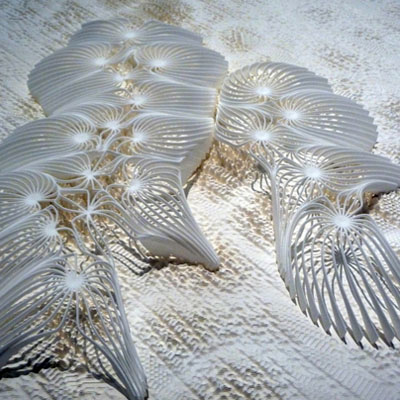
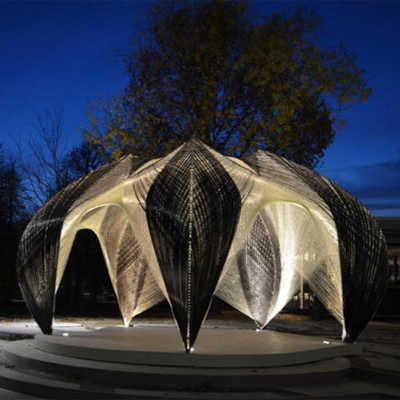
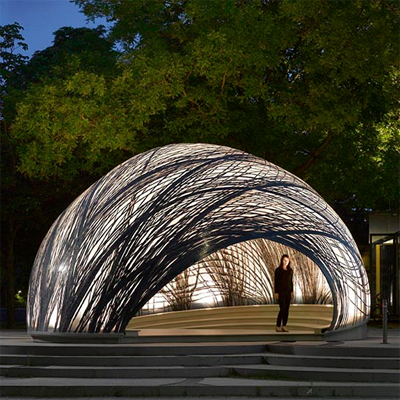
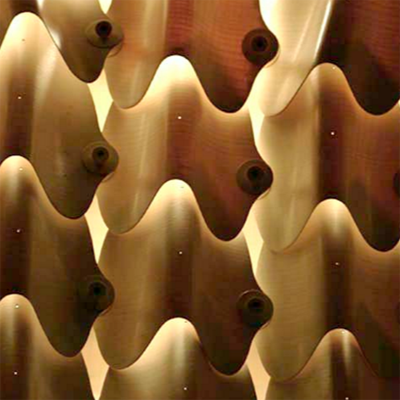
Images from left to right – Alisa Andrasek x2, Achin Menges x3, Julian Melchiorri, Michael Pawlyn.

The Surrogate Twin

Posted on

210516 – Foster Products – Aram Gallery, London WC2

210516 – Foster Products – Aram Gallery, London WC2 > words

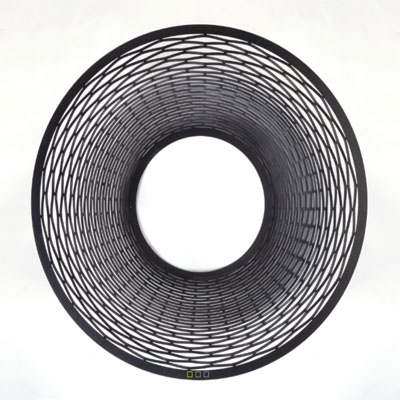
The Aram showroom at 110 Drury Lane has a small gallery on its upper level. On display through to 02.07.16 is some of the industrial design work of the Foster + Partners studio. In typical understatement the products on display were everything expected – extremely professional and as always, despite their aesthetic simplicity extremely complex. I have always admired Foster + Partners as they are the architectural equivalent of Apple, McLaren or Volkswagen. All these companies have an evolutionary approach to design where models are constantly developed and tested. Good ideas from previous designs roll over into future designs, being upgraded, made more efficient, elegant or production friendly on route. The Nomos table being a typical example where the 1981 table originally built for the Fosters own studio was a fairly crude adaptation of an existing drawing board, this is refined when used in the Renault building and refined again when mass produced by Tecno.

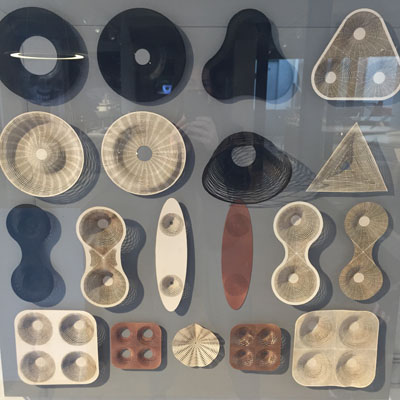
The show has a combination of early sketch models, working models, production stage models and finished pieces. The crudity of some of the early concept pieces and models lends us mere mortals hope when we next look at the first sketch of our latest project. Knowing that all ideas are first conceived on the back of an envelope as a sketch or a quickly made cardboard model and only with considerable work, skill and time do they develop into useable pieces of merit. The Foster industrial products on display are very much the resolve of teams of designers, each with a specialised input and the sophisticated concluding piece is an agglomeration of these inputs.

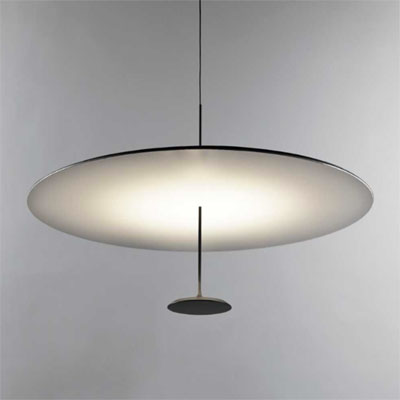
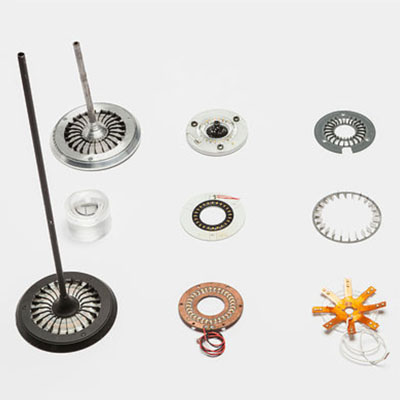
Some of the lighting pieces therefore are particularly complex. The Lumina Dot light a simple disc LED pendant lamp being one. LED’s give off a considerable amount of heat which is usually absorbed by a large heat sink. In Dot the LED’s are cooled by a fluid that runs through a tube connecting the lower LED disc to the heat sink in the larger reflector. The cooling fluid turns to vapour and transfers the heat to the heat sink. The vapour would then cool return to liquid and the cycle would continue. This in itself would be a beautiful diagram to see. Unfortunately there is little information at the exhibition and it takes the trained eye quite some time to work out what is going on. Why a product takes a certain form or how components were fabricated is what makes these exhibitions interesting and educational so please more information. Sadly students of design still naively believe that design is about inventing endless shapes and forms and increased design and production information at exhibitions such as this would help knowledge transfer.

It is an exhibition I will revisit as I still have too many unanswered whys? Why cast the heat sink? Why does any light product require so many parts? Why use Ductal concrete? Why cant we touch, feel the weight or texture of a material? The biggest why for me would be this – why does Foster + Partners find it so difficult to deliver organic forms and are happier with pure geometries. There are numerous talented students leaving the Bartlett each year that have an eye for soft complex computer derived geometries and many head straight to Fosters. Perhaps those at the top of the Foster hierarchy should loosen the reigns a little so that those in the office that are not yet associates may show what they can do?

Posted on

130416 – RooBot – London

130416 – RooBot – London > words

In September 1994 I began a lecture at UCL with two images shown side by side. One image was of a male body builder, his huge arms crossed in front of acres of chest. The other image was of a female ballet dancer standing on one pointe with her other leg reaching into the air way above her head. It was an introduction to a talk on ‘Extreme Climates and Responsive Systems’ and the analogy represented by the images was immediate. The body builder represented the machines of the Industrial Revolution and the ballet dancer the machines that we needed today. The ballet dancer was fuel efficient, had a high power to weight ratio, had uniform strength throughout a full range of movement, used biomechanics over brute force, had coordination and could interact with other complex movement patterns, could be choreographed to work as part of a complex integrated team, could adapt quickly to a range of landscapes and environments. More importantly the ballet dancer was female as Gaia is female and very much part of a circular system. Biomechanics and circular systems would be the inspiration for the next decades work on ever more delicate machines that responded to the harsher climates of our planet.

We jump forward twenty years and robots are at last coming to a department store near you. Robots have been a recurring Sci-Fi topic for hundreds of years from earliest automata’s of the Renaissance to early twentieth century films such as Metropolis. The 1950’s saw a new push for automated friends and assistants as American directors popularised science fiction with films such as Forbidden Planet and The Day The Earth Stood Still. Many visions of the future from these films had man and robot working together but the realities of reaching this goal have proved a little more difficult to resolve. The computing age has made vast strides forward in the development of robotics. The seamless link between hardware and software has until now been allusive. Many early robots were simply machines doing automated repetitive tasks. The next generation will be robots that can multi-task and make elementary decision upon those tasks i.e. how to pick things up, how much pressure to apply, how to balance, how and where to put things down, how quickly to move, how to avoid obstacles etc. The majority of funded research explores aspects of one or more of these tasks i.e. Boston Dynamics location based environmental sensors, balance and balance correction. Others such as Pepper and Erica explore the interface of man and machine with their emotive recognition and responsive robots.

A lot of these projects are still based on pattern recognition and the ability to churn through huge quantities of data instantaneously. We have come a long way since Alan Turing’s work but the majority of modern robots are still Turing machines albeit very sophisticated ones. AI will enable robots to learn and this will improve their ability to make decisions. In many ways this will still be data crunching and statistical analysis but all done at such speed that it would seem like a conscience decision expressed by a piece of hardware, the robot. The Tech firms are throwing huge budgets at this. Facebook recently set up Building 8 to work on hardware that can utilise its software and data harvested from its billions of users. As early simple products come to market the revenues generated will head straight back to the R&D departments for use on the next big project. The process will snowball and progress will be quick and its progression logarithmic. This is all happening now and the journey is well underway. Facebook’s ten-year roadmap may well be reached in six.

A kangaroo can travel huge distances with great economical efficiency at cruise speeds that average 20 kph (12 mph). Kangaroos can, when required reach speeds of up to 65 kph (40 mph). When travelling at speed the Kangaroos huge tail works as a whipping counterbalance to the head and body. This forms a pendulum motion over the hips where head and tail move up and down in unison helping to create lift. The Kangaroos rear legs have elasticated tendons that stretch from the back of the knee to the underside of the toe. The tendon is stretched over an exaggerated and lengthened heal. The tendon is an energy storage mechanism. It recycles the energy used upon landing and stores it in the elasticated tendon. The heal adds leverage to the storage system. Approximately 50% of kangaroos jump makes use of this recycled energy with the rear legs powerful muscles providing the remainder. A kangaroo increases its momentum not by increasing the speed at which its hops but instead by increasing the length of each stride. In this way, combined with its recycled energy, the kangaroo uses almost the same amount of energy at whatever speed it travels. This soft biomechanical motion is a fluid integration of total body movement and will be very difficult to replicate with a machine.

Festo is a multi national that makes hydraulic and pneumatic components for industry. Festo has an R&D department that uses its technologies to experiment with biomorphic machines. This R&D is mainly used as both training for its young engineers and marketing for its products and as such presents a conflict of interest between marketing and research. Machines here are made to resemble animals and they may have some attributes of that animal but resemblance dominates. For example the Bionic Kangaroo (their name, I’ll call it a RooBot) has the plastic body of a kangaroo with a plastic tail but it is a hopping machine. It could be a frog or it could be a fluffy white cloud. The RooBot like the kangaroo has an elastic tendon but this does not recycle energy as does the kangaroos, its energy is pre loaded by a standard pneumatic cylinder DNSU fed by a high pressure storage unit and a valve. The RooBot’s tail and head are plastic add-ons that do nothing other than suggest form. The RooBot can hop, it can turn and it can balance all very commendable achievements but this is not M.I.T. Media Labs. The RooBot is a sophisticated marketing toy posing as research and here is the dilemma. Although one is aware that marketing of existing products dominates the research into biomorphics Festo’s R&D has still produced some incredibly poetic pieces. The Air Mantra is an exquisite art piece and shoals of them ‘swim’ the galleries of the world. The Festo engineers have produced other mechanical fish that have the same mesmerising beauty and the RooBot suggests very similar potentials.

So what is the point of this meandering text? The film Blade Runner (adapted from Philip K Dick’s Do Androids Dream Of Electronic Sheep) was set in Los Angeles 2019, three years from now. So somehow within the next three years we have to move on from the RooBot to the Nexus 6 perfect Replicant, unlikely indeed. However, what all these pieces do is reaffirm just how incredible and unique the biological perfection that exists on our planet is and how much we have to learn from all nature that surround us.

If I had wish for one superpower it would be for immortality just to be able to watch this fantastic journey unfold.        

The Surrogate Twin