
071016 – Lost Apple – London > words
On 220916 a rumour was leaked to the investment press that Apple had approached McLaren as a possible takeover target. The rumour was denied by all involved but the possibility has raised some interesting issues.
1. It never ceases to amaze the shear scale of Apple Inc. Company valuations when they move beyond the stratospheric multi billion become difficult to contextualise. At the time of writing Apples valuation is just below $1tn (trillion) with a cash pile of $216b. McLaren is valued at $1.5b and Apple has recently paid $3b for Beats so as an acquisition McLaren is small fry. With Sterling down 17% post Brexit and down 29% since 2014 McLaren is in bargain territory.
2. The design link to McLaren via Foster and Partners is easy to comprehend with Foster working on the Apple store roll out as well as the new Apple HQ. Foster has also completed the McLaren HQ and the McLaren Production Centre. The three design approaches of Foster, Apple, McLaren all sit firmly in the same camp. In these firms design is evolutionary, symbiotic and painfully labour intensive with constant reworking and refining. This design approach benefits from large offices with multi-disciplinary teams that have an inherent rich R&D cross pollination.
3. Strategically what is Apple doing and has Apple lost its way? This is a question asked by many since the death of Steve Jobs.
I have neither reason nor qualification to question the strategy of a proven company such as Apple yet intellectual curiosity continues to think these things through and in writing my thoughts perhaps some clarity will prevail. I have always been an Apple customer and have bought Apple products since the mid 1980’s. Apple in that time have done a few upgrades that have annoyed but most of their products I have used extensively until they are either obsolete or eventually fall apart. I have no complaints with Apple products and will buy Apple again and again but I see little clarity in Apple’s strategic direction.
Apple is one of the most secret companies with much of its R&D located in separate buildings scattered across LA. This will soon change as Apple relocates to the new HQ in Cupertino bringing all of the Apple design departments under one roof and no-one really knows what Apple has planned. Apple has large financial reserves and could use this to push the company in any or many directions. It has recently moved towards luxury items and cars neither of which sit comfortably within the established Apple ecosystem. Apple has also consistently argued that it is primarily a hardware company, something that I have always questioned, although Apple has recently changed tack on this.
Cars and Luxury offer design glamour and it is understandable that the design team would push in this direction but is this where Apple should be moving? It is said in product design that ‘eventually everything becomes a toaster’, a standardised product sold by many competing manufacturers. With any new product as the competition catch up and any progressive product development plateaus the only way to maintain market share is on cost and margins become squeezed. There is of course brand loyalty but a toaster is a toaster and the customer will only pay so much premium for brand loyalty when every other toaster does exactly the same job. Margins can be maintained through quality and the move toward luxury goods can add the further premium of status but is this of relevance when using an everyday utility that due to technological advancements has a relatively short lifespan.
Apple has never wanted to be an IBM or a Hewlett Packard. Under Steve Jobs, throughout 1976-1985 Apple avoided developing the related products to computers i.e. printers, scanners, hard drives etc. Only when Steve Jobs lost control of Apple in 1985 did Apple wrongly diversify into a whole range of computer related products. When Steve Jobs returned to the company in 1997 the first thing he did was to reduce the itinerary and concentrate on doing a few products very well, a wise move. Apple since the death of Steve Jobs under the leadership of Tim Cook have capitalised on the marketing, logistics and production of existing products or the existing product pipeline. Apple needs new products.
As an Apple user I equally value hardware and software, the two are inseparable. Apple software is intuitive, aesthetic, rarely crashes and has a high level of security. The software is integrated seamlessly across all of Apples products and it is this eco system that I am buying. If hardware design follows logical parameters, hardware will shrink moving slowly towards the point of invisibility. Commercially hardware is replaced every 6-8 years whereas software is constantly updated and can be regular income stream.
Apple has shown little interest in developing further computer related products and has stayed away from AI, VR, AR and also have avoided IOT products (Artificial Intelligence, Virtual Reality, Augmented Reality, Internet Of Things). All of this is in error and undervalues, the software and IOS established eco system, it undervalues customer loyalty and it misses out on the potential of VR, AR and IOT. As an Apple customer, if these products existed, I would buy a flat bed A3 Apple printer / scanner. I would expect it to be a cleaner design, smaller and more efficient than existing products on the market. For the home I would buy Apple thermostats and security cameras. I would buy Apple HDs and Apple home energy storage all of which would be integrated via the cloud. I would gladly pay Apple for the support and seamless integration of all of these devices into a controllable whole and therefor IOT would be my focus for Apple R&D.
The majority of home appliances are DC below 9V. Every appliance comes with its own transformer reducing the grid fed AC input current. All of the above IOT could wirelessly charge from a DC storage pack and be controlled via WiFi from the cloud. This would maximise the reach of Apples ecosystem and create revenue streams through upgrades, supports and running fees. At a later stage the car could be integrated with IOT as components from home to car could be swapped or have dual use. The products would all use the same power and run the same software. VR opens up huge entertainment, business and social networking potentials and this with time would integrate into the IOT described above.
Apple is renown for not always being first but for being best. Apple did not make the first smart phone or the first music playing flash drive but it took these products and set the standard for other manufacturers to follow. Perhaps in the Apple research labs sit all of the above just waiting on the market to be ready to accept them but there has been little news of this. Competition in the IOT market place will be fierce so perhaps letting the other majors slug out the initial rounds is the wise approach. Product interconnectivity, establishing cross product protocols etc. will leave many early entrants with obsolete equipment. Apple’s slow take up on IOT may be a deliberate strategy and the rumours of developing a car merely a diverting smoke screen. However if Apple grew first through IOT and then later added the car, the car would become an extension of the IOT environment. This reinterprets the car as a utility through which to access software and moves away from the historically established car interpretation of speed and status. The car would no longer be purely a mobility product but instead an extension of the home or rather an extension of the cloud and the resources of the cloud. It becomes a container of experience rather than the experience of movement. All hardware within the IOT facilitates the existential through access to the virtual and the cerebral.
IOT has been moving toward a point of convergence where embedded technologies in products are constantly pro-active monitoring and managing data. The net collects this data and uses it to be better tuned to the users needs. IOT builds the infrastructure for the information age with the smart home sitting in a smart grid together within a smart city. When technology is embedded the interface between the user and the product moves to the first person, third person remotes vanish. Control is more intuitive. Technology as a prosthetic extension, a tool, a car, a plane, becomes an atmospheric or environmental extension and this is totally new territory. Impose onto this AR and VR and the possible permutations are unfathomable.
The smart phone became the user interface for a range of traditional services and as such replaced those services. The smart phone took on the role of the camera, the book, the radio, the postman, the bank, the office, the games consul, the TV, the meeting room, the drawing board, the atlas, the sketch pad, the recording studio, the photo album, the library, the remote control, the newspaper, the medical monitor, the personal trainer, the language coach, the yoga instructor, the list keeps growing.
As the smart phone takes on these new roles the original appliance slowly disappears typically, the radio, the fax machine, the book, the TV and the camera. Group activities such as fitness or language become individual activities interacting with a virtual group. The virtual group may be thousands of miles away or disbursed across the globe or be augmented. This shrinks space time and condenses the experience whilst blurring cognition between virtual and real. Out dated objects become obsolete and yet the smart phone does not morph its form or increase in size to accommodate the acquisition of these obsolete products or activities and the rituals previously associated to products or activities are not carried over to the new medium of the smart phone. The generic language of interaction with the smart phone, swipe, expand, cut, paste, repeat etc. transcends all media. I play the violin on the smart phone using the same language as I would construct a painting or compose a document. This allows infinite access to cross disciplinary developments an expansion of the accessible territory of expression, a unique development in the history of man.
These are early days, presentations on IOT often consist of little more content than sales reps flogging thermostats and yet IOT as a self regulating, responsive and possibly augmented environment will have a impact beyond any technological development to date and Apple would want to be part of that ethnological experiment.
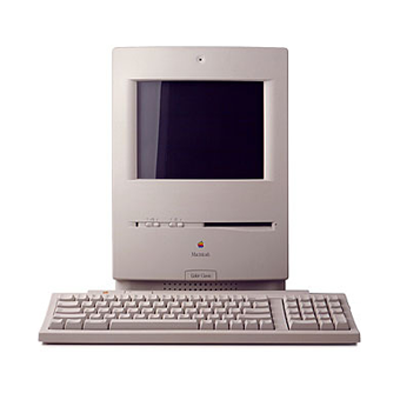
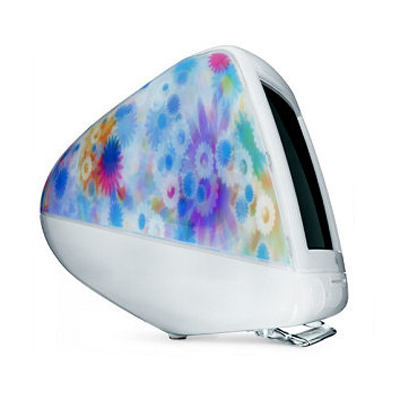
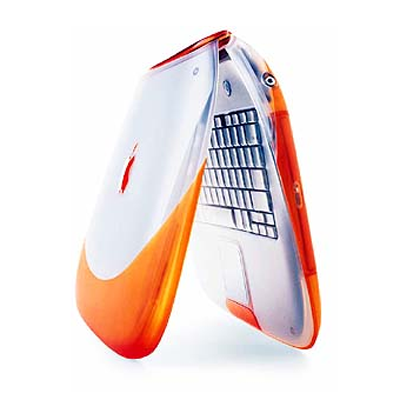
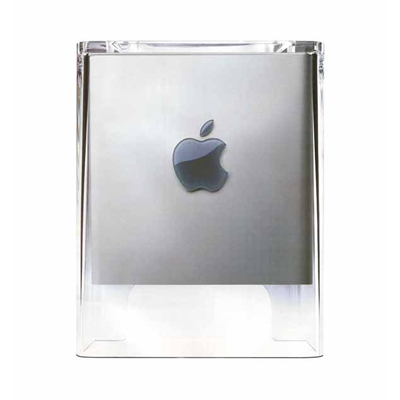
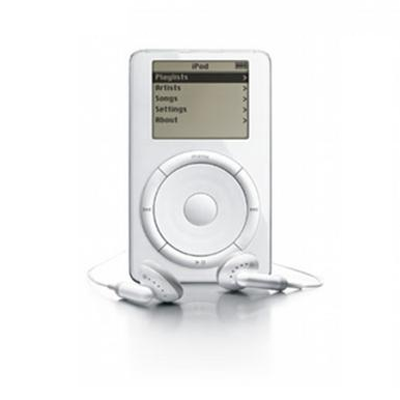
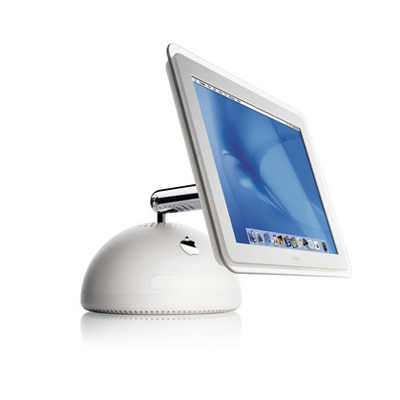
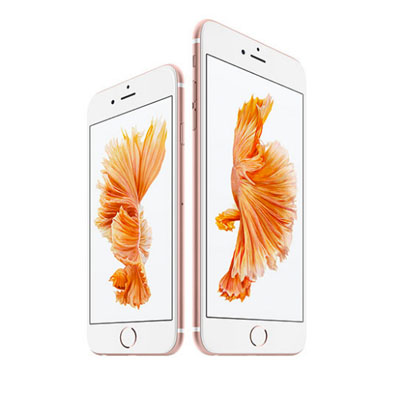
Images seven iconic Apple products:- The Macintosh Classic 1993, The iMac G3 1998, The iBook G3 1999, The G4 Cube 2000, The iPod 2 2002, The iMac G4 2002, The iPhone 7 2016,
The Surrogate Twin