
171015 – The Fabric Of India – V&A, London > words
This morning I am sitting in my bathroom staring at a towel. It has a double sided combed cotton pile. It has a hemmed border and both ends have a flattened detail over several bars that make a diagonal wave across the warp of the towel. The towel is a faded lilac I have had it for many years. I have washed it, dried it, folded it, I have washed with it possibly thousands of times. The towel is made of Egyptian cotton. I know this as it is written on the label. The towel is just an ordinary john Lewis towel and I find myself staring at it blankly as I do not know exactly how it was made. I am reminded that so many of the everyday objects that I use I have no ideal how they work, what they are made of or how they were manufactured. What has bought me to this towel staring was the exhibition at the V&A The Fabric Of India.
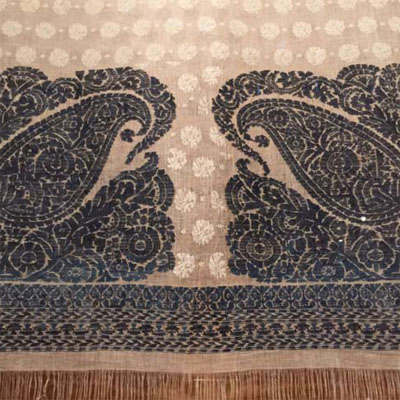
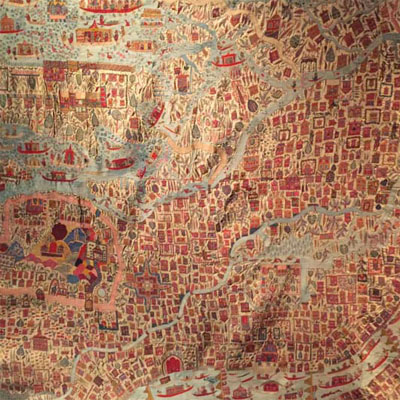
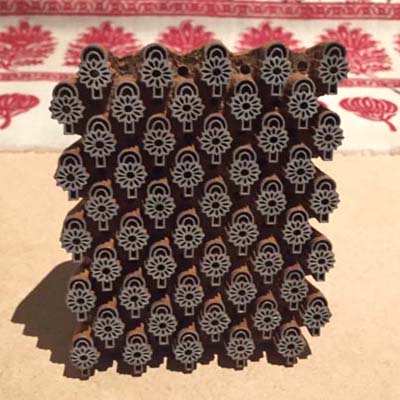
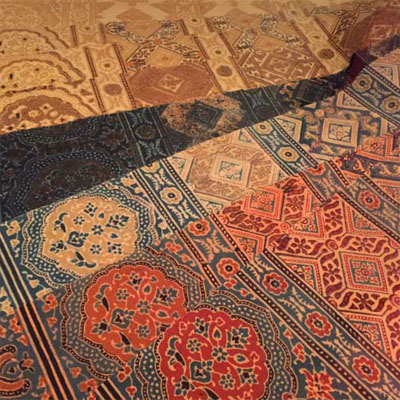
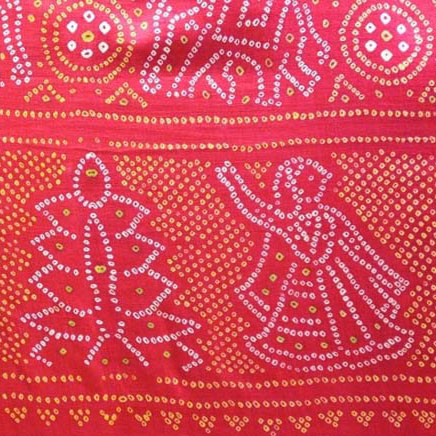
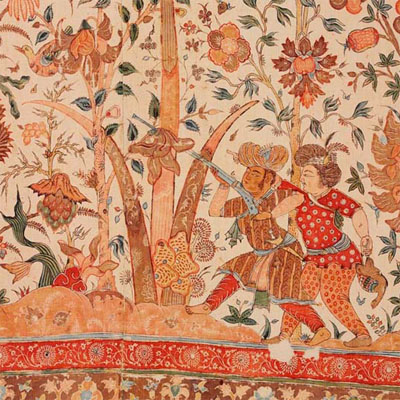
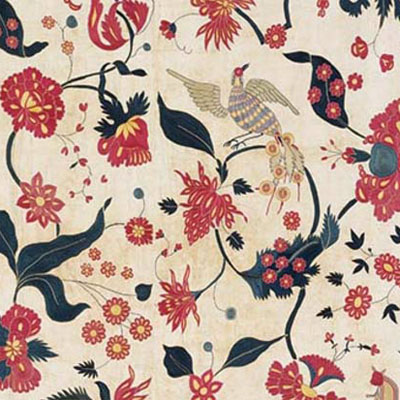
The exhibition splits into two distinct halves. The first talks about techniques and processes the second about conclusions and uses. The two halves of the exhibition space are joined by a delightful transition space made with walls of vertical elastic cord that have a wonderful optical affect when moving. When just through the transition space and I am confronted with a 200mm border of an asymmetrical composition of people, animals and plants and I read that it has been woven. At this point I realize that I cannot understand how this is possible. The complexities involved are beyond comprehension when knowing that it is made by hand working on a primitive loom. I can understand warp and weft, I understand how to make basic patterns, I do not understand how a pattern can be given a bias one side to the other or how to make complex asymmetrical compositions. A fascinating exhibition and one that will be scheduled a re-visit. It was a shame that a working hand-loom was not in operation as the primitive sounds would have added greatly to the ambience.