
210516 – Foster Products – Aram Gallery, London WC2 > words
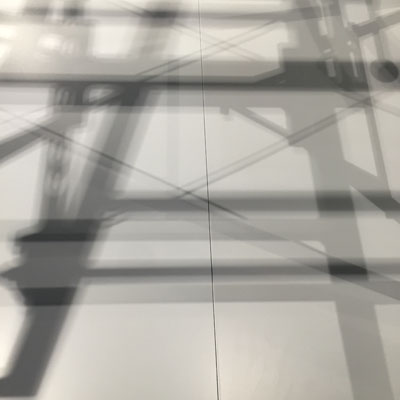
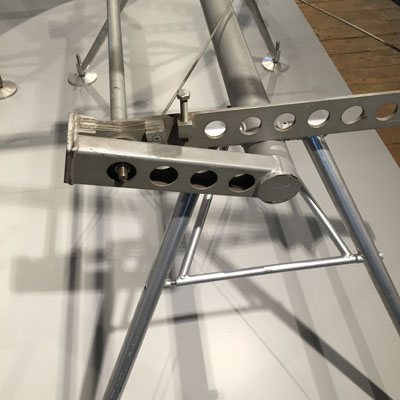
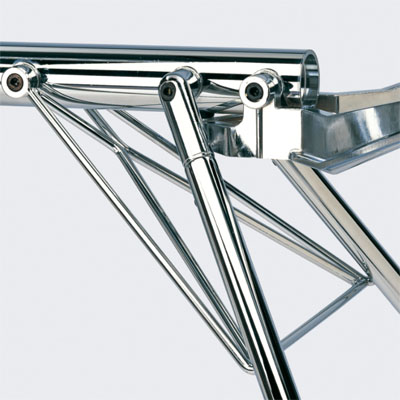
The Aram showroom at 110 Drury Lane has a small gallery on its upper level. On display through to 02.07.16 is some of the industrial design work of the Foster + Partners studio. In typical understatement the products on display were everything expected – extremely professional and as always, despite their aesthetic simplicity extremely complex. I have always admired Foster + Partners as they are the architectural equivalent of Apple, McLaren or Volkswagen. All these companies have an evolutionary approach to design where models are constantly developed and tested. Good ideas from previous designs roll over into future designs, being upgraded, made more efficient, elegant or production friendly on route. The Nomos table being a typical example where the 1981 table originally built for the Fosters own studio was a fairly crude adaptation of an existing drawing board, this is refined when used in the Renault building and refined again when mass produced by Tecno.
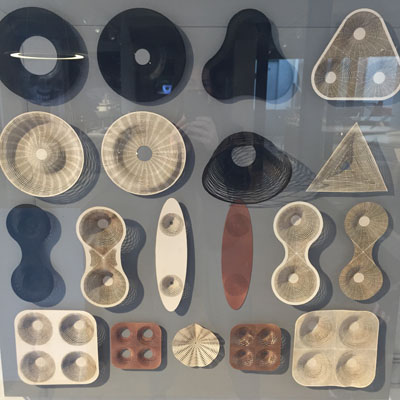
The show has a combination of early sketch models, working models, production stage models and finished pieces. The crudity of some of the early concept pieces and models lends us mere mortals hope when we next look at the first sketch of our latest project. Knowing that all ideas are first conceived on the back of an envelope as a sketch or a quickly made cardboard model and only with considerable work, skill and time do they develop into useable pieces of merit. The Foster industrial products on display are very much the resolve of teams of designers, each with a specialised input and the sophisticated concluding piece is an agglomeration of these inputs.
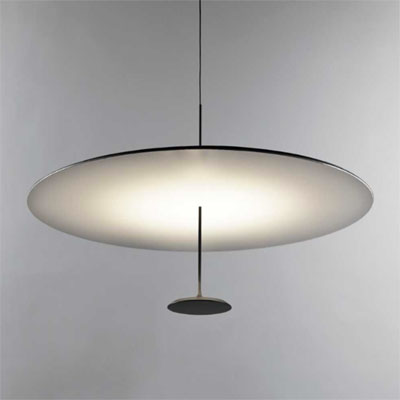
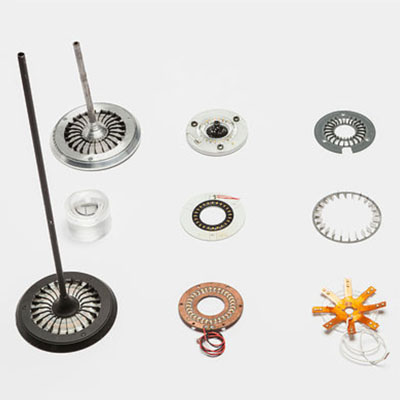
Some of the lighting pieces therefore are particularly complex. The Lumina Dot light a simple disc LED pendant lamp being one. LED’s give off a considerable amount of heat which is usually absorbed by a large heat sink. In Dot the LED’s are cooled by a fluid that runs through a tube connecting the lower LED disc to the heat sink in the larger reflector. The cooling fluid turns to vapour and transfers the heat to the heat sink. The vapour would then cool return to liquid and the cycle would continue. This in itself would be a beautiful diagram to see. Unfortunately there is little information at the exhibition and it takes the trained eye quite some time to work out what is going on. Why a product takes a certain form or how components were fabricated is what makes these exhibitions interesting and educational so please more information. Sadly students of design still naively believe that design is about inventing endless shapes and forms and increased design and production information at exhibitions such as this would help knowledge transfer.
It is an exhibition I will revisit as I still have too many unanswered whys? Why cast the heat sink? Why does any light product require so many parts? Why use Ductal concrete? Why cant we touch, feel the weight or texture of a material? The biggest why for me would be this – why does Foster + Partners find it so difficult to deliver organic forms and are happier with pure geometries. There are numerous talented students leaving the Bartlett each year that have an eye for soft complex computer derived geometries and many head straight to Fosters. Perhaps those at the top of the Foster hierarchy should loosen the reigns a little so that those in the office that are not yet associates may show what they can do?