
160916 – Dolly – London > words
I recently read a science fiction book in which the earth had been destroyed by a meteorite. Just before impact a Noah’s Ark’s library of species were sent into space where they were kept in a cryogenic state until the earth was ready for rehabilitation. The book covered multi millenniums of attempted regeneration of the earth with each successive attempt failing to maintain any permanence. In the most interesting of these attempts at terraform earth, man had evolved into a species without gender and with a collective memory. It was assumed that once man had prevented all illnesses including aging and was able to live for several hundred years biological need to reproduce would be lost. The laboratory provided new borns from cells preconditioned to resist known disease and illness. Over periods of evolutionary time the human race lost its gender and as there was increased similarity amongst new borns humans gained a collective memory. What was learnt by one human was immediately learnt by its closest relatives and offspring. This enabled humans to make collective decisions on issues of importance.
I once had a garden in which I grew a flowering hedge. I started with one plant and would take cuttings to grow the full hedge. The process was very quick and lacked any skill. The Hibiscus Rose of Sharon is a hardy and prolific plant. What I didn’t know at the time was that I had successfully performed cloning of a species at a 99% success rate on multiple occasions. The plants were clones as the male female reproductive route had been avoided and the DNA structure of each plant was genetically identical to its parent. I had created a hedge of perfect DNA cloned replicants. In horticulture, cloning is a natural form of reproduction and some species have used it for over fifty thousand years, blueberry plants and hazel trees replicate asexually with fragments breaking off of an individual plant to grow on and become clonal colonies. Humans have cultivated cloned plants for at least two millennia. Grapes and olives are known to have been cloned this way with their descendants still alive and producing today. Horticultural cloning raises few eyebrows but cloning of mammals is not met with as much acceptance.
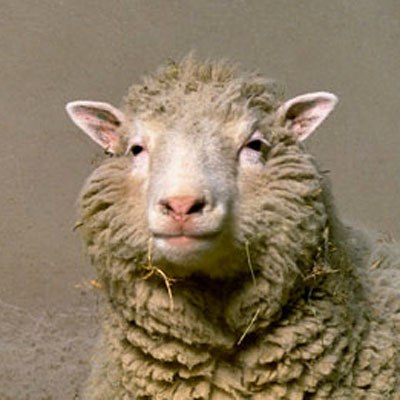
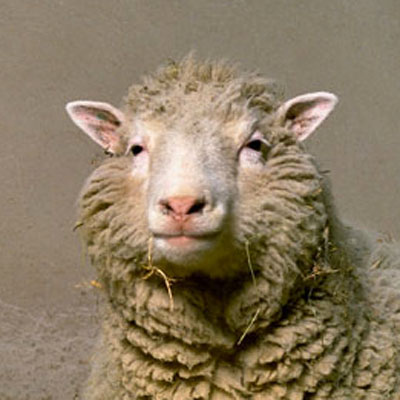
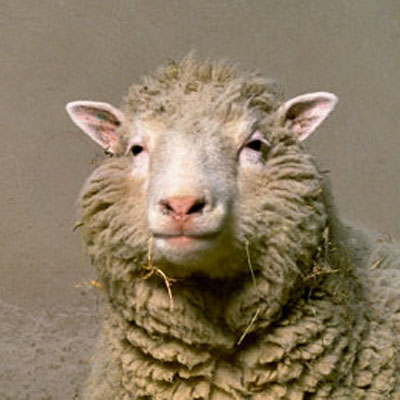
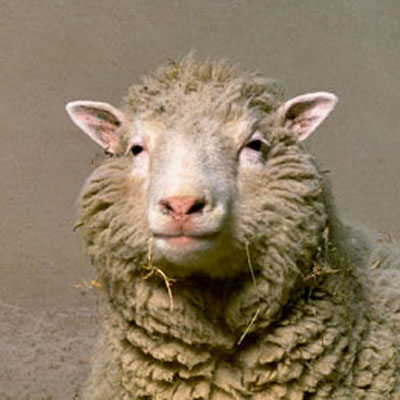
Code name 6LLS or Dolly the sheep was the first mammal cloned from an adult somatic cell. She was born on 05.07.1996 and had three mothers, one provided the egg, one the DNA and one carried the embryo. Dolly lived a fairly normal sheep life and went on to have many lambs through sexual reproduction. Dolly is the most famous cloned mammal as she was the first but many large mammals have been cloned since her birth. Dolly was the only success out of 277 attempts to clone a sheep back in 1996 however by 2016 the Korean company Sooam Biotech was producing 500 cloned embryos a day with an 80% plus success rate. It is now possible to clone mammals without the use of an embryo directly using pathenogenesis. In many Asian countries cloning livestock is an accepted way of maintaining food supply although the subject is still taboo in the west. So why is mammal cloning a taboo subject and what is holding up scientific progress in this area. Religion and conservatism play their parts but the main fear is not that of replication but that of improvement.
Cross breeding of plants (not strictly cloning) has existed for millennium, selective cross pollination to create stronger cereal crops has continued since we first ploughed a field. Larger, sweeter fruit, winter hardy vegetables, faster growing, two harvests a year crops, forever more diverse flowers, all accepted. Horses, dogs, cattle, canaries and numerous other mammals crossbred to produce stronger, faster, heavier, more colourful derivatives all also accepted. Genetically modified crops (GMC) are plants that have had their DNA engineered usually with emphasis on a particular trait, speed of growth, resistance to disease, nutrient profile and longevity post harvest etc. GMC’s again are met with resistance and yet in the US 93% plus of all cotton, soya beans and corn have been genetically modified. Genetically modified mammals are again taboo and are mainly still laboratory experiments.
The concept of cloning mammals and that of genetically modified mammals cannot be separated and are the obvious stepping-stone to the creation of cloned humans. There have been numerous films about human cloning and most adhere to the following themes. The cloned workforce or army used for those unwanted jobs like asteroid mining, intergalactic wars and the like. In these the clones usually rise up with intent to destroy the human race although this is subverted in the films Moon and Oblivion. Another genre would be that people are cloned for spare parts, the film Never Let Me Go is a disturbing version of this type. Lost lovers have been cloned as in the film The Womb, Spies have been cloned the film Imposter comes to mind. The moral dilemma of ‘is a clone human’ is often tackled, the film The Island as example. The eugenics of Hitler’s Master Race or The Brave New World of Aldous Huxley adds that touch of fear where man plays god as controller and dictator. The film Gattaca offers a modern interpretation upon this theme and this interpretation may be near to the eventual development of human cloning.
We all wish to be better than we are, to have better health, a higher IQ, increased longevity. When the human DNA sequence is fully understood and can be accurately engineered the market for these products will be considerable. Who would leave to chance through natural birth health conditions that could be removed from the reproduction process? Those that could afford to would immediately buy the best of everything and there is the first dilemma that access to capital has an evolutionary consequence (although one could easily argue that this has always been the case of capital structures and forced social systems). The second dilemma would be that of species diversity as ideas on aesthetics and preferences follow trends often dictated by media and markets. The third dilemma is the ecosystem in which the modified mammal, human or otherwise is introduced. Man has control of the individual product but not of the consequences of introducing that product into a balanced ecosystem.
If the body and the mind could be separated, the mind being software, memory, knowledge, the essence of what ‘I am’ and the body being hardware. The software could be reinstalled into the new cloned self each time the old cloned self reaches its renew date. Biological upgrades would be discovered on route for both hardware and software and a potential immortality would prevail. This increased longevity would be useful as mankind moves towards off world colonisation and space exploration. When human DNA is fully understood and can be coded, evolutionary strands will be first virtually modeled. The multi generation evolutionary timescale will be condensed into a few virtual research hours and the conclusions tested, accepted, adapted or rejected.
So here is my list of ingredients for my new cloned self. The body of Gisele Bündchen, the speed of Usain Bolt, the stamina of Mo Farah the agility of Simone Biles, the ability of Michael Phelps and the intelligence of Aum Amin. It would also be useful to add a dash of Warren Buffet assuming that wealth can be genetically encoded? Except of course like any new product it is probably best to wait for a couple of generations of product development to first iron out the many teething issues, flatulence, drooling, neural crash who knows? Then of course there is security, genetic hacking, Trojan sequencing not to mention the selling of fakes, a dubious discount market or post product updates. The genetic street markets in Blade Runner or new eyes in Minority Report have their call.
The Surrogate Twin