
010822 – Model T, 1908-1927. > words
15,007,033 is a big number, even today, but in the 1920’s it was huge, unimaginable, incomparable as it was the number of Model T cars sold between 1908 and 1927. The Model T had a greater influence than any other man-made object on the American way of life, with only the washing machine as a possible comparable, today the personal computer would also need to be considered. The cars made accessible, affordable freedom, access to travel, it opened up the roads and therefor helped urbanise, numerous businesses developed using the Model T as its primary workhorse. As a utility vehicle it was the family car, the doctor’s coupe, the builders flat back, the local fire brigade’s truck, the milk wagon, the police car and the ambulance. The Pullford Company quickly accessorized the Model T, advertising to make it a ‘Practical Tractor’ in less than 30 minutes, to be able to carry out all the work that four horses can pull. The Pullford Company offered plows, harrows, drills, mowers, hay loaders, road graders all as adaptions or add-ons to the trusty Model T. It was everyone’s ultimate utility vehicle. Famously it cost $850 dollars in 1908, its price increase to $950 dollars in 1909 but as the production numbers increased the cost came down and by 1916 a two-seater runabout would cost $345 and a four-seater touring car $360. There was no other car on the market offering as much for so little. The systematic mechanization of mass production inspired numerous copycat industries and lead to the outstanding rise of American economic growth throughout the twentieth century.
With fifteen million happy customers, it would be difficult to argue that it was a poorly designed car, but it did have some very crude details that could have easily been improved during the normal evolution of a car production life. This however was contrary to Henry Ford’s belief and aim as standardization and methods of mass production took priority when it came to design decisions. The Model T’s slow design evolution was compromised by Ford’s obsession with the ideas of inter-changeable of parts. A component from a 1908 machine would fit on a 1927 machine, and new parts could also be retro fitted. This gave the Model T great endurance and adaptability but also eventually its design became dated as other cars makes allowed the increase cost of their cars to fund the increased design development.
The Model T was not the first Ford. Henry Ford built his first experimental quadricycle in 1896 (although sometimes quoted as 1892) but commercial production did not begin until 1901. Ford built thirty cars and then his company collapsed. In 1903 Ford took a new approach and built a sprint car for use in the popular local track events, this was primarily to attract publicity, this approach succeeded and procured backers. The Ford Motor Company was then incorporated with the sum of $28,000 and production began with the Model A 1903-04. The Model A had a two-cylinder engine under the driver’s seat and a chain drive to the rear wheels. It was an expensive car at the time and did not sell well. This was followed by the unsuccessful Ford Model B, this was Ford’s first four cylinder car. Which in turn was upgraded to the Models C & F, all unsuccessful. Bowing to the pressure of his financial backers Ford produced an up market, six cylinder Model K which was equally unsuccessful. Briefly a Model N was developed but this quickly morphed into the Model T. Ford’s primary objective was always to build an affordable quality car that the man of modest means could buy and use on a daily basis. Cars at the time were very much a rich man’s toy or status symbol. In an all or nothing last attempt The Model T was developed and put into production in 1908.
Fifteen million cars sold and a huge commercial success but was the Model T a well-designed car? What was it really like to drive and own? To criticize a design, the needs to be put into context, the context of the times, the available knowledge of technologies and the available material technologies. A design also has a context of use, is it appropriate for its purpose?
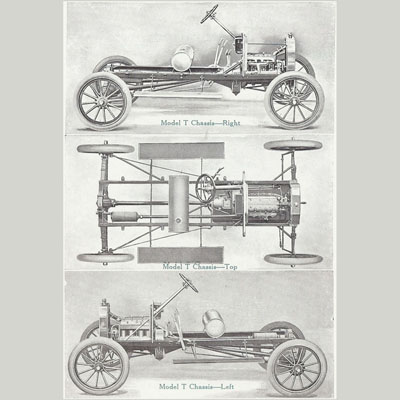
The chassis of the Model T is almost web like it is so delicate and fragile. The idea of a rigid chassis complemented with able suspension was not a design concept in the early 1900’s. The chassis consist of two thin parallel and narrowly spaced longitudinal C shaped channels with minimal cross bracing and thin radial rod diagonals to the rear axle. The track of the car was predetermined by necessity to run the cart ruts of the dirt roads. The chassis sat on transverse semi elliptical leaf springs back and front above the two axles. This gave the car a high roll centre, so it would sway or rock from side to side when on bumpy ground. The suspension, the chassis and the car body all flexed to soak up movements encountered when travelling. This would be nothing like a contemporary chassis, but it was fit for purpose, minimal and cheap to produce and could accommodate the poor roads. The flex through the chassis would eventually cause metal fatigue at all stiffening junctions and there were after-market solutions to this but in general the chassis was strong enough and appropriate for its intended use.
Henry Ford came across Vanadium steel at a racetrack on a crashed French race car. He was impressed by its strength, and weight and took a small sample for analysis and upon learning the production process he used this metal on the Model T. Vanadium steel was an advanced alloy of the time and the Model T used Vanadium steel in many places including the chassis. Vanadium steel was lighter and stronger than carbon steel, parts could be made smaller and lighter. This reduction of weight and minimalization of components, ease of assembly, access and repair were key concepts to Ford’s design philosophy. Cost was kept to a minimum by not having certain components. There was no brass, no footplates, no locks on the doors. There was no petrol pump as the tank was stored high under the seat and gravity fed to the carburettor. There was no fuel filter, any sediments fell into a bulb below the tank and could be drained. There was no water pump, water was circulated via convection, this was ok for the many open roads but not great for congested traffic, but most roads were open. There was no oil pump, the crank splashing through oil in the sump provided lubrication, a very primitive solution made worse by a very shallow sump. The gearbox used the same oil as the engine and rotated in a shallow trough of oil, the flywheel with its magneto splashing oil as it rotated. Even by using the two transverse semi elliptical springs, one per axle, saved weight, usually there would be two per axle one in each corner of the car. Running a machine that was missing all these components meant that the Ford Model T needed a lot of manual adjustments and a high level of regular maintenance.
The engine was a cast iron four-cylinder, in line, longitudinal monobloc. The engine bloc incorporated the pistons with water cooling jackets and crankshaft top mounts. A cog driven camshaft run off the crank opened inverted valves via pushrods. All of this within the cylinder bloc. The cast iron cylinder head was separate and housed only the spark plugs. A copper asbestos casket separated the head from the bloc (a Ford invention). The combustion chambers were L shaped, flat over the piston chamber and extended to overhang the valves. By contemporary standard this provided a very poor combustion chamber configuration, but this was unknown at the time. Ease of fabrication and maintenance drove design decisions. The head and block design, separated by a gasket were state of the art in 1908. Engine block and cylinder heads were often cast as one unit, also a four-cylinder monobloc incorporating water jackets was up to date engineering in 1908. Cylinders would usually be built in pairs and then paired. The aluminium sump was also separate and bolted to the bottom of the engine bloc. The Model T’s sump lacked depth, this would cause bearing problems on all cars and the crank had no counter balance and very long levers, more nodding donkey than motorcar but again this was normal for the period. The camshaft is driven off the crank and these via pushrods operate a side valve head. The engine was 2.9 litres and develop 20hp or just under 7hp per litre a deplorable inefficiency by contemporary standards but adequate for the day where inefficient 6 litre plus engines were the norm as capacity was the easiest way to create power. The crank had three main bearings and the engine had a 1243 firing order (modern car 1342). The engine, like cars of the period had a long stroke, meaning that the crankshaft has a wide radius. This gave good torque but limited the engine to around 1800rpm as the moving components were heavy. The long stroke also made the engine bloc very tall. The low rpm, high torque and light weight of the car gave it 13mpg on unrefined 40 octane fuel, a high mpg for 1908. The compression was only 4.5 to 1 allowing the engine to run on kerosene, alcohol or other poor-quality fuels of the time. The low compression also made starting by hand cranking easier, electric starters were not available as an option for the Model T until 1919 (although invented in 1903).
The whole transmission fits via a bell housing to the engine bloc, this is again contemporary, around this time gearboxes tended to be separate components attached to the engine via shafts. The Model T engine and gear box were tidy and compact unit by the standards of 1908. However, the Transmission is nothing like a contemporary gearbox. It uses elliptical planetary gears that are in constant motion as the engine turns, this drives a gearbox drive that is also in constant motion. The gears are engaged by friction collars, initially made of steel clamped cotton, operated by three pedals. Each pedal tightens a collar around a spinning pulley. The pedal on the left is pushed down and held down to engage a low forward gear, its central position is neutral (it slips), when released, top position, it engages a high forward gear. The pedal in the middle is held down to engage reverse. The pedal on the right is held down to apply a brake to the engine rotation via the transmission. Transmission braking was the norm on the early cars, most had no wheel brakes at all and only later had rear wheel brakes. There was a rear emergency brake, operated by hand and this was rod driven, its primary role was as a parking brake.
There was no battery and no dynamo, there was no high voltage distributer as in modern cars but instead four multi-spark coils firing spark plugs one per cylinder. This provided multiple sparks in the combustion chamber. There were two levers on the steering column one controlled acceleration and the other controlled ignition advance and retard. The Flywheel magneto was a simple way to generate electricity using the rotation of the flywheel as the engine turned. Magnets mounted on the flywheel move past coils mounted behind the engine this generated the electricity that fired the spark plugs. The magneto would be dropped on later post Model T Fords. The Model T was a perfect example of precision engineering of its day. A Rolls-Royce, the obvious symbol of precision and quality, was hand crafted machine with each of its parts a one off, each car bespoke. The Model T factory produced interchangeable identical parts.
“Any colour as long as its black”. The Model T’s were at first produced in many colours, eventually as production numbers increased black was the primary option as black was the fastest air drying paint, the cars stood outside to dry. Every aspect of the Model T’s design was to cut costs and produce a machine at the lowest possible price. Making the car available to a wider cliental, instead of a car only for the rich, was Henry Ford’s social mission and this determined all design decisions. The car was an amazing success and socially revolutionary. It used the best materials, up to date technologies for both car design and manufacturing, all of which were amazing achievements for 1908. Model T sales peaked at 2,011,125 units sold in 2013 and then began their decline. In total 15,007, 033 units were sold through to 1927 and approximately 60,000 still remain. Today, the Ford Model T ranks ninth in all time car sales of one production model but this today is with a global population considerably greater than in 1908. Relative to population the Ford T would still be the number one selling car.
The Model T’s main design failure was that it failed to evolve over its production period. Cars that have long production runs such as the Volkswagen Beetle, selling 21,529,464 units evolved considerable between its 1938-2003 production dates. The Model T not only failed to evolve Ford’s had no other car to offer until the Model T was taken out of production. It was replaced by the Ford Model A, 1828-1932 that sold 4.8m units during it production run. However, by then the other car makers had caught up and competition was fierce. The Great depression first hit in 1929 but by 1931 was in fall momentum, this would affect all aspects of manufacturing as survival was the prime objective for the next decade.
The Model T is a very beautiful car, it is designed as, and is recognisable as a contemporary car. It has the engine in front, shaft drive, rear differential. It has an enclosed passenger compartment, it is operated by a steering wheel, foot pedals and hand controls and yet it is still possible to see its carriage routes. The transition from horse and carriage to horseless carriage was long and complex but the early 1900’s witnessed increased speed of consolidation of design and technological development. The racetrack became the testing ground and manufacturers quickly assimilated all the best ideas into each model. The two World Wars further hastened technological development, with cross-over technologies and skills migrating across the various engineering disciplines of aircraft, weaponry, product design and car manufacture.
The Model T was Henry Ford’s most famous car. However, Henry Ford will always be best remembered for his introduction of Mass Production design and techniques to the industrial world, a system that would be copied by every other volume producer in the following decades. The production line system of high-volume mass production would not be superseded until Toyota’s Lean Design systems on the 1980’s.
Images
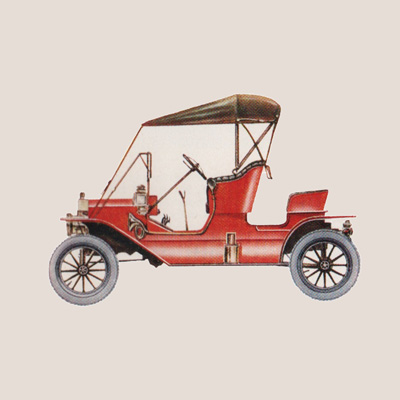
- 1. Model T, 1911 Runabout
- 2. Model T, Chassis
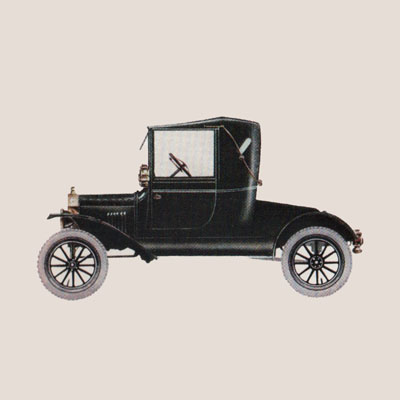
- 3. Model T, 1916 Doctors Coupe
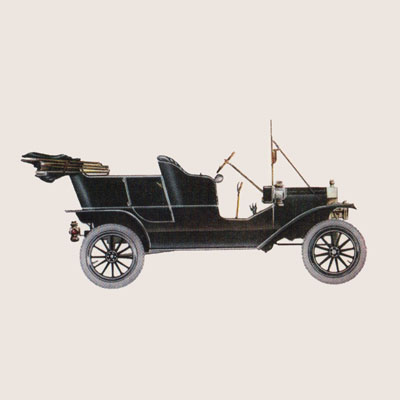
- 4. Model T, 1911 Tourer
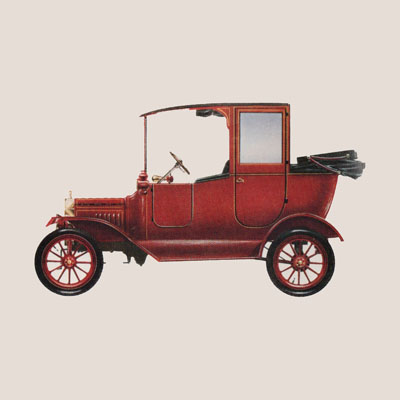
- 5. Model T, 1915 Town Car
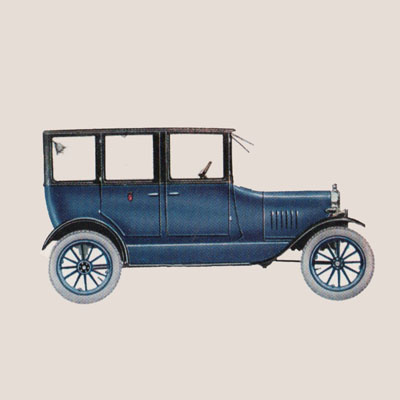
- 6. Model T, 1923 ForDor Sedan
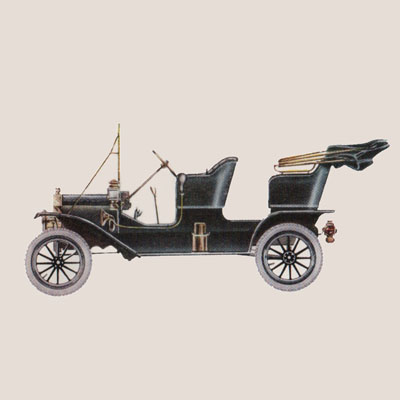
- 7. Model T, 1909 Phaeton