
010716 – Environs 1 – London > words
We are constantly presented with new terminologies, smart materials, disruptives, robots, drones, virtual reality and wearable tech, we need first to remember that design is evolutionary (See text Environs 2). Todays amazing realisations have their roots in the conceptual projects of the past. These projects have been evolving incrementally in the research labs of architectural and design schools for many decades. Over time each isolated experiment has been collected and collated by the next generation into ever more comprehensive products and environs.
The 1960’s were one of the richest periods of liberal free thinking, many conceptual ideas that were crudely sketched or montaged then have since formed the roots for endless projects, some realised, some academic. Examples include The Mowbot, derivatives of which can now be bought in the high street, The Electric Tomato now comes in the form of an iPhone. The intangible sensory environments of the past are fast becoming reality with the growth of virtual reality, holographic projections and automated environments. The Internet of Things will soon spread from the home to the city. The potential of free solar power and wireless energy would mean that information and animated responsive environs are only a few years of development away. We are moving away from mono specific tools towards multi specific tools. Just as the computer, the phone, the watch were once mono specific tools they have now evolved into tools of multiple application. Other products will follow suit, the car will become the library, the energy storage centre, the entertainment centre, the bedroom, the office. As tools move from mono to multiple applications an overlap between products will make many objects redundant. Preexisting semantic forms will no longer have relevance. The move from micro to Nano will continue the pursuit of the ephemeral as objects slowly disappear. Everywhere access to a global cloud will enable the place less international nomad not so dissimilar to the ideals proposed by Superstudio. Micro climates of information and energy stitched invisibly into landscapes and ecologies are now a very feasible possibility.
So as a point of reflection here are some favourite projects.
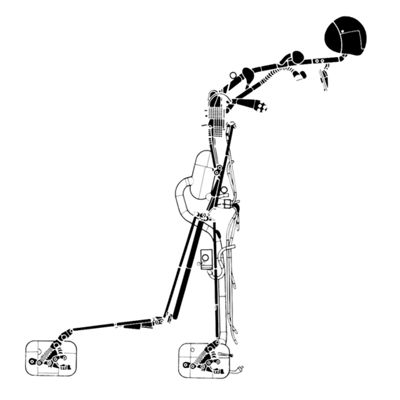
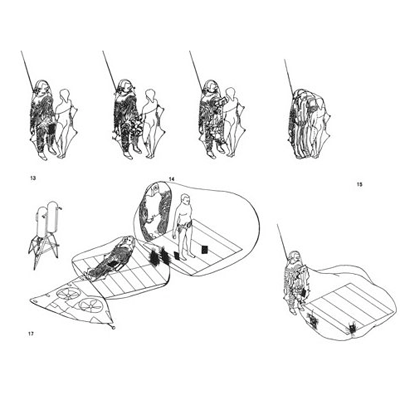
1967 – Suitaloon and Cushicle, Mike Webb.
If it wasn’t for my Suitaloon I would have to buy a house. The Suitaloon is a wearable environment. Each suit has a plug. You can plug into a friend and two suits become one, or onto any envelope. The plug serves as a means of connecting envelopes together to form larger spaces.
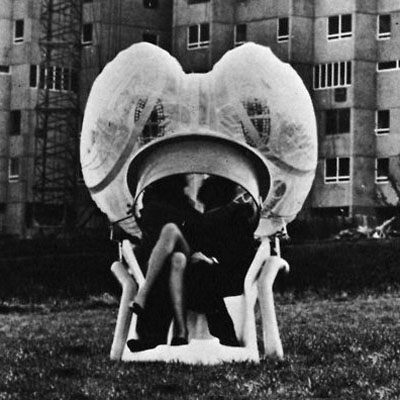
1968 – Pneumatic Space for Two, Hans Rucker.
The all encompassing sensory environmental capsule for friends.
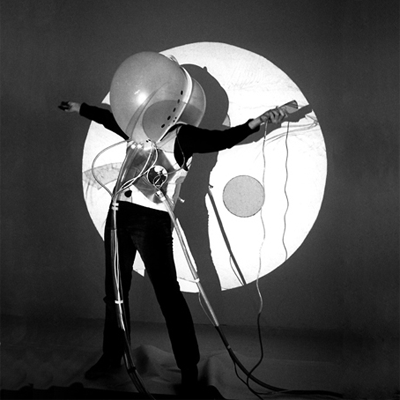
1969 – The White Suit, Coop Himmilblau.
The White Suit has sounds, projections and a pneumatic vest for tactile transference.
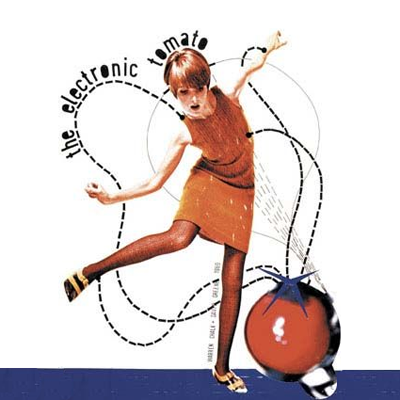
1969 – The Electric Tomato, Ron Herron, Warren Chalk, David Greene.
The Electric Tomato or Manzak is your own cyber friend, all the sensory equipment you need for environmental information.
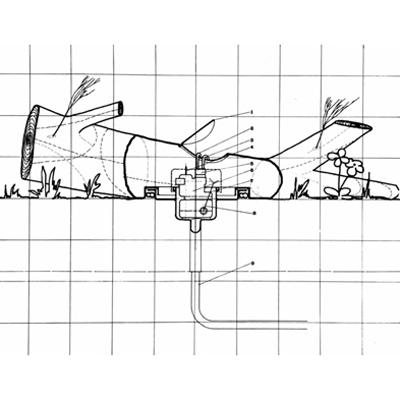
1969 – Logplug and Rockplug, David Greene.
A system of distributed nodes for energy, communication and services.
1970 – The Mowbot, David Greene.
An automated work pet.
And some favourite permeable environments.
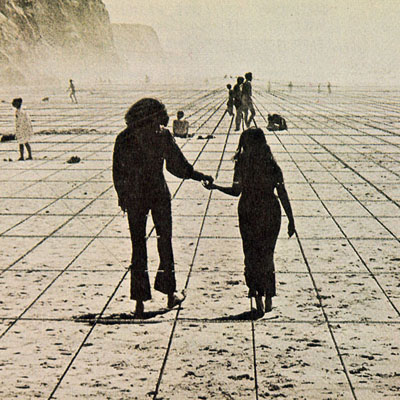
1967 – The Continuous Walk. Superstudio.
The world is imagined as a network of energy creating new artificial panoramas between man and the environment. This continuous permeable surface encircles the planet with its thermally controlled and modulated microclimate, it is without borders or enclosure.
1968 – All Watched Over By Machines of Loving Grace, Richard Brautgan. (extract)
I like to think
(it has to be)
of a cybernetic ecology
where we are free of our labours
and joined back to nature
returning to our mammal
brothers and sisters
and all watched over
by machines of loving grace
The Surrogate Twin