
290716 – Electric 1 – London > words
In the 1890’s the automobile industry was in its infancy, three fuel sources contested to dominate this new technological marketplace that of steam, electric and petrol and all were on equal footing. Today in a world dominated by and with a long history of petrol fuelled cars one forgets that steam and electric at the turn of the century took an early lead. Steam already had 100 years of railway R&D and the steam engine had been about for nearly 200 years. Adapting a steam locomotive to the roads should not have posed too many problems. Electricity had a 200 year history with electric trams having 100 years of R&D. A full three years before Bertha Benz borrowed her husbands latest invention, the three wheeled Benz Patent Motorwagen and in 1888 performed one of the best marketing drives of all time, English and French companies were already producing batteries, dynamos, motors and controllers ready to supply the infrastructure needed for the dominant vehicle of choice, the electric car. Electric cars were easy to drive with a few hours tuition required. The motors required no preparation, there were less moving parts, they were relatively silent and made no pollution. In the late 1890’s electric cars had already set land speed records travelling at over 65mph (100kph). So why by the early 1910’s had they all but been forgotten in a world of petrol fuelled dominance?
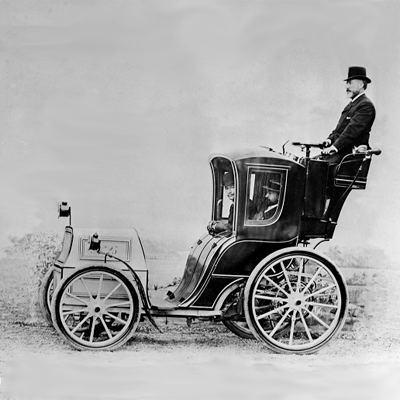
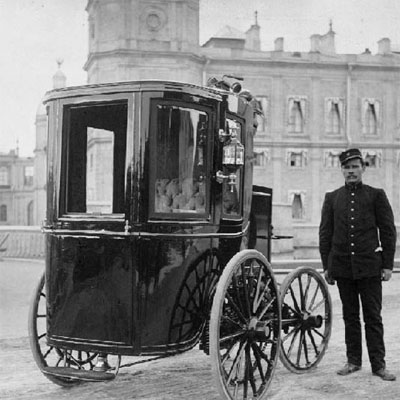
We have to also remember that the automobile at the end of the 1890’s was never considered to be a possession but instead a hired utility. Very few people owned a horse and carriage especially in cities where space was at a premium. Carriages were hired, they were the cab companies, being an owner driver was never a desired Edwardian consideration. As such the driver was the invisible servant, he sat atop the carriage exposed to the elements and the carriages themselves were social spaces, warm and protected, people sat Vis å Vis. The cities were polluted, coal fires for housing, poor sewers and the streets were covered in horse manure and urine. When the potential for an electric car became an affordable reality the cab companies were the first to adopt them to replace horse and carriage. The cab companies already had city infrastructure for its horse carriages. This infrastructure could quickly be converted in whole or in part as charging and battery replacement stations for the new electric vehicles.
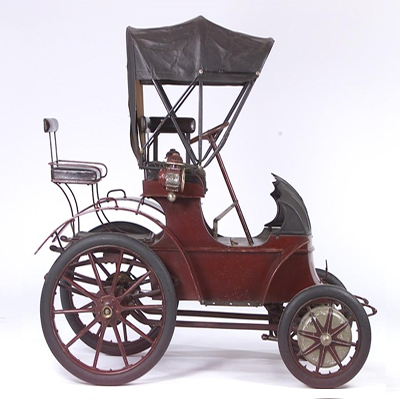
From 1900 to 1910 40% of all cars sold in the US were electric with only 22% being driven by the internal combustion engine. Most cars were only used in cities where range was not an issue and outside of cities roads were too poor to be used by any vehicles. Only later when smooth roads were built linking cities were longer journeys desirable. Early on electric vehicles were a superior technology. The 1899 Lohner-Porsche amongst others had numerous innovations including wheel hub motors, regenerative braking, an electronic / petrol hybrid variant, a slide out battery compartment for quick change instead of charging and although normally driven in full electric mode by two motors one on each front wheel a four wheel drive version was made. Unfortunately for electric vehicles the battery was always the weak link, it was heavy and had a low energy density and was further disadvantaged by extreme cold and poor charging infrastructure. The invention of an electronic start for the internal combustion engine and the production of Henry Ford’s first Model T, a car that sold at half the price of any electric vehicle, only hastened the demise of the electric car. As production increased on the Model T the purchase costs kept getting lower, speeding the downfall of the electric vehicles.
Commercial delivery electric vehicles ran on for a little longer. In Europe during the war years petrol was unobtainable so industries relied on electric power to shift heavy loads. In the UK electric delivery vehicles ran on through the 1960’s and 70’s, electric milk floats were a common site within the English townscape. By the 1960’s the problems caused by pollution produced by the internal combustion engine was a known entity especially in high-density countries like the UK. Town planning acts began to propose the expulsion of petrol vehicles from city centres and offered the idea of inner city traffic being all electric. Numerous electric micro cars were produced to support the planner’s ideas but many of these were poorly made and often looked more like large toys than real cars and they were never able to capture a commercial market. In the US in the early 1990’s General Motors produced the EV1, partly in response to the Middle Eastern oil crisis and partly as a solution to the LA smog. The EV1 was the first serious contender for a mass produced electric car but the oil and motor industries quickly realized that a car such as this would cut into their profit stream so they used their political might to terminate the project.
Historically there is a transitional period whenever a new technology is introduced. The transitional period is one of the most interesting as precedents are carried over from tangential industries and designers search for form through established typographies. For materials examples would be stone imitating timber in classical architecture, steel imitating timber and stone in Victorian architecture, plastics imitating numerous other materials. In design examples would be the computer or the radio, in architecture the Chicago skyscrapers desperate search for an aesthetic language to deal with the new multi-storey buildings, in transport the transition from horse and carriage to horseless carriage. All of these transition periods search for a visual aesthetic whilst further related material innovations push the medium. Eventually a winning combination materializes and with the acceptance of a new material or technology its individual merits can be exploited. Similarly as the aesthetic language for a new product becomes established and focused continued refinements ensure rapid innovative development; the radio, the TV, the computer, the train, the car, the plane, all being typical examples. In the free for all of the early days designers and inventors test their ideas with eclectic crude prototypes. Usually these prototypes have a strong bias towards one aspect of the design, often they can be very wide of the target e.g flapping machines for flight, but sometimes they are only off target as technology or society were not ready, sometimes good ideas get lost as bad ideas receive better marketing or funding. People are always looking for the shortest and easiest route to profit or problem solve and the shortest route is not always the best e.g. DDT, chlorofluorocarbons, pre-fabricated tower blocks. With regards to transport as the internal combustion engine gained dominance its embedded finance and technology make it ever harder to displace by alternatives.
With the recent resurgence of electric vehicles again, design moves through another transitional phase where precedent dictates form……electric vehicles look like cars, they have a bonnet and boot, they have a grill and radiator vent, they have a central transmission tunnel, they have dials, switches and knobs, they are obsessed with speed and the image of speed, none of which have anything to do with the future role of the electric vehicle. If autonomous driving becomes an everyday reality by the 2020 ETA expected the driver will once again sit metaphorically outside the carriage. If the electric vehicle becomes further integrated with the home and the Internet Of Things as would be logical, sharing components, battery packs, charging systems, information, interchangeable motors, servos and other parts, it may be worth considering the electric car of the very near future as a detachable room.
Assuming that we achieve autonomous electric vehicles the majority would probably be available to lease cab services, bus services and delivery services. One would imagine that the majority of inner city over ground transport to be first implemented would be small utility vehicles. Even large loads could be delivered via electric vehicles from distribution centres outside the inner city, again these would be shared and leased. The vehicles may be little more than electronic platforms onto which containers, cranes etc. could be loaded. If the electric vehicle is no longer a possession, the car designer’s obsession with speed and status become obsolete. Aerodynamic forms at sub 30mph inner city speeds become questionable. Shared cabs become social spaces, single person and double person transport would be little more than an enclosed chair, any distance travel may have a sleep pod.
Future design solutions to yet unknown requirements will invent new forms that will sit above a platform of batteries and sensors. The platform has no front or back as it will travel equally in either direction, with four wheel steering probably also sideways. We are again in an interesting transitional period not dissimilar to the beginning of the twentieth century and perhaps there are lessons to be learnt from the many ideas that were shelved during that exciting period of pioneering development however eccentric they may look now.
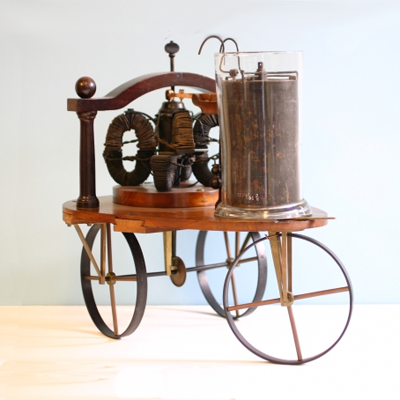
Images chronological order left to right
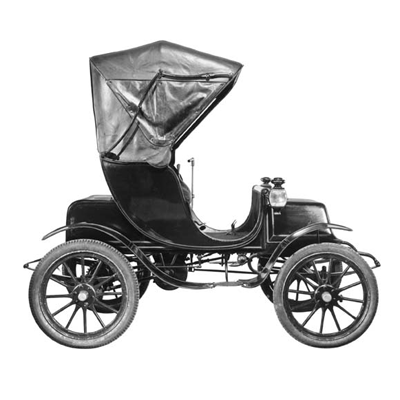
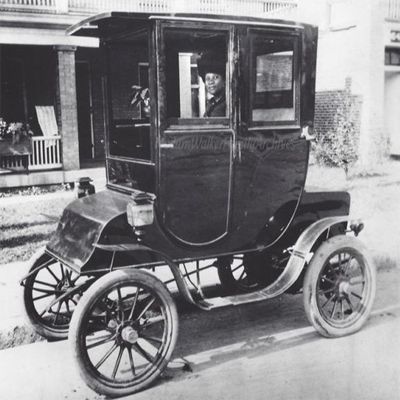
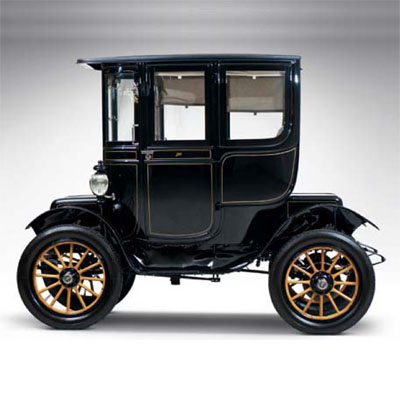
1835 Sibrandus Stratingh, c1898 Jeantaud electric cab, 1899 Lohner Porsche, 1899 Hippolyte Romanov, 1902 Studebaker, c1914 Waverly Electric, 1912 Baker Electric,
The Surrogate Twin