
121116 – Rauschenberg Static – Tate Modern, London SE1 > words
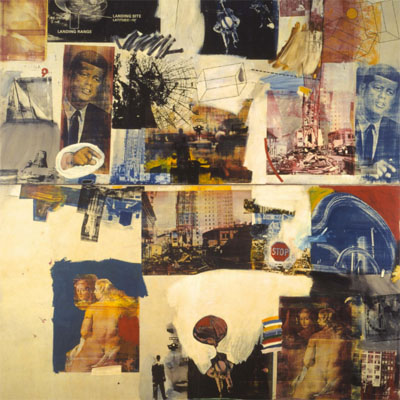
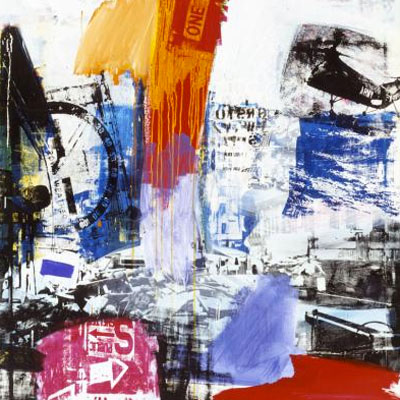
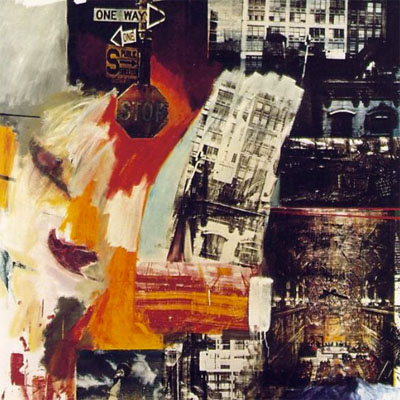
The radio is stuck between channels in the vacuum not yet immersed with signals. In and out of range drift the nearest stations as if somehow the wind blows one nearer or further from the receiver. This ether, the zone between, is the static of the yet to be known. It is outside of my control and its sequence as yet unwritten. A blues riff can be heard then silence, a rose tinted love ballad, a news clip about rockets, war and space, an ad for soap, celebrity gossip then more interference. Over this I hear a distant aircraft, a clanking metal fence and the wind through the trees. If one could capture ten minutes of this static and compress it to a picture plane, the space created would be a Rauschenberg. It is the space of here and now, the space of today made from the fragments of memories and experiences of the moments that make that period of time. This compressed picture plane recalls events, the word recall is subjective as we chose what we recall, good and bad, relevant or pointless. We weigh each of these clips, some monotone, some vibrant, some clear and over powering and compose them. There is no one concluding narrative, no story to tell, just a period of time taken from the confused discarded past in which we lived.
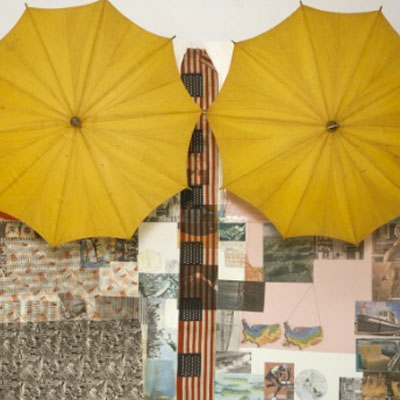
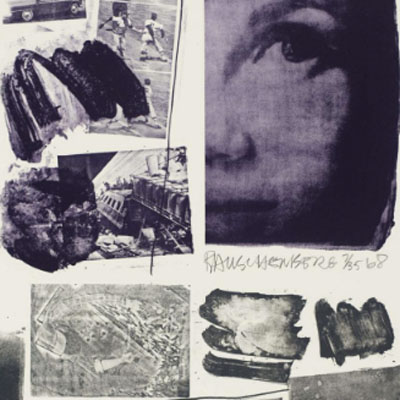
Place and event was never the picture perfect still photograph. We never occupied the conventional photographic space as it cuts a slice of space-time that is far too thin and too precise. We instead inhabited the woolly blur of a past that was driven by choice in a space that was determined by others. The consequence of these events with all their spontaneity and contradictions, neither controlled or ordered, not random or improvised but somewhere in between are captured on a Rauschenberg canvas. In Rauschenberg’s work there are overlaps and confusions, there are sharp and blurred edges, some images stand clear in the void, clear in the static, but there is always impurity. These compressed picture planes are hypersensitive screens or filters offered up for others to interpret. The art interacts with the viewer, the observer, through their own subjective valuation of image and their associated recall. The art further interacts with the viewer by having objects jump off of the picture plane and into the space of the gallery. The office fan or the taxidermy bird sit in the real space of the gallery in front of the compressed space of the picture plane but physically tied back to it, part of it.
To my students I would say that Robert Rauschenberg and Andy Warhol were the last relevant artists where arts role was to mirror life. Art as commentary or as the conscience of society in which the artist lives, a mirror to the world, real or metaphorical. Rauschenberg described himself as a reporter. Art beyond this date becomes something else as it is so closely linked to popular and celebrity culture its only objective is to garner fame and capital. It has become a brand-based commodity.
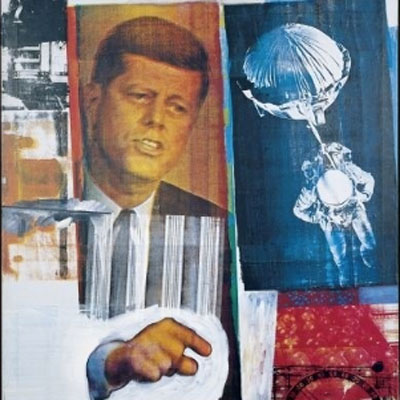
In the era of mass communication where the airwaves are saturated by TV, radio, advertising, newspapers, comics, fiction, and film, one can flip through channels as easy as turning pages, but the meaning is lost. A war is represented with the same emphasis as the coke bottle. Genocide and washing powder have equal footing, or a story about genocide is repetitively interrupted by adverts about washing powder and this makes for a very strange world. With time reality, fact, fiction and ultimately values become blurred. When constantly experiencing the world through the third person, the mediums of communication, everything turns to fiction. In this world without scale, where fragments are de and re-contextualised, associations enable a wide subjective interpretation of fact. Marketing collates the majority subjective interpretation and helps establish this as a mainstream truth. The world is collaged, condensed and flattened, subjective emphasis helps enhance the story we wish to read, the image we wish to see. Rauschenberg’s work dives straight into this static, where meaning through association are loaded and biased. A world where careful editing may re-write history but here it represents an existential world where there is neither right or good, it is just there.
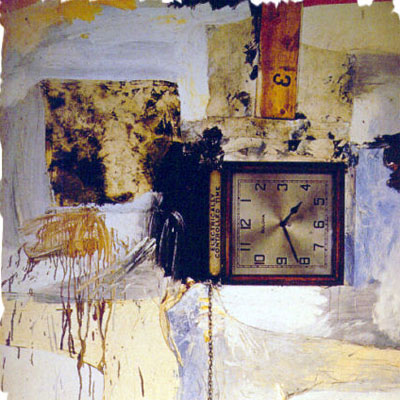
The narrative in a figurative painting tells a constant story to those enabled, through education, to read its signs and symbols. Semantic content is made lucid through the use of composition, light and line. The meaning is the mere assemblage of its parts. The collage is non-directional. It first presents itself as a texture in which one can recognise familiar occurrences. These recognised occurrences are strung together with a subjective construal based upon personal values. The collage may tell differing stories to its varied audience but more appropriately the collage is how we receive information in a world of mass media. Time is no longer linear but fragmented, scale less, fed to us in clips, with each clip already removed from its original source by framing, speed, saturation or some other form of manipulation. In Rauschenberg’s world this representation of space-time is not only recorded by the use of image but also equally represented by artefact, the found and the discarded. In any existential art there is, by definition, no moral or meaning it just exits. Perhaps this is why art after this period seeks accreditation through popular appeal and capital valuation.
On 041216 to see the Rauschenberg exhibition at the Tate Modern held an unexpected surprise. The compressed picture plane in combination with the use of ready mades that free stand within the gallery space had the most unexpected presence. The Rauschenberg two-dimensional work captures a pocket of space-time from a now distant time zone, this is a painterly space, a virtual world. The ready mades sit in the gallery in real time, they invite the viewer to interact, they are part of the viewers space occupied in the present. Working elements such as lights and fans enforce the suggestion of occupied present time. This space immediately in front of the picture plane forms a transition zone an area of space that is the ‘in between’, both part of the virtual world and part of the real world and simultaneously part of the 1960’s/70’s and part of the present. The effect is subtle but a precursor for the new spatial type that we experience regularly today and will become a more prominent spatial type as VR increases in mainstream usage. For now we’ll call this space Wii space after the computer game, as this is the most obvious dislocation between inhabited and experienced space. Where the inhabited space is physical and in the present and the experienced space is virtual either purely virtual or jointly occupied by other users that could be located geographically anywhere. Augmented space explorers such as the Pokemon player inhabit this zone. Platforms such as Improbable SpatialOS (recently bought by Google), where infinite virtual worlds sit within the cloud, these can be simultaneously occupied by thousands of users and will soon become everyday.
As we spend forever higher proportions of our time occupying semi virtual space with new markets and experiences opening up within the created virtual worlds, we continue to occupy the ‘between zone’ or ‘Wii space’ and become ever more divorced from reality. In many ways urban life has already moved us one step from natures reality. We occupy cinemas, libraries, retail parks, offices and stadiums, each focused on an isolated activity often deliberately escapist and unworldly. We move between these disconnected spaces without a second thought, out of the cinema, across the transportation zone, into the café, where each space is given a specific activity and purpose. We forever continue to compartmentalise and subdivide and with each subdivision the transition from each spatial type to the next becomes absorbed as normality. Natures space is continuous and fluid, perhaps it is this lack of subdivision that makes natures space so daunting as we prefer everything boxed and mono-purposed. Our very idea of order begins first with compartmentalisation something so very alien to symbiotic nature and now so irrelevant in a world that is becoming ever more interconnected.
Rauschenberg’s work was never constructed to offer solutions or critiques it simply captures a period of time, with all its influences and confusions, and simply reflects that this is ‘us’ now.
The Surrogate Twin