
291216 – Story Board – London, W2 > words
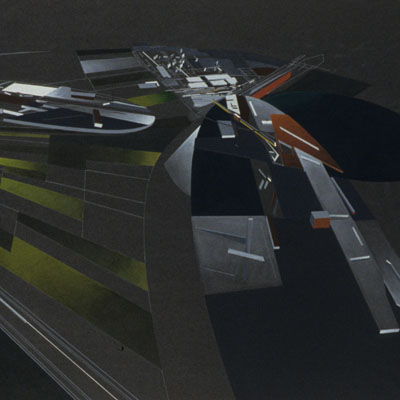
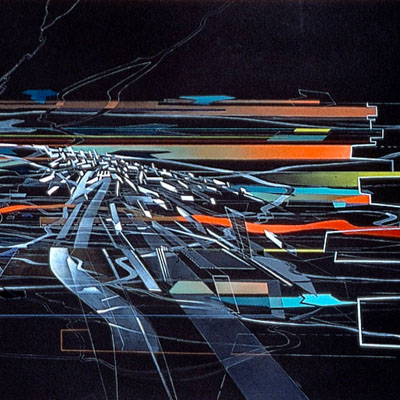
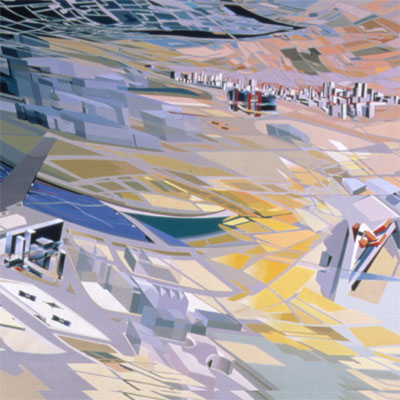
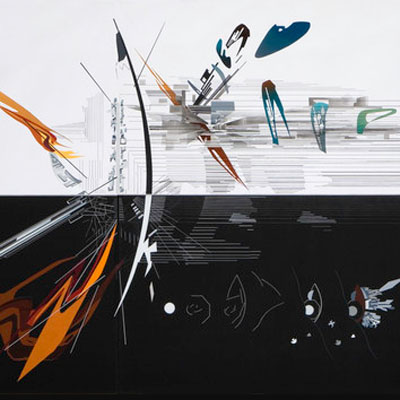
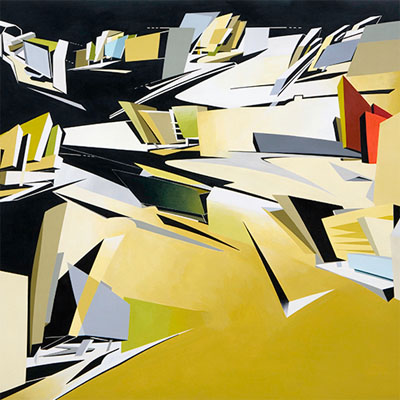
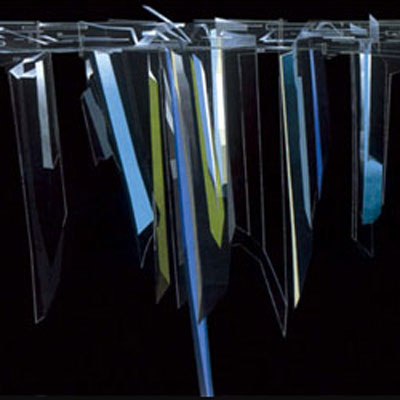
Zaha Hadid, paintings, The Serpentine Sackler Gallery. It is impossible not to reflect on the influence of the AA on architecture during the 1970’s. It has been over thirty years since I last saw these paintings and with retrospect the AA and Zaha’s work are impossible to separate. There is the influence of Tschumi, Koolhaas and Zenghelis all plain to see etched across each canvas. Each painting is multi layered, a storyboard that builds the presence of the idea for a building. The drawings are elaborate sketches, they are produced before, during and after a project. They do not conclude but are instead thoughts in progress with notes from the margins all overlaid. A drawing may have two or three perspectives. The same drawing may be redrawn, recomposed using a different colour palette. The painting is the storyboard of this process but it is also a stepping-stone, it surmises and collates ideas about a project to a point in time from which the next part of the journey may begin. The drawing collates and inspires, it is fluid, has calligraphic speed it is poignant and expectant.
Traditional architectural drawing is a static conclusion of the work to date, it is slow and time consuming to produce and the drawing process often does not keep pace with the thought or development process. Traditional working drawings are also very much about resolving issues, structure, services, composition, context or massing. Zaha’s drawings search more for feeling, they are more intuitive, where intuition is the combined reaction of knowledge and experience. The space is painted as a sequential viewing, forcing the viewer to move back and forth as if they were walking around a sculpture.
But the paintings are also more than a storyboard. The shifting perspectives and the changing light capture the essence that space and time are intrinsically linked and that we experience space by walking through and around it. That space itself is a moving entity on a spinning planet orbiting a star that is its life-blood. As the space follows this trajectory it encompasses the diurnal range of light and dark, the seasonal range of hot and cold, wet and dry and the passage of time. The building ages and with aging its context is changed, both the historical context from which the space is viewed, the physical context in which the space is grounded and possibly also the utilitarian context in which the space is used. Through all these movements the space is slowly forever in constant flux.
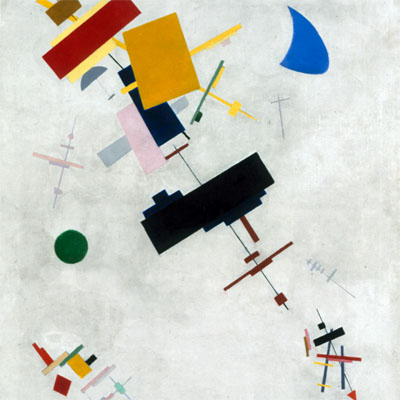
In Zaha’s paintings we can see the influence of Tschumi, where space and event are a symbiotic filmic sequence. The paintings are optimistic, devoid of history, forward looking. The drawings are also a way to focus and direct the conversation by editing out all that interferes. Block colour simplifies the context to hue, light, shade and mass. Poetic license allows for the sweeping statement and through the sweeping statement we have access to the vision of what could be. Whole urban landscapes simply become faceted planes into which insertions are made (Zenghelis again). Then there is Koolhaas and the link to the Suprematists, the block axonometric that rides up the page like a medieval perspective. The Malevich Tektonik, the colour bock composition.
These are drawings of initial ideas and sketches, intuitively procured and then elaborately drawn by teams. They are large drawings that take time to set up as each is not a single drawing but is made up of multiple layers and perspectives. Some take months, the Trafalgar drawings would be one such example. They depict the Trafalgar Square project over a 24hour period, they show the square by day and night, from the back and the front, from near and far, they have elements that are transparent as both the inside and the outside are viewed. Zaha’s exquisite ‘eye’ for composition gives the paintings credence and beauty. Zaha’s aesthetic skill is one that few can match across an oeuvre of work that transcends so many mediums and scales.
The paintings are without question beautiful and are now very much part of brand Zaha, they surmise the direction, aesthetic and aspirations set by the designer. As tools for communicating a project they require considerable decoding, they are an additional language one needs to learn to decipher. Within the historical context at a time when all is ephemeral, transitory and evolving at such pace building a static representation of the movements and energies that shape a site may be, at this point in time, a necessary response. To represent the fluid is to build with fluid forms.
See also text 310316 – Zaha Hadid – London.
Images left to right – Details from –
1 Kazimir Malevich (1878-1935) 2-7 Zaha Hadid.
The Surrogate Twin