





100117 – The Yoko Towers – London c10/1991 > words
Termites and Butterflies
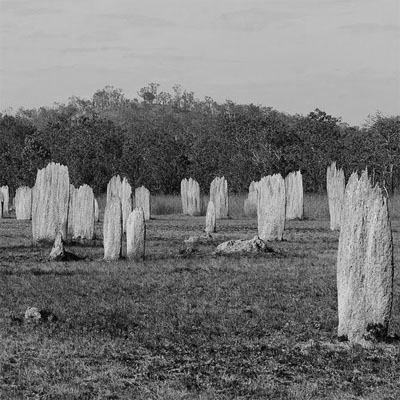
The Amitermes Meridionalis also known as the Magnetic or Compass Termites of Western Australia build their tower homes aligned to the sun. The termite mounds are elliptical in plan. The termites build the long axis of the ellipse north south; this aligns with the sun offering the smallest solar exposure with the narrow edge of the nest fronting the midday sun. The east and west facades of the nest are expansive and maximise morning and evening solar gain. The base of the termite mound goes deep underground, sometimes as low as the water table; here temperatures are low and stable. The sidewalls of the nest contain ventilation shafts that have a two-fold purpose; they insulate the inner nest from the sun whilst allowing the escape of hot air vertically up through the vents in the sidewalls. As the stack effect of heated air climbs the vents, cool air is drawn in at the base or from the voids created below ground. This form of natural solar ventilation helps maintain the lower and steady interior temperature of the nest that is required for egg laying and fungus farming.
Iridescence may not always be caused by pigmentation but by structural colour. Structural colour is a microstructure that refracts rather than reflects light. Structural colour is produced by microscopically structured surfaces that interfere with light. This is one of several photonic devices used by animals to induce and enhance colour. Some butterfly wings and birds feathers being common examples. e.g. a peacocks feathers are pigmented brown but reflect and refract iridescent blues, greens and turquoise. Morpho butterflies appear coloured with metallic blues and greens by using structural colour and not pigmentation.
The Yoko Towers are a generic office type designed to be located within the equatorial belts. The office towers are flattened spheroidal forms that align north south, presenting their narrow facades to the noon sun. The perimeter enclosure has two distinct layers. The inner skin is double-glazed. An outer tertiary skin has a thirty per cent photovoltaic frit allowing light through whilst collecting and converting solar energy. There is a 1200mm gap between the inner double-glazed skin and the outer tertiary fritted skin. This gap collects passive solar gain through the tertiary skin and uses the stack effect between the two skins for venting the internal offices. Deep below ground are the cooling tanks. Water is drawn up, to and through waffled ventilated concrete floor slabs combined with chilled ceilings. Air is drawn through these floor slabs by controlled vents that open onto the heat stack created behind the tertiary skin, this in turn cools the offices.
The building in section consists of six floor stacked ‘villages’ that each sit on a double height communal zone. The double height communal space is a water garden with excessive planting that assists to humidify and oxygenate the six floors of offices that sit directly above it. Below ground a huge cooling plenum and water storage space serves the water gardens. There are several stacked villages in each tower. The offices consist of a vertical series of concrete waffle floors enclosed by a double glazed skin. The external wings of the tertiary skin enclose the passive solar zone and heat stack that vents the office waffle floors. The heat stacks are in turn vented at roof level. At night or when the towers wish to retain heat, the vents at the top of the heat stacks are closed and the gap between the inner and outer skins becomes an insulating barrier. In plan the service cores are moved off centre to the façade that faces the noon sun forming a thermal defensive mass by day and a heat sink by night. The Yoko Towers apply the lessons learnt from the constructions of the termites.
The outer photovoltaic fritted skin converts the suns energy to electricity. Each floor has its own battery storage, distributed where required throughout the plan. The localised battery storage is fed during the day by the sun and at night by low cost electricity. Electricity is also produced via turbine generators driven by escaping air at roof level at the top of the heat stacks. The outer skin of the building attempts to mimic the structural colouration of a butterfly’s wing. In 1991 when the project was conceived, glass could not be etched at a micro scale so a coating was applied to attempt to achieve the equivalent colour refraction. It was assumed that the coating could be choreographed through controlled wave interference to refract light within a prescribed colour range. Exact intonation of colour would depend upon the lights direction. At night when the office lights are on and the skies dark, the refractive skin reverses to emit coloured light. The image is of an early maquette of the Yoko Towers with the offices against a night sky.
This project like many other personal projects included within the diary text were completed in my twenties and early thirties. Unfeasible at the time of conception the projects deserve review, as many of the ideas from which they evolved are as relevant today as they were unpopular when first drawn.
The Surrogate Twin
Images left to right. 1 Compass Termite Mounds of Northern Australia. 2 Yoko Towers.