
011019 – China Scale of Intent – London > words
Empires have existed for millenniums. Squabbles over land and resources by various groups or tribes continue until eventually a dominant player emerges, subordinating its rivals and bringing order to a larger populace. To strengthen its resolve and maintain order it improves its armies. Once order exists, its armies are usually then employed on further conquest on land and resource acquisitions. Acquisitions are taken by force. Throughout time this has been the principle means of empire building, where the strong extort the weak. Subordination followed by resource drain of mineral, fiscal and human capital eventually consume all benefits of the acquired land mass and populace. The growing empire has to look further afield for new resources to acquire and exploit. This process continues until the acquired resources can no longer support the growing empire and the empire implodes and collapses returning again to smaller self-governed states. Empires acquired by force are short lived. The British Empire colonised in much the same way, with the stronger more technologically advanced nation controlling the weaker nations. British Colonial rule differed in that it partnered rather than dominated its colonies. The British Empire formed business partnerships with the indigenous elite using a countries existing controlling elite and structures to incite its order. The role was exploitive, but the countries also benefited from provisions of governance and infrastructures. An increased longevity was gained from this relationship.
The American Empire has been more subtle. Although American military power dominates every other nation by numerous factors, America was built primarily through the propaganda of media, its film industry and its adverts. The chief weapons were jeans, t-shirts and Coca-Cola, symbols of the good life obtainable within a commoditised world. Post World Wars, America not only controlled global debt, it also provided the majority of the goods that that borrowed capital could purchase. On this America grew very rich and the globalised world became Americanised adopting America’s clothes, its music, its eating habits, its skyscrapers, its finance and its governance. This was a new type of empire led by TV and media but without land acquisition. American military bases are strategically located around the globe within other nation states. America maintains peace and conformity through dominant presence rather than action, although when required they act swiftly and conclusively. American military presence lubricates global trade allowing resources to be allocated uninterrupted, a policed order. Markets are left to find their own natural equilibrium and are only policed when all else breaks down. An empire built by creating the desire for the American way of life and providing the commodities to fulfil such desires.
Empires grow slowly, the ancient dynasties of China, The Greek, The Roman, The Ottoman, The Habsburgs. These empires took hundreds of years to grow, to mature and eventually fade. Businesses took multiple generations to become fully established, The Rothschild’s, The Morgan’s, The Rockefeller’s, The Ford’s, for these industrialists and bankers it took a considerable amount of time to grow their businesses. The grandfathers of modern business, as of 2019, Apple and Microsoft are respectively 43 and 44 years old. Amazon (25) Google (21) and Facebook (15) are in their teens or early twenties. These businesses have incomes beyond many smaller countries. Empires today like businesses grow quickly. The American country can be dated from the Declaration of Independence 1776, but the American Empire is really a post war phenomenon putting it in its mid-seventies. Perhaps this stretches one’s interpretation of empire, as traditionally we consider empires within contained perimeters. We think of the world map painted pink under the British Empire, strict locations with enforced borders. The American Empire is an empire of influence. Its borders are not fenced, they are not straight lines, thresholds between inside and outside. They are not best represented by Trump’s Mexican wall. Its boundaries are permeable, they overlap and bleed into other sovereign states and cultures. It grows as its influence grows by its rate of adoption. The modern businesses listed above are also without borders permeating all aspects of societies and cultures. What empires and businesses have in common are the infrastructures that facilitate their adoption.
Networks, the control of the infrastructures and gateways are key to building any business or any Empire. Whether they were the Minoans or Phoenicians controlling the Mediterranean shipping routes in the second millennium BC, the Venetians controlling the silk and spice gateway connecting The East to The West in the fourteenth Century or the British controlling the shipping routes in the eighteenth century. All these conduits of communication facilitate trade and allow their owner to generate a rentier income from their use. America grew its commodity focussed empire through the use of magazines, radio and TV encouraging free global trade whilst all protected by numerous discreetly located strategic defence ports spread across the globe. These trade networks, when they function smoothly are often an invisible occurrence on our everyday lives. Today these infrastructures are best exemplified by the networked logistics of companies such as Apple and Amazon that make commodity culture so effortless with click to door retailing. To enable the ease of search engines, like the abilities of autonomous driving, require huge amounts of input for them to function and considerable hardware to enable procurement and delivery.
China, once the greatest empire on earth, lost out to The West through inward looking and protectionist policies. At the dawn of the Enlightenment and as the following Scientific and Industrial Revolutions took off in the West, China was left behind, losing its lead through two hundred years of stagnation. China as we all know has been catching up. Slowly at first from the 1970’s but everything changed from 09.11.1989 onwards with the fall of The Berlin Wall. China’s change of speed has caught the West off guard. Immense capital allocation delivered with direction and focus has grown China’s GDP an average 15.8% every year for the past 32 years. China was the fifth largest economy in the 1950’s sitting just above India but now sits second only to the US. China is building its new empire. Its ambition started in the 1970’s but its growth began from 1989 making the upcoming Chinese Empire barely thirty years old, younger that Microsoft or Apple and yet it is growing at such a phenomenal speed and its ambitions are truly global. The upcoming Chinese Empire is growing not by conquest but by controlling integrated networks. China’s hardware, the huge infrastructure and gateway projects and its software, the purchase of existing businesses and patents whether in part of in full, a controlling and influencing proportion of global businesses. The rights and wrongs of empires are for history to judge, it is their actual strategy and procurement, their engineering and governmental achievements on route that are of interest here.
The Belt and Road Initiative, BRI – “Purpose – to construct a unified large market and make full use of both international and domestic markets, through cultural exchange and integration, to enhance mutual understanding and trust of member nations, ending up in an innovative pattern with capital inflows, talent pool, and technology database” (Wiki)
BRI – To create a market and build trust. This over simplification fully exaggerates the difference between an idea and the delivery of that idea. ‘To create a market and build trust’ translates to the largest global infrastructure project in world history. The delivery of which requires strategic, financial and engineering expertise at scale previously unprecedented.
China is looking to establish a new Middle Kingdom and become the dominant state in the Asia-Pacific region. To achieve this China needs to develop an educated middle class, it needs resource security and it needs to export innovation as noted in the points below.
1 The transition from a rural to a consumer-based society
2 To increase high quality imports
3 To invest abroad
4 To innovate and develop
In 1990 China was still largely a rural country with 75% of the population living in the countryside. Today half of China’s population are urban city dwellers. As China has opened up from a communist country of the 1970’s to a capitalist-communist country in the 1990’s the economic development has increased inequality. Educated early starters have been able to increase their economic lead over the adapting rural class. China has set up a strong educational policy with emphasis on maths and sciences and is now a world leader for the standards achieved at maths at secondary level. Asia are world leaders in academic achievement with China, Korea and Singapore leading the way. Education is key to growing both a middle class and a consumer-based society, lifting living standards across the country whilst creating liquidity for the internal markets through increased disposable income.
China has long been the factory of the world, where labour, prices and margins were all low. It grew its reputation by making other people’s goods at a fraction of the price. As China’s standard of living improves its labour prices also have increased and China now needs to move on to produce higher margin products. Increasing quality imports educates the consumer, it sets new consumer product standards and increases government revenues through churn and taxation. To improve liquidity China needs to make the transition from a country of savers to a country of spenders. Imports are also a means of international negotiation and trade. Buying from other countries wins friends and partners which are required to grow a network. Although imports will inevitably be replicated via the internal markets.
Since 1980 the industrialised world has been underinvesting in transport related infrastructure, instead seeking an export (commodities and services) orientated development model. China has pursued an infrastructure development strategy, at first at home and then by creating physical links with future trading partners. In so doing China has developed expertise in both infrastructure investment finance and in engineering and project procurement. The BRI may well be a means by which China intends to extend its influence at the expense of the US, as the two superpowers, old and new, go head to head. However, the ancient Silk Roads just like the BRI were never just Chinese, roads never travel in just one direction. The US has been the world’s largest national economy since 1871. Its 2019 GDP is forecast to exceed 21Trillion USD. In 1978 China was the ninth largest economy with a GDP of 214 Billion USD, in 2019 it was ranked second with a GDP of 9.2 Trillion USD.
China has been heavily investing abroad especially to secure resource commodities and raw materials. It has often done this in Third World countries by offering infrastructure expertise, finance and development in exchange for long mining leases. The Third World countries get ports, roads and railways for allowing China to dig in their back yards. China gets the resources it needs and much of the infrastructure it builds as payment for the leases it would have had to build anyway to shift the resources, yet for both sides this is still a win-win deal. Securing copper, iron-ore, lithium, coal and oil means that China’s development remains uninterrupted. China’s currency is pegged to the dollar and commodities trade in dollars, so investing in resource security also cushions dollar price swings.
Made in China was once a euphemism for a low-cost poor-quality copy. China is now spending money on R&D and innovation. Developing high quality products and patenting its innovations and IP. This will be a huge transition from poor quality copy-cat products to a world innovator. China is already a world leader for solar panel and wind turbine design. It also now manufactures more cars p.a. than the US and is now second only to the US in its annual output of scientific papers and its supercomputing capability. A less regulated Chinese market also allows for increased research into genetics and bio-engineering. China is a secretive country and there is much going on in the background away from the western press. This is conjecture but one should expect China to throw some surprises into the space race within the very near future.
For China, there will of course be internal friction, any empire that grows this fast will leave many behind. Access to the net combined with the leverage of globalisation means that the difference between the haves and have-nots will at first be extreme and this could create internal social and political conflict. China has strong governance and the people of China have a strong autonomous national identity, so lengthy internal conflict, even with the recent Hong Kong riots, is unlikely. China will also be aware that they were once world leaders and were reduced to an opium den in colonial servitude, a world third class citizen, from which it has taken 200 years to recover. Collectively their sights are firmly set and set very high.
As an upcoming nation state China has little competition. Its huge territory and population are considerable assets. Imports are a short-term fix as they will soon be replicated by the internal markets. It would seem unfortunate that the Chinese have rushed to emulate Western Imperialism grown on energy hungry, finite resource exploitation. In 2009 China consumed 46% of global coal production and similar percentages of aluminium, copper, nickel and zinc. A consequence of this rapid development has been China’s high level of ground, water and air pollution. A slower strategically better planned development route may have avoided all of these issues, prevention is always better than cure. There are also many aspects of Western culture that would be best edited out. Post war global values have become Americanised. In a commodity culture, possession is valued over ability, ownership over education, emphasis on the winner takes all. Excessive consumption and disposable consumerism have given us a materialist Bling culture, huge wealth discrepancy, obesity and environmental degradation. Western Scientific Enlightenment gave us a homocentric concept of our world and this we have practiced for 400 years. Today the planet desperately needs a Gaia-centric model. It would have been a far more progressive goal to have seen China lead the way to achieving this as the planet does not need a ‘more of the same, business as usual’ approach. It is time to change and the next Empire needs to lead the way.
Fundamental to China’s ambition is the Belt and Road Initiative. The BRI was set up in 2013 although its steering committee was not announced until 2015. The Belts are overland corridors and the Roads are maritime shipping lanes. The BRI has been compared historically to The Silk Road and Maritime Silk Road that connected The East to The West throughout the late middle ages. The BRI is far more ambitious and is nearer to the protected shipping lanes, ports and infrastructure that was set up to build the British Colonial Empire. The BRI is truly global in ambition and influence, it eventually will have developments and investments in 152 countries and a target completion date of 2049. The BRI will be the largest infrastructure project in world history. The project consumed 40% of China’s GDP in 2017. The project tries to address the infrastructure gap between the developed and the developing worlds and in so doing improve trade links and create markets.
The North Belt moves through Central Asia and Russia to Europe. The Central Belt passes through West Asia to the Persian Gulf. The South Belt runs from China to South East Asia to the Indian Ocean and Pakistan. At the same time the 21st Century Maritime Silk Road, a sea route corridor, crosses the South China Sea, the South Pacific Ocean, the Indian Ocean, the Red Sea and via the Suez Canal on to Europe. There is further an Ice Silk Road, a Northern Sea Route in the Artic and a Super Grid that will develop high voltage electricity across the whole of the Asian Continent.
Since the 1980’s Asia and Eastern Europe have pursued export orientated strategies, this has created an infrastructure-based development expertise in bridges, roads, tunnels dams, airports, ports and high-speed rail. These are Chinese Mega-Infrastructure projects. In comparison, during the same period, the industrialised world has underinvested in transportation infrastructure.
The BRI achievements to date are impressive, from its concept in 2013, through steering committee 2015, to procurement as of 2019, this is only six years. It is already the largest infrastructure and investment project in history, it covers 68 countries, 65% of the world’s population and 40% of the world’s GDP. It has been difficult to write a text about the BRI without simply writing an endless list of projects, this would be both tedious and beyond the remit of this essay, an abbreviated list however is required to give an idea of the scale and scope of these projects. In Africa – Djibouti the BRI has provided a new port and an international airport. In Ethiopia, completed in 2015, 750 km of standard gauge railway line, connecting Ethiopia to Djibouti. In Kenya, completed 2014, 470 km of standard gauge railway. In Nigeria further railways and the facilities to access satellite TV across 10,000 African villages. In Europe The China-Britain route launched in 2017 and as of 2018 connects 48 Chinese cities with 42 European cities. This line was extended towards Vietnam in 2018. In Russia the China-Belarus Industrial Park covers 91.5 sq. km. There is a 140 km high speed rail route in Indonesia commenced in 2016. In Laos a 414 km of railway project began in 2016. In Malaysia new rail and pipeline projects have begun. There are further projects and ports in Pakistan and Sri Lanka. In Thailand, solar parks, industrial Parks and a high-speed railway have all begun. There are two Hydropower projects on site in Argentina and numerous economic and infrastructure agreements have been signed with other countries with projects waiting to come on line. For example, instant port cities Bagamoyo, Mlingotini, Sihanoukville, Colombo, Kyaukpyu and Gwadar, Inland instant cities, Khorgos, and further railways planned for Thailand. The huge scale and scope of these projects is difficult to comprehend. Many of the above countries didn’t even have standard gauge railways let alone high-speed rail links. All of these projects move freight and people to and from China and the projects are financed by long-term Chinese loans, a very similar strategy to Post War American Imperialism. The difference is that these have all happened within the last six years.
The Karot Hydropower Project in Pakistan is typical of the agreements. The $2B project is funded by China’s Silk Road Fund and developed by The Karot Power Company which indirectly is a subsidiary to China’s Three Gorges Corporation. Upon completion The Karot Power Company will run and maintain the project for thirty years at a pre-agreed tariff rate. At the end of the thirty years the hydropower project will be transferred to the Punjab government. The project is a lease with a guaranteed return minimizing the risk for both parties but the primary beneficiary are the Chinese. There will also be collateral business opportunities during the thirty-year management period where both the Chinese and Pakistan businesses may benefit. The Chinese have been accused of Neo Colonialism and Debt trap diplomacy for many aspects of its BRI projects but this is not so dissimilar to America’s silent Empire building in post war Europe and Japan. The BRI has been called the Chinese Marshall Plan. In both the above cases at the time of the agreements, this was the best win-win solution. Could Pakistan afford a $2B hydropower plant without outside finance and expertise? Pakistan is better off for the next thirty years with a reliable energy supply upon which it could establish economic growth than it would be without this aid. Pakistan has a growing middle class. Two thirds of its population are under thirty and it is the fastest growing retail market in the world. China invests in links that can help access these markets and into which it can sell its goods.
Additionally, China benefits through these schemes from its excess capacity in the mainland, creating new markets for its goods. In Sri Lanka when the government struggled to make the repayments on the Hambantota port as payment the Sri Lankan government leased the port and 15,000 acres of the surrounding land back to the Chinese company for 99 years. This is a kind of land grab and territorial expansion that worries many of the neighbouring countries and is cause for political concern. Any port that can house and trade goods can equally be used for military purposes. There is now a Chinese military base at the port of Djibouti and one would expect others to follow to protect Chinese investments and assets. The BRI is not only about road and rail, hard infrastructure projects it is also about striking legal agreements on conditions relating to loans. There is then a soft infrastructure being put into place where China can exert its influence.
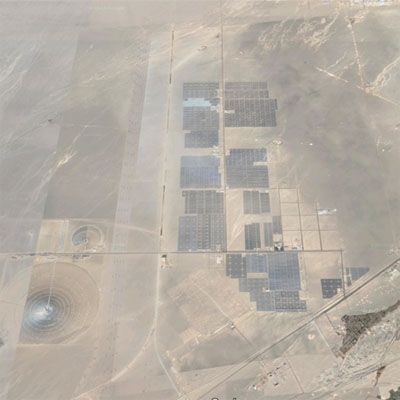
At home China’s energy infrastructure is undergoing a profound transformation. Early growth was fuelled by oil and coal power stations, too quickly set up and poorly executed, causing well publicised pollution within its cities. To counter this China’s new energy mix will include 110 new nuclear power stations due for completion in 2030. Off the coast of Jiangsu province, the Three Gorges Sea project, due for completion in 2027, will be the largest off shore wind farm in the world. On a Tibetan plateau, in the Qinghai province is the world’s largest solar park. New hydroelectric projects include the 16,000 MW Baihetan Dam in Sichuan province due to open in 2022 and the Suwalong project on the Upper Yangtze River, its dam is 112m high and it is due for completion in 2021. To ensure that all of these renewable energy generators work continuously and at their most efficient five new pumped storage power plants are currently under construction and all of this is integrated into a new national grid. Some of China’s scheduled infrastructure will not be seen by satellite, several highspeed rail tunnels are due for completion. The Zhoushan and the Taihu tunnels are subsea tunnels that will allow trains to travel at 250 kmph. The Bonhai high speed rail link, under the Bonhai Straight connecting the cities of Dalian and Yantai will be 123 km long and in places over 70m deep. It will be over twice the length of the Channel Tunnel connecting the UK to France. Not all tunnels are for trains, a 1000km tunnel will carry 15 billion tonnes of water p.a. from the high wet plains of Tibet to the dry densely populated Xinjiang province.
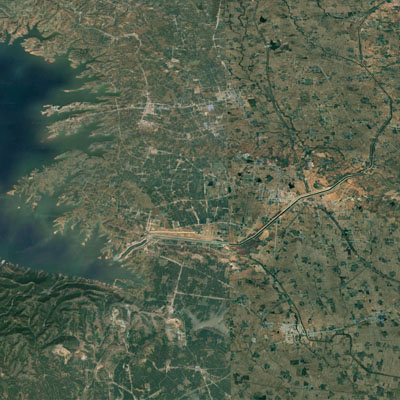
China has 20% of the world’s population but only 6% of the worlds fresh water, further, most of its water is in the South and not in the North. China has built the South – North Water Transfer Project, three canals that together move 45 billion cubic meters of water from the Yangtze river in the south to the less fertile regions of the North. These canals are also used for shipping as part of the BRI. Along its rivers China has 22,000 large hydro-dams half of the global total, each dam has an upstream and downstream consequence. Large rivers often flow through several countries. New China Hydroelectric dams on the Mekong have caused issues with five poorer countries that rely on its water and fish further down-stream. There will be continuing issues with the scale and speed of these infrastructure developments. China is set for further growth and territorial/market expansion. The Chinese government provides the infrastructure to allow development and then floods the markets with billions of dollars of cheap loans encouraging entrepreneurs and business. This push for market capture that has continued for the past three decades will not slow any time soon.
China, is a member of the Paris Climate Agreement. China is both a world leader in the take up of renewables but it is also the world’s leading polluter, its fossil fuel emissions exceed all of Europe’s combined. Most of China’s carbon dioxide emissions come from burning coal in new power stations to generate electricity. Many new coal-burning power stations have yet to be finished just as the rest of the world is closing them down. As part of the BRI infrastructure projects China has set aside $30bn to build coal-fired power stations in other third-world countries, including Pakistan. The world can ill afford more CO2 emissions being released into the atmosphere especially from countries where lower levels of regulation allow very inefficient and highly pollutive burning of coal.
The environmental consequences have been made worse since 2017. Under president Donald Trump, America’s withdrawal from the Paris Agreement, America’s trade war with China, the recent Hong Kong riots have all diverted China’s attention away from green initiatives. In 2018 all subsidies to solar and wind generation were dropped without warning and investment in these industries have shrunk 39% so far in 2019. In the mean-time the use of coal as a cheap and convenient option has increased. The short-termism, the rush to build empires sacrifices the long-term prospects both of China and the planet. The British Empire consumed, wasted and polluted through ignorance and primitive technologies. The American Empire consumed, wasted and polluted, through greed, self-obsession, power, control and wealth accumulation. The Chinese have the chance to take a new strategic approach and not to follow the errors of others and previous empires. The world no longer lives in ignorance, we watch by satellite and monitor daily the continued destruction of our planet. We are fully aware of the consequences of what we are doing and yet still ‘business as normal’ proceeds. When this approach is taken by an individual it is shameful. When it is taken by a great nation in the process of building a truly global empire it is unforgivable and the damage caused will be irreversible. The ambition, engineering and funding achievements for the BRI are extraordinary but the scale and speed of these projects, that focus solely on economics, have huge international environmental impact. Each infrastructure project, carried out in whatever country has an immediate environmental consequence. Infrastructure by its very nature generates further development along its lines of communication and this sets up huge areas as future development zones each with a further environmental consequence. The planet is a finite resource that we all share and is already over populated, projects of this scale will encourage further population growth and should be of international concern. For the rest of us mere mortals all we will be able to do is watch and monitor our forever changing planet by satellite.
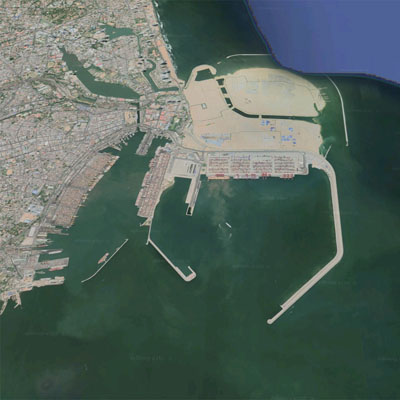
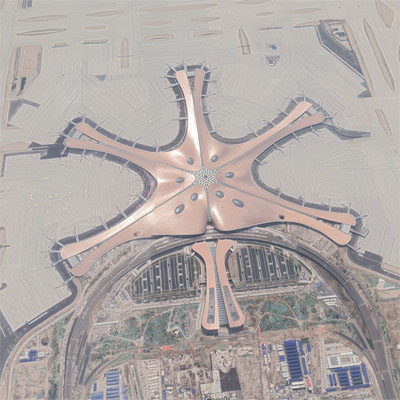
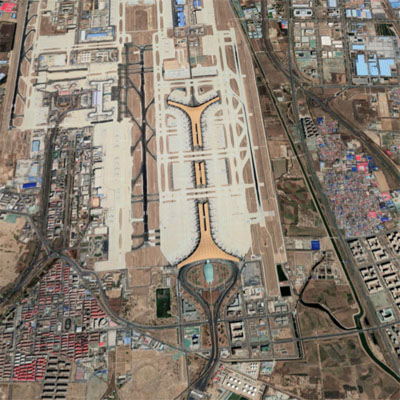
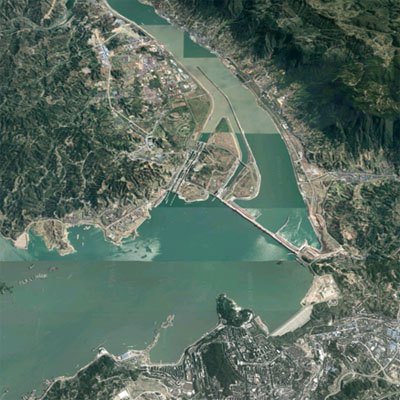
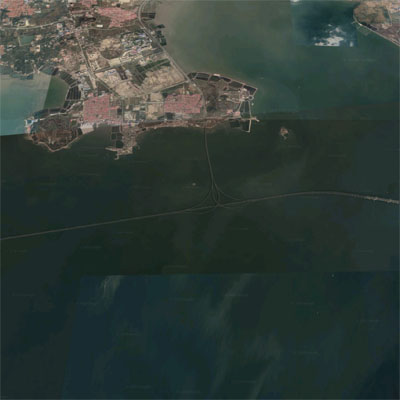
Many of the BRI projects are utility projects that have little architectural or cultural quality, elementary roads, bridges and railways. I have selected images of projects that can be viewed via satellite to show their scale and that also offer quality design. All images are from Google maps, which in itself is an incredible resource for watching and supervising our planet.
1. Columbo Port City, Sri Lanka
2. Beijing Daxing International Airport by Zaha Hadid Architects
3. Beijing Capital International Airport by Foster and Partners
4. Shouhang Dunhuang CSP and Solar Park
5. Three Gorges Dam
6. Haiwan Bridge, Jiaozhou Bay China
7. The Danjiangkou Reservoir and Canal, South to North water Diversion, China