
131019 – Gauguin – London > words
Gauguin can be appreciated in the same way as Modigliani, there is an idealised charm to their work, a search for an inner purity, one uncorrupted by contemporary society. Perhaps it is the search for what it is to be human, stripped of all our contemporary prosthetic industrial add-ons. It is a vision that is charming as naivety is charming, it wants to see the world as a child sees the world for the first time, a vision unloaded and not pre-dispatched.
It is impossible however to look at the work of Gauguin without seeing the character behind the work. Gauguin was a disgusting human, an egocentric with a Christ affiliation. His list of irresponsibility is endless. He left his Danish wife and five young children in Paris to go to the French Colonial Polynesian Islands and knowingly spread syphilis among indigenous teenage girls. Whilst there he abused his position of the ‘French White Man’ in power over the Polynesians setting up his hedonistic shack that in turn ruined many young Tahitian lives.
The contemporary audience needs to consciously block the realities of the chronical behind each picture and to view the paintings within the broader genre and objectives of the Impressionists and the Expressionists. Both the Impressionists and the Expressionists responded to the ebbs and flows of their times. Rural life was slowly disappearing and human existence was fast becoming mechanised. Concentration within new urban centres and related activities had created all of the frictions of dislocation and adjustment. One’s previously conceived role, usually that of one’s parents, had been re-manufactured. The assembly lines and supportive industries were the future. Industrialisation dehumanised as much as they liberated. Displacement was the order of the day. Mechanisation brought leverage, by many multiples, to all aspects of human labour, but in so doing reduced the human role to low skilled repetitive tasks. A mechanical servitude.
Even the role of the artist had been displaced, mechanised by the camera and the printing press, soon to be further displaced as moving film took over as the medium for narrative. The Impressionists searched for new objectives within painting, emotive, sensorial and spiritual, whatever the machines could not produce. Experimentation with light, with movement and with meaning developed new forms of pictorial representation. The artists canvas became an inconclusive surface, transient, a moment, an idea, an illusion to an idyll, metaphorically inciting multiple subjective interpretations. The paintings moods, of feelings, of warmth, to capture the essence of kindness or the sorrow felt on the fall of a tear. Reflections upon summer ponds or autumn leaves dotting a landscape, create an ambience, a cognitive recollection, an emotive terrain, felt but difficult to describe. Realist representation no longer had a purpose. Soundscapes are painted, wind and heat, ephemeral and subjective feelings of place are laid on canvas. Van Gogh’s fields of immersive warm happy yellow or Monet’s blissful summers.
The invention of the camera at the end of the nineteenth century changed directions in art as realism could now be captured mechanically. The Industrial Revolution had begun to have considerable effect on the shaping cities and had made new interventions into landscapes. These were seen by many to be alienating and dehumanising. Artists reacted to these conditions and sort new ways to represent the world and their role within it. Fauvists, Expressionists and Impressionists tried to capture moods and feelings using painterly techniques with emphasis on colour and light. The Primitives saw civilisation as a corruption of what it was to be human and the only option was to return to the essence of humanity, the primitive ‘noble savage’. The ‘noble savage’ a romanticised view of man living in harmony with nature has been a recurring theme throughout history. Eighteenth century landscape paintings themed peasants living in idyllic bliss among classical ruins. The views were a romantic fantasy as the reality of poverty toiling a living off of the land was far from idyllic. Romanticised eighteenth century landscape painting stayed within the confines of Europe. By the late nineteenth century European landscapes had also been mechanised, scarred by industries mines, railways, roads and canals. To search for the ‘noble savage’ one needed to leave civilisation and venture into the third world.
Gauguin first went to Tahiti in 1891. Upon his return to France in 1895, Gauguin was asked why he had gone. Gauguin answered: ‘I was captivated by that virgin land and its primitive and simple race; I went back there, and I’m going to go there again. In order to produce something new, you have to return to the original source, to the childhood of mankind.’
The principle issue of the view of returning to ‘the childhood of mankind’, in search of the ’noble savage’ is that it is the imperial viewpoint of the educated and civilised man. The two civilisations are never compared as diverged equals. It establishes the precedent of an us and them, the civilised and the uncivilised, a looking down on the lesser others. This is the first dilemma for Gauguin, the white colonial traveller setting sale for Tahiti in French Polynesia when trying to discover the essence of the primitive. To be conscious of something is called intentionality. Intentionality is loaded with pre-informed expectations. Seeing and looking are strategic activities, they are not passive. The subject, here the artist, frames, crops and edits. He assembles subjectively but draws upon pre-conceived ideas and beliefs which in turn are of his culture and his civilisation. This viewpoint is impossible to lose, even by consciously blocking it, one has made a strategic decision to edit out all that is civilised. This editing can only be done by someone conscious of their own culture and therefore by editing one is not fully immersed in the present but instead taking a distanced viewpoint.
The West discovered Tahiti in 1767. The first missionary expeditions arrived only thirty years later. It became a French protectorate in 1842 and by the time of its annexation in 1880, all local traditions and beliefs had been banned. When Gauguin arrived in 1888, he was another western tourist visiting a French colonial outpost. The Polynesians were already a hybrid culture. Their clothes, mannerisms, sayings, religions, superstitions and values were already carrying the memes of Catholic French colonialism.
Gauguin’s search for the ‘childhood of mankind’ has two clear dilemmas. First, he as the viewer cannot rid himself of his cultural past and its perspective. Second, the Polynesians had already been under French influence for over one hundred years, an influence he despised and openly criticised, but an influence that he was also very much part of. Therefore, Gauguin’s Primitivism is a fantasy, the fantasy that he travelled to Tahiti to see. The artists idealised construct and as such a dream incorporating his myths and desires of the ‘noble savage’ living in paradise. This is escapist, but this escapism gives access to a fast disappearing world and forms the construct of Gauguin’s view. A French Colonialist’s construct that would draw upon the stories of pirate tales, Robinson Crusoe, cannibals and boat people. This escapism pushes one to the edge of what one comprehends as normality, one’s comfort zone, and allows one to take voyages into the subjective unnormal. These are experiential expeditions, lived dreams. In Noa Noa, Gauguin writes: ‘At first I saw in her only the jaws of a cannibal, the teeth ready to rend, the lurking look of a cruel and cunning animal, and found her, in spite of her beautiful and noble forehead, very ugly.’ This is a fanciful view framed by a pre-loaded civilised mind.
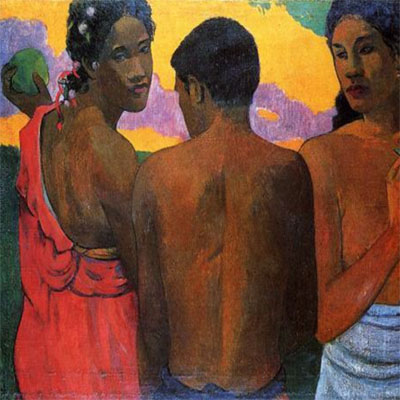
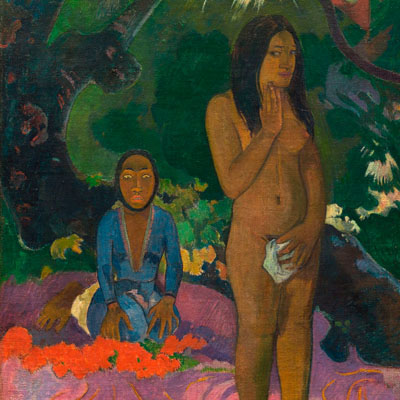
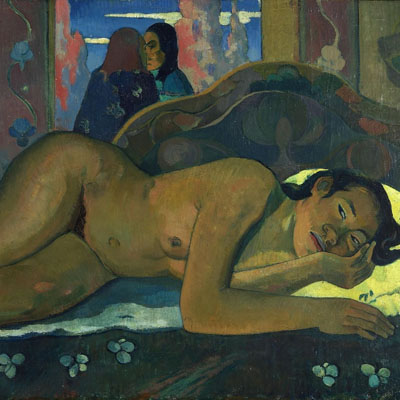
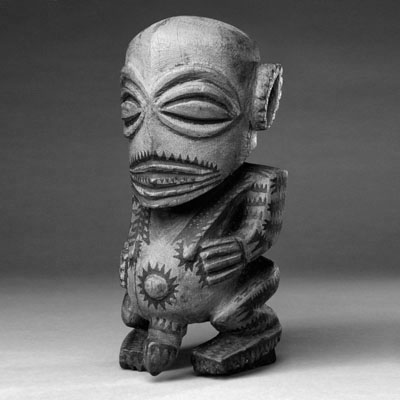
If one searches for 19th century Polynesian paintings one finds very little. The Polynesians painted graphic geometric patterns, similar to their fabrics, tattoos and bas relief carvings. They sculpted stand-alone effigies to gods or spirits typically to aid fishing, farming and fertility. They never painted figures in landscapes. Gauguin’s view is of a western idealised landscape as paradise. Much of the symbolism within his paintings are Christian in composition and reference. Eve’s apple is replaced with a mango (Three Tahitians 1899), nudity is emphasised through embarrassed gesture and shy concealment (Parau ne te Varua ino 1892), a trinity, stables and manger, with cattle in the background (The Birth 1896). (Cattle were introduced to Polynesia by a Royal Naval officer from Norfolk in the 18th century)
The purpose of the above text in relation to Primitivism is that Gauguin’s ‘view’ is pre-conceived, pre-loaded and conditioned. It is a construct of the artist as a response to events happening in the western world and should be seen as such. Gauguin, was in many ways the serpent in paradise, he embodied the plundering colonial attitudes of his time looting exotic Polynesian details and fusing them with western symbolism. This concocted the dreamscapes that became the piquant infusion that intoxicated many future modernists and it is for this that Gauguin should be remembered. Gauguin’s work, especially his depictions of Polynesian women, were extremely influential to the work of Picasso.
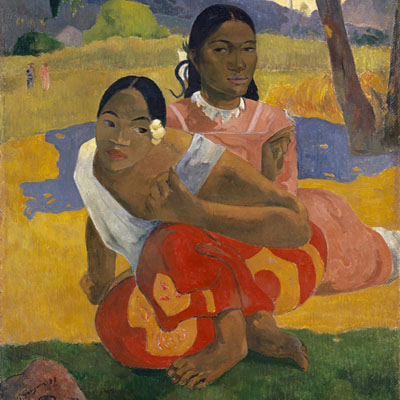
Primitivism is a first-person experience, it is guttural, immediate, you need to smell it, taste it, fear it. It is adrenaline, lust, sweat, heat, you need to crawl through the mud, be repulsed by its stench or intoxicated by its scent, it’s a pheromone reaction, its inescapable and all consuming. Somehow this needs to be captured on canvas. This was a relevant pursuit in the late 19th century, art as mirror to the machine, but time and context changes perception. Naked, teenaged, dark skinned Polynesians, wrapped in bright colours and lurid patterned fabrics may well have been controversial in blushed, bustled and corseted 19th century Paris, but it has almost no shock value today. The gallery with its neutral walls, the chronological or themed organisation of its paintings does little to capture the impulsive. Framed moments each at the same height two paces apart, misses the cut and thrust of being there (Bond inuendo intended). The experience needs saturation, not organisation, confrontation, not conformation, it needs to be close up and personal, a chaotic assemblage, questioning one’s values, shouting – Where do you stand? A dive into Munch’s Scream (1893).
How can a gallery ever deliver this type of sensorial experience? Edvard Munch’s, The Scream hangs on The Oslo National Gallery wall like an A1 poster. The silent scream from an earless figure, released as he realises that his reality has begun to distort into a psychedelic warp of orange and blue. The paranoia of this realisation is best portrayed by Neo after giving Agent Smith the finger and asking for his phone call. As Neo’s mouth slowly seals, eventually to disappear, from which no sound can be omitted, he realises that his previously known reality is about to become the Matrix (1999). It’s an out of body experience, a loss of control, the loss of oneself into an unknown environment. This was Gauguin’s search; it could not be painted, it had to be lived and recorded. To question ‘what is’ cannot be done by applying rules and laws, moral or otherwise, one needs just to ‘do’ without hindrance or taboo. Somehow that process of doing, the activity of participating, being there, the primordial act, is what needs to be conveyed. This is an experiential tall order but this is the first-person Primitive.
Images
1. Three Tahitians 1899
2. Parau na te Varua ino 1892
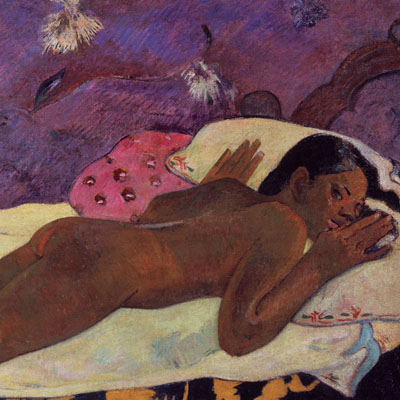
3. Spirit of The Dead Watching 1882
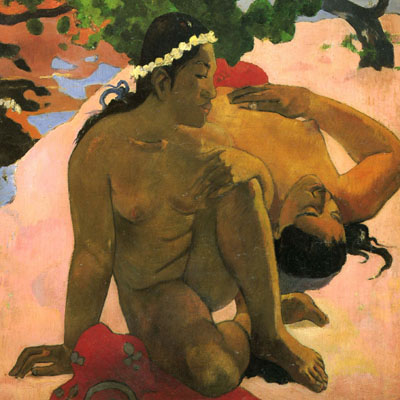
4. Eh quoi! Tu es jaloux? 1892
5. O Taiti (Nevermore) 1897
6. Polynesian Fisherman God c19th Century
7. Nafea Faa Ipoipo 1892