
220220 – Nicolaes Maes – London, National Gallery > words
This morning’s adventure was to the National Gallery to view one of our much beloved art styles, the humble realism of the Dutch Golden Age, an exhibition from the 17th Century Master, Nicolaes Maes (1634-1693). Five years a student of Rembrandt, his work has been known to have been mistakenly sold as Rembrandt’s own. Maes’s brushed ink sketches, drawn fast, fluid, full of movement are all very Rembrandt. This is an exhibition of three rooms, in three distinct phases.
Room One is full of his early work, fresh from the studio of Rembrandt and working in Amsterdam. The works on display consist of medium sized allegorical compositions, many directly referencing Rembrandt’s own paintings on biblical themes, along with ink preparatory sketches. The works are in the style of Rembrandt, lofty compositions that never really sing, crushed by Rembrandts own work and influence. Maes’s early work, whilst in Amsterdam, is very competent but without magic.
Room Two is the room that captivates. Following his apprenticeship and a short period working in Amsterdam, Maes returned to his home town Dordrecht in 1653 and here ‘reality’ takes over. The focus of the work in this room is around Protestant values in the age of science. Myths and allegory are disposed of, and the everyday, doorstep events become the main direction for configuration and chronical. Compositions are structured not as static viewed, three walled interiors, but instead act as a suite of rooms through which a story can be told. Secondary spaces can be glimpsed from the main picture space, light leads the eye to allow the narrative to evolve. Often the hierarchy of these spaces are inverted to entice intimacy and humour, as the main picture space could be a hallway, a scullery or the servant’s staircase. The space beyond the main picture, being the principal space of the dwelling. It is in these spaces the story unfolds onto which servant’s eaves drop. It’s difficult not to view these paintings without a smirk as the everyday is turned into a major event simply by being captured on canvas. These are Dutch interiors painted at a small domestic scale but with an intelligent eye and a wry sense of humour.
Intricate brushwork and the use of Chiaroscuro, (inherited from Rembrandt), are applied to domestic anonymities, a quiet snooze, lace making, secret glances. Each painting is storytelling, a still from a silent film. In The Eavesdropper, the narrative evolves. Chiaroscuro is used to dramatize the whole picture. Light introduces the narrative, unfolding from left to right. It first falls on a book, the brightest light in the frame, representing wisdom, education and knowledge. On the wall behind is a map charting the world of Dutch trade and exploration. The eavesdropper’s apron is next lit. This central figure, the housekeeper, suggested by the heavy keys that hang from her waist comes down the stairs from her accounts, she, the subject of the painting, sets the tempo of quiet secretive amusement. A door ajar forms a screen, a thin veil shielding the room beyond, the door itself lit. Light takes the viewer across the floor and deep into the picture space, to an abandoned crib. The wet nurse distracted, flirts with an admirer in the street beyond. In the distance through the window, a windmill a symbol of Dutch triumph over the sea with the reclamation of its coasts. It is a picture about an intimate tail, a trivial occurrence but it is also a picture loaded with moral ethics, about a nation confident in its newfound wealth and success, now a global player and no longer a cultural backwater. These pictures take us into the very depths of the households, the private spaces, where we can see and hear through narrative, events that we should not. The Eavesdroppers series are painted in the process of overhearing their masters as they argue or flirt. The Eavesdropper faces us, the audience, with a smile, a finger on her lips, to hush us, offering an invitation into the canvass to hide behind a door or a curtain and listen, giggling at events that we should not hear. Every image in this room is intimate, humorous and delightful.
Room Three is a change of sides and this produces a double-take as you have to check that the paintings that you are viewing are by the same artist. From 1660 Maes devoted himself to portraiture, developing a style that was increasingly flamboyant and indebted to Van Dyck. The Protestant, refrained domestic paintings of servants at work are completely discarded and replaced with a room of French Catholic extravagance. These, the then fashionable portrait paintings of his later career, increase in size and flamboyance. Rich in fabric, colour and texture, flowing and animated, only the occasional sense of humour appears but not with the same tongue in cheek smirk of Room Two. In Room Three we are thrown suddenly into the slick posturing of the upper classes, whole families, lavished, preened and wrapped in acres of Venetian silk. In his later career Maes was indeed commercially very successful and much in demand, portraiture paid handsomely and he followed the money. On his death in 1693, he left several houses, in both Amsterdam and Dordrecht and a considerable sum of money. His paintings tell his life story, from his student days under the wing of Rembrandt, on through a process of cherished-discovery and eventually, upwardly mobile to end his career capturing the Dutch elite of which he was now firmly a part.
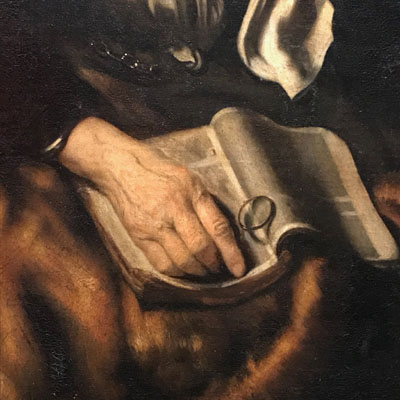
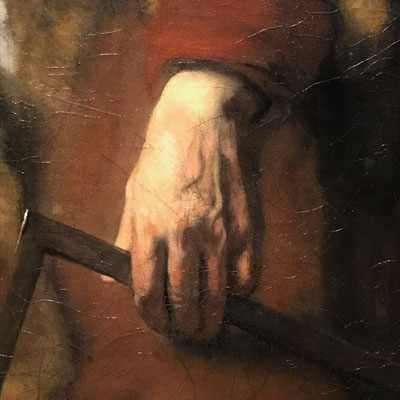
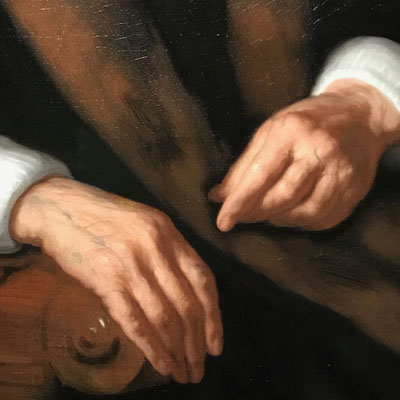
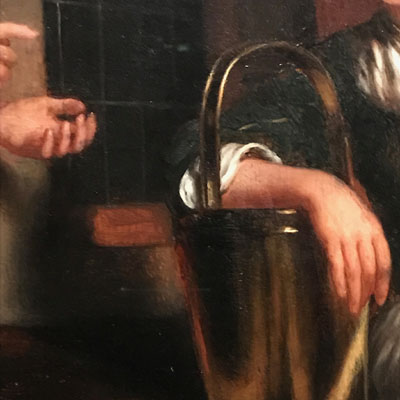
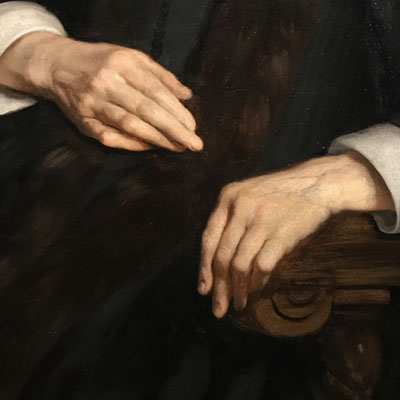
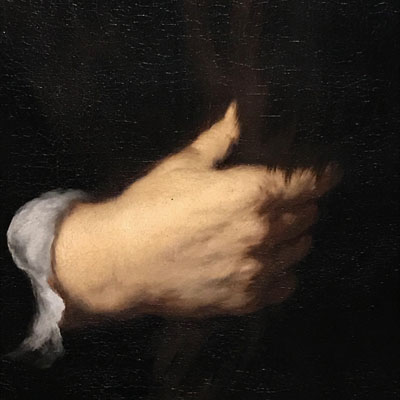
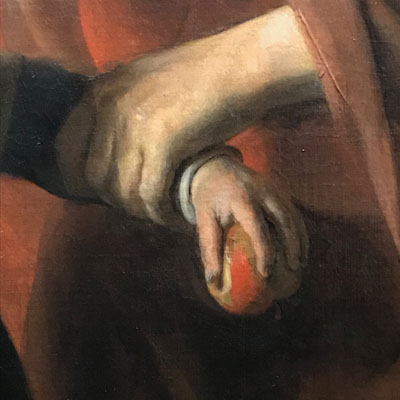
Images by Nicolaes Maes. Hands from a time when craft was an admired skill.