
170416 – Morphing the Body –V&A, London > words
The Undressed exhibition at the V&A London.
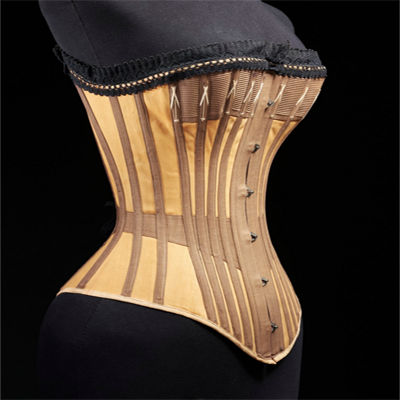
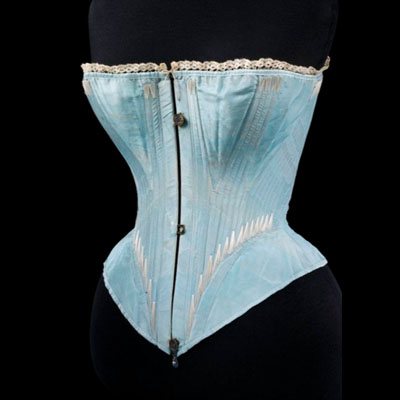
Morphing the body to an idealised form is a theme that runs throughout this exhibition. Waistlines move up and down the torso, bottoms expand and contract, sometimes sideways from the hips, sometimes rearward from the coccyx. Shoulders broaden, or are pulled back and dropped thrusting the chest skyward. Curves are enhanced, silhouettes revealed and the details extenuate the line. Form is idealised, across all periods there is a pursuit for the idealised form, that of the time. What many consider to be instruments of torture are also instruments of empowerment and this would seem to be historically consistent. The hour glass figure of Edwardian women determined the deportment that was required for women to enter the new mercantile nineteenth century society. The clothes of the 1960’s expressed a new sexual liberation and changing attitudes to ones role within society. Sexual expression and identity expression are two parts of a double-edged sword. Identity expression tends to be political and linked to prevailing ideologies whereas sexual expression is a subset within the present politic and is local and targeted.
What I found most interesting about the morphing of form, male and female was the move towards underwear as outerwear and developments in plastic surgery. Underwear as outerwear is suggestive, as much an invitation as an expression. Painters have used this throughout time as a means by which one is able to reveal ones true self. Also as a means of enticement drawing the viewer into the intimate space portrayed, women at their boudoir being a recurring theme with voyeur males in background. Underwear as outerwear in fashion today is slightly more crass but it also blurs the distinction of the role of each garment and these roles may well be an antiquated legacy. Underwear as outerwear is also an expression of gender equality with what was previously hidden and private becoming public. Historically society has been male dominated primarily due to the males physical strength. In times when physical power has less and less currency we may well see a gender role reversal. Underwear as outerwear can be political and intrusive as it invades the perceived personal space of others. Partly as an item that is usually associated with intimacy and is now being shared publicly sending out a confused signal. But also as a show of self-confidence that carries aggressive overtones with its disregard for convention and authority. With time any decontextualizing of the hierarchy of garments becomes normalised and any intended inherent message becomes diluted.
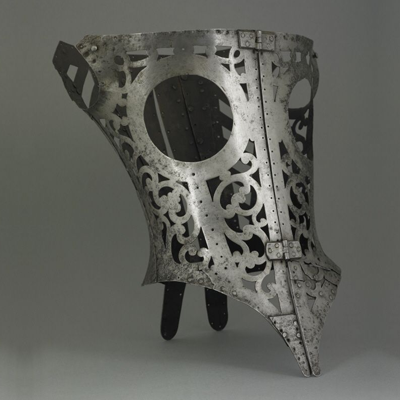
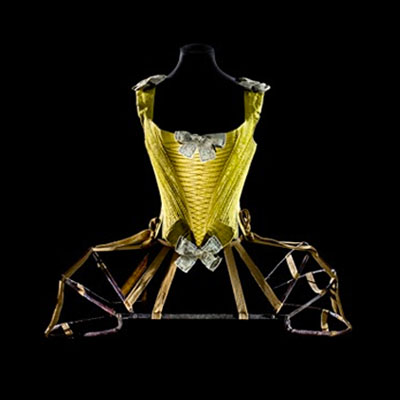
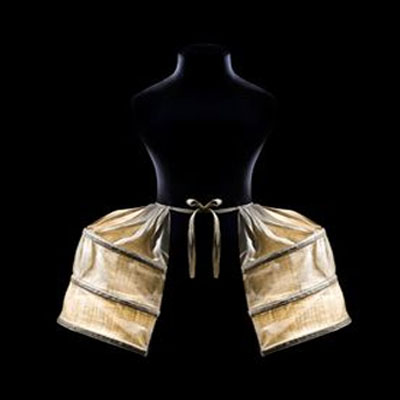
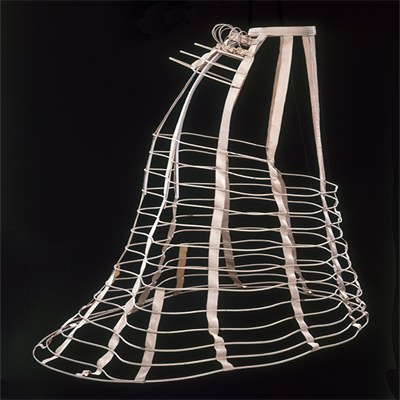
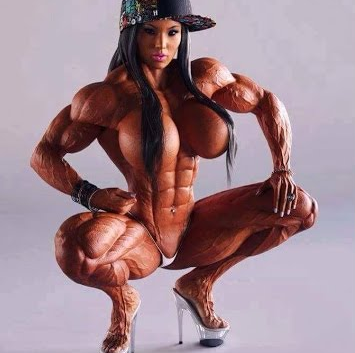
The second point of interest is the developments in plastic surgery and actual body enhancements. The hour glass figure of the nineteenth century encased in an exoskeleton of an idealised form slowly gives way to the more natural figure of the 1960s clothed in casual fabrics. Today nudity is commonplace on most beaches and has been normalised through printed and digital image. As it becomes more acceptable for the body to be seen in public (red carpet catwalks) it has become more important for the body to hold its own form. Men have exercised for millennium to obtain a perceived manly figure. This became more extreme with the body builders of the 1960s and 70s to the point of creating the unusable body. Women today spend many hours in the gym and are as self conscious about their chest, abs and butts as men. This requires a lot of time and hard work and beyond a certain age results are much harder to achieve. Plastic surgery offers both a shortcut to and an enhancement of the body beyond what may otherwise have been achievable. As the nineteenth century shaped the form of the body with the exoskeleton, the corset, the twenty-first century shapes form from within the body. Breast augmentation, gluteal implants, liposuction, rhinoplasty, otoplasty, blepharoplasty, rhytidectomy, abdominoplasty, rib removal, botox, tattoos, piercing (boob, butt, tummy, face, ear and nose jobs) are all common procedures. Some parts are cut away others are padded out with silicon sandwiched between the ribs and the skin. When discussed matter-of-factly it hardly seems normal behaviour and is much more of a radical intervention than trying to achieve a nineteenth century wasp waste. When augmented, the body requires special clothing to exhibit its new form. Clothing that can both reveal and enhance whether this is lycra and mesh or the sheer fabrics that dominate recent fashion trends. Today’s idealised form is heavily influenced by medias focus on popular culture. Cartoons and superheroes are satirical extrapolations that caricature human qualities, good and bad, weak and strong, masculine and feminine, beautiful and ugly, these set up a bipolar duality in which a narrative can be simplified. Popular culture maximises catchment using this simplified narrative. Popularity fuels a cultural feedback loop where humans that have been caricatured to exaggerate qualities to add emphasis for media become the icons for humans to emulate. The internally augmented form is a product of this emulation. At present the body is enhanced as an idealised natural form but how long will it be before bustles and panniers, or their modern equivalents, are inserted. Decorative silicon implants already adorn many faces of street cultured youths and asymmetrical forms may be the future norm.
In summation there has been an evolution from the natural body squeezed into the idealised form of the exoskeleton, through to a period of the natural body fitted in casual clothes, to a body augmented from within sheathed in a gossamer skin. As we move towards electronic tattoos, technological implants and responsive augmentation where programming and choreography may be as important as form manipulation. The morphing body may be able to respond to occasions or seasons or perhaps more immediately to the requirements of the next meeting or event. The clip from Terminator 3 immediately comes to mind, when Kristanna Loken looks at a Victoria Secrets billboard with the text ‘What is Sexy?’ and responds by inflating her breasts.
The Surrogate Twin