
080716 – The Potter – V&A, London, SW7 > words
First Year, First Term. Like most design students back in the early eighties when first introduced to the work of Antonio Gaudi we were inspired. As our knowledge of architectural and design history grew we became less interested as Gaudi’s work stood outside the context of the historical international dialogue. His work is categorised as provincial or colloquial and it is; but what wonderful extreme excess. My first visit to the Sagrada Familia, along with every other Gaudi building, would have been in 1982 and I was surprised to really like the work despite the preconceived ideas set out above. The work is artisan, hands on, and you can feel it, Gaudi’s fingerprints are everywhere. The work is intimate and personal, like looking through somebodies sketchbook, with notes, thoughts, ideas and opinions scribbled in the margins. From our student days we all recall the story of the critic, who whilst leaning on his walking cane said to Gaudi that his buildings would not stand up with columns at all angles. Gaudi replied by kicking the critics walking cane away and the critic fell over disproving the critic’s structural logic. So when the V&A was to host a presentation on the engineering of the Sagrada Familia it was an event not to be missed.
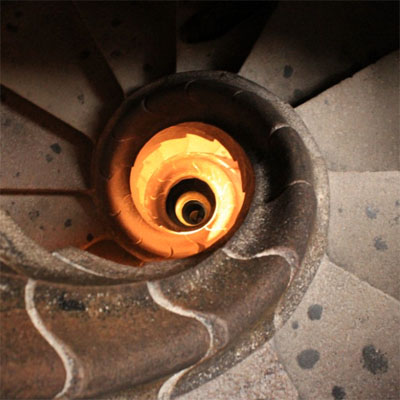
Work commenced on The Sagrada Familia in 1882 and it is still on going, the finish is some time away, possibly 2026, it is a one hundred and thirty four year old continuous building site. The engineers presenting the talks discussed matrix calculations, catenary curves, parabolic surfaces, earthquake resistance, pre-stressed cantilever staircases, post-stressed stonework and double volute twisting columns. They talked through the CAD modelling and fabrication of the thousands of unique pieces that go into making these forms. They showed pictures of huge teams, and one can only imagine equally huge budgets, all members diligently working to get the job done, to finish the project as near as possible to Gaudi’s original vision. Gaudi however, didn’t leave many accurate working drawings, mainly suggestive sketches and plaster models and that all leads us to ask the question could Gaudi have completed the Sagrada Familia with late nineteenth century technology and a bit more time? And the answer is a resounding NO…..followed by a resounding YES.
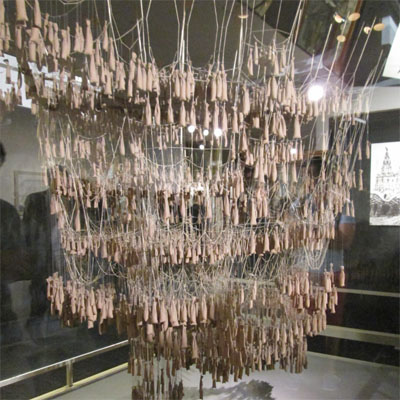
Gaudi was a very competent engineer, he understood catenary and parabolic curves. There exists an inverted model of all of the forces that flow through the Sagrada Familia, it is made of string and weights. Another model made of fine chain would be hung from the studio ceiling showing the inverted forms of towers and domes. The hung chain model was reflected with a mirror on the studio floor so that those working on the project could see the volumes. The inverted fine chain model was an abacus version of parametric modelling. If a chain end point were moved to enlarge or reduce the floor plan the whole volume would adjust to accommodate the new dimensions and settle in an optimised catenary geometry. In this way aesthetic composition and structural dynamics move in tandem. Gaudi would photograph the chain models and ‘colour fill’ the photographs to create a ‘solid block render’ and all this one hundred plus years before CAD parametric modelling. The engineers working on the Sagrada Familia today use CADD-S5 software, a design and production software usually used for ship design.
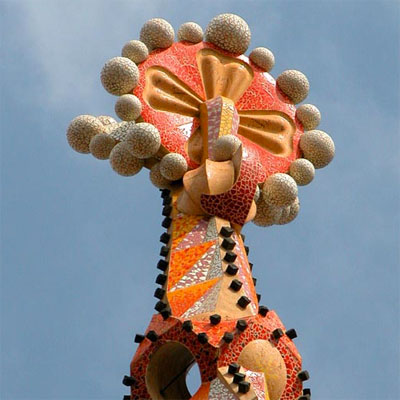
Gaudi was first and foremost a potter, from a family of potters; he worked in clay by adding and taking away, kneading and forming. He would hand sketches to his team of artisans for them to interpret. Gaudi’s immediate workforce were all local Catalonian’s from Tarragona that thought and worked as he did. One can imagine Gaudi the engineer inverting chains and nets and dripping slip plaster along their lengths until it solidified the form, inverting the resulting parabolic curve to form a dome or tower. But Gaudi the potter would also notice that the slip nets had additional residue, their own mini sculptures, he would know how to add to these, how to give them shape to compliment the form. He would add colour, ceramics, sculpture and religious symbolism. He would know how and where he could cut away mass to allow light to permeate the skin. He would also know when his vision was out of the technical reach of his artisans and he would adapt to that and the project would morph into its new form, the pragmatic hands on solution delivered with creative vision and tactile sensitivity. So the Sagrada Familia the he would have delivered would have been different to the one we have today. So does any of this matter? No not really, the engineering team completing the Sagrada Familia will build an incredible building but probably not the one that Gaudi would have built but one I am sure one that Gaudi would be proud.
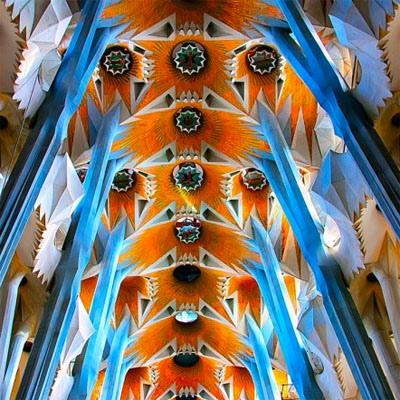
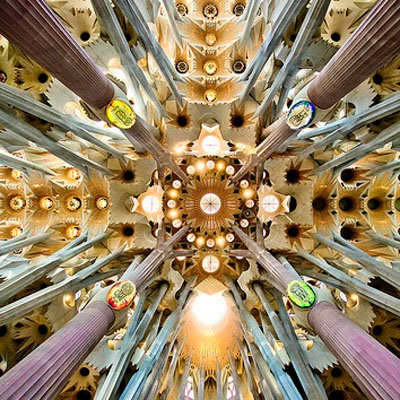
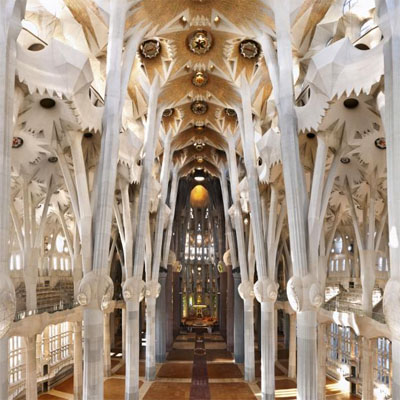
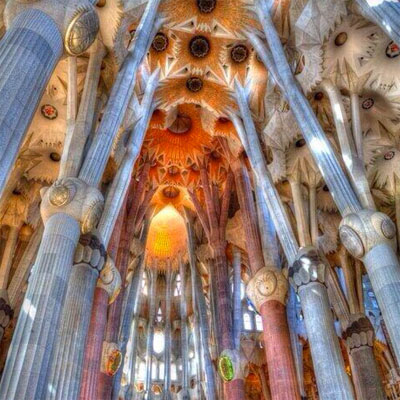
During the V&A presentation of Gaudi’s work it was impossible not to think of how contemporary it all looked, not so much in its composition but in its surface texture. The compositions break all traditional conventions, ecclesiastical rules are refigured, rules of symmetry and assemblage are also broken. Each façade is different, towers cluster, idiosyncratic eclectic forms meet standard gables that run in sequence from one collision to the next. The leaning columns and the parabolic curves cut on asymmetric lines feel 1950’s but the interiors are straight out of the Bartlett’s Marcos Cruz Unit 20 3D printing workshop. The ceilings an inverted landscape of abstract flowers and bifurcated columns create an interior as artificial woodland.
The Surrogate Twin