
030816 – Synthetic Landscapes 3 – The Automaton Gardener > words
Synthetic Landscapes should be read 1 through to 4.
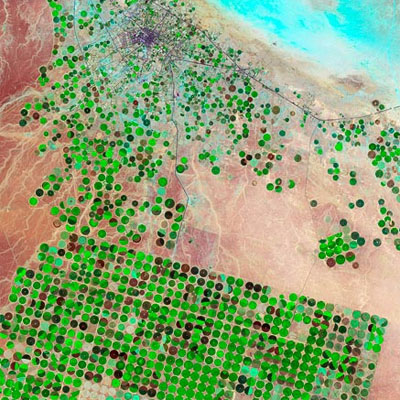
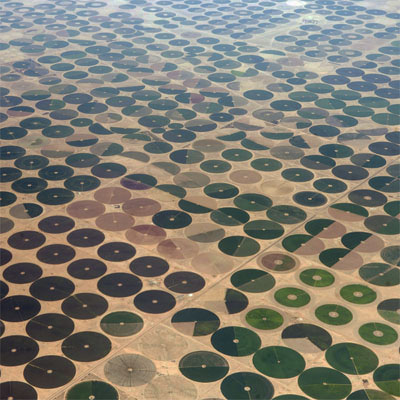
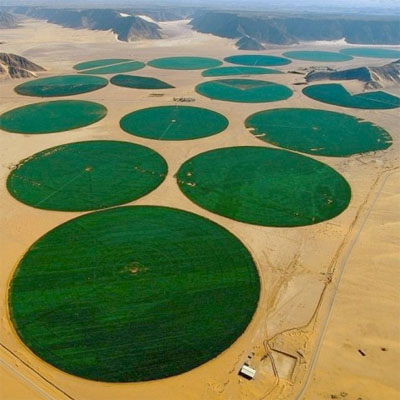
Landscapes in extreme environments are heavily nursed. Central pivot irrigation provides the most common form and these create surreal circular patterns that are seen clearly from above. The simple technology, invented by Frank Zybach in the 1940’s, consisted of a boom sprinkler system fed from a central point. The interlocked booms can be 500m in length, these rotate about the central point so a 500m length would create a 1km diameter circle but an 800m diameter circle (400m boom) is the common norm. The sprinkler booms are supported by trusses, these in turn are supported by wheeled towers driven by electric motors. The outer edge of the boom, the perimeter of the circle makes a full rotation every three days. Water is evenly spread and the outer edge of the boom travels at a faster pace than the inner parts and therefor covers a greater area. Holes that distribute the water from the boom are correspondingly larger towards the ends of the radii. Central pivot irrigation best suits large areas of flat land and are often located over subterranean aquifers. The more efficient systems employ hoses that deposit the water directly onto the ground next to the plants and cutting evaporative losses that are high. Central pivot irrigation systems can use hundreds of gallons of water per minute but are still considered to be more water efficient than traditional farmland in specific locations. However by allowing farming to exist in areas where climatic conditions would not normally support farming, pivot irrigation quickly depletes underground water supply. It makes no long-term ecological sense to continue using central pivot irrigation in arid regions without controlling evaporative loss and better sustainable management amongst farmers. The aesthetics however are seductive; lush green circles carpet the desert sands creating extravagant geometries that can be viewed from space.
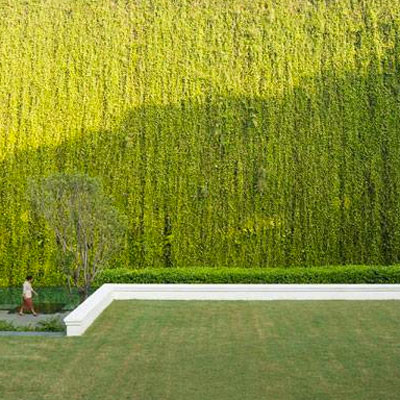
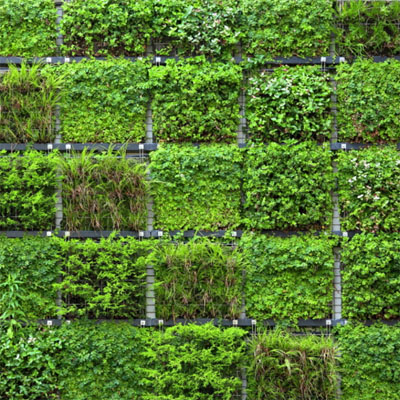
Vertical landscapes, Green Walls or Living Walls are indoor or outdoor vertical gardens. The vegetation grows on substrates of either loose dirt in trays, felts, woven mats or polyurethane sheet media. The media used is dependent upon wall height, scale and location but all consist of a grid system that has a feed of water and substrate panels. The walls are high maintenance, earth needs to be replaced at least yearly and matting panels every three years, replacement requires disrupting both the established aesthetics and planting. Vertical Landscapes using structural media have become increasingly popular as a means of covering large vertical surfaces and fifteen year life spans have been achieved. As the benefits of the vertical planting become better understood and with increased use further efficiencies will incur, including assisted natural ventilation of buildings.
Vertical Landscapes are of interest at the larger scales and could function and offer positive for both the built and the urban environment. Cities are heat sinks, acres of concrete paving, roads and walls all of which absorb solar radiation and re-radiate the absorbed heat allowing a heat build up in cities. Vertical Landscapes can help negate the affects of the heat sinks associated with building materials. Urban areas lack adequate green space, green walls can humidify, add oxygen, remove carbon dioxide and lower ambient temperatures. On a building they could help recycle grey water, shade and humidify, assist and filter ventilation, encourage biodiversity and increase habitats. Green walls offer an addition to the architectural vocabulary of the façade, increasing its depth and its texture.
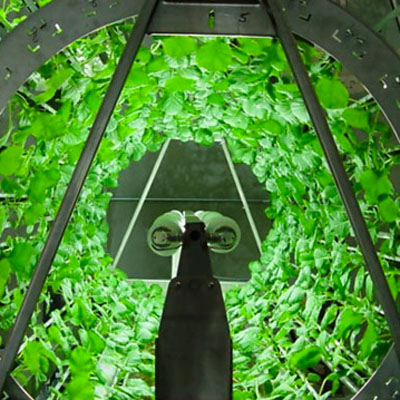
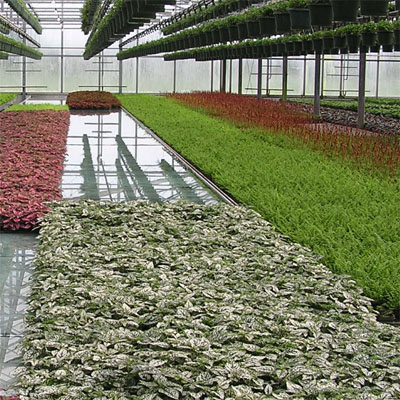
Hydroponics has a history of over 300 years and is a method of growing plants in water without soil. The plants are drip-fed mineral nutrient solutions that can be from organic waste products such as food waste, fish waste and manures. One advantage of hydroponics is the efficiency with which the plants roots can have constant access to both oxygen, water and nutrients, taking as much or as little as required. Excess water can be drained, aerated to eliminate anoxic toxins, supplemented with minerals and recycled back to the plants. Although hydroponics may use a static solution culture a continuous flow nutrient film is preferred it is easier to manage and can obtain higher crop yields. It is possible to grow plants using aeroponics where the roots are fed with nutrients via an atomizing mist. A wide range of plants can be grown together in this way as each plants microclimate can be finely controlled and pathogen spread can be greatly reduced. Aeroponics uses 65% less water than hydroponics and produces a greater biomass. There are available a wide range of substrates and nutrient feeds but the method of feeding is consistent. The hydroponic mechanised landscape offers an unusual aesthetic potential.
These mechanised, highly serviced, landscapes may have a much greater role in a post-industrial urban environment. Automation, robotics, micro drones may soon be cost effective gardeners fussing over rooftops and facades. Responsive systems moving in and out of the sun, opening and closing, moving to allow light through or clustering to prevent hard rains reaching ground. Systems that capture sunlight, wind and rain and hold and release these when required, turning rain into humidity, turning solar into coolant, modulating its own microclimate. In this system architecture is not a pre-determined form but instead a conclusion to a series of responses set around a desired environment.
In conclusion, a landscape of choreographic intensity.
The Surrogate Twin