


191016 – AI.viation – London > words
Mans obsession with flight goes back millennium from the mythological Icarus who unfortunately flew too near to the sun, to the flying machines of Leonardo Da Vinci. The Montgolfier Brothers first took to the skies in a hot air balloon in 1785 and the first successful parachute jump was made by Jacques Garnerin in 1797. These were men who’s ideas were ahead of their times and ahead of the capabilities of available technology. At the turn of the twentieth century technology had caught up and the ascent to flight was tackled in earnest.
Many early flying machines were driven by little more than the belief in an idea. There were those that flapped, beat, whisked and scooped at the air hoping to gain lift. Many a full size craft were built too quickly following a sketch with almost no development testing and brave men died trying to prove their invention. Early on two approaches developed scientifically, one from box kites and the other from gliders. The box kite approach culminated in Alberto Santos Dumont’s tail first box kite of 1906. The glider approach rigorously researched by the Wright Brothers with first flight achieved in 1903. Some of the early flying machines have an exquisite beauty and fragility being as delicate as a dragonfly wing.
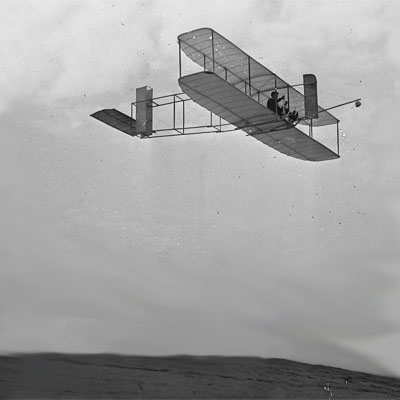
The work of the Wright Brothers shows the clarity of their problem solving technique and is a lesson in strategy for all designers. Aspects of flight are isolated and first resolved independently, slowly and methodically and over time each component is then assembled into a working whole, a total aircraft. There are four main aspects that are tackled scientifically. Lift, pitch, roll and yaw. Early work focussed on lift with flying glider wings over Kitty Hawk beach. The beach had constant winds and these would aid the experiments. A bi-wing tethered to the ground hangs motionless in the air as wind moves through it. Once the understanding of lift had been accomplished the control over each of the three axis of movement was undertaken. A front rudder was developed to control pitch, a rear tail to control yaw and wing warping to control roll.
The design inspiration for control of roll famously comes to Wilbur Wright whilst selling a bike inner tube in the brother’s bike store. As the inner tube was taken from the box Wilber notice that by holding the end corners of the box on opposing diagonals he could squeeze and twist the length of the box. On a bi-plane a similar technique could be used to wing warp and create roll. To test the idea the Wright Brothers built a bi-winged model glider with a short stabilising tail. By attaching strings to the wing tips top and bottom they could warp the wings and roll the craft from left to right. The Wright Brothers understood the concepts of the centre of gravity and balance, moving the front rudder, responsible for pitch. If too near to the main wings this made the craft too responsive and when further away less responsive but more stable. This would have been very similar to their work on bicycles, for example when shortening or lengthening the front forks with regard to steering. The Wright Brothers built wind tunnels and studied the effects of moving small weights across a frame. They made small incremental changes to their designs and tested and recorded the consequences of each. The work was hands on intuitive and methodically logged and appraised. This approach formed the foundation for understanding controlled flight.
It is interesting to note the conceptual simplicity of the Wright Brothers approach to flight and of The Wright Flyer of 1903. This is that the plane is a glider with an engine and that flight is achieved with the engine pushing or pulling the glider through the air in one direction, forwards. The plane is not a humming bird, a bat, a falcon or a dragonfly and has none of the manoeuvrability of any of these. This conceptual simplicity of a glider with an engine is still very much relevant today and covers most aircraft. The skills of the humming bird, bat, falcon or a dragonfly are still beyond our technology but recent experiments with computer controlled drone flight should soon be transferable to responsive aircraft. With recent advances in robotics and AI, vertical take off and landing (VTOL) craft that are emissions free, autonomous, computer controlled and have a radically simplified interface, may soon be an option for the everyday commute.
Of all of mans great technological achievements from the invention of the wheel onwards few had the impact of mans conquest of the sky. Flight shrunk the world by linking isolated cultures, opened up new trade routes and added another horrific dimension to warfare. The very first flying machines were only achieved one lifetime ago. In 1903 Wilbur and Orville Wright flew just over 36m in 12 seconds at a speed of 10.9 km per hour, whilst by 1976 the record aircraft speed had increased to 3530 km per hour and manned rocket speed to 8281 km per hour.
The exponential curve of mans technological progress is well known but needs to be forever re-quantified to give context to the ever increasing speed of change. At ten million years ago man first uses tools, he learns to control fire 1-2 million years ago, he first wears clothes around 50000 years ago, begins agriculture 11000 years ago, first uses iron 6000 years ago, invents the wheel 5500 years ago, invents paper 2000 years ago, invents gunpowder 1100 years ago, eyeglasses 1000 years ago, printing 500 years ago, telescopes, mechanised farming, steam engines, all arrive 300 years ago, electricity, radio, food preservation, early medicine, 200 years ago. Mass produced cars, washing machines, TVs, refrigerators 90 years ago, nuclear power 70 years ago, satellites, lasers and computers 50 years ago, CD’s, mp3s and the world wide web 30 years ago, cell phones and touch screens 10 years ago.
From the point where man first used tools it took a further 10 million years just to learn to get dressed. Technological development was graphically almost horizontal for a further 50000 years with most of mans technical innovation happening in the last 100 years. This is the Law of Accelerating Returns. The speed of change has left our social and political systems behind, our education systems are woefully inadequate and we are all ill prepared for what is about to happen next with the coming of AI (Artificial Intelligence). Every innovation that man has made to date has been a tool that he could control to carry out a specific task whether that has been a flint axe, an aircraft, a computer or new medicinal drugs. This is about to change.
Mans closest evolutionary cousin is the chimpanzee. On equal weight terms the chimpanzee is twice as strong as a human. The only reason that man dominates chimpanzees is due to his superior intellect. This intellect has allowed man to become the dominant species on the planet. With the invention of AI man will build a self-learning silicon based machine that will be his intellectual superior. This will be the first tool that man has built that will have the ability to supersede his own knowledge. It will also be the first time that mankind has not been the superior intellect on this planet.
Technological innovation is driven by communication. The invention of the printing press in the fifteenth century had minimal effect on mankind as the distribution and understanding of knowledge was limited. It was not until the twentieth century with the inventions of flight, TV and telephone that the distribution of knowledge and the reciprocal progress in technological invention took off.
Sci-Fi’s depiction of the future provides interesting analogies. The character Iron Man, from the films based on the Marvel comics, designs his new inventions through polite conversation with J.A.R.V.I.S. his super AI computer. The superior intellect of Tony Stark (Iron Man) instructs the computer to perform certain tasks en route to designing some new innovation. It is a one sided dialogue between man and his servant the machine. In reality it is far more likely that Tony Stark would not be instructing J.A.R.V.I.S. but instead trying to keep up with J.A.R.V.I.S. Tony Stark would be asking what have you just done, can you explain that again, lets start from the beginning and please break it down into small steps so that my carbon based organic brain can comprehend. Pseudo science has often been inspired by the popular press, the sci-fi comics of yesteryear or the science fiction films of today. The difference is that the science fiction films today are so well academically researched and politically connected that many of their projections are very credible. J.A.R.V.I.S. as trusted ally will always be a subject of conjecture.
The popular conception of AI is of something in human form such as the Terminator, Ex-Machina or the robots of Jonathan Nolan’s Westworld. Mankind has spent much of the last 30 years developing and integrating the worldwide web. Over 40% of the planet can now wirelessly connect to the web with that figure rising to 75% in most of the developed world. We have spent the same amount of time creating a global and logistic world. The planet is run by systems and AI will be a system, a controlling network. As an innovation AI is no longer a prosthetic device, the tool as an extension of ourselves but instead due to the global net it is an extension of our relationships to all connected others. The cloud becomes a stream of shared consciousness.
There are three states of AI.
ANI or Narrow AI. This has specific skills in one subject.
AGI or General AI. This has developed human equivalent skills across all subjects.
ASI or Super intelligent AI. This exceeds human intelligence.
Once AGI has been reached it will self learn and redesign itself at such speed that it would soon be way beyond the powers of human comprehension.
The world already runs numerous ANI systems, Google ‘Search’, Amazon ‘you also might like’, Facebook friends, Siri, numerous apps and chat bots, high frequency financial trading, logistics firms, management firms. ANI are used to increase efficiency, they generally lie dormant until asked to perform some specific task. ANI are already part of an intrinsic network within our world. AGI would quickly interconnect all of the existing ANI systems to make one whole controllable network, it would then use that data to self improve and develop. It is estimated that we will have full AGI by 2025 – 40, within nine to twenty four years. Reaching AGI is hard to forecast as development is exponential but once AGI is reached and all existing ANI system are absorbed they would then all be self learning and self improving systems. One estimate suggests that it will take a decade for a computer to reach the human equivalent of a four year old, another hour to be of Einstein’s equivalent and another hour and a half to be 200,000 times more intelligent than all humans. We still mistakenly think of the computer as a single object and of a smarter computer as a larger more powerful single object but that is not how an intelligent computer would allocate resources. ASI would split its learning tasks to numerous computers around the planet and collectively share that information as it grows creating a whole series of development and feedback loops. There is no finite limit known on the level of possible intelligence but what is certain is that this organisation will be an ecosystem and not a humanoid object. Mankind has never before confronted a superior intellect and no one can truly guess the outcome of that conversation. Conversations are based upon values and who can guess what values AI would hold? Even objectivity needs a starting premise.
At the beginning of this text the intent was to compare AI with our first explorations in flight but this now seems inappropriate. Anthropologically personal computers could be compared to flight, both came out of the garage workshop and yet had global life changing consequences; both open up new cultural exchanges whilst simultaneously shrinking the world; both evolved with incredible technological speed; both will be remembered as part of the list of key events that shaped mankind. AI moves way beyond this and is more comparable to the space exploration we have yet to undertake, a very large unknown indeed. What is similar to the days of early flight is that it is driven by lot of hope, belief, trust and blind faith and recalls the day man first stepped off of the cliff and into a head wind hoping to spend time with the birds. There is still a lot to learn from the slow incremental approach of the Wright Brothers where risk is minimised and each step recorded.
The commercialisation of the Internet over the last 20 years has seen a disproportional consolidation of wealth and power into the hands of an ever-decreasing minority. This same minority own the large R&D workshops developing AI. Whoever controls AI will also control all of the patents produced from AI including an increasing number of medical and biological patents. At the same time more and more jobs will be automated meaning wealth consolidation and wealth disparity will also move along an exponential trajectory adding further to existing social problems.
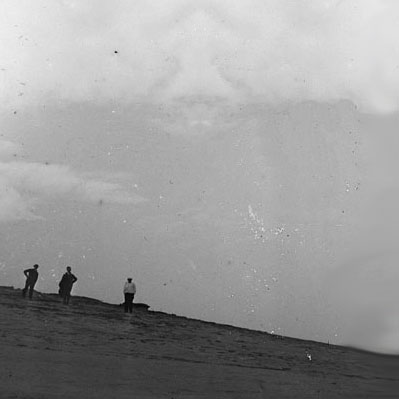
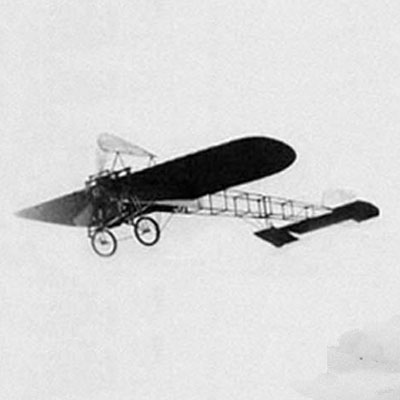
Images:The Wright Brothers test an early glider at Kitty Hawk beach, Louis Bieriot’s XI monoplane 1909.
The Surrogate Twin